
REMINGTON CORNER
You never know what we'll churn up in cleaning a stall
Even before sweet potatoes became a trendy go-to thing in health-conscious circles, my wife and I were considering them anew. Not the marshmallow-covered side dish I loved at Grandma’s dinners, but in something less Candy Land. You know, as chips or fries, for starters. Let’s not overlook the basics before moving on to international cuisine.
Still, getting those just right can be tricky, but my wife has been tweaking the details. Let me say, though, they’re good. Very good, indeed.
In fact, sampling the last round, I proclaimed, “These could be company food,” meaning something we keep up our sleeves for those times we’re expecting guests.
“It’s something they probably wouldn’t get regularly,” she agreed.
That, in turn, had us pondering traditional French fries, which Americans seem to find on every restaurant menu.
“People just don’t make those at home anymore. And homemade can be glorious when they’re done right.”
Amen.
Well, that had me remembering Grandma again, this time her deep-fat fryer and the hand-cut fries she used to make and then serve with her homemade ketchup.
Thinking of that and how both would be “gourmet” items today, I had to admit, “We really didn’t appreciate those properly at the time.” Back when we were kids.
Back before McDonald’s. Back when “dining out” often meant the “drive-in,” rather than the “drive-thru.” For the uninitiated, the drive in had waitresses who came to your car.
High among my regrets in this zigzag life of mine is the number of friends who have slipped away along the journey. I started to add “lovers,” but will hedge for a moment, given all of the complications.
Unlike my parents’ generation, mine has exhibited a tendency to let the connections go once we’re no longer in physical proximity. We don’t exchange Christmas cards the way they did. And we don’t visit much in our travels.
I think we’ve simply been too swamped trying to stay afloat in busy schedules, and while it’s possible I’m in an aberrant corner of the baby boomer phenomenon, when I ask around, no one argues to the contrary.
The one exception might be those individuals who serve as “switchboards” connecting social circles, the ones who know the news about everybody, those unique folks you easily confide in, for that matter, or at least easily reveal much more than you’d intend. In my Hippie Trails novels they show up as characters like Tate in the dorm or Nita in the newsroom. But they’re rare, and now that I’m retired from the office, I’m far from the last one of my active acquaintance.
Yes, it is hard to keep up.
~*~
One factor might be simply that guys, as a rule, rarely correspond. More often than not, it’s been their wives who’ve kept me informed – the ones I’ve yet to meet, in many cases, if we’re still exchanging holiday greetings. And that’s before the reality of divorce.
As I’ve also found, attempts to resume contact after a long hiatus can be problematic. Usually, only silence has followed or, in one case, a polite but all too curt update.
Quite simply, we’ve all gone our separate ways.
Admittedly, working in the newspaper trade did little to enhance this. It’s a field with high turnover, at least in the entry-level operations where many of us served in our younger years – the time most prone to socializing together. But the hours are typically nights and weekends, and few anymore would retreat to a nearby bar till closing, as we did during my first internship. Besides, in my last newsroom, closing hour had already arrived before we clocked out and the intensified drunk-driving crackdown dimmed any desire to stop on the way home.
That last newsroom really split into three working circles that rarely interacted anyway – the Sunday paper, where I devoted most of my career, dayside, and nightside. Few of us lived in the same city as the office, either, so once our shift was over, we fanned out across the state for home – well, some split across a state line to the south or east, as well. There was little to link our “outside” activities and families to theirs, despite some attempts such as minor-league baseball outings or a picnic. Mostly, we were pulled along our private byways.
~*~
Looking at my broader life, I’ve known some incredibly talented people and wonder from time to time how they’ve fared. (The kinds I’ve sketched in my Hometown News novel, for that matter.) Many, as I sense, have wound up performing in the small, out-of-the-way places where they’ve settled – something occasionally confirmed in a successful Google search. Or I keep reflecting on a comment a poet repeated the other night, someone born the same year as me – “I never achieved the great things that were expected of me,” even “I failed to accomplish” – something I suspect is very common among those of us born this side of the crest in the baby boom wave. Those just a year or two ahead had that much of an edge in the job openings, especially when it came to university tenure track.
Still, once in a while some jarring bit of news breaks through.
The latest reports the fatal heart attack on Thanksgiving Eve that claimed a photojournalism guru who was at the edge of one of those circles. I knew him through Marcy, the amazing shooter we’d hired at the small newspaper where I was the No. 2 guy in a staff of eight full-timers trying to cover sections of five counties – an operation so tight we didn’t even have access to live wire photos. We were forced to be resourceful (or else mediocre), and some of my proudest work comes from that shoestring venture – especially the projects with Marcy.
Given the long hours and very low pay, it couldn’t last forever. For those of us who were the hired guns from outside, the clock was always ticking – it was only a matter of time before moving on, hopefully out of our own initiative. In this instance, Marcy and Larry married shortly after I’d swept up my own young bride, and as a young couple, they soon shot off to new adventures to the east while my wife and all of our possessions trucked southwest and later northwest.
Larry, as you may have guessed, was the photo guru. In our few encounters, he always loomed larger than life as he overflowed with ideas and energy and, especially, an outrageous glow of humor. He went on, as his obituary confirms, to build a storybook professional resume of management-level success that included the National Geographic and a handful of big-city, big-name newspapers before easing on into college teaching, at least until he was embroiled in a scandal.
Newsroom management, I might add, has always been a tightrope walking act. I’ve seen some very good leaders who were shaken from their heights and simply could never quite get back into the business – they’d gone too far up to go back in the ranks but not far enough up to move from one disaster to the next, as the top level seemed to do.
His wife – and later, former wife – was one of the two photojournalists who have long set the very high standard I apply in editing news pictures, and I’ve often said I’ve worked with some of the best in the business. Her images always had a signature warmth and vision, even before we evaluate her impeccably flawless lab work. But I lost track of her career, picking up only mention that she, too, had gone on to college teaching – something I know she must do well. Somehow I missed that she’d shared in a Pulitzer Prize and now, as I look that up, I see the years she covered the White House for the Associated Press and more. There’s her portrait of five living presidents together or Bill and Hillary with the pope or Socks the cat atop a White House lectern. Yeah, she done good – real good. As I said all along, she’s the best. (Well, with one – just one – exception, who I came across thanks to her reference. But that’s another long story.)
What I didn’t remember – or perhaps even know – was how much Larry fit into that little paper where I’d worked. He was born within its circulation area and became its photographer at the beginning of his career – the same job his future wife would fill. His degree was from the state university at the other edge of our coverage.
What keeps coming back to me is the fact he was only a year older than I am. He always seemed to be, well, that looming presence up the ladder. The one landing in places I might aspire to. One well ahead of me, the way a guide would be.
There were a few close shots at that leap – near misses – but they rarely linger on my list of regrets. If anything, in retrospect, I feel blessed I was instead enabled to reclaim my own life by putting in the required work hours and then going home, where I could live and love and worship and pursue my own literary practices.
I am puzzled that this distant news hits me more than the deaths of a half-dozen colleagues of my generation from my last newsroom did – cancer, diabetes, heart-attack, perhaps even suicide. But I also acknowledge a circle of dear friends facing long-term, but ultimately fatal, diagnoses as well as others who have already had close calls, plus a few others who have passed on – or passed over, in the old Quaker term. Natural mortality is circling in, after all, and there’s no escaping. I’m aging.
So here I am with some glorious wedding photos – taken a day after the ceremony by a Pulitzer Prize winner. The ones that stay in the filing cabinet, given my own eventual divorce. Not just because of the wild polyester suit I wore for the occasion. Historic documentation, as I’m reminded.
And all of that’s flooding back now. Even without the novels.
In moving around over my adult years as I have, I’ll probably never know the destinies of many of the individuals who’ve shared my life at crucial points. In many cases, even their last names slip away.
But I’ve recently learned of how things turned out for one small circle. It produced two women attorneys (one a federal prosecutor), an OBGYN female doctor, a food wholesale executive now turned United Way director, a technical support field manager, a retired six-figure systems analyst … for starters.
Looking at the service club logo behind one of them in a news story photo, it’s difficult to explain how far we’ve come in the decades since the early ’70s. Hippie, eh?
But from what I hear, some of them still like to party.
A misunderstanding of the “turn on, tune in, drop out” motto popularized by Timothy Leary in 1966 likely blinded most of us to the extent to which the hippie movement was rooted in college campuses. That is, the “drop out” part was assumed to mean quitting one’s studies, even though Leary later insisted he meant it as a discovery of one’s unique nature and self-reliance, a mission that should have been central to the college experience itself.
Revisiting the era as it blossomed in the late ’60s and early ’70s, I see how much of its energy came from college students and the circles they supported – musicians, artisans and craftspeople, small-scale entrepreneurs of all stripes, social activists, dealers. Not just students, either, but hip young faculty and their families – all overlapping.
Essentially, it meant dropping a lot of old assumptions and embracing new experiences and values.
The reality, then, is that relatively few hippies dropped out of college, at least over the long haul. Talk all you want about Gypsies or vagabonds, few hippies stayed out on the road for long. Most remained grounded right in the center of the action.
Can’t drive through the Big Dig – the tunnels that take Interstate 93 under Boston’s downtown – without thinking of the story of Remington the Rabbit.
Seems his first owner, a teen, named him after her favorite TV show at the time, Remington Steele, in honor of its star. The one she had a crush on.
And then, when she and her mother moved to England, Remington became a feature in another household, at least until they, too, had to move, this time into an apartment that didn’t allow pets.
So Remington, in his long life, spent his final days surrounded by three children who, from all accounts, treated him well and found their delight returned.
And then, when Remington’s days ended, their father provided the crowning touch. Seems Daddy was an engineer working on the Big Dig in Boston. And that’s where Remington was clandestinely buried.
Somehow seems fitting, amid all that steel, knowing there’s a rabbit in the works, somewhere over my head.
From the pews in the sanctuary, the five stained-glass windows over the altar appear curiously bland in contrast to the two vast arrays to the left or the rear. Only if you cross into the chancel and catch a glint of sunlight might you sense something quite different is at hand before you.
That’s how I first noticed that unlike traditional stained glass, none of this set had been enhanced by paint. All of the color was in the glass itself, yet there were no muddy patches where colors overlapped, as might be expected while mixing pigments. Some of these resembled Impressionist painting or bookmaker marbling. Moreover, when direct sunlight hit some of the pieces, the color blazed with gold or copper or fine jewels.
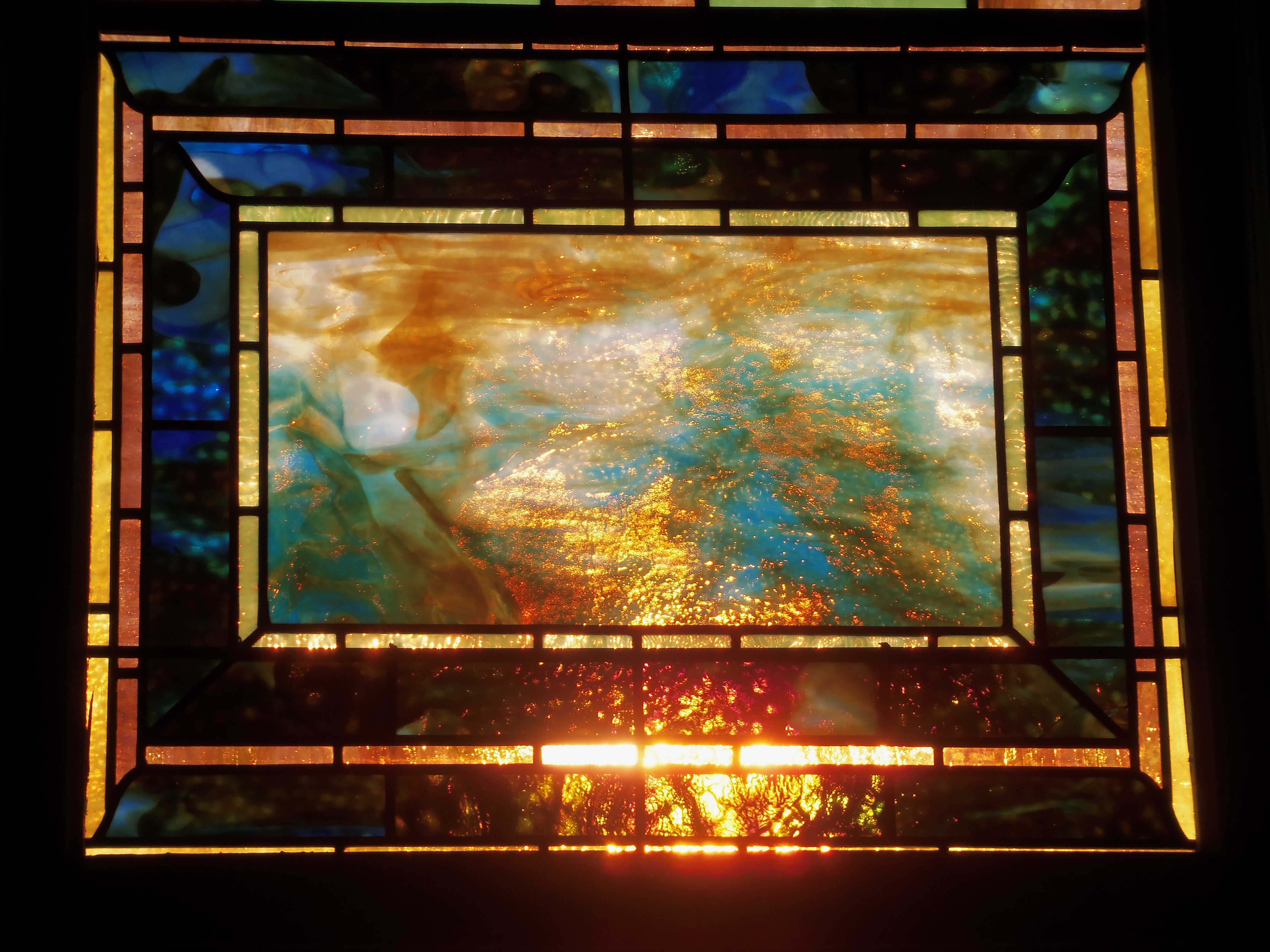
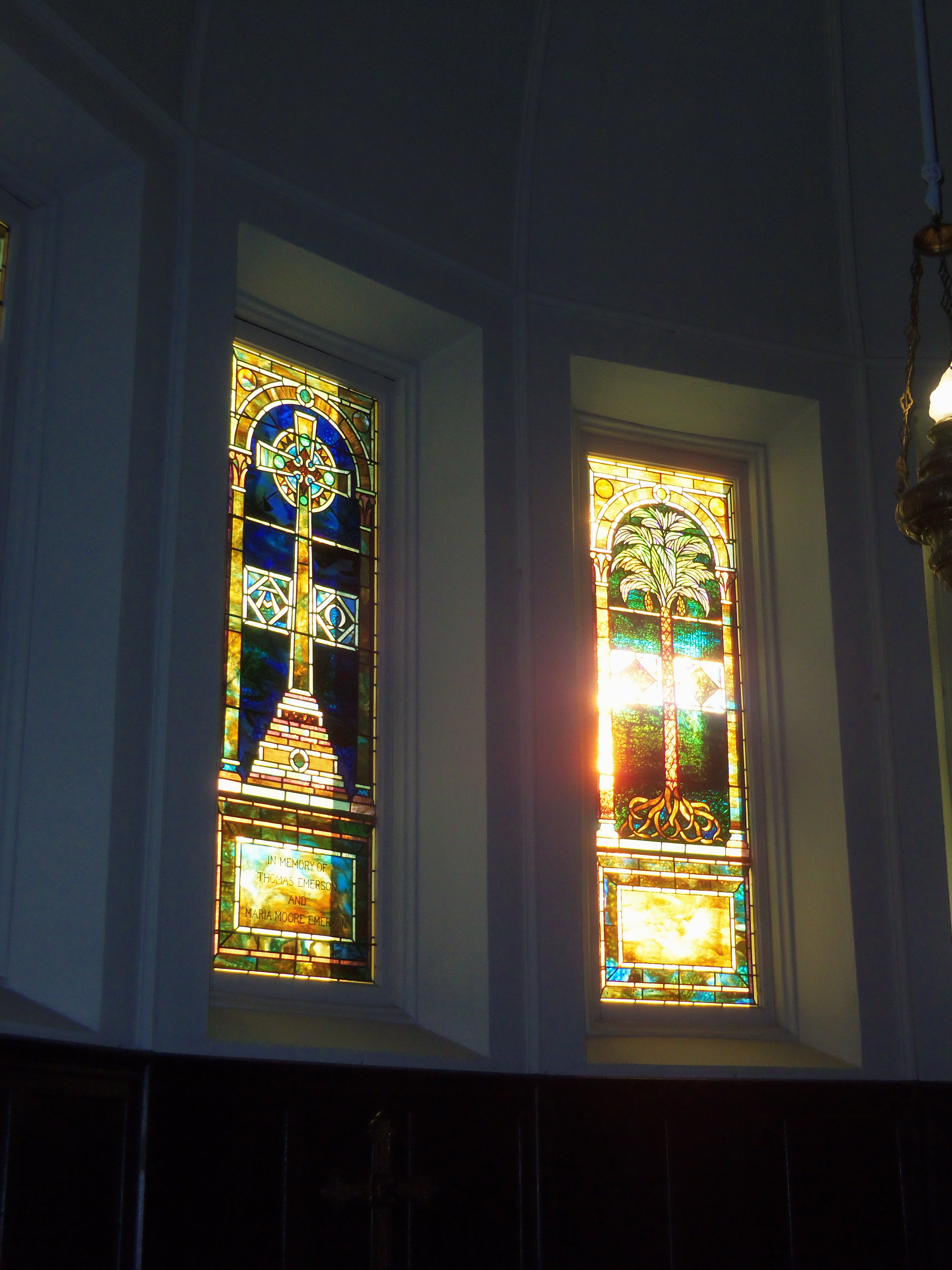
Could it be? I’d heard that one reason Louis Comfort Tiffany obtained such incredible effects in his work was that he used such materials in his glass. For starters, the only way to get a gold color is to use gold.
As I started to seek documentation, some fascinating connections appear.
As it turns out, the Tiffany Glass Company and its successor, Tiffany Glass and Decorating Company, created thousands of ecclesiastical church windows. Many of these were designed and executed by his studio, rather than Tiffany himself, but they would nonetheless bear his stamp and influence.
Tiffany’s 1890 Hay Memorial at Emmanuel Episcopal in Pittsburgh presents some striking similarity to the set at the 1895 St. John’s Methodist in Watertown, Massachusetts.


Both are narrow arched windows with greenish bottom panels ringed in copper tones. The central cross resembles the crosses at Watertown. And the mention of Tiffany’s love of exotic Oriental painting and his travels in northern Africa might explain the two Watertown windows dominated by palm trees.
The Watertown congregation originated in 1836 in the Whitney family home, and they remained active supporters at the time the 1895 stone building was erected. Their David Whitney Jr. relocated to Detroit as a young man, quickly became that city’s wealthiest resident, and built an 1894 mansion that still features its elaborate Tiffany windows.
Finally, I run into the pastor as he’s leaving his office. I pose the question, “Tiffany?”
“Technically, no.”
“His studio, then?”
“Yes.”
Regardless of the creator’s name, these five windows are marvelous, especially when struck by sunlight. Unfortunately, their placement on the west side of the building means the Sunday morning worshipers would not get to view them at their best.
Vespers, anyone?


For a classical music enthusiast like me, one of the great things about living in New England is the plethora of fine pipe organs. They’re found not just in many of the historic steeplehouses, but also in places like the city hall in Portland, Maine, or the music hall in Methuen, Massachusetts, built especially for the massive Wurlitzer, and, of course, Symphony Hall in Boston.
(They’re not, however, found in our Quaker meetinghouses, except for the occasional harmonium or a modest electronic organ in a corner. I could even point to my quibbles about the expense of building and maintaining great instruments in a house of worship, but let me add how much I appreciate listening when they’re played in good hands.)
Their very variety can be remarkable. Locally, we have an 1876 Hutchings instrument that two Eagle Scouts rescued in unplayable condition from the old Methodist chapel, carefully dismantling, numbering and cataloguing the pipes, storing them in a barn, and eventually seeing their restoration in the congregation’s new building. (Hutchings, by the way, created the original part of the organ at Boston’s Symphony Hall in 1900.) Hook and Hastings, meanwhile, is credited with an 1850 one-manual instrument at First Baptist, a 1908 two-manual at St. Charles Roman Catholic, and a 1911 two-manual at St. Thomas Episcopal. First Parish (U.C.C.) has an impressive 1995 Faucher hybrid that incorporates the building’s earlier Goodrich and Hutchings instruments. Expanding the circle a bit adds a wonderful 1975 two-manual baroque-style instrument at Durham Community Church and the oldest playable organ in America, the circa 1665 Brattle, now at St. John Episcopal in Portsmouth. (Manuals, for the uninitiated, are the number of keyboards, one atop another. And don’t overlook the incredible bass notes played by the pedals under the feet!)
Maybe I shouldn’t have been surprised, then, when I stumbled upon a four-manual keyboard in Watertown, Massachusetts. “Is it still playable,” I asked. “Oh, yes. I sit down to it from time to time,” I was told. “It has a lovely, soft sound. It was built by Aeolian-Skinner but never made leaner,” meaning the E. Power Biggs’ influence in the ‘60s, especially through his performances and recordings on the Flentrop organ at Harvard’s Busch-Reisenger Museum and his advice – or misguided advice, depending – to organ owners in that era.


Getting ready for the trick-or-treaters tonight means bringing the box of decorations down from the loft of the barn, perhaps carving a jack o’ lantern or two, putting up some spooky lights, and making sure we have bags of candy ready for the kids who come knocking on our door between 5 and 8 p.m. (Dover’s officially sanctioned window).
For readers in other countries, I should perhaps explain America’s Halloween tradition of allowing children to go door to door, knocking or ringing the doorbell, and then calling out “trick or treat” and receiving a sweet morsel in return. In the old days, there was the veiled threat, “or else,” which often led to a prank like having your windows soaped – or worse. These days, it’s often a matter of having any pumpkins left out being smashed in the middle of the night, regardless of your good acts.
Over the years, though, the event’s lost a lot of its edge.
For one thing, as a result of tales about razorblades being found in apples and other urban myths, only commercially prepared and sealed products are acceptable as handouts – no more apples, little bags of homemade caramelized popcorn or cookies, or (my favorite) Rice Crispies squares. It’s almost universally little candy bars, door after door. Gone’s the wide variety you’d compare at the end of the evening. Of course, most kids get candy throughout the year, so it’s no longer the Other Christmas when it came to rare sweets.
For another, concerns about safety mean it’s rarer to allow children to roam on their own. In our neighborhood, at least, almost everyone’s accompanied by a parent – and many of them have better costumes than the kids. For that matter, they often seem to be enjoying it more, too.
The safety issue has led to some weird twists of its own. Manchester, for instance, moved the event to Sunday afternoon – broad daylight. As one neighbor kid at the time observed, how lame! There’s nothing spooky in that! And then there’s the going store to store in the malls. Even lamer.
The one vexing situation is the car that cruises slowly while their children go door to door. Get out and walk, please! You’re being asocial. Usually, these are people who don’t even live in the neighborhood but have chosen to live out in the country, “away from neighbors.” And now they want what they don’t offer in return.
I remember, especially, living in a neighborhood of modest townhouse rentals and seeing the BMWs and Mercedes cruising through. Nobody in the neighborhood could afford vehicles like those, and now we were expected to give their kids little gifts?
I had the urge for a little tricking on my own in return. If I only had a plan …
 Jnana's Red Barn