SECOND TAKE ON THAT BUMPER SLOGAN

I’ll admit I laughed when I saw the sticker:

WHEN RELIGION RULED THE WORLD
THEY CALLED IT THE DARK AGES

But then I started thinking of the ongoing reconsideration of the era itself, which suggests a far richer and more varied culture than we’ve admitted. Just look at the glorious cathedrals, for starters.

Add to that an awareness of the atheistic evils of the 20th century, beginning with Hitler, Stalin, Mao, and others. How many millions were murdered as their victims?

The sticker was on a tiny van parked at the trail head, and a bit further I came across its owner in a cloud of smoke.

Not to be judgmental, but I found myself wondering about his alternative. It looked pretty dark. As for me, I’ve seen enough to suggest religion – true religion – can release us from darkness as a people.

Let’s start with the civil rights movement, if you wish. But there are many others.

Think of religion as a sword that cuts both ways, depending on its user and that matter of love. And then ask, How else are we to aspire to a better world?

MORE THAN SNOW IN THE AIR, AT LAST

Just as the first snowstorm of the season has finally hit New Hampshire, the state’s first-in-the-nation presidential primary is beginning to show some flickering flames. The kind that produce both heat and light. Up till now, it’s been only smoke, mostly on the Republican side. (The Democrats have been politely, though passionately, lined up behind Hillary or Bernie, recognizing the battle they’ll share together after the national convention.) The Granite State’s winnowing function has worked best when some unanticipated turn reveals a candidate’s true character for the public to see, either with devastating consequences for the campaign or its big breakthrough moment.

To be candid, I’m surprised we got through the autumn without seeing one or two of these. Yes, Trump came close when he attacked a St. Anselm college student as a “Bush plant” after she asked him a question, but the story never gained traction. The rest of the pack of candidates never picked up on the theme or any other, for that matter. The race to date has been pretty bland, all too predictable, little to set one apart from the other. Where’s the genuine courage or bold intelligence been? Talk all you want about the Trump-Carson-Fiorina outsider role, the pros in the lineup have been notable mostly in their failure to connect as seasoned campaigners rather than slick packaging alone. We’ll probably see some fascinating postmortems when it’s all over, but for now the scene’s been pretty befuddling.

We did awaken to an unexpected surprise November 28 when Joseph W. McQuaid, publisher of the state’s largest newspaper, endorsed Chris Christie. While the Union Leader and its New Hampshire Sunday News hold staunchly conservative editorial pages, there are Republicans in the state who insist these are liberal media. Ahem. True, McQuaid has often marched out of step with many of the state’s right-wing voters – anyone remember Malcom Forbes, for instance? – but you can assume Joe’s never, ever voted for a Democrat.

Yesterday morning, though, came the startling headline across the top of the front page: “Trump campaign insults NH voters’ intelligence,” an editorial by McQuaid noting Trump’s resemblance to bully “Biff” in the “Back to the Future” series. As McQuaid wrote, “Trump has shown himself to be a crude blowhard with no clear philosophy and no deeper understanding of the important and serious role of President of the United States than one of the goons he lets rough up protesters in his crowds.”

You get the idea.

And Trump’s response?

As this morning’s top of the front page headline announces, “Trump calls McQuaid ‘lowlife.'”

Of the many things you might accuse the publisher, “lowlife” is not one that springs to my mind, especially when coming from the lips of someone like Trump. The inaccurate retort carries the air of desperation – and flailing.

We’re still six weeks away from the voting booths, and Trump’s starting to show his central weakness. Am I wrong in seeing him as thin-skinned, someone who can’t take criticism or a well-aimed insult? Who can’t take what he routinely dishes out? Is this a wakeup call to his rivals to get their punches in, too, now that they see he’s not invincible? For that matter, what will their responses reveal about them?

Sure looks like it’s about to get interesting. Maybe even exciting. But first, I need to shovel some snow.

RAILSCAPES

From the rails, the landscape threads together quite differently than it does from a highway or water passage.

The tracks pass sidings, graffiti-tagged warehouses and low factories, storage yards of all varieties, rundown housing, apartment clusters – and once out into the farmlands, grain elevators as well.

Clicking along, you can’t help but wonder how many of the enterprises are legit or how many, in their decrepitude, cover questionable activities.

For a maverick intellectual gone incognito, they might even be an ideal location to go underground for a while – a place to work uninterrupted.

In my novella With a passing freight train of 119 cars and twin cabooses, English Bible translator John Wycliffe shows up in a railroad crossing on the American Great Plains, where he’s soon joined by Hieronymus Bosch.

As they discover, once you’re lost in time and space, anything just might happen.

~*~

Train 1For more of the fantasy, click here.

REVISITING THE EARLY CHURCH, IN PART

While walking to Quaker Meeting one Sunday morning, I heard a familiar hymn from my childhood wafting from the open doors at St. Mary’s. About a block later, still humming along, I realized it was the Protestant hymn, “Faith of Our Fathers.”

Well, I thought it was a Protestant hymn, especially now that this music is as likely to be heard in American Catholic services as in the mainstream Protestant ones, which have been drifting toward the newer pop-influenced praise songs. (A musically literate friend, by the way, dubs the rocking chants the Rupture songs.)

Imagine my surprise in learning the hymn in question was written to commemorate the English Catholics martyred in the schism that created the Church of England!

Either way, the questions remain, Whose father? And which faith?

And, as a digression seen in genealogy, we can add that it’s often the mother’s faith that’s followed.

Still, any way you want to look at this, I think it reflects a widespread sense of an earlier “golden age” of faith. Early Quakers, for instance, insisted that they weren’t intent on reforming Christianity, but rather restoring it to a richness from “before the great darkness of apostasy that set upon the church,” something I’d deduced meant from before the first Nicene Council.

And, for balance, many later Quakers looked and still look to the upheavals of that first generation or two of the Society of Friends as a golden era of faithful devotion, something a closer reading of history will challenge.

Now that image of the early church has in turn been challenged in my reading of Richard E. Rubenstein’s When Jesus Became God, which focuses on the tribulations leading up to the Nicene Council and then flowing out of it.

The fact that both major sides in this confrontation were so violent, often as roving mobs, continues to rattle me, along with their allegiance to priests and bishops and the secular power those clergy already carried, even when Christianity itself was at odds with the Roman empire.

More subtle is the emerging schism between the Greek-speaking Christians of the eastern Mediterranean, with their complexity of thought and love of philosophical speculation, in contrast to the more action-oriented Latin-speaking Christians to the west, who lost much of the subtlety of the debate. Already, the tensions between the metropolitan bishops, or theoretically equal “popes,” of the eastern Mediterranean sea and Rome were mounting. If Rubenstein is right, the schism between the Eastern Orthodox churches and the Roman Catholics was taking shape even before the Nicene Council, no matter how later history records the tragic events.

All of this leaves me asking just when the church moved from synagogues and home-based circles into a priestly class abetted by passionate mobs in the streets.

As Rubenstein repeats, there came a point when Jews were no longer part of the discussion but were rather persecuted.

Now, let us consider. Could that be when “the dark night of apostasy” arose?

MAINTAINING A GROUP IDENTITY IN A WIDER COMMUNITY

Seeing radical religion continued through an elder-and-student succession over the generations also sets it apart from the wider society. In practice, it also invokes a circle of learning, all working together.

Sometimes, as in monasteries, the circle receives support from the wider society. At other times, it is based in circles of families whose identity somehow stands apart from the wider society. Upholding those values requires passing the teachings and practices down through the families.

This has been the history of the Jewish people, for starters, the preservation of a unique vision of justice and philanthropy, a critical stance from the mainstream, the independent role of prophecy in which political and social rulers are placed under a more absolute authority, monotheism rather than polytheism.

We see it, too, to some extent in minority and ethnic communities as they attempt to maintain their unique identities and cultures.

The Amish, of course, stand out in America as they pursue this.

One of the complications is that it can lead to a relatively small gene pool when it comes to finding a spouse.

In the Church of the Brethren, the annual sessions, which alternated between the East Coast and the Midwest, were often followed by marriage announcements. In other words, it was the place to go if you were looking. The shared values heightened the chances for a successful union, we can suppose.

For Quakers, the boarding schools allowed for some wider mixing than one would find in the home village. Still, the lines could tangle in time, even with a strict ban on first-cousin marriages. I remember a conversation with one young couple who told me they were also third cousins or some such. Don’t think it was aunt and uncle, but it seemed that complicated at the time.

Maybe that’s why I wasn’t shocked by the complex, tangled family lines presented in Jeffrey Eugenides’ Middlesex or even the incest. (As others have noted, the reason the incest taboo is so universal is simply that the practice has likewise been so universal.)

In the novel, persecution leads to brutal oppression and massacre. The generations are torn apart. And then, somehow, they continue. What shocks most is the violence and hatred and related moral failures of the more “civilized” ships that fail to come to the rescue of innocent victims. But that returns us to thoughts of the wider society, doesn’t it.

WHAT A GANG

Some of us of a certain age remember a weird black-and-white Saturday morning children’s show starring Andy Devine, a rotund, raspy-voiced former cowboy movie sidekick. I never knew quite what to make of the show back then, but each week essentially had three individual adventures bridged by the host and an audience of screaming kids. The same ones, in the close-ups, each week.

When the topic of Andy’s Gang comes up – along with a singing of its theme song, “I’ve got a gang, you’ve got a gang, everybody’s got a gang – ANDY’S GANG!” – what I’ve noticed is the utterly perplexed look on the faces of those who’ve never seen it. In short, nobody can describe it in a way that comes across. The cartoons came on afterward and ran till noon or so.

Thus, when a recent Google search turned up some Andy’s Gang videos from the ’50s, we started watching. Let’s just say the show hasn’t aged well. After a few shots of the host, the mother in the room said she’d never allow her kids around that character. Ahem. And that was before his classic “Pluck your magic twang-er, Froggie,” which she declared had obviously Freudian meaning. (She was, in fact, more graphic.) And then we got a mini-episode with two bare-chested boys in India, who were rescuing monkeys. Another friend points out the blatantly racist undertone of the stories in Africa. Do your own analysis there, if you want.

I think the third regular adventure had a goat-cart in Ireland.

And then there’s an ad where Andy’s telling a friend he has a big date lined up. He gets all spiffed up for the event. Let’s just say, when she shows up (to eat cereal with him), she’s not age-appropriate.

It’s supposed to be cute, I know, but these days it’s just creepy. The word, in fact, just kept returning.

At least each week’s show ended with a reminder to be good boys and girls and go to Sunday school the next morning.


REAMS OF CORRESPONDENCE

She wanted to review our email exchanges from our days of courtship but couldn’t find copies of what she’d sent me. Hoped I had printouts.

I’ve been downsizing, so some things weren’t where I expected to find them. Knew I had a loose-leaf binder somewhere.

Nowhere in my studio, though, the one in the attic. No, not the bookshelves or even the remaining filing cabinets or the knee-high closet under the roof. Nor in the first sweep of the loft of the barn. Not in the drawer of surviving correspondence there, either.

Naturally, I was perplexed.

One more round, though, and I came across a crate of binders. Aha! First one had Quaker letters, back before Internet. Second one, other letters. And then, a three-inch thick binder, our nine months of emails. My first emails, actually. How embarrassing … and fascinating! So long ago, it now seems.

Has me reflecting on how much times have changed, too – amazed, on one hand, how much I actually sent out in the postal system and received in reply. Where did the time come from? And reflecting, on another side, at how much today would be a click and later delete … and thus lost. (Printouts? Too tedious, most of the time.)

Another question even has me pondering how much of my poetry and fiction would have simply been shot off as blog posts rather than tediously typed and retyped, revised and condensed into literature, had another option existed?

If my small-press acceptances letters fill three filing drawers, as they do, the rejections would take up 20 times the space. Where would I put them? Or why?

Now, back to the juicy stuff …

A DARK CLOUD OVER THE HIGH-TECH ERA

Back in college, I encountered the argument that the more people were engaged in long-range planning, the less possible long-range planning became. In other words, as they put their assumptions into action, the entire field shifted.

Or, put another way, the fewer givens could be counted on ahead. That farm where you wanted to build a mall may already be a housing development or the interest rates may have soared out of sight or malls themselves may have given way to Amazon.

It was also all part of a recognition of the rapidly changing social world ahead, as we’re seeing in our high-tech era. Just where do people get together nowadays, anyway? As for dating?

Over the summer, I sat in on a workshop trying to look at some of the ethical issues we Quakers face in adapting to the use of Internet/social media in maintaining our faith communities, including the possibilities of online committee meetings rather than sitting down in one space together.

There are other issues the greater society faces, such as the rewiring of the human brain as a consequence of early-childhood online time or our “multitasking” activities. The ability to sit down and read complicated, nuanced long works is no doubt in jeopardy. As is, likely, the time for moral reflection. (Does that explain some of the latest developments in the presidential primary posturing?)

We didn’t get far in that direction, though, apart from looking at some of the pros and cons of our own Internet use. As an avid blogger and the author of ebooks, I had my own list.

The part I keep returning to, however, has to do with something at the core at what we’re using. Our screens, laptops, smart-phones, networks, and so on are all dependent on rare-earth elements, which – as their name reflects – are scarce commodities. Not just because they’re hard to find, either, but because they occur in low concentrations where they exist. It’s ecologically costly to extract them. Add to that, they’re mostly found in China – and the known sources are running out. (As the saying goes, the Mideast has oil, China has the rare earth supply.)

Remember, too, high-tech equipment is obsolete the day it’s produced – the next generation is already on the way.

Now you can add this to my neo-Luddite concerns.

I’ve long harbored suspicions about who’s paying for all of our “free” online usage. (Well, Firefox and Wikipedia are now pleading for donations after spoiling us into getting used to having something for nothing. I’ll assume most folks won’t contribute until they have to. Leave the voluntary donations to others.)

I remember the joys of hitchhiking, as well as how quickly it all ceased.

So here we are, all the same. Let’s see what’s around the corner.

WHAT AN AUTHOR SEES IN AN AMBITIOUS NOVEL

A young organist once mentioned that he doesn’t listen to music the way some of the rest of us do. While I’m usually aware of the time signature, or at least a basic pattern to beat, much more than that fills his awareness. We could begin with the key or chordal progressions or structural development or phrasing. As for emotions? Way down on his list.

Of course, something similar happens for me as a reader. The author looks at much else besides the story, as reading reviews of Jeffrey Eugenides’ Middlesex reminds me.

I’ve already mentioned that my primary interest was in its presentation of Greek-American life. These aren’t celebrities or university professors or artists but people trying to survive the economic challenges of everyday existence. He does so in a matter-of-fact way, with a darker view of humanity than I’d usually take but more accepting of their foibles and failures, too. Everyone’s flawed. He’s not afraid to reveal the villains among them, family or not. If only I could revisit my own Sunday dinners with such cold accuracy! (The skeletons in my family closet, from what I can tell, are much further back and mostly in my mother’s ancestry. But the dysfunctions, well, that’s an entirely different matter.) To put his accomplishment here in a different light, his details are both particular and universal. They hit close to home. If only we had terms of affection like Dolly mou, which I take to be a variation on Koukla mou. Or, for that matter, if we were only so outwardly open and affectionate, period.

The novel’s more prominent theme, Cal’s sexual identity, advances in good taste. Nothing salacious but rather an ongoing, almost innocent discovery by narrator and reader alike. Eugenides manages the rare accomplishment of being a male who writes a convincing female character from within. In fact, he gets close enough to have had me wondering if were writing autobiographically of his own condition. That, alone, is astonishing.

As I was reading, I wasn’t yet aware of his reputation as a short-story master, but it makes sense. Much of this novel builds as shifts between stories separated over time.

Technically, his use of point of view is amazing. His Virgin Suicides was acclaimed for its daring use of first-person plural. Here, though, he mixes first-person singular, with its immediacy and intimacy, and third-person, with its semi-omniscient awareness, sometimes in abutting sentences, so that you get a stereoscopic view at once from within and without. Through the first half of the book, especially, much of this happens before Cal’s birth, which creates a kind of time travel. And it works. How much of the related details are “real” and how much merely imagined by the narrator, we should note, remains up in the air. But it’s effective, all the same.

Eugenides’ presentations of the massacre by the Turks and later race riot in Detroit are masterful and moving.

Throughout, the factual accuracy feels right. He’s done his homework and often conveys complexities with a few confident brush strokes. His insights on Eastern Orthodox Christianity are especially notable that way. As for his takes on hippie experience, I’ll simply say, Ouch! As I said, he often takes a darker view of humanity than do I.

Another major subject is his corner of the American Midwest. Contrary to common opinion, the region is hardly homogeneous and is anything but compact. Ohio, for instance, is the size of England. Presentations of it in contemporary literature are surprisingly rare, at least in proportion to the population. And there are many variations in the underlying cultures and outlooks. Kurt Vonnegut’s Indiana, for one thing, is quite different from Saul Bellow’s Chicago – and neither of them resembles what I know of Eugenides’ locale, Detroit. (Let me add my own emphasis on the importance of place itself to the extent it might be considered a character within much of my writing.)

What Eugenides presents is a more compact metropolis than I remember, but definitive in a blend of influences I recognize across much of northern Ohio and Indiana as well. Whether dealing with the older inner city, which then leads into issues of race and racism, or later suburban life, the descriptions resonate with what I found throughout the industrial Rust Belt. Cal’s grandfather’s encounters with Ford Motor Company’s melting-pot police or Cal’s father’s dealing with the real estate point system quickly demonstrate the cost of maintaining a unique identity. You didn’t have to be an immigrant to run afoul of that, either, I’d add from another direction.

It’s not a “perfect” novel, but nothing this ambitious could be. As the Detroit Free Press review expressed, “What Dublin got from James Joyce — a sprawling, ambitious, loving, exasperated and playful chronicle of all its good and bad parts — Detroit got from native son Euginides.”

For me, a drift sets in late in the volume with the introduction of the Desired Object and Cal’s sexual desire awakening. The tight construction seems to be coming apart, sprawling, but! In retrospect, it’s more that a second novel is taking off with leaps to Manhattan and then San Francisco before coming to a powerfully focused and moving conclusion.

So here I am, full of admiration and wonder. How does he pull this off? Where do those brilliant flashes of humor spring from? How does he make some essentially unsympathetic characters come to life in daily survival?

He plays throughout the story with Cal’s grandmother’s skillful touch with silkworms and the ways their silk reflects events around them. It’s one more stream of knowledge that runs like a thread holding the work together.

Eugenides, then, may be seeing himself as a silkworm issuing the long, long filament – for that matter, a nearly endless stream of organ chords – or, as we’d say, spinning a yarn.

Somehow, it all fits. Marvelously.

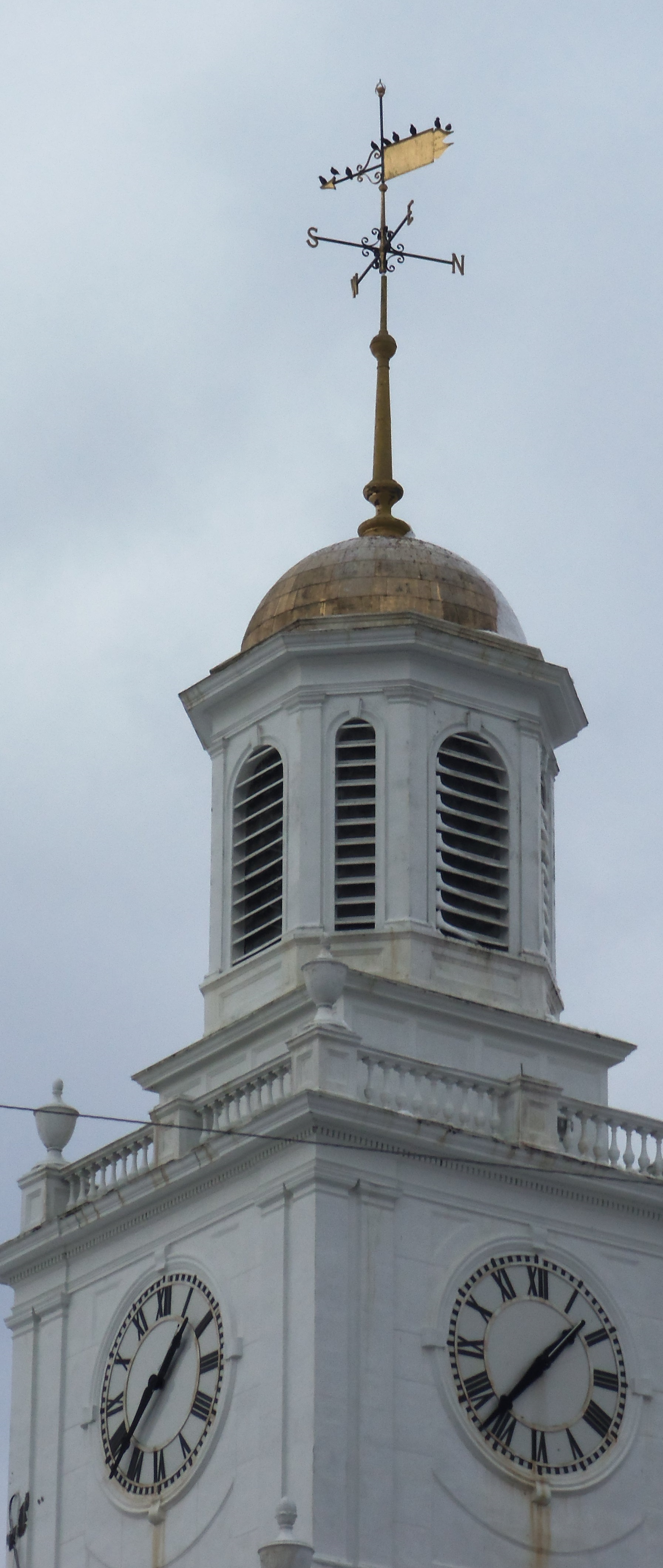
FLOCKING TO CITY HALL

I love seeing birds perched atop a prominent weather vane.

The previous building included an opera house that would have been the largest auditorium in New Hampshire, if it hadn’t burned down. Rather spectacularly, at that.

Numbers 122
Without the birds, too. Once a month, folks flock to a contradance on the top floor.