When I see this …

… I think of this.
 For the free ebook novel and more, click here.
You never know what we'll churn up in cleaning a stall
When I see this …
… I think of this.
For the free ebook novel and more, click here.
The influence of surveys on political voting has long troubled me, and from what I’m seeing, it’s getting only worse.
On the candidates’ side of the equation, an escalating reliance on their privately acquired marketing research (and that’s what this really is, marketing, as in advertising) leads to tailoring their message to likely voters’ expectations. Prejudices, anyone? The campaign applies the responses to focus on establishing a positive brand and image quite apart from character and qualifications, even before sussing out the negative labels to stick to competitors in the race. This plays right into opportunistic office seekers and their key backers, and soon the public really has no way of trusting the campaign’s stated positions. How much is merely a mirage or out-and-out smoke and mirrors?
The media, meanwhile, have increasingly focused precious time and space on the horse race numbers rather than examining the policy implications and records of the rivals. The latest polls, not the campaigning itself, take over the coverage. It’s too much like sports without athletic skills in action.
And then, on the voters’ side of the equation, we have the question of whether the survey projections actually alter the very pulse they purport to be measuring. For one thing, supporting a loser takes courage. Give ideologues credit for sticking with candidates who reasonably have no chance of winning. But for many voters, the polls can play into self-doubt. What do other people see in the leading candidate that I don’t? Popularity, in other words, builds on itself.
Of course, there’s always the danger of overconfidence. Why bother to vote if so-and-so’s going to win anyway? Even if its your favorite. Me, I usually lean toward the upset, if possible.
Meanwhile, the ongoing presidential primary drive has the pollsters’ influence running rampant.
As we saw in Iowa, Republicans hoping to stop Donald Trump looked for a candidate running closest behind him and then did all they could to add some momentum to the chase. Is Ted Cruz the guy they really want? Well, what he did have was some numbers.
Among the Democrats, the projected percentages have many Bernie Sanders’ fans deliberating whether to vote their heart now, despite the possibility of wounding Hillary Clinton’s chances in November – or of casting their primary vote for her as the party’s best chance of retaining the White House come autumn.
Being practical in the polling booth does start to wear thin. It’s enough to wonder how you’d really vote if you didn’t have those surveys in your face.
Living in New England, I’ve become enamored with lighthouses. My fascination has nothing to do with the quaint impression many tourists carry but rather an awareness of the ways these now antiquated emblems of peril define our landscape. Along the water, if you can identify the light, you know where you are. Believe me, there are places that would otherwise be difficult.
The night ocean, as I’ve also discovered, can be anything but romantic. It’s a different world from the one visitors encounter during the day. Cold, windy, wet, threatening, even on many summer nights. Yes, on a balmy evening, especially with moonlight, it can be magical. More often, a night ocean can be downright spooky.
Along the dark coastline, the flash of light can help you place yourself in the scene. You triangulate your position using the lights. Each lighthouse beacon has an identifiable pattern – one flash every five seconds. Or ten. Or two flashes. Their colors may be unique in that place, too – blue, green, or red, instead of clear.
The most powerful beams reach out 20 miles or more over the water. Think about that – the light doesn’t scatter but holds together using a technology that predates the laser. How much we take for granted!
And to think, in the old days the illumination came from whale oil or similar fuels.
These days it can be a 110-volt bulb the size of your thumb.
The mechanism that shapes the beams is itself a remarkable piece of technology – the Fresnel lens. Developed by the French physicist Augustin-Jean Fresnel in 1823, it’s a large sculptured glass cone, where each overlapping leaf joins to focus the ray into one. The larger ones are the size of a child, with the light from inside. Remarkably, these are much thinner than a conventional lens for the job would be – thus allowing more light to pass through and the lens to be mounted in a rotating base. (One we’ve visited floated in a 500-pound pool of mercury.)
A section of a 4th order Fresnel lens is featured on the cover of my booklet.
Just as incredible can be the tales of the lighthouse keepers and their families – lonely work, often tedious, cold, staying awake through the night, put at risk by the storms. Nothing nostalgic there, being faithful.
As I look at the light and its tower, my mind leaps to the universal application of light as a metaphor of religion and spiritual experience. It’s especially prominent in the writings of Quakers (Society of Friends), where it frames an understanding of an alternative Christianity – one earlier generations never dared voice completely. Still, the Light led them in fresh directions – and can still do the same for us today as it reaches far, including into the human heart and mind.
 ~*~
~*~
For your own copy, click here.
We’re getting a flood of mailings decrying tax increases attributed to some of the governors seeking the Republican presidential nomination.
The blanket charge against them fails to determine just who’s paying what, much less where the money’s going. Maybe it’s on all the rich? Maybe these are actually user fees? No telling.
Some of us are far more inclined to pay a tax for some service where we see a direct benefit – education, parks, highways, snowplowing, health care – than for those that profit special interests, the ones who hire high-powered lobbyists with an eye on the public purse. A subsidy of some kind. Maybe a tax break or outright credit.
Until we hear otherwise, let’s simply assume that those who are claiming to have cut taxes have also cut public services in some way. Remember that possibility if you’re standing in a long line to renew your license or are waiting for the fire department to arrive or wonder why nobody’s picking up the phone at town hall.
The blanket charge gets an emotional reaction, of course – we’d all like to escape paying our bills. But that’s not how the world works. Just ask any businessman. Or even those candidates making the accusations against their rivals.
Some of the profiles in circulation are concluding that Donald Trump is skilled not as a negotiator, despite his claims, but in his ability to read an individual or entire audience he’s addressing – and then tune his presentation to their psyche and cater to their dreams.
That has me seeing Trump as a chameleon. Just look at how easily he changes colors to match the environment.
In many of his big deals, he may have gotten his way – but the financial consequences have often been disastrous. Plaza Hotel, anyone?
Joe McQuaid, publisher of the New Hampshire Union Leader, caught that in the headline to his front-page editorial yesterday: “Con man Trump.”
He then sees another twist: “Nothing he says or does will bother his most committed followers. But if they thought about it, they might realize that Trump is insulting them just as he insults everyone else.” As for the anti-politician role? “Trump is as slick and oily a pol as any we have seen. But when he doesn’t get his way, as with [last night’s] TV debate, he reveals the real Trump.
“He is a schoolyard, rich-kid bully who thinks he can push around networks, newspapers, and opponents while conning voters at the same time. We have seen that con before …”
So, we put the two impressions and what do we get? A con-meleon?
When I see this …

… I think of this.
For the free ebook novel and more, click here.
Decades ago, after hearing mention that my family had Quaker roots in North Carolina, I began the genealogical detective work that now fills my Orphan George Chronicles. Although I’d independently come to the Society of Friends and become a formal member, I was surprised to hear that my family had been Quaker and that there were Quakers in North Carolina – my, have my eyes been opened!
In the genealogical work, I chose to begin with my great-grandparents – people I’d never met in the flesh.
But when my father died, the focus shifted. I realized only one person remained who might be able to fill me in on questions of his childhood and parents, and that was his “baby sister.” That would mean getting to know her – and her parents – without all of the filters that had always been applied by my mother, who had issues of her own. (Oh, for these family dynamics!)
It became a rich and fascinating project, given all the more incentive when we met my aunt and her husband, a retired university dean, at the airport. It was a first-time encounter for them and my brood, yet he swept up my younger one in his arms and proclaimed, “It’s so good to have another Democrat in the Hodson family!” The party activist suddenly had a favorite uncle. Make it great-uncle-by-marriage if you will, he got the crown.
At that point, my aunt remarked that Grandpa’s slogan, painted on all of his trucks and on the calendars he mailed out each year, was “Dayton’s Leading Republican Plumber.” She promised to send a photo of the vans all lined up on the street. “You didn’t know that? It was even on his stationery and bills.” This was something I’d never known, although he did sign one of his last notes to me as “formerly Dayton’s leading Republican plumber,” a comment that long puzzled me. Through much of the spring and summer I wound up following up on her reactions and insights to her childhood and adolescence, which to my surprise (the word of the day) paralleled my own, especially in regards to their now-Methodist church, the denomination I grew up in. At last, I could finally look directly at my grandparents through all the memories and scattered bits of data I could assemble, as well as all the material I already had, doing genealogy. It was like being given a key, at last.
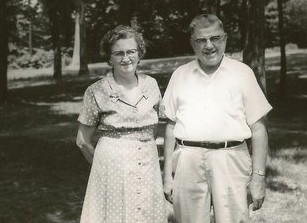
My aunt suggested I correspond with a surviving first-cousin Dad’s age, who wound up also contributing memories, and the result was a remarkable project, not quite memoir but more a realization of finally knowing my grandparents, pro and con, for the first time – years after their deaths – as well as questioning many of our ingrained expectations: just what are grandparents supposed to be, do, or look like, for instance. Unexpectedly, I reconnected to more feelings/memories from their house on McOwen Street than to the house I grew up in on Oakdale Avenue. Some of the stories that turned up, like my dad’s desire to be a sports writer or a big chicken dinner Grandpa arranged to help pay medical bills for one of Mom’s best friends, are priceless. From an intellectual perspective, the project also illuminates the difficulty of knowing – it often meant triangulating something in the middle of three often contradictory sets of perceptions. More importantly, to some extent, I’ve finally been able to reconnect with more than a few fragments of my childhood.
From my end, there’s little I’d say was happy in all of that childhood. But there are things I can finally claim and appreciate, and even rework or rewire. Much of my adult life, as I’ve found in Dad’s genealogy (Mom’s is entirely different, and far more gothic than she ever would have admitted) has been a matter of reclaiming many of the values and practices Grandma and Grandpa rejected in their move to the up-and-coming industrial city. I never knew that my Hodson ancestors were Quaker or that Grandma’s were Dunker (Church of the Brethren), very close to Amish and oh-so Pennsylvania Dutch. But they rejected all that, with some values somehow surviving, however invisibly.
Some discoveries still amaze me. The fact that Grandpa accomplished all he did with nothing more than a grade-school education, for one thing.
Or that his two best friends in adulthood were both a decade older than himself, and both died within a year – one of ALS, the other in a car collision. Since he was the youngest of three sons, I wonder about the dynamics.
There’s much, much more I’ve uncovered along the way. As you can guess, it’s a long story. Today would have been his birthday.
 Strolling Dover: for more, click here.
One place where the Bush family might claim a legacy in American politics is in its reliance on casting an opponent in a negative light rather than advancing what one member called “the vision thing.” Not just a rival’s record, either, but spouses and children have been targeted as well. Just ask John McCain about the gossip spread in South Carolina back in 2000.
So here we are, 16 years later with another Bush in the running and our mailbox keeps getting attacks on his GOP opponents, most of them funded by his Right to Rise USA super PAC. Well, in one flyer, it was just three of them – Donald Trump somehow keeps going unnoticed. In the flyer, a photo shows Gov. Chris Christie from behind, to emphasize his obesity – while conversing closely with President Obama, a touch intended to inflame the hate-Obama core of the Republican base. It’s rather heavy-handed, actually.
The brochure does try to say something positive about its candidate: JEB, Tough, Tested, Ready. As we watch him in action, though, we have reason to doubt anyone in the field sees him that way.
As I view the waves of negativity, I keep thinking of individuals who are fountains of gossip – mostly dirty stuff, or at least juicy. Not what you’d want to hear about yourself. But then, when you mention this person to a mutual acquaintance, the response is something along the lines of “You should hear what they say about you.”
And that’s how I’m feeling about Jeb. Just what is he saying about US, behind our backs? Or worse yet, what would he do?
The negative approach just doesn’t build trust, does it?
Within a religious tradition – I’m tempted to say any religious tradition – there are wise, seasoned guides. The ones who know from their own faithful practice what temptations and struggles the aspirant will face and how to overcome them.
Known in the various traditions as guru, swami, roshi, rinpoche, abbot, mother superior, bishop, or simply elder, among others, the best of these are adept at listening and then asking the right question.
In doing so, they hold the individual and the spiritual teachings together. As I know from my ongoing Quaker practice and earlier training.
These poems pay homage to that role.
 ~*~
~*~
For a free copy of the chapbook, click here.
 Jnana's Red Barn