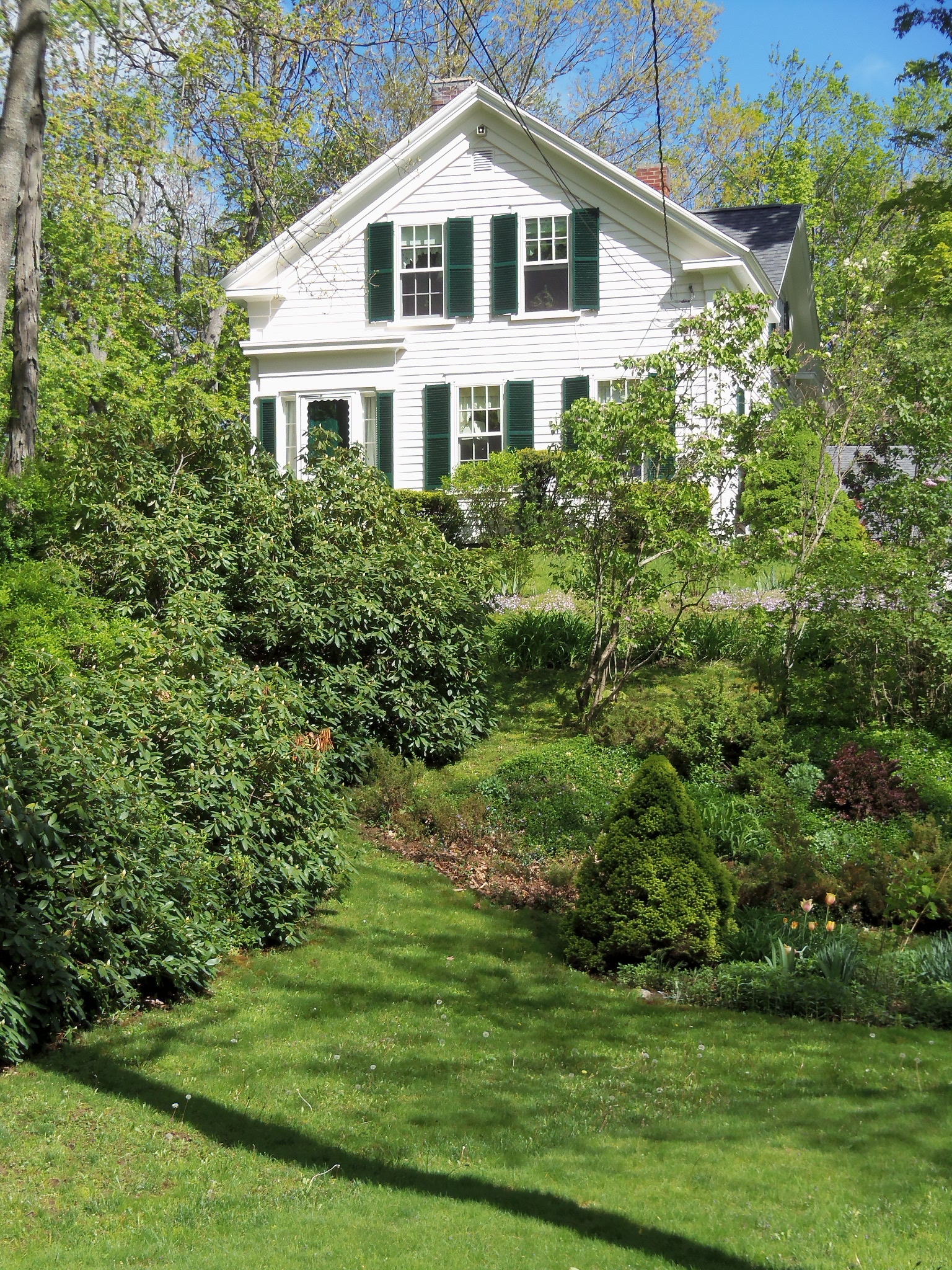
Here’s a local example of the Greek Revival style, which flourished 1820-1860.
 Strolling Dover: for more, click here.
You never know what we'll churn up in cleaning a stall
Here’s a local example of the Greek Revival style, which flourished 1820-1860.
Strolling Dover: for more, click here.
When I see this …

… I think of this.
 For the free ebook novel and more, click here.
Among the historic divisions among Friends, none were more traumatic than the Hicksite-Orthodox separations, 1826-27. While New England and North Carolina were spared, most other American yearly meetings were torn in two. The reasons were deep and complicated – often along socio-economic and geographic lines. Subsistence versus commercial farming, artistan-craftsmen versus industrialists, rural versus urban, traditional versus forward-looking, tensions between having the polity of Friends lodged within the monthly meeting or at the yearly meeting level, even language itself, one holding to old expressions versus those wanting to embrace a new evangelical ecumenism.
We were not alone. The Puritan legacy, for instance, splintered into Congregationalists and Unitarians about the same time we Quakers split, theirs ostensibly over naming the president to head, first, Dartmouth College and then Harvard. The Dunkers (or German Baptist Brethren), meanwhile, managed to hold together, although their tensions would finally reappear in the 1880s, leading to a five-way split, producing the Church of the Brethren – about the same time many Friends began turning to pastor-led programmed worship. Curiously, the Brethren, laboring under a single yearly meeting, faced major tensions between the Eastern, old-fashioned members and the “Western” (west of the Appalachian Mountains) progressives – the same lineup that Friends would see in the quietist versus pastoral worship styles, with our Western Yearly Meetings going programmed and the Eastern ones largely holding to tradition.
These tensions were fueled by and reflected in many larger societal issues. In politics, the Jacksonians reflected the emergence of westward expansion. In religion, the Great Awakening first blazed through New England (sometimes as the New Lights movement) before igniting in Kentucky and the newly settled regions. In the economy, the industrial revolution was well under way.
For Quakers, the divisions essentially shut down the itinerant ministry from traveling Friends, which had kept the central messages of the faith and practice intact. That loss no doubt played into the emergence of the pastoral system in places where Friends were settling, rather than long settled. Another loss was a breakdown in the sharing of epistles and other written material. We no longer had a common vision to express or unite behind.
I reflect on these not so much as history but as a recognition that our larger society is in one of those watershed transitions – as our presentations and discussions on envisioning the future have suggested. How do we parlay what’s been entrusted to us into the future? Will Friends, as a whole, respond with radically new worship, organization, expression? Will we be sufficiently open to be led where we are needed? Of course, Israel under Roman occupation turned out to be another of those watershed moments, spreading both Judaism and the newly emerging Christianity across the empire. But that’s a much larger and more complicated story, except for the fact that we’re Friends as a consequence.
Or, as old Quakers would say, “Christ is come and coming.” It’s more than “Season’s Greetings,” after all.
With its fierce winters, New England weather encouraged enterprising Yankees to build enclosed passageways from the house to the barn. And then those, too, grew into more housing or shops.
 Strolling Dover: for more, click here.
New England can be a harsh place. Its winter is long, with snow possible October into April or even longer, at least where I live.
You’re never far from earlier generations, either. They’re hardy as stone.
Each month sinks down through centuries.
As do the poems in this almanac.
The new year’s just around the corner. For your own copy, click here.
 ~*~
~*~
When I see this …

… I think of this.
For the free ebook novel and more, click here.
As I noted at the time …
When I see this …

… I think of this.
For the free ebook novel and more, click here.
How do we deal with a segment of the public that has no interest in factual reality? Where belief, unsupported by critical reasoning, crosses into outright superstition? Too often, alas, it’s even wrapped in religious trappings – tainting both church and state with irrational fervor or madness.
And that’s what we have in the aftermath of Donald Trump’s campaign. The lies and half-truths will be hard to wash clean. The stench will remain even longer.
Yes, the underlying hurt runs deep, but Bernie Sanders tagged the causes of the problems accurately and pointed to joint collective action to repair the damage and heal the common good. Not so Trump or his legions.
There was nothing pragmatic or even logical in Trump’s babbling, no matter how many were deluded by his initial snake-oil charm. He was not telling it like it was but rather how they imagined life that might have been had they not been passed by. And then, toward the end, he was denying so much of what he’d told them in the first place or that his words had been just a joke. Locker room banter, as he claimed, not that many of us white guys recognized anything of the sort.
Now, no matter the outcome of the election, the nation’s divided by what he’s encouraged.
It’s not just racism, though those who think it’s fine for police to murder unarmed citizens is justifiable go about stealing Black Lives Matter lawn signs and then are alarmed if blacks take up the right-wing’s interpretation of the Second Amendment in self-defense. Folks, what would you do in that situation?
I’ll return to Bernie’s to-do list. I don’t think he was the administrator to push the goals through, but he certainly did an admirable job in articulating them. May he continue, building a base to take both houses of Congress in 2018.
Meanwhile, I’ll lament for what passes for national debate these days in all the tumult. We need honest dialogue to advance. And that will include admission of fault where it’s dues, rather than more blaming others.

 Jnana's Red Barn