HOME TO ENLIGHTENMENT STYLE

A prime location in the big city.

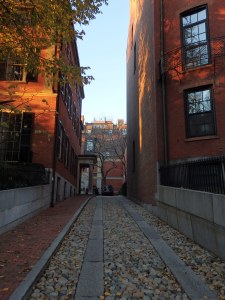
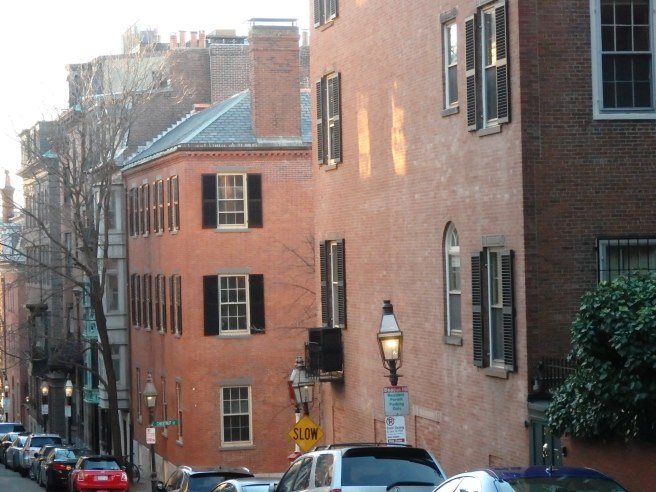
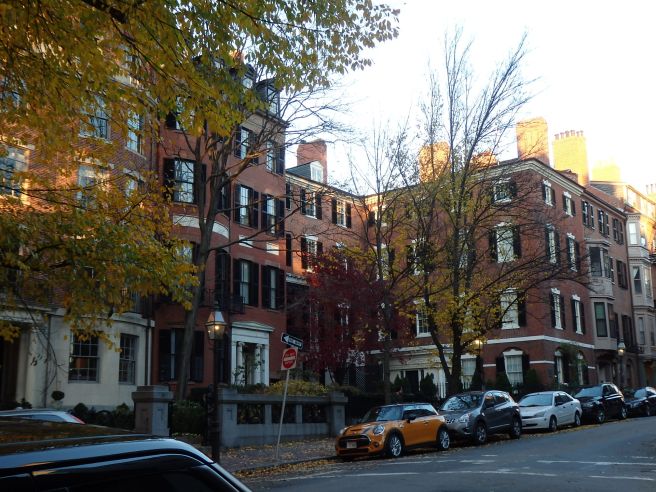
Beacon Hill’s narrow streets and closely set homes invite pedestrians to enter a timeless order and grace. It’s hard for us not to imagine living here early in the 19th century as American ideas took hold.

Boston is a rich and varied destination – the Hub of New England, or the Universe, as they used to say. Living a little more than an hour to the north, we’re well within its orb.

A quiet break in a crowded neighborhood.


Beacon Hill is, after all, hilly.

MOUNTAINS AS A RELATIVE MEASURE

As I listen, I realize the locals don’t consider the surrounding ridges to be mountains. Although these “foothills” or just plain “hills” are as tall as Pennsylvania’s Alleghenies, shorn of trees, to speak of “mountains” signifies that one must drive away into forest. The time comes to hike in unfamiliar high country.

I drive west, into a mountain pass, and park at the trail head.

Climbing through clouds on Sheep Lake Trail, I identify snow lilies, phlox, two whistling marmots I mistake for groundhogs, and a ptarmigan. In these topless mountains, snow and rocks glimmer atop jagged white threads that twist, plunge, and roar over miles. In this clarity I recount a friend’s determination to perceive the important task to perform each day — a focus she achieved in the sunset of her young death. Go on.

The next outing, I follow another friend’s favorite trail. My valley of orchards and meadows stretches behind in a twilight of small-city lights and barren blue ridges. In golden splay dusk, I learn to fear glaciers atop volcanic spines and in their grooved depths, too. So much depends on which way you turn. Clouds, one moment pink, shift into slate-blue. Think of a great-uncle’s farm in Ohio flatlands when green-wood ringed the fields and autos were novelties; and how, when the United Brethren in Christ build their new sanctuary, one tree furnishes enough lumber for all the pews. Such timber is long gone from most of the Midwest, and nearly gone here, as well.

Strangely, adjusting to such disorientation can allow one to see more than the landscape with fresh eyes. I begin reckoning my birthplace afresh, too. I perceive a native poetry now vanished: in flat terrain they coined Sweet Potato Ridge Road when they became sensitive to what had been called Nigger Pike, after work crews that came out from the workhouse jail in the city; Diamond Mill Road was made of limestone gravel flecked with quartz or mica, but named for the distillery beside the rails. What could be in those rural lanes I had sped along on the way to the farm to cause their ghosts to arise out here? I think, too, of the hayloft I had delighted climbing in, even though the old folks feared I’d fall through and be trampled by cattle; more ominously, some shed rafters I walked like a high-wire artist had hogs rummaging below, with razor snouts and teeth and a latent taste for blood. That farm acreage is scarcely like these Western orchards or open ranges, yet something echoes. It’s earth and air. Sunshine and clouds. My days in the mountains are airy conifers. I could be a pioneer, in spirit, at least. My ancestors settled those Ohio tracts. Another line, a bit earlier, settled North Carolina Piedmont. Here, I find unspoiled corners.

Perhaps bears do drink beer. Rocks, leap from mountaintops into oceans. Naked breasts, swell from snowmelt pool to sky.

Against this wall, between his desert and the frigid sea current, I declare my vast ignorance: left to myself, I’d likely starve, soon sicken of berries, and have never caught fish properly or gutted a rabbit. Somehow, I wait to be fed. Thus, one point of my Dedicated Laborious Quest involves learning to be wholly myself — embracing flaws as well as talents, as I search out my own boundaries.

Away from the office and encircled by an ever-renewing earth — even an apparently lifeless desert that restores his sanity and a brand of insanity, too — you may find that every trail you follow brings you closer to your own attainment, your emerging sense of place and mission within the universe. As for looniness — ah, loco! — you soon appreciate how all are in some way at least un poco, indeed.

For more insights from the American Far West and Kokopelli, click here.

IN THE SHADOW OF THE BLACK SPREAD EAGLE ON LUDGATE HILL

Sometimes in exploring a niche of history, you come across an unexpected incidental detail that significantly alters your previous perception. For example, many of the earliest Quaker tracts and books bear the imprint of Giles Calvert, a publisher and bookseller at the Black Spread Eagle on Ludgate Hill near St. Paul Cathedral in London.

So extensive is his Quaker role that I’d assumed Calvert (1612-1663) was a member of the Society of Friends. For one thing, he was the elder brother of Martha Simmonds, an early Quaker convert and a central character in the notorious Bristol Controversy of 1656 that led to the blasphemy trial and conviction in Parliament of a leading Friends’ minister, James Nayler. The connection intensifies when you discover that two years earlier she had joined with Friends and the next year married Thomas Simmonds, who (according to one account) took over the shop from Calvert, by then the leading publisher of Quaker literature. And Martha Simmonds (1624-1665) was hardly shy about public protest and witness on behalf of her faith. She’s a controversial figure in her own right as she challenged much of the male leadership of the emerging Quaker movement.

One earlier connection I’d come across was Calvert’s role as publisher of Gerrard Winstanley’s True Leveller (or Digger) writings from 1648 to 1652, the year the Quaker works begin appearing. Winstanley was a radical religious and political thinker and leader, one who later had an influential role among Friends even if he drifted away for a while – his life leaves many questions and holes for the curious.

Still, it’s enough to strengthen Calvert’s position as a Quaker vanguard.

In my recent reading of Douglas Gwyn’s Seekers Found: Atonement in Early Quaker Experience (Pendle Hill Books, 2000), a broader portrait emerges.

Gwyn makes a critical connection that begins with Parliament’s attempt to impose Presbyterianism on the Church of England. “One factor that doomed the project to failure was the suspension of censorship of the press,” itself a parallel to the suspension of mandatory church attendance amid the waves of civil war. “Religious ideas that before 1642 had circulated only below the surface, if at all, now reeled off presses in exponentially expanding numbers. Propaganda pieces, ranging from one-sheet ‘broadsides’ to tomes hundreds of pages long were printed and sold at low cost.”

This had my mind leaping backward to the sense that many underground religious and spiritual streams had somehow survived in Britain for centuries, in part because of valiant efforts that kept the Roman Catholic Inquisition at bay. Queen Mother Joan of Kent’s influence at the trial of John Wycliffe and the Lollards in 1378 remains a pivotal moment in the history of freedom of religion. We were a long way from tolerance, but it was far superior to the terrors of the papal machine.

Gwyn, though, introduces Calvert at this later point beginning in 1642, “One of the most notorious publishers of dissenting literature … among the first publishers in England who was not also a printer.” (That, in itself, is a fascinating detail. I had assumed he handset the type himself, placed the paper and ink of the flat press, and collated and bound the pages. Instead, he served as a go-between.) “Over the course of his career,” which began in 1643, “he published more than 600 of the most radical tracts and books written in England during that period. … Calvert was questioned, fined, and imprisoned briefly on various occasions for his publishing activities, but he was never really silenced. Once the door was opened for a free press, it was never to be effectively closed again.”

It was enough to send me back to Christopher Hill’s classic The World Turned Upside Down (Penguin, 1975), where Calvert gets two mentions, the first for his Quaker service. In the other, a longer overview, Hill observes, “The printer Giles Calvert’s shop perhaps came the closest to uniting the radicals in spite of themselves – ‘that forge of the devil from whence so many blasphemous, lying scandalous pamphlets for many years past have spread over the land,'” as one critic put it. Hill then notes that A.L. Morton, the leading scholar on the Ranter movement, “stresses the importance of Calvert as a unifying force.” Hill has Calvert working as late as 1662 “still inciting the publication of seditious literature, and after his death in 1663 his widow continued his policy.” Unclear is whether Calvert was still with the Black Spread Eagle or working more independently; either way, he was a force who’s largely unknown today.

It’s heady stuff, of course. Here we have a champion in the history of freedom of the press and the circulation of revolutionary ideas itself. At the moment, Giles Calvert gets a single sentence as his Wikipedia entry – and that notes his publication of John Saltmarsh, another important influence on Quaker thought, as Gwyn delineates.

As a writer and editor, I am as fascinated by the idea of a bookstore that also showcases its own line of books and pamphlets as I am by the existence of a bold publisher of revolution, political, spiritual, or even literary. Think of City Lights Books in San Francisco in our own time, with its line of poetry from the Beat and Hippie years. No doubt there are many others over the centuries.

I wonder, too, about the bookstore itself. Was it more like a newsstand, with the latest blast hot-off-the-press as must-have material? (That has me thinking of record stores back in the Beatles era!) Think, too, of the audience hungry for the most recent release – in contrast to our surfeit of information today. What were the discussions like, too, in deciding whether to publish a piece or edit it or, perhaps, in gathering customers around a table to debate the merits of the most current issues? Who frequented the shop, for that matter?

Imagine, if you will, the movie version. I want the key characters to be ink-stained, for starters, and maybe tobacco smokers.

Actually, I’m beginning to wonder. Would this be more like a porn shop? At least before the Internet took over? Customers entering surreptitiously, hoping not to be seen? And then slip away again?

Well, Quaker was a term of derision. As well as one of scandal. Bear it as we may.
IT’S COMFORTING TO FIND OTHERS ALSO INTRIGUED BY THESE HISTORIES

A common version of the rise of the Quaker movement has George Fox wandering north from the English Midlands, receiving a vision atop Pendle Hill in 1652, and soon after finding welcome among a radical group known as the Seekers. As his message then ignites them, the Society of Friends is born and spreads amid a flurry of controversy and persecution.

Many contemporary Friends are quite fond of the term, “Seekers After Truth,” another name for those English radicals, by the way – and that serves to reinforce this view of history.

I’ve leaned toward a somewhat different take, especially in regard to the Mennonite-tinged General Baptists in England who shaped Fox’s growth in the half-dozen years before his 1652 Pendle Hill epiphany.

While history can be quite fascinating on its own terms, my bigger interest is on the continuing impact on thought and action in the present, and that’s where I find myself quite intrigued with  Douglas Gwyn, Seekers Found: Atonement in Early Quaker Experience (Wallingford, Pa., 2000), now that I’m finally getting to it.

While I’d been influenced by some of his earlier writings, this one somehow flew past my must-read pile – in part because it was published just as I was entering my second marriage, along with all of its challenges, and in part because of the ways the title seemed to focus on the Seekers version of the story.

Ah! To leap ahead all these years!

Now that I’ve finally read the book, let me say, it’s far-reaching and profound – much different from my expectations of being focused exclusively on the Seekers. Along the way, he engages topics I’ve written about extensively, adding many welcome insights and prompting me to rethink some of my assumptions and conclusions.

The opening chapter, “A Looking-Glass for Seekers: The American Culture of Seeking Today,” looks at the counterculture of the ’60s and ’70s as parallels to the revolutionary upheavals of the mid-1600s in Britain, a position I’ve long argued. If anything, the conflicting differences in the kinds of hippies he identifies have grown in the 17 years since the publication of his book.

Gwyn then moves to a sequence of Spiritualists he identifies as “seekers” and the ways their thinking and practice evolves to a point that many key Quaker tenets are already in place before Fox and his colleagues. These chapters explore Caspar Schwenkfeld and Sebastian Franck in northern Europe during the Protestant Reformation of the 1520s and ’30s before shifting to England, with its own powerful voices in John Saltmarsh, William Erbury, William Walwyn, and Gerrard Winstanley, among others. To be candid, I was familiar only with Winstanley, along with a passing knowledge of the five Schwenckfeld churches in Pennsylvania.

From there he plunges into the more familiar chronology of the early Quaker movement itself and its rivals, albeit with his own insights and welcome details.

For one thing, he gives more information more on the short-lived General Baptists than I’d uncovered elsewhere, as well as on the Calvinist-leaning Particular Baptists, the kind who now exist widely throughout America.

While it is easy to perceive this work as a history, I’m more inclined to view it as an exploration of an emerging theology, especially as Gwyn tackles one of the thornier issues that’s long spurred critics of Quaker thought – atonement. Or, more broadly, the crucifixion, resurrection, and atonement. While I’ve long argued that early Friends did not dare to fully articulate their understanding in face of the Blasphemy Acts of the time and then declined to do so once they’d gained respectability, Gwyn sees them experiencing the historic events of Calvary within their own actions and suffering for faith. As I’ve contended, their failure to clearly state their alternative theology then set the trajectory for misunderstandings that would rip through the Society of Friends in the early 19th century, something that Gwyn confirms in his examination of the controversy surrounding George Keith in the 1690s as Gwyn turns to struggles that beset the Quaker movement as it coalesced into a disciplined organization out of its many radical, freethinking strands:

Clearly, there are major dangers on both sides of this schizoid split between orthodoxy (right belief) and orthopraxis (right action), between gospel and gospel order. For American Friends, the theological questions fended off in the 1690s would come back after 1800 to wreak havoc on them in the Hicksite controversy, leading eventually to separation in 1827.   

~*~

On a personal level, I’ve come to value Gwyn as a fellow traveler in arcane investigations, Quaker and counterculture. Turns out he lived in Bloomington, Indiana, the same time I did, and we have similar leaps to both coasts (seminary in New York, for him, while it was Upstate New York and then the yoga ashram in the Pocono mountains for me) and then the Far West (his Berkeley, California, as a Quaker pastor, while I was in the Pacific Northwest). We’re both in New England these days and have had close conversations with both Asian practices and Friends rediscovering the writings of George Fox.

I intend to draw much more from his Seekers Found volume over the coming months. His insights are too pertinent to be overlooked.

~*~

For my own reflections on alternative Christianity, take a peep at my new book, Religion Turned Upside Down.


SO MUCH FOR THAT PICTURESQUE IMPRESSION

Looking at all of the old red-brick mills remaining along the waterways of New England, you’re likely to see them as strong, serious, silent enterprises in their day. Something like a library, perchance.

The reality is something quite different. They were beehives, for one thing, where workers were subject to wide fluctuations in hot and cold (no heat, which could spark fires, along with some brutal summers) – in addition to cotton lung, like the black lung suffered by miners.

As for the quiet? Forget it. These factories were powered by leather belts that ran in relays from the groaning, splashing waterwheel to squeaky overhead rollers on each floor which in turn led to all kinds of clacking machinery. The whole building shook.

Not all of them wove cotton, either, but the mechanics were the same.

The leather belts, by the way, would wear out and break. They alone led to a unique art of construction and maintenance. The city where I live had tanneries to supply the mills, unlike the next city downstream, which was involved largely in shipping.

As the ditty went:

“Portsmouth by the sea,
Dover by the smell.”

As I was saying about that initial impression? These were the nitty-gritty realities.

LIBERTY

Few people move to desert out of any desire for its peculiar landscape. True, there are those who hope its dry air will alleviate some health problem, yet even they typically install green lawns and shrubs requiring frequent irrigation. There is the prospector expecting to strike riches to squander elsewhere, or the cowboy or shepherd accompanying the herd or the flock, or a refugee or smuggler moving across the opening as a place of the least likelihood of detection or the least resistance in the border. Admittedly, some come to a particular job or to retire. Some come for opportunities of outdoors recreation — proximity to forested mountains or snow-fed rivers rather than the tawny dry ground itself. Almost all, however, have taken flight from something back there — whatever their birthplace or last residence — more than any deep conviction that this horizon embraces their Promised Land. They arrive with boxes and garments, with reminders of conflict or distance. Moreover, they cling to the desert fringe — settling in oasis towns or cities where irrigation water rushes along cement ditches — rather than miles beyond their next neighbor, with only buff surroundings.

My wife and I are no exception.

At the office, I’m asked, Where were you born? What brought you here? Where are your parents? I calculate: few children live within a day’s drive of grandparents, aunts, or uncles. Compared to my birthplace, cemeteries are rare. Nobody admits fleeing family, which is a fact of life. The trout fishing, they say, is unsurpassed. There is salmon. If you have water, you can garden nearly anything to perfection. You can hunt elk in the mountains or various quail in the foothills. You can raft on the river. There’s no rain to speak of, and overcast days are infrequent, excepting the winter.

I explain my reasons were professional. I’m establishing a career and am something of a specialist whose last job was eliminated by sharp, painful budget cutbacks. Here, at least, I have opportunities to advance as a manager, working under a progressive-minded mentor. I accept this move as a shortcut before moving on, to bigger things beyond that horizon. Besides, I’ve promised my wife that somehow we’d relocate to this corner of the nation, a place she fondly remembers from four years of childhood. Following me in this move, she’s distraught to find desert where she anticipated rainforest. In short, both of us suffer dislocation.

Here, then, a rewiring begins. Some of it connects the person to the place. Some of it, the two people to each other. Some of it, the individuals to their dreams.

Horses preserve a way of desert life. Consider rodeo. Agriculture is spelled rancher, not farmer: Even fifteen acres becomes a ranch. There’s great distance nearly anywhere you’d want to go. Religion polarizes into New Age, on one hand, and fundamentalist, on the other, with little in between; this condition is as true within denominations as across the diverse range of religions themselves. There’s a different spectrum of ethnicity to contend with, too — Native-American, Hispanic, and Asian. More, too, than the Eurocentric nationalities and African consciousness he had seen Back East — to say nothing of rearranged economic strata. Within and without. The bum on the corner turns out to be a multi-millionaire who owns a thousand acres. Here cattle are not cows; it’s beef rather than dairy. Federal government agencies are omnipresent: the Bureau of Reclamation manages hydroelectric generation and irrigation; beyond, there are military bases, national forests, tribal reservations, high country meadows, famed parks, Corps of Engineers reservoirs, state-owned sporting grounds, horticultural boards, Extension Service projects. People apply to the Feds when they file for grazing rights or mineral mining stakes supposedly there for the taking. You’ll observe unspoken contradictions, beginning with the right-wing rhetoric common within these federally subsidized communities. As for the Bureau of Reclamation: how dare we say we’re reclaiming when we’re merely putting our human stamp on a piece of soil by diverting water and planting? Maybe we’re declaiming or proclaiming instead. The Bureau of Indian Affairs appeared even more unsettling. Chiefly …

I am learning. There’s good reason the rattlesnake-infested, corrugated humps encircling the orchard valley are pale brown: they receive none of the snowmelt impounded from late March into July in the high mountains. Agencies release and distribute that water through blazing summer into October. Green agriculture parallels the river and irrigation canals, defying the tough, roasted inclines above, where sagebrush and bunchgrass stroke tawny eternity. In this compass, wind rarely precedes rain. Beyond lucrative strips of orchards, the principal agriculture involves herds or hay; because of irrigation and unfettered sunlight, five mowings a year are common; bales are trucked to dairy cows and pleasure horses on the rainy side of the tall mountains. Desert has few chickens — and no pigs to speak of. Somewhere out there, Basque shepherds elude the heat. Forests begin at the top of high ridges observed fifty miles distant.

In the Far West, most men hunt and fish. Their goal is big game: deer and elk, especially. Big trout and salmon, too. Everything else remains “Back East” or target practice. Its vastness hammers the imagination.

On our journey westward, we notice that Custer National Forest flanks the barren holdings of the Crow and Northern Cheyenne reservations. Somehow that summarizes a Far West polity in what I thought would be a classless society.

For more insights from the American Far West and Kokopelli, click here.

IN SEARCH OF DEEPER EXISTENCE

We made a leap, heading off nearly stiff-necked to find ourselves, as some diners proclaim, “served where quality counts.” Over steak dinners, this quaking closet monk is surprised by how much change can happen when I think nothing is moving. Just pass the salt, sugar, coffee, cream — thunder, please — in what they call the Brand Room surrounded by “Western art,” supposedly realistic styling of cowboys, Indians, and wildlife in dramatized poses. People from all over the world come to a few tiny rodeo towns like this to collect such canvases. Examine the pieces closely, though, and you perceive the false notes. The clothing, poses, landscapes distort. The artists react against the very masters they wish to emulate. Much of it is cranked out without looking acutely at the things being portrayed. Some may be driven by a worship of a past that never was quite that way; some, by a retreat from current events. Most viewers merely acknowledge symbol and go on as though sleepwalking, an act that continues misunderstanding. The rifle, saddle, spurs, and cougar evoke no real emotion: they are foreign to the touch and nose. But I desire to perceive this territory afresh — no matter how startling my findings deviate from convention. When I meet a bear or a buffalo, it won’t be like the dilated scoundrels in these paintings. My horse won’t rear behind me. He’ll simply center in his tracks — quiet, aware, efficient. He knows how it will be.

The Dedicated Laborious Quest begins with sustained exercise of a specific activity: a sport, an art, a science. Anything that requires years of individual exertion, even solitude, drawing upon many facets of the practitioner’s being — heart, mind, soul, and might.

Somehow, the novice begins dancing, if only in his head. Something simple, at first, until familiarity gains ground. Feet, legs, torso, arms, and hands eventually follow. A reel leads into a jig. Thought and emotions balance. Head and heart dialogue. With confidence comes freedom. More and more, the aspirant concentrates on partners or the group or motion itself, rather than his own next step or position. The music becomes more textured, until the hornpipe stands as the liveliest structure. So it’s been in this landscape. This is not just any desert, for there’s nothing generic about any detail encountered closely. With both people and places you come to know dearly, you find nuances and subtle contradictions will blur any sharp image. It’s easier to describe someone or something you meet briefly than what you know intimately. To say desert is dry and sunny misses the point, especially if you arrive in winter. At first, like so many others, we didn’t even consider this valley as desert, for it has no camel caravans or mounds of shifting sands with Great Pyramids on the horizon. One word or phrase can be misleading. Even the Evil Stepmother from folklore and fairy tales must have possessed some redeeming qualities. Could we be more specific than “evil”? Simply selfish? Or was she mean, jealous, domineering, afraid of whatever, from the wrong party? Suppose she was really a victim of some deep abuse? The portrait changes. Has anyone detailed how she dances? In the end, it’s either entertainment or worship, depending on the individual’s orientation. An authentic spiritual discipline teaches, through experience, we are not gods. Choose, then, good or evil, flowing or hoarding, living or dying.

Matching maps to the landscape, I look vainly for towns that do not exist or discover attractions placed on the wrong side of the road. Admit that everything is moving and transitory, even the mountains. Mariners, too, will speak of shifting sandbars as only one hazard of sailing on charts. Pay attention, then, but never toss your maps overboard. Are they all that different from Holy Scripture?

In a multitude of ways, people fear religion will lead them not just into wilderness but a desert. Demand, in fact, they leave everything behind. The description will vary by tradition. Entering the Void or emptiness, becoming selfless or egoless, abandoning the Little Self for the Big Self, achieving annihilation and sacrifice, attaining renunciation (Sannyasa), taking up your own Cross — these are a few of its names. Marriage adds its own complications.

Having come to the desert, we now know the fuller value of water. Something simple, essential. No one can live without it. The list of necessities is a short one; the possibilities of embellishment, endless.

There are rivers on every map you rely on. Sometimes when I walk out into the expanse, I encounter one. Sometimes, one deep enough to block my way. And then I turn to the page for a bridge.

Or, better yet, call out for my buddy, Kokopelli.

For more insights from the American Far West and Kokopelli, click here.

PARADING THROUGH THE PUBLIC GARDEN

Happy birthday, Mr. President!

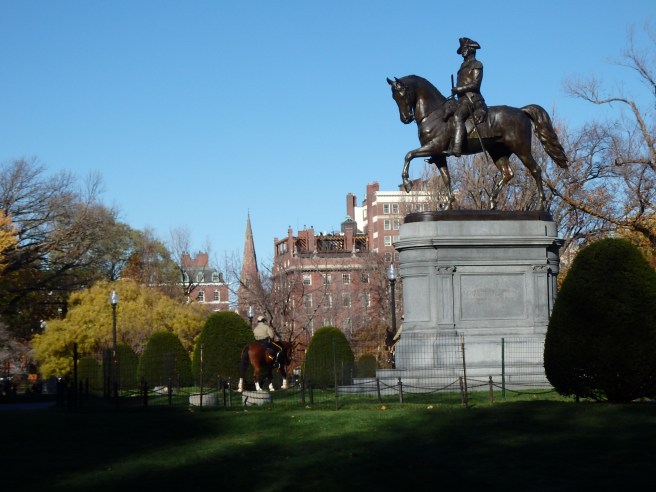
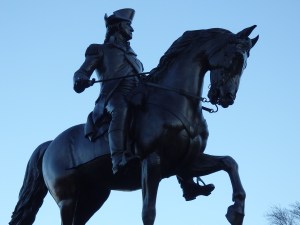
George Washington rides in full splendor at an entrance to the Public Garden. Sometimes he’s not alone, no matter how much he overshadows mere human equestrians.

Boston is a rich and varied destination – the Hub of New England, or the Universe, as they used to say. Living a little more than an hour to the north, we’re well within its orb.

The horse really adds to the impression.

THE INTERIOR SURPRISES

When the Pacific Northwest is mentioned, most people envision lush evergreen rainforests amid glacial mountains; few consider the desert that occupies most of Washington State, Oregon, and Idaho. I now explore the western end of the largely treeless expanse beginning within the Dakotas, Nebraska, Kansas, and Texas and extending almost to the Pacific Rim itself. Remember, a leafy tree requires thirty inches of rainfall a year to survive; an evergreen, somewhat less. My valley received an average of a little more than seven inches a year. Having grown up adjusting to muggy summers, I find a desert can affect my spirit in more ways than I ever would have imagined.

But you can choose, too, not to call everything by the names on maps. As geographies are being transformed ever more rapidly, few outward specifics hold long. Seek instead the vibrations of a site, sense its unseen roots and unexpressed timeless potential. In that vein, another depth appears. Perhaps each human inhabitant will go beyond basic misunderstandings. As I still hope.

Some maps are even jigsaw puzzles. And you think they’re for children?

Returning from that first trip to India, my spiritual mentor remarked that each village had felt different. “It’s more than appearances. The difference is the distinct vibration of a site. Many of their deities belong to a specific locality. One village will worship one god; another will enshrine another.” That’s how they identified the unique quality of a spot, just as Westerners have chemical elements to define physical qualities of a substance.

Even though I wasn’t quite certain of their origin or all of their psychic flavors, I sensed such subtleties. There are spiritual fingerprints certain people leave behind: a Quaker or Dunker neighborhood, for instance, may have a distinctive feel even a century after those worshipers depart. The same seems to be true for American Indian sites.

For more insights from the American Far West and Kokopelli, click here.

JUST HOW BIG IS THAT TOWN WITH THE MILLS?

When I began drafting Big Inca versus a New Pony Express Rider, I was coming off a two-year stint that had me traveling across the Northeast, including the Atlantic Seaboard from Maine through Virginia. I hunkered down in Baltimore to concentrate on a handful of major writing projects in a very intense year of self-imposed sabbatical. (No university support, if you were wondering.)

While Big Inca marked a sharp departure from my other works, moving into dark subconscious realms and mysterious meanderings, it did incorporate castoffs from some of the other projects. The prompt, though, was a vague dream of restoring landmark mills beside a river, a project that could have happened just about anywhere in the region I’d been traveling.

We think of them as textile mills, and many of them were. But the water power could be employed for just about any kind of manufacturing, as I’ve since learned, from machine-making itself to shoes to clothespins to locomotives, as well as the grain and sawmill operations I’d been introduced to on our trips to historic sites in my childhood, starting with the overshot wheel and grindstones in Carillon Park in Dayton and the reconstructed Spring Mill village in Indiana.

As a youth, I’d also owned a gorgeous volume the duPont company had published to celebrate its history, and my favorite parts were the illustrations of its early mills and supporting waterways and lands in Delaware.

So there was already a degree of romance in my thinking about the use of old-fashioned waterpower.

Then, in my first job after college, I was introduced to the ruins of cigar factories beside a dam in the Susquehanna River, a tangled patch I returned to frequently, as I describe in my set of poems, Susquehanna. Just how would the mills have looked, anyway? And how would they have shaped the adjacent neighborhood, a setting reflected in Riverside, another of my poetry collections?

My more recent employment had me calling on places like Fall River, Massachusetts, with its array of vacant stone mills, as well as towns incorporating the more common red brick versions, large and small.

Add to that mention of the entrepreneurial impact of the many mills that once stood along the Jones Falls in Baltimore itself, before the freeway wound through the sites, and I was quickly writing.

Since releasing the novel, though, I’ve been wondering about scale. Just how big a town are we dealing with? And, for that matter, how big a mill yard?

In the back of my head I’d imagined something along the lines of Binghamton, New York, a city of roughly 50,000 – large enough to move about in inconspicuously but not too big to be, well, anywhere in the corporate radar these days. Or, more accurately, the recent past when the action takes place.

That’s had me looking more closely at old mill towns, of course, and asking if this one or that could be the right setting. Security, by the way, adds another consideration – I wouldn’t want the novel’s mills sitting right downtown, as they do where I now live or in several of the neighboring towns. Somersworth, to the north, has train tracks separating its old mills from the rest of the town, and Binghamton had a freeway.

A smaller town, in contrast, might simply have too many nosy neighbors who would insist on knowing everything about a newcomer like Bill, and that wouldn’t do. Still, there are some beautiful sites for imagining as you move about.