BUT TO KNOW OTHERWISE

In this environment I encounter many birds I can’t yet identify: stellar and Clark jays in addition to magpies, much less the common raven I’d thought a crow. Meanwhile, the cardinals, warblers, and finches I knew back east are memories. Even this landscape contradicts my usual referents.

The mailman delivers a long letter from a friend who confesses that sometimes an hour passes before he puts his first word down on paper — something I’d never guess, for his lines flow so naturally. I assumed they originated effortlessly. But to know otherwise?

Don’t force it, as Kokopelli cautions. Wait for the energy to gather.

Keep the pathway clear.

For more insights from the American Far West and Kokopelli, click here.
ON THE GREAT WORKS RIVER

OLYMPUS DIGITAL CAMERA
Standing proud today …


Seen from the far side ..
Seen from the far side …


Even a small stream could be put to work.

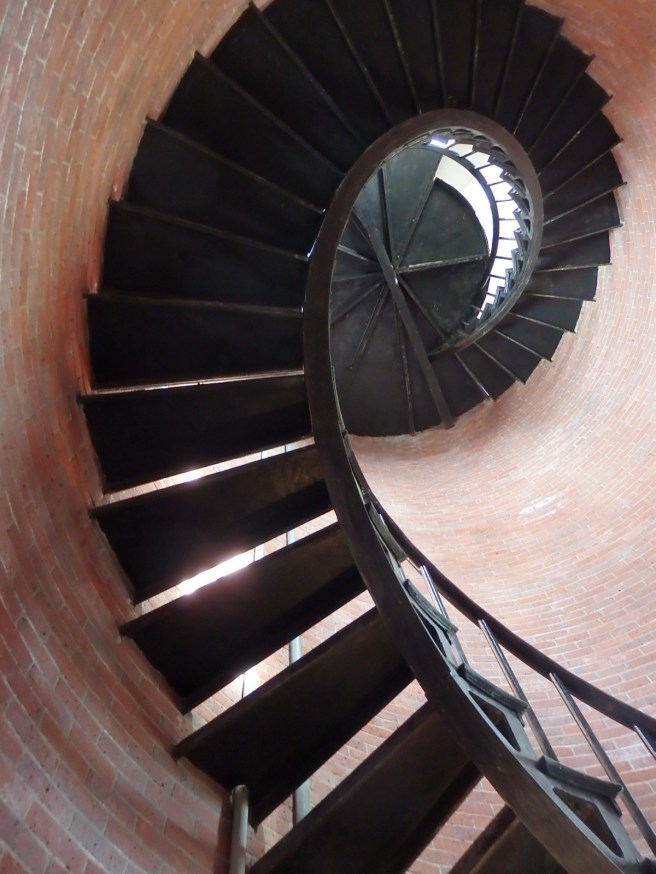
Not all of New England’s water-powered mills sat along major rivers. This woolen mill in North Berwick, Maine, was founded by Quaker William Hill, beginning in 1862, and made blankets for Union soldiers. The Great Works River itself had been named by earlier Quakers.

The mill has been renovated into residences and offices.

My fondness for old mills, by the way, did prompt a novel, Big Inca.

UPDRAFT

This is desert. And logging country, too, where the best place to find loggers is in a bar, any bar. Just listen.

“When I’m real loose, I like t’dance t’country-westron music. Out seven nights a week, then a month without any. Can’t work anyplace but woods. Done everything but hemlock. Started skidding horses in Colorado. Now driving a diesel Ford. Not much time for thinking. Slick roads, sharp corners, dumb ladies in the way.”

Here’s how it works, as Kokopelli and I play along.

“Aim a load down logging roads and then highway t’ the mills. A thirty-, fifty-mile stretch each way, four to six times a day while the CB chatters.

“Every spring when the ground’s too wet, the Forest Circus shuts ya down, the heavy equipment breaks the roads.

“That’s our vacation, three months off, taking unemployment.

“Head for Hawaii, Reno, or Vegas. There’s no money in mud. So ya take care of yard work, fix the house, prune the orchards.

“Successful loggers have expensive hobbies like race cars or airplanes. Mechanics, anyway.

“The drought will cut our pay in half. They’ll keep us out. Fire hazard.”

As they say.

Kokopelli tells me doors define a room, more than walls and roofs. Tells me to see their potential. An opportunity to spy or exit at will. Or interrupt. Doors with keys invoke power. Ownership. Think of all the doors in Versailles.

For me, the greatest freedom comes outdoors or while playing a dance with Kokopelli. Now the cat wants out.

Decisions are doors, too. Take style and size. Standardization leads toward smallness. Once, they were French-doubled or twelve-feet tall. Bronze portals to cathedrals. Red doors and oak doors. Lacy castings for an office. Frosted glass at the bank. Now they’re internationally uniform. The small millwright goes under, as well as local characteristics.

When the cat went out, my wife came in. Everybody seems to like her. But I see her other side, when she’s really destructive. I want to scream.

Instead, I blurt out, “To hell with the dark stupidity of their Christian indoctrination! Bring on wild goats! Pan pipes! My roaring conch will shake the walls of this slumber!” I have no idea what prompts that thought. Why Christian, other than the fact it’s the predominant religion in this country? Just where would a person start without any teaching? Most likely, I meant dogma, which I see repeated with only a superficial understanding. But that could apply to any faith tradition, couldn’t it? So just what am I fleeing? And what do I really hope to find?

Maybe it’s a door. Or a corridor. A cavern. A current of water. A trail. A strait gate with a narrow way.

Choose one. And then enter.

I want full awareness. Experience, rather than theory. Ecstasy, especially. For whatever reasons, I veer away from the Judeo-Christian prophetic stream and toward the shamanic traditions, wondering whether the Siberian word shaman arises from the Pali samana, for holy man. I accept the argument that meditation grew out of primitive hunting, the waiting for the game, the belief that game is supernatural, requiring supernatural aid. I must remember to thank the trapped bear, if the time comes. “Boy, do the local elk hunters have a lot to learn,” I whistle — me, who’s never gone hunting.

Kokopelli raises one arm as if he’s holding a rifle. Then, with his other hand, he pulls a trigger. I think he felled what he wanted.

“Yes, hunting antedates farming,” I whisper to no one but him. “See that, Cain and Abel!”

Maybe that’s why I’ve come so far west, just to see the sunrise.

But just as there’s light, there’s also darkness. Trust and distrust.

List the names of deities. As for a supernatural trickster, Mara or Maya seems to relate to Satan, who in turn relates to Coyote. Now for Pan!

Arcane teachings. I consider delving into palmistry, followed by astrology, Tibetan texts, more deeply into Tantra, and back through meditation. If only my paying job didn’t requiring more and more of my time, I might pick up the thread from hunting, tracking holiness through food traditions. The balance of feasting and fasting. The importance of prohibitions as strengthening the ability to say NO as well as reinforcing a group identity. “So what kind of vegetarian are you?”

Kokopelli reminds them this is desert. If it weren’t for irrigation or berry-picking trips to the high mountains, you’d starve.

For more insights from the American Far West and Kokopelli, click here.
COMMITMENT TO LIBERTY

I didn't ask the name of the reenactor, lower right. He was proud of his unit, and now stands representing all of them.
I didn’t ask the name of the reenactor, lower right. He was proud of his unit, and now stands representing all of them.

Public sculpture typically celebrates famed men or mythological figures, but the Memorial to Robert Gould Shaw Memorial and the Massachusetts 54th Regiment, which sits across from the State House, is in a league of its own.

Within its unified design, the focus turns to each of the enlisted black soldiers as they resolutely march to battle to free slaves. Every face is unique, sympathetic, tragic, and each body moves with muscle, even anger and justice. If August Saint-Gaudens had created no other work, this masterpiece would have sealed his reputation.

Each face is unique and distinctive.


The ugency and motion compressed into the relatively narrow sculpture is amazing. By the way, as the reenactor pointed out, the artist knew he was placing the canteens on the wrong side of the soldiers. It was a matter of artistic license.
The urgency and motion compressed into the relatively narrow sculpture is amazing. By the way, as the reenactor pointed out, the artist knew he was placing the canteens on the wrong side of the soldiers. It was a matter of artistic license.

Boston is a rich and varied destination – the Hub of New England, or the Universe, as they used to say. Living a little more than an hour to the north, we’re well within its orb.


OVERLOOKING THE REMAINING MILLS

In the heart of downtown ...
In the heart of downtown …
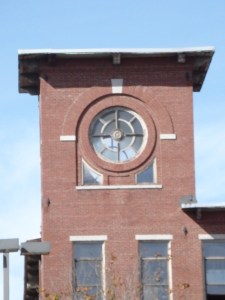
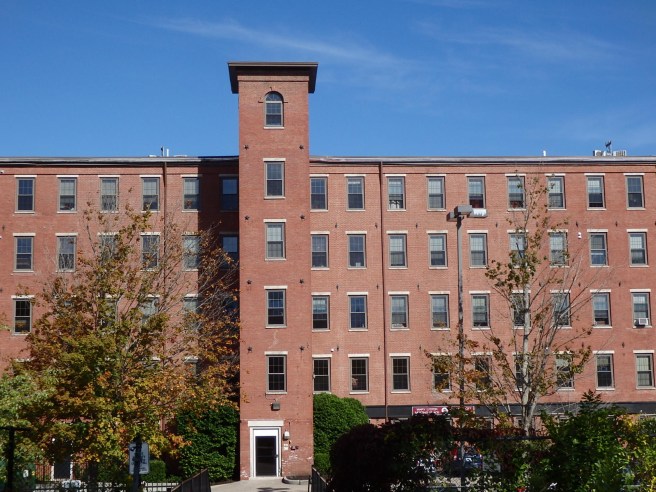
The Cocheco Millworks stretch through downtown Dover.
The Washington Mill complex picks up on the other side of the Cocheco River.

Hard as it is to imagine, Dover once had twice as many mills along the river, plus tanneries and other supporting enterprises.

My fondness for old mills, by the way, did prompt a novel, Big Inca.

LOOKING FOR WIDER CONNECTIONS

My wife, meanwhile, has her own perspective. “Many people think this valley can prosper in isolation, but let me tell you, the local museum indicates otherwise. It’s filled with Pennsylvania long rifles, Ohio flint, a New Hampshire stagecoach, antique cars from Michigan, pianos made in Indiana, Connecticut pistols, even Illinois farm implements. Everybody came from somewhere.” In her case, South Carolina.

Taking her up on the invitation to tour the exhibits, my wife paid special attention to local Indian basketry and beadwork. “Over time, their artistry was pathetically stripped down to resemble coloring books,” she told me afterward. “The gift shop sells greeting cards from Iowa and crafts from what the sales clerk said was ‘Berea, Virginia.’

“Virginia? I replied.”

“The college there.”

“Oh, you mean Kentucky!”

“‘Kentucky, then,’ she said, as if it’s all the same.”

I understand the scowl. “I notice, around here ‘Easterners’ seem to come from such ‘seaboard’ states as landlocked Nebraska, Kansas, and Illinois.”

“That’ll be news to them,” she grins. “Bet they never thought of themselves as Easterners, either!”

Infinite misunderstandings continue, tit for tat.

“Even so,” I say, “this is big sky and cowboy spreads. Even these treeless foothills ignite something in my airy nature. I hope this elation never ends.”

An elation, at least, when I’m out of the office.

I look forward to tonight’s gig with Kokopelli.

For more insights from the American Far West and Kokopelli, click here.
TOWN AND COUNTRY

Our landlord explains his own decision to relocate in the valley: “Cities embody man’s attempt to be supreme over all. You tire of the power games, the competition rather than harmony. The back country I love emphasizes what’s greater than man. There I’ll endure avalanches, sliding roadways in mountain passes, storms, grizzlies, even cougars. The city relies on institutional religion, second-hand versions of Great Spirit codified to support the System. No, that’s not for me. My back country upholds individual revelation. Wilderness raises fresh opposition against everything that binds artificially. The back country leads me closer to basic understanding. You need to accept whatever Absolute there is, whatever portion of the Mystery you can chew off at the moment. It makes me recognize how much more there always is. The city’s linear, controlled. But back country is circular, like wave motions. It’s feminine, robust and soft all at once. Its give-and-take reminds me of Emma.”

And, as I also knew, the land can be as hard and unforgiving as rock.

For more insights from the American Far West and Kokopelli, click here.
WORKING THE LATE SHIFT

Approaching thirty years of Aquarius, I consider what happens when the office finally hushes. Despite the line bells and the whine of an engraving machine in adjoining rooms, I’m the only one at a keyboard while the police dispatcher mumbles about deranged prowlers, unwanted guests, a prostitute overdosing with the hypo still in her arm (though she later claims she never uses the stuff, as they all say). Sometimes, pretending I no longer care, I sit and read as blue smoke swirls toward fluorescent tubes.

I wish Kokopelli were here, even with one of his stinky cigars. Or the pipe, the one he plays for music or the one he fills with leaf, either one.

Instead, I ponder ways this place differs from Long Pond and its Mafia hit men out of New York and Philadelphia visit to drop a corpse in icy brambles. A nearby restaurant serves poached venison year-around. Another hit happens near a stone mason’s hunting cabin above Devil’s Hole, on mountainside still fire-scarred where his father had built it like a dock. I’ve been both places. Two hits in one place out of many.

When I step outside for my dinner break, I observe a doll holding a cigarette at nose level, as if waiting for some night bird to perch. While she stares through smoke as if she desires me, I wondered how many have fallen for her tricks. I scan her hand and fingers and spot the glittering emblem. I buy a cheap cigar — for later, whether Kokopelli shows up or skips.

At heart, though, I sing for a restoration of America. A healing of fields, of fish, of human integrity, of Eden’s ideal. I want to live free in the Holy Spirit. “May we turn it,” I pray silently. Be it so!  Genuine repentance. Turning. Always turning toward what’s holy.

At breakfast, I begin: “Praise the hunger that brings us together.”

Kokopelli takes a second helping.

I meditate as befits a stone sitting in water.

I gain bearings in addition to the mountain. Some are also barriers. Nuclear reactors, to the southeast. To the north, Army maneuvers. To our west, the Indian reservation. All posted: DO NOT ENTER.

For more insights from the American Far West and Kokopelli, click here.
ALL POSTED

On the late-night swing at the office — the one my coworkers call the “presidential death watch,” standing by just in case something major develops — I wait for the product to churn. When it does, I hear once more the locomotives rolling into Union Station overhead, their rumbling through concrete walls as my grandmother returns from Detroit or Fort Wayne. It’s the same rolling thunder I hear later in Manhattan, in the pavement of Lexington Avenue, under the taxis and human footsteps. Tonight these trains roll along spider webbing.

Although I now live in desert, my office resembles offices everywhere. In the morning, chubby wheeler-dealers strut into the room and bark orders. In this case, they’re Texans clad in polyester and strings ties. More gyrating rolls spit out headlines under the ceaseless deadline.

At times I long for an appointment as serene as a winter pond. Make an offer. The owners want more. They grin and demand, boy. Watch the shit.

I ask Kokopelli, “Why do people avoid bare truth? What virtue is found in complication? Why can’t I simply stick to the steps of the Way? How much opportunity slips away when entanglements dim my view of my Guide? What will be my first big break? Or three?”

“How the hell should I know,” he grins.

He knows, all right. No doubt about it.

~*~

When I arrive home, she greets me with a mischievous grin: “I’ve only lied once or twice in my life and this is the third time. Welcome to the split-pea patch of my existence.”

For more insights from the American Far West and Kokopelli, click here.
LOOKING FOR THE ORIGINS OF A MEDITATIVE PRACTICE

One of my ongoing questions about Quaker practice is just how early Friends came to discover – or rediscover – a form of meditative practice while so far removed from Asian spiritual traditions.

Early Quaker worship, let’s be certain, was often quite different from the silence-based hour many contemporary Friends claim. Women and children, especially, often released emotional torrents in the gathered assembly – and a decade or two later, in response and en route to something more respectable, many hours of worship were filled by a recognized minister filling most of the time with his own message. (Or, possibly, her.) As Douglas Gwyn remarks in Seekers Found: Atonement in Early Quaker Experience: “These ministers then proceeded to speak almost the length of the meeting …” Even the controversial Elias Hicks, in the early 1800s, could be counted on to deliver vocal ministry lasting 20 to 30 minutes, a detail that would shock many today who insist, as many of the Hicksites would, that a vocal message be brief and pithy.

And so I was startled to hear Douglas Gwyn note another possibility for our traditional silence or open worship:

On another level, it is also intriguing to speculate whether the Quaker movement represented a resurgence of the old Celtic Christian tradition in the North. Celtic Christian emphases upon the indwelling of Christ, the inclusion of all creation in God’s redemptive work, the spiritual authority of women, and the cross as real personal triumph through suffering – all these themes found conspicuous expression in the Quaker movement. Although they were filtered through the thought-forms of Reformation, they still constituted a strong counterpoint to the dominant Puritan message. … in the backwater of the English Reformation, this very old, isolated stream of Western Christianity would have continued as an undercurrent in the faith of country folk. … As he [George Fox] moved westward into Westmorland, Cumberland, and northern Lancashire, where the movement exploded in 1652, he entered the largest area of vestigial Celtic tradition in England.

Hints of the dimensions of the earlier Celtic Christianity can be found in Thomas Cahill’s epic 1995 How the Irish Saved Civilization: The Untold Story of Ireland’s Heroic Role From the Fall of Rome to the Rise of Medieval Europe, where he follows a strand of Christianity that was suppressed after the historic confrontations with Roman authorities in the late 600s on the English holy island of Lindisfarne in Northumberland. Quite simply, Roman Catholicism might have taken a much different direction than it has.

Did Celtic Christianity include meditative practices like those we find in yoga or Zen Buddhism? We can only speculate.

Still, as Gwyn remarks of the early Quaker movement nearly a millennium after the Lindisfarne controversies, it was while traveling through Cumberland that John

Burnyeat observes that they still did not know “true striving,” which is “out of self,” “standing still out of our own thoughts, willings, and runnings.” But other Quaker ministers came through the area and guided them “in what to wait, and how to stand still.” Evidently, there was some degree of technique to early Quaker spirituality, or at least some kind of guidance that helped refocus spiritual energies from ego-centered striving to true surrender. Slowly, “a hope began to appear in us, and we met together often, and waited to see the Salvation of God.”

That degree of technique may still be needed for many who come to Friends meetings, not knowing how to center into the silence, especially in today’s media-saturated overload.

Were these Quaker ministers thus reviving something that was already in the peoples’ bones? It makes for some interesting speculation.  The fact is that in today’s society, many of us need some help learning to sit still and enter a holy silence.

~*~

More of my own reflections on alternative Christianity are found at Religion Turned Upside Down. Feel free to take a look.