WORKING THE LATE SHIFT

Approaching thirty years of Aquarius, I consider what happens when the office finally hushes. Despite the line bells and the whine of an engraving machine in adjoining rooms, I’m the only one at a keyboard while the police dispatcher mumbles about deranged prowlers, unwanted guests, a prostitute overdosing with the hypo still in her arm (though she later claims she never uses the stuff, as they all say). Sometimes, pretending I no longer care, I sit and read as blue smoke swirls toward fluorescent tubes.

I wish Kokopelli were here, even with one of his stinky cigars. Or the pipe, the one he plays for music or the one he fills with leaf, either one.

Instead, I ponder ways this place differs from Long Pond and its Mafia hit men out of New York and Philadelphia visit to drop a corpse in icy brambles. A nearby restaurant serves poached venison year-around. Another hit happens near a stone mason’s hunting cabin above Devil’s Hole, on mountainside still fire-scarred where his father had built it like a dock. I’ve been both places. Two hits in one place out of many.

When I step outside for my dinner break, I observe a doll holding a cigarette at nose level, as if waiting for some night bird to perch. While she stares through smoke as if she desires me, I wondered how many have fallen for her tricks. I scan her hand and fingers and spot the glittering emblem. I buy a cheap cigar — for later, whether Kokopelli shows up or skips.

At heart, though, I sing for a restoration of America. A healing of fields, of fish, of human integrity, of Eden’s ideal. I want to live free in the Holy Spirit. “May we turn it,” I pray silently. Be it so!  Genuine repentance. Turning. Always turning toward what’s holy.

At breakfast, I begin: “Praise the hunger that brings us together.”

Kokopelli takes a second helping.

I meditate as befits a stone sitting in water.

I gain bearings in addition to the mountain. Some are also barriers. Nuclear reactors, to the southeast. To the north, Army maneuvers. To our west, the Indian reservation. All posted: DO NOT ENTER.

For more insights from the American Far West and Kokopelli, click here.
ALL POSTED

On the late-night swing at the office — the one my coworkers call the “presidential death watch,” standing by just in case something major develops — I wait for the product to churn. When it does, I hear once more the locomotives rolling into Union Station overhead, their rumbling through concrete walls as my grandmother returns from Detroit or Fort Wayne. It’s the same rolling thunder I hear later in Manhattan, in the pavement of Lexington Avenue, under the taxis and human footsteps. Tonight these trains roll along spider webbing.

Although I now live in desert, my office resembles offices everywhere. In the morning, chubby wheeler-dealers strut into the room and bark orders. In this case, they’re Texans clad in polyester and strings ties. More gyrating rolls spit out headlines under the ceaseless deadline.

At times I long for an appointment as serene as a winter pond. Make an offer. The owners want more. They grin and demand, boy. Watch the shit.

I ask Kokopelli, “Why do people avoid bare truth? What virtue is found in complication? Why can’t I simply stick to the steps of the Way? How much opportunity slips away when entanglements dim my view of my Guide? What will be my first big break? Or three?”

“How the hell should I know,” he grins.

He knows, all right. No doubt about it.

~*~

When I arrive home, she greets me with a mischievous grin: “I’ve only lied once or twice in my life and this is the third time. Welcome to the split-pea patch of my existence.”

For more insights from the American Far West and Kokopelli, click here.
LOOKING FOR THE ORIGINS OF A MEDITATIVE PRACTICE

One of my ongoing questions about Quaker practice is just how early Friends came to discover – or rediscover – a form of meditative practice while so far removed from Asian spiritual traditions.

Early Quaker worship, let’s be certain, was often quite different from the silence-based hour many contemporary Friends claim. Women and children, especially, often released emotional torrents in the gathered assembly – and a decade or two later, in response and en route to something more respectable, many hours of worship were filled by a recognized minister filling most of the time with his own message. (Or, possibly, her.) As Douglas Gwyn remarks in Seekers Found: Atonement in Early Quaker Experience: “These ministers then proceeded to speak almost the length of the meeting …” Even the controversial Elias Hicks, in the early 1800s, could be counted on to deliver vocal ministry lasting 20 to 30 minutes, a detail that would shock many today who insist, as many of the Hicksites would, that a vocal message be brief and pithy.

And so I was startled to hear Douglas Gwyn note another possibility for our traditional silence or open worship:

On another level, it is also intriguing to speculate whether the Quaker movement represented a resurgence of the old Celtic Christian tradition in the North. Celtic Christian emphases upon the indwelling of Christ, the inclusion of all creation in God’s redemptive work, the spiritual authority of women, and the cross as real personal triumph through suffering – all these themes found conspicuous expression in the Quaker movement. Although they were filtered through the thought-forms of Reformation, they still constituted a strong counterpoint to the dominant Puritan message. … in the backwater of the English Reformation, this very old, isolated stream of Western Christianity would have continued as an undercurrent in the faith of country folk. … As he [George Fox] moved westward into Westmorland, Cumberland, and northern Lancashire, where the movement exploded in 1652, he entered the largest area of vestigial Celtic tradition in England.

Hints of the dimensions of the earlier Celtic Christianity can be found in Thomas Cahill’s epic 1995 How the Irish Saved Civilization: The Untold Story of Ireland’s Heroic Role From the Fall of Rome to the Rise of Medieval Europe, where he follows a strand of Christianity that was suppressed after the historic confrontations with Roman authorities in the late 600s on the English holy island of Lindisfarne in Northumberland. Quite simply, Roman Catholicism might have taken a much different direction than it has.

Did Celtic Christianity include meditative practices like those we find in yoga or Zen Buddhism? We can only speculate.

Still, as Gwyn remarks of the early Quaker movement nearly a millennium after the Lindisfarne controversies, it was while traveling through Cumberland that John

Burnyeat observes that they still did not know “true striving,” which is “out of self,” “standing still out of our own thoughts, willings, and runnings.” But other Quaker ministers came through the area and guided them “in what to wait, and how to stand still.” Evidently, there was some degree of technique to early Quaker spirituality, or at least some kind of guidance that helped refocus spiritual energies from ego-centered striving to true surrender. Slowly, “a hope began to appear in us, and we met together often, and waited to see the Salvation of God.”

That degree of technique may still be needed for many who come to Friends meetings, not knowing how to center into the silence, especially in today’s media-saturated overload.

Were these Quaker ministers thus reviving something that was already in the peoples’ bones? It makes for some interesting speculation.  The fact is that in today’s society, many of us need some help learning to sit still and enter a holy silence.

~*~

More of my own reflections on alternative Christianity are found at Religion Turned Upside Down. Feel free to take a look.

POWERING MANUFACTURING

At the Slater Mill ...
At the Slater Mill …

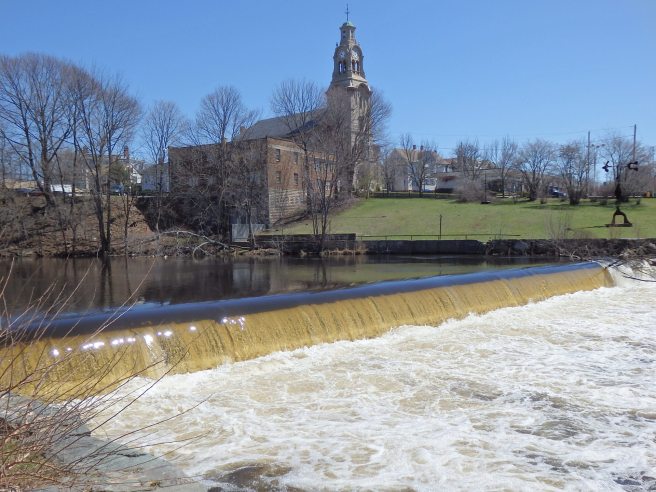
The modest Blackstone River flows through Pawtucket, Rhode Island, where it powered the birth of America’s industrial revolution.

The stream reaches to Worcester, Massachusetts, the second-largest city in New England, and once ran many factories along its way.

My fondness for old mills, by the way, did prompt a novel, Big Inca.

Just upstream ...
Just upstream …


Viewed from inside the Slater Mill ...
Viewed from inside the Slater Mill …


THE MOODIEST FEATURE

Initially, I regard the mountain as another slumber-induced fantasy. Its climax appears pristine, boundless, haughty, mesmerizing, even eerie. Over time I behold its hideousness and terror as well. Such beauty may suddenly turn fatal. Timberlands netted with trails and campsites, plus unfettered wildlife, extend from its ivory helix. These opportunities are my primary rationale for migrating to this corner of the nation. But these woodlands border desert, and none of my maps alert me to the consequences. Not even Georgia O’Keeffe’s brilliant renderings of New Mexico, artwork I long admired, hint at its harsh thirst. Rather, the paintings emerge as another kind of dream to be savored, confined to a gallery or oversized pages. Besides, my definition of desert would have required camels, or at least organ barrel cactus, neither of them found in the cheat grass and sagebrush foothills surrounding my new home and workplace.

A glacier-glad mountain resembles a foaming waterfall. It is, after all, an endlessly frozen cataract. Below it, in late spring or early summer, breastworks are laced with plummeting streams racing toward September irrigation in desert to the east. On the clearest days, Rainier’s ice sparkles; its beacon flashes sixty miles to the orchard where we dwelled. At sunset the inactive volcano’s shadow is a finger reaching toward the rising full moon. It points as well to places we’ve abandoned.

The predominant mountain is also the moodiest feature of the vista. Everything’s arrayed in reference to this pillar. To observe it over time is akin to regarding one’s beloved. Neither the zenith nor one’s honey is as immovable as one presumes. They are not the divinity. They’re more accurately repeated dreams, where some episodes fade out over the years while others intensify. Sleep visions of the soul, having one foot in the dreamer’s past and the other in the present, dance on water. Sometimes they drown. Even a mountain.

You should see the way Kokopelli makes it dance before sunrise.

For more insights from the American Far West and Kokopelli, click here.
NOW, TO LOOK MORE CLOSELY AT A TWO-EDGED SWORD

If you want to see out-and-out prejudice by people who think themselves to be open-minded, here’s a good litmus test. Raise a matter of Christianity. Or, as a woman, wear a cross necklace. Then ask if it’s the same response you’d get had you presented something from another religion.

Put another way, I’d long ago been appalled by an assumption many of us liberals took in regard to Christians – and to be candid, I was once one who was self-righteously disparaging. Quite frankly, it’s out-and-out judgmentalism that hurts our progressive causes. It’s ignorant of the important support radical faith gave to many movements through the centuries and can still give to the future. It’s a point for dialogue with our opponents, if we’re willing to engage it.

Two common assumptions spring to mind here.

The first involves intelligence. There’s more to life, let me point out, than materiality. Think of love, music, morality, for starters – people with knowledge of ways of empathy, too. Extend that, then, to a recognition that to be a person of faith does not automatically mean stupidity, even if we do see way too many examples in the public arena – not just those of the Christian label, either. Nor do Christian do not come in a one-size-defines-all homogeneity – some denominations, for instance, refuse to bear arms or participate in war as a consequence of Jesus’ command to love our neighbor, while other churches rally around the troops. The ways of thinking and the emphases vary widely, from Fundamentalists to Evangelicals (yes, there are differences there) to Pentecostals to various strands of Calvinists or Lutherans (yes, again some key differences) to various Wesleyan (Methodist) and Baptist and Anabaptist (Amish, Mennonite, Brethren, Quaker) and on to the Unitarians. And that’s just among the Protestants. Add to that the Anglicans (Episcopalians), Roman Catholics, and Eastern Orthodox and you have a very rich mix, indeed.

Within those are some very intelligent and sensitive people, along with circles of personal growth and ethical accountability.

The reality is that religion is capable of engaging our innermost motions – our hopes and fears, especially. It’s a power that can run many ways, challenging the status quo as well as establishing community. The state and the establishment have many reasons to desire to curb it, as history attests. Even at a personal level, it can be scary stuff.

Pointedly, progressive movements have sprung from this source. For centuries, up through America’s civil rights revolution, social change has grown from radical Christianity. A central thread of the Bible has been the evolution of justice and then radical peace and equality. Read it closely, and what emerges remains a challenge to the status quo. Let’s not lose it now!

As the prayer goes, “Thy kingdom come, thy will be done, on earth …”

Many of us see that as a more loving, just, and peaceful society. Mock it if you wish, but think of the alternatives. Are they really progress?

All of that, of course, leads to my second point: the so-called Christian right, of the political sort, hardly owns the mantel of Jesus. And since any religion has the potential of engaging those most soulful endeavors of human existence, we see across the spectrum instances of appealing to fear and oppression, on one side, as well as forgiveness and oneness, on the other. Religion in this dimension presents an opportunity for conversation and growth, if we allow it.

~*~

For more on radical faith, see my book, Religion Turned Upside Down.

SUMMONS AND SORROW

On scattered reservations, a few elders rise before dawn each day and summon the sun to return. Don’t scoff. When I, too, get up in the dark and meditate, I feel my own self-confidence rising. Watch the world awaken. Light a wood fire, something I sit beside and watch for hours, its flames more imaginative than television. Bask in the radiant warmth.

Kokopelli, night owl that he is, still slumbers.

My wife, in another room, rolls toward the wall and finally rises to join me.

There’s a science, and then there’s an art. In the pyre, paper first chars, then shrinks, and finally explodes. Only then do flames engulf it. “Consider the bomb a ream would create,” I grin at her.

“Now who would you want to bomb, Buzzard?”

But I also know how difficult igniting that ream would be, and how difficult to keep it burning. Watch carefully and misconceptions turn to ash.

In the continuing drought of that fall and winter, I explore national forest well into February. Areas that should be buried in a half-dozen feet of snow are instead bare. Atop one mountain, I look over a cliff. “I think it’s dolomite.” Maybe it isn’t. Maybe the identification isn’t earth-shaking important, but learning the names of places and their minerals, fauna, and flora adds dimensions to a place. Improves your chances of survival, too, if put to the test. For now, I scramble on the scree and realize that white painted stones at the cliff’s edge marked out a heliport. Far below my feet, a table of forest spreads into basins that are invisible from my vantage, and other places I’ve already been. I trace Forest Service roads, such as they are — 1707 from Raganunda to the top or 601 down to Willy Dick’s. “Keep elk gate closed,” the sign reads when I came out, passing a few back country ranches to the highway’s rush and debris. Far above all that, I sing out: “God bless a bloody rib cage above gray fuzz. Perhaps we’ll have rain in the morning! We shouldn’t be kicking this dust.”

In a zero-degree fog, the sun rises as white as the moon.

“Let our liquid flow again despite this desiccation!” I cry in my dreams. “Why is it so difficult to recall the thoughts rainstorms instilled?”

“You put too much value on sorrow,” Kokopelli tells me. Even in my sleep, that old guide’s still at work.

For more insights from the American Far West and Kokopelli, click here.
SPIRE OF INSPIRATION

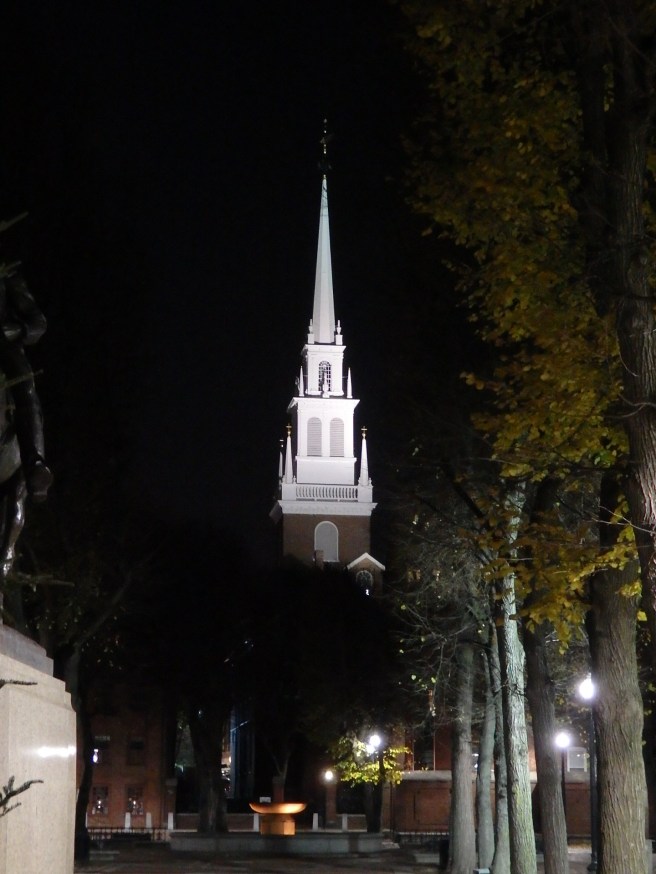
Old North Church, in Boston's North End.
Old North Church, in Boston’s North End.

Lanterns in the spire of North Church signaled directions to Paul Revere and other riders at the outbreak of the American Revolution. The race to Lexington and Concord was on.

Boston is a rich and varied destination – the Hub of New England, or the Universe, as they used to say. Living a little more than an hour to the north, we’re well within its orb.


STANDING BESIDE THE PROUD MERRIMACK

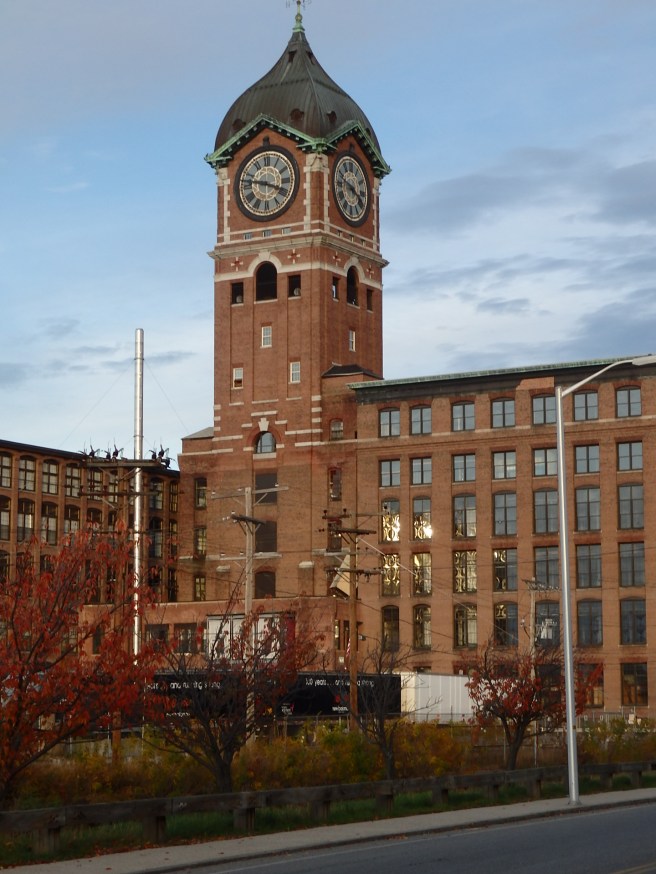
The clock tower of the Ayer Mill in Lawrence, Massachusetts, overlooks the Merrimack River on the other side of the wing to the left. It's an impressive sight.
The clock tower of the Ayer Mill in Lawrence, Massachusetts, overlooks the Merrimack River on the other side of the wing to the left. It’s an impressive sight.

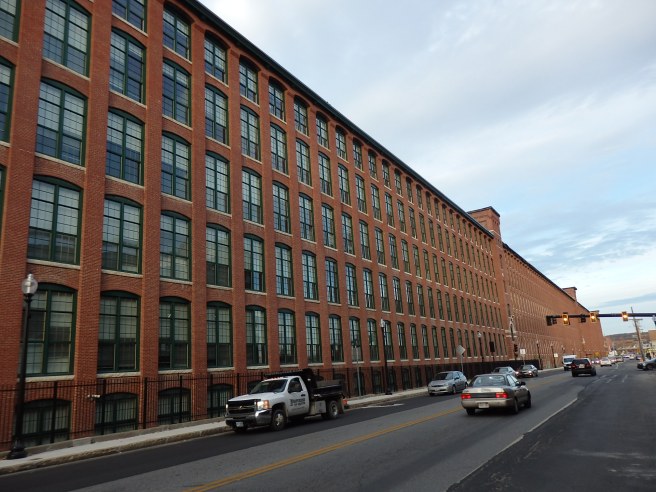
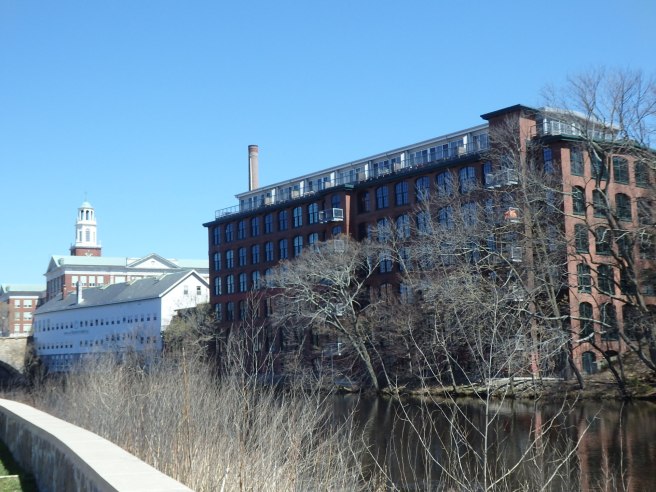
While water-powered mills sprang up all across New England, thanks to its abundance of falling waters, the riverbanks of some locations became jammed with factories that employed thousands. The Merrimack River, for instance, had major industrial clusters at Manchester and Nashua, New Hampshire, and Lowell and Lawrence, Massachusetts, all relying on the use and reuse of the same water carefully shepherded downstream.

Many of those landmark buildings have been lost over time – fire, neglect, and urban renewal have taken their toll – but those that remain can be truly impressive, especially now that they’re being repurposed and renovated into charming, flexible centers of entrepreneurial innovation and center-city living.

Lawrence, with what was once the biggest dam in the world, is a prime example.

Hard as it is to imagine, this group of mills was once dwarfed by those on the other side of the Merrimack River as it rolled through Lawrence, Massachusetts.

HIGH VICTORIAN

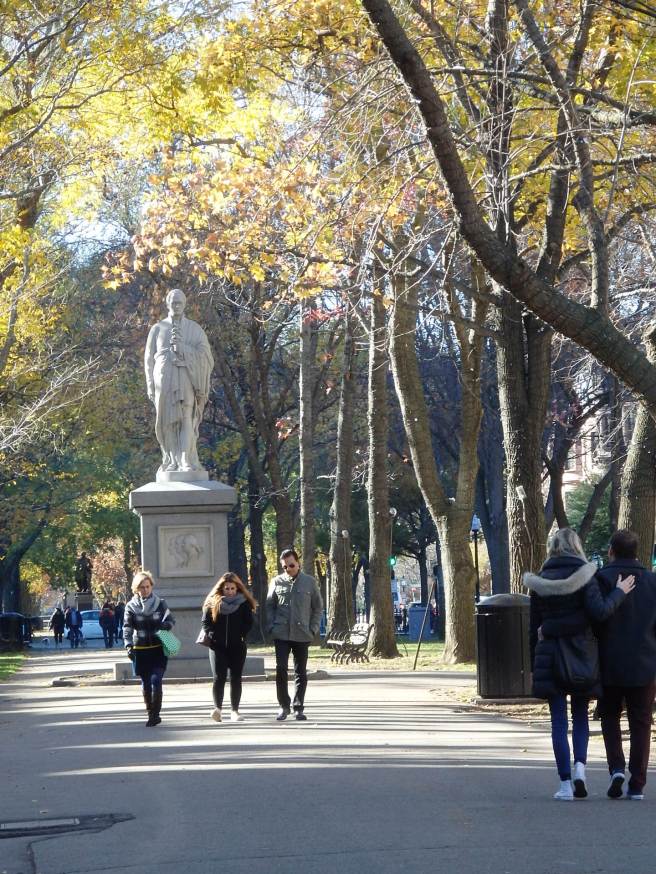
Strolling through the neighborhood.

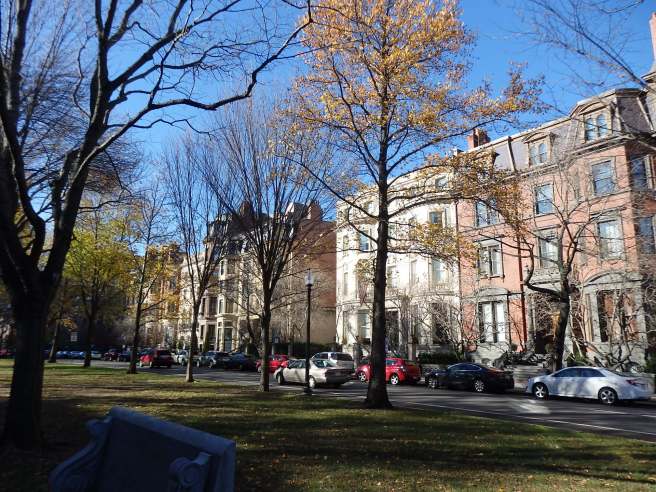
Boston’s Back Bay boulevards reflect the rising wealth of the city in the aftermath of the Civil War.

Boston is a rich and varied destination – the Hub of New England, or the Universe, as they used to say. Living a little more than an hour to the north, we’re well within its orb.

Boulevards lined with housing like this.