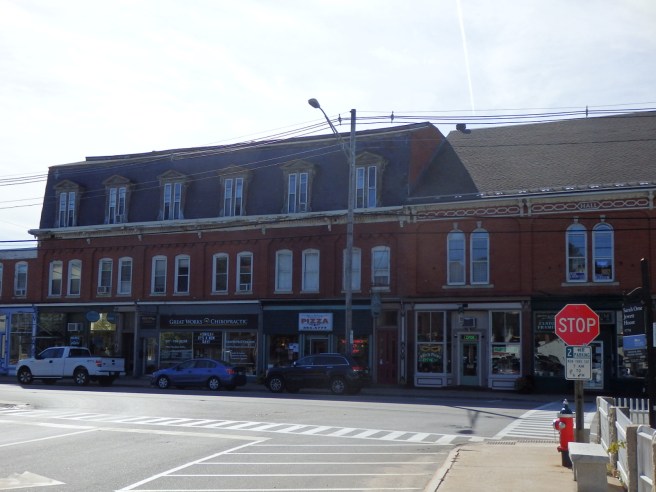
South Berwick, just across the Salmon River from us, has a downtown block that retains an iconic appearance. The town is also home to Berwick Academy, a private prep school.
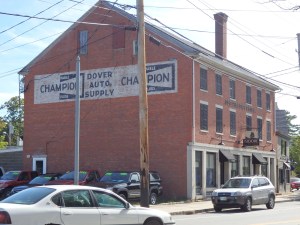
You never know what we'll churn up in cleaning a stall
South Berwick, just across the Salmon River from us, has a downtown block that retains an iconic appearance. The town is also home to Berwick Academy, a private prep school.
When you drive, details pile up.
Where mat-house villages once stood, Highway 21 now runs along a large irrigation canal. Because the roadway goes nearly straight, a few subtle curves become especially treacherous.
Illegal aliens buy cars but have no driver’s license or training. No insurance, either. There’s a headlamp out, few repairs, or brakes gone bad. Talk about trouble.
In the dark, a big white furry wing sweeps in front of my windshield. An owl. An omen, nearly colliding. It’s hard to say who’s more startled.
It might have told me the Pom Pom or feather religion, Washat, remains the most practiced old religion on the reservation.
Kokopelli was a member.
Twenty cars park in a hollow point toward what appears to be a white frame meetinghouse. Inside is a congregation of dove hunters.
There isn’t a cloud in the sky, only one jet contrail as crows circle some relentless screeching. As they flap up, slaughter moves out of the shadows and coyote pursue the only antelope in these parts, the ones on the Army reservation.
On the bright side, the State Fair is a three-hundred-pound pumpkin multiplied. Its doe-goats are judged by measuring and weighing their teats in a beauty pageant stripped to essentials.
Back home, her moodiness could be impossible.
Downtown, about nine at night, a wino-cowboy walks into the office. “Where’s the city desk?” He has no place to stay. “It’s a long story.” A quarter in his pocket, stub of a cigarette, and scabies — mites that are highly contagious. “I don’t want to spread them the way some bastard did to me.” So he went to the hospital from the Gospel Mission, received medicine (how’d he know to do all this?). Didn’t get back in. (“He refused to stay for the service,” they explained.) Angry, turns to ask: “Where does a stranger go for help in this town?”
How should I know? I’m just filling in for somebody else.
“Well, if anybody whizzes you,” the stranger says, “it was a matter of amphetamines. Maybe you heard about ‘The Duke’ in Traders? The trial dismissed on procedural grounds?”
He buried $67,000, but when he returned, the money was gone. So he says, far too articulate for the typical migrant.
Later, Kokopelli tells me that guy’s trouble.
Details pile up as I stay downtown at night and taste the psychic toll of economic theories in wasted, untapped talents. The stench stirs tears. Lonely men at counters stretch cups. Icy evenings of waitresses, cowboys, GIs, prostitutes drive from many towns, a migrant worker family whose car broke down, out-of-work loggers, midnight mechanics and nurses. Add to them an assortment of skinny wannabe rich bitches or real estate and insurance brokers. Clerks trying to live on earnings from clothing stores. A few lumpy bag ladies. Walk in, and all look up from their coffee with vacant eyes. It could be Dickens.
I see another hunger, but my own faith isn’t strong enough — I’d yield to despair.
Later, I sing to Kokopelli, “All of man’s good resolutions turn sang froid in the seasons of samsara.” Noticing his quizzed expression, I translate: “Our good intentions turn cold-blooded in the web of life’s illusions.”
It’s the spider again. Coyote’s cousin. Their damned net.
“Sometimes, Bozo, I wonder about you,” Kokopelli says, exhaling blue curlicues.
“There’s no Dedicated Laborious Quest, no magic without the strength of sitting or dancing.”
I dare not be entrapped in any desire to move freely through the vertical and horizontal dimensions of wherever I simply am. So far I’ve surveyed past and present. The future must wait. First, I need to map the emotional and sensual planes of this realm. Every dance has distinctive rhythms and expressions, as Kokopelli reminds me.
For more insights from the American Far West and Kokopelli, click here.
I’m invited to photograph an Indian funeral for a 109-year-old woman. It’s a traditional affair, with a Pendleton trapper’s blanket on a casket lowered by hand. Even so, young punks surround me: “Don’t you think you’re crazy,” they ask, implying?
I look around for Kokopelli, who might intercede on my behalf. He’s nowhere in sight.
Later, with a Styrofoam cross and dozens of American flags, the casket rides the back of a pickup, viewed by faces in Cool-Ray sunglasses — ancient traditions side-by-side with the cheapest, most honky-tonk trinkets of the New American Way.
I wasn’t permitted to enter the house, either.
For more insights from the American Far West and Kokopelli, click here.
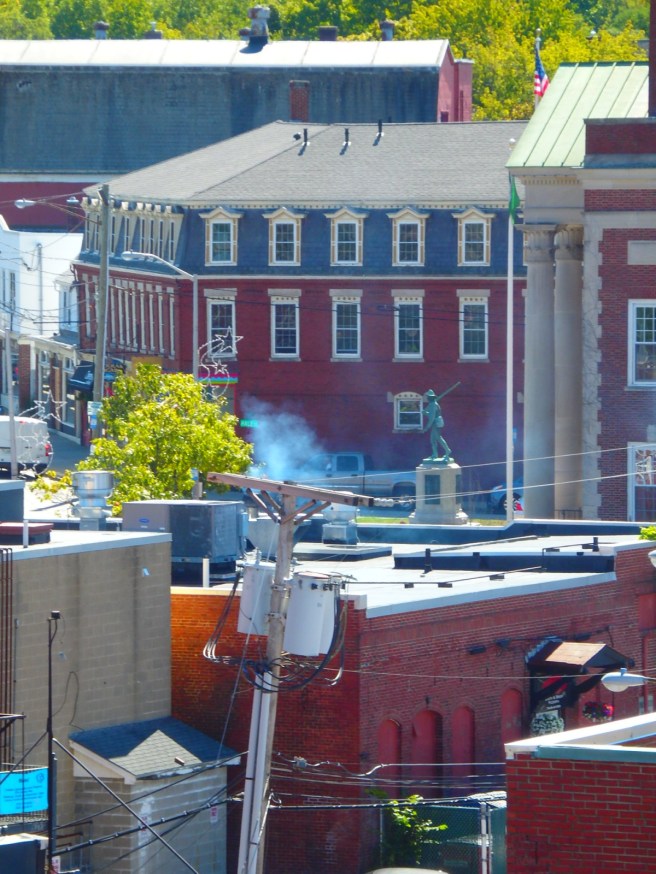
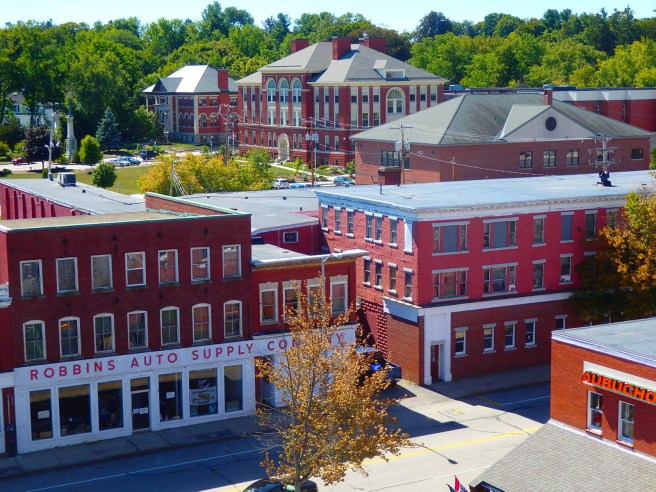
Here’s a bit of scale for the town I call home.
On one of my solitary walks with Kokopelli, I admire the fullness of purple-tipped grasses along the canal bank. Some offer bunched, short seeds in clusters. Others have long-shafted seeds in plumes. Or oblong, spiked seeds suspended like bells. “There must be a thousand golden variations,” I tell him. Oats. Wheat. Barley. Bread and beer. Silk-enshrouded ears of corn for sweet butter. Fat tender steaks. Sour whiskey mash. Like some people I knew. The many named needles and strands of whips and brushes reach skyward, flaying the wind, inviting birds to flight.
For more insights from the American Far West and Kokopelli, click here.
Instead, I looked in another direction and discovered that the Yakama people once occupied 17,000 square miles and had three distinct language stocks. So, even back then one tongue was insufficient to articulate the vibrations of this place, even as an open desert. To try relating the qualities of a simple thing, a pane of hundred-year-old glass, perhaps; the interaction of clouds and sun, alkali and volcanic ash is far more complex. You start by learning the names of flora and fauna. Watch, listen, wait. I open a window and consider the current research, which places the first people here about 14,000 years before my arrival. These nomads made tools from bone and mineral. Hunted large and small game. Fished salmon. Collected river mussels. Gathered wild food plants. Given a guide and sufficient time, maybe I could learn to do these things. (Don’t look at me, Kokopelli shrugs. I’m not from around here.) Maybe I shouldn’t feel so strange about being here, either, even though such long perspective makes me feel incredibly insignificant. The Anglo civilization embodied here is only veneer concealing much deeper systems. The ancient climate was cooler and moister. The land was dotted by many lakes and small streams. Grasslands scattered with pine stands and willow flourished where there’s only sagebrush now. Food sources included bison, antelope, deer, foxes, muskrats, rabbits, ducks and geese (their eggs, too), and turtles.
I want to leap through time to join them, dressing the hides of their game, or making rattles and tools. These people used red and yellow pigments, and valued birds for their feathers as well as their flesh — cormorants, geese, condors, turkey vultures, and eagles all had clothing functions. Maybe I need some ceremonial garb. (Come, now! Kokopelli is hooting with laughter. He loves to taunt and mock me.) Tiny bone needles were used as far back as 10,000 years. I have enough trouble with steel needles today. So what do I make of their earliest burials, cremations that send the body back into spirit?
It’s obvious my own difficulties won’t end overnight.
This is a time of sparrows.
For more insights from the American Far West and Kokopelli, click here.
A wolf is powerful because it eats powerful food, Kokopelli warns me.
As for the girl-chasing man who’s always hungry, it’s “hair-pie,” he grins.
Although I’ve never hunted, I see points at which ancient traditions lurk within modern religious practices. Meditation, high among them, has roots in hunting and gathering. Then, too, there’s the role organized sportsmen have performed in restoring populations of wildlife, and you can learn much from hunters eminently adept at reading animals’ ways in the field. Keep an eye open.
Natures change slowly. The hunt on land and the water has barely begun.
There’s great game beyond food. Much of it, Kokopelli sings, runs through your brain.
For more insights from the American Far West and Kokopelli, click here.
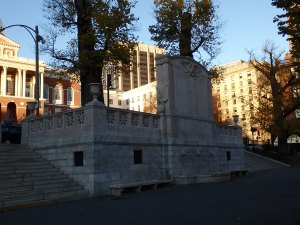
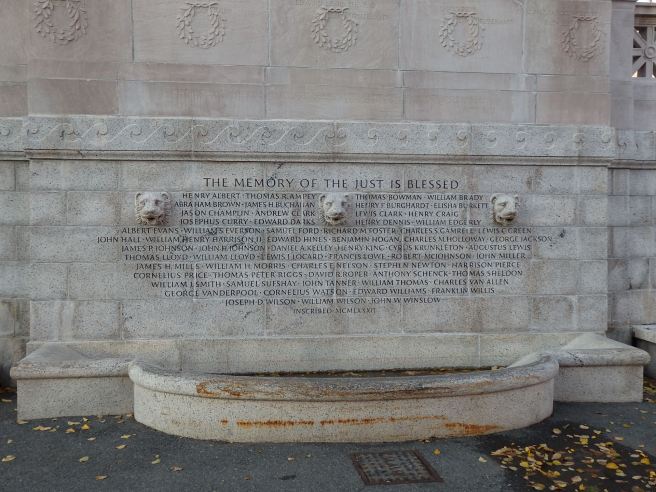
The rear of the stone structure supporting the Memorial to Robert Gould Shaw Memorial and the Massachusetts 54th Regiment is worth a close examination in its own right. Engraved here are the names of the soldiers, most of them from humble beginnings and circumstances, who would otherwise be lost to history if not for their heroic service and sacrifice.
Boston is a rich and varied destination – the Hub of New England, or the Universe, as they used to say. Living a little more than an hour to the north, we’re well within its orb.
Regular visitors to the Barn are aware of my interest in radical thought, especially of the religious variety. It’s not just Quaker, either, or related Anabaptists like the Mennonites, Brethren (including my Dunker ancestry), or Amish. No, it ranges across Biblical times, First Americans, and Asian traditions, too. Just think of the yoga, Zen, and Tibetan Buddhism, for perspective.
Well, a footnote in Douglas Gwyn’s Seekers Found: Atonement in Early Quaker Experience has made me stare in wonder. It’s a great title, to be frank: The Baptists: Fount of All Heresy, a 1984 essay by J.F. McGregor.
Look, anyone familiar with Christian history knows that accusations of heresy go way back to the earliest days of the church, and for that matter, the concept can be found in Judaism and Islam, the other faiths arising from the Book. Those in other traditions can weigh as they wish.
My point, of course, is that heresy way outdates the 1640s of McGregor’s focus. The Inquisition itself would need to be considered, along with all of its victims.
Still, his provocative title has merit, apart from any argument he develops.
A reading of John M. Barry’s Roger Williams and the Creation of the American Soul: Church, State, and the Birth of Liberty, examining the life and influence of the founder of the first Baptist church in America – events in the 1630s – could place Williams as the fount of heresy in New England. Of course, there are others who could be added to the list. The name of Hansard Knollys has popped up again, a minister who came to Dover in the 1630s after troubles in Massachusetts and then returned to England as a prominent figure in the emerging Particular Baptists there, not that I’d call him the fount, but hey, he may have plowed the ground here for Quakers a few decades later.
This really can get arcane, can’t it.
~*~
More of my own reflections on alternative Christianity are found at Religion Turned Upside Down.
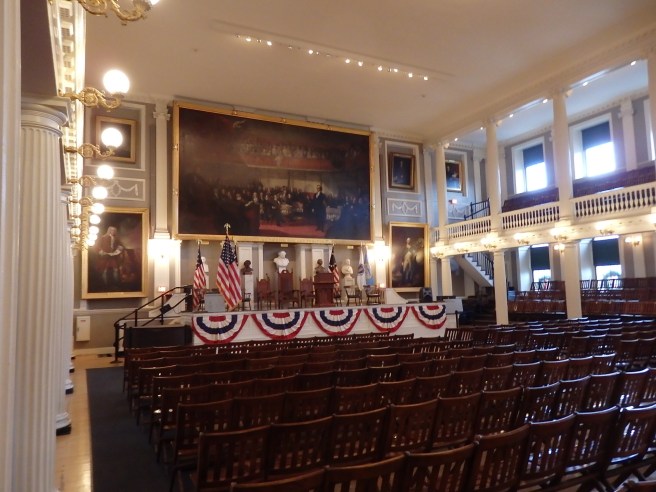
Maybe it’s all a reflection of classic proportions, but so much in Peter Faneuil’s historic town hall and marketplace simply feels right ever since it was erected in 1742 and enlarged in 1805 under Charles Bulfinch’s masterful design.
Boston is a rich and varied destination – the Hub of New England, or the Universe, as they used to say. Living a little more than an hour to the north, we’re well within its orb.

 Jnana's Red Barn