ROUND AND ROUND ANEW

I awaken with indigo skin. Sparrows hop about on my mattress. I vaguely recall a plunging star followed by blindness. In that sleep, a voice spoke in primary colors and related a saga oozing blood between brown feathers. I followed her in a procession toward the origin. She pointed out a killer whale, a shaman’s folded robes, a raven’s halo, a falcon spitting fog, a cluster of warthogs, a gathering of peacocks and white llamas, the roots of a great-grandfather’s moustache. As we ascended from a swampy trail of frogs, birds, cobwebs, sunning turtles, and lizards, we skirted the foot of a smoldering volcano. Off in the other direction in emerald water, an island burned. She, however, had other plans. Wild goats ran from our approach. Soon we braved auto glare, road owls, iron bridges. Spinning me back to my Midwestern sources, she demonstrated how thin the thread of perception remains. Spider-thin, in fact. She showed me I’m one animal at one time and in one location, but when those factors change, I become another. Only the soul is constant. When she held a mirror before me, there was no reflection. When I asked her name, she smiled coyly. “You’ll find it written in the desert.”

Each time you acknowledge the distractions that keep you from dancing freely, turn back toward the melody and the rhythm. Turning, I knew, was repenting. Turning and returning, in the music I danced and played. My partner there has always been faithful.

For more insights from the American Far West and Kokopelli, click here.

TO SPEAK FROM INWARD ENCOUNTER

One of the phrases early Quakers used to identify the movement, before settling formally on the Society of Friends or its more recent expansion as the Religious Society of Friends, has long baffled me.

Their use of First Publishers of Truth, drawing on an older meaning of publish as proclaiming or announcing rather than our familiar sense today of printing, simply left me puzzled. It even struck me as arrogant. After all, the Samaritan woman at the well (John 4:4-28) could be considered the first, as well as the disciples and others who witnessed the miracles and heard the teachings.

More recently, though, I encountered two messages in worship regarding the disciple known as “doubting” Thomas and these had me rethinking the importance of first-hand experience in religious matters. (The first message, rising in the silence of traditional Quaker worship, was followed a week later in the homily of the Greek Orthodox liturgy. Coincidence, I figured I needed to take a second look at the passage.)

What I now see is the fact that Thomas was not content to take the Resurrection on hearsay accounts. People can, after all, be deluded, even self-deluded. His brash retort could then well be something I might utter, or more likely want to voice, in a similar setting. Why shouldn’t this circle be hysterical?

What happens, though, is a first-hand experience of the risen Jesus, who then remarks that not everyone will have a face-to-face encounter like this but still believe.

Based on what? My take now is that it would be grounded in their own first-hand experience, in whatever form, rather than tales based on others.

Those early Quakers could point people to submission to the Light or the opening of the Seed or a confrontation with Truth, all in the face of intense persecution. Powerfully, they were speaking from their own experiences, when their lives were transformed.

~*~

For more regarding faithful practice, see my Religion Turned Upside Down observations.

THE DRIVING FORCE IN THE MESSAGE

For much of its existence, the Society of Friends has embodied a peaceful, respectable, even restrained way of life. Not so the earliest decades, when the economy, political structure, religion, communities, and families throughout Britain were all in chaotic upheaval. As Quakers emerged in the tumult, they coalesced many of the more radical elements as movement after movement broke up under the pressures and changing conditions.

As many observers have noted, the early Quaker message was that this was a time of apocalypse – the ultimate victory of good over evil was at hand, making way for the Second Coming of Christ. In battles of such magnitude, which Douglas Gwyn repeatedly views as a Quaker pentecost of the 1650s, there was no place for reserve – boldness came to the fore. And then, when the openings of revolution closed up again, resulting in the Restoration of the monarchy, Friends were forced to bank their fires.

Continue reading “THE DRIVING FORCE IN THE MESSAGE”

LEAVING THE POINTS OF REFERENCE

To step into desert far enough you no longer see cars or houses brings a break with convention. Returning from one exploration with Kokopelli, I view the town as a mound of pea pods. Next, it becomes peanuts (which aren’t raised in these parts). Eventually, as packages of Grape-Nut Flakes — each building containing bodies, nothing more. Entire cities appear as collections of books identical to a room of cardboard boxes. Every abode duplicates a television set. I know this isn’t how people should be living. This isn’t freedom. This isn’t personality. We have our work cut out, don’t we? If Kokopelli hadn’t come this way earlier, I might have feared for my sanity. Instead, I know the brain’s a weird instrument and let it go at that.

Imagine undertaking a trip where there are no road signs, no maps, no pages of text. You have no way of knowing how far to the next town, gas station, restaurant, motel, or campground. Ask people and hope they know. With utter sincerity, half of them give bogus information. The other half lie. Without a guide, all the books you’ve read can’t possibly help find the marker, YOU ARE HERE. Your teacher embodies map, compass, path, and highway. If you have the genuine article, it’s better than an Interstate speedway. If it’s false, watch out. I wished my own were closer. I was running on memories. As my Teacher said, “When you think I-I-I, you’re a smoky fire blowing every which way. No I, no me, no my attachment means there’s no smoke, just a good hot flame burning clearly.” For me, this meant breaking out of my own shell. Would I have wings or claws? I hadn’t considered the spider.

At least I have Kokopelli, on occasion. Most of the time.

In this desert, I seek to unearth the hidden meanings of place. I return to a chart of Aboriginal names and translations, and substituted these for the Geological Survey’s designations. The mountain once known as Komo Kulshan is STEEP. That’s how it is when GOING FOR CLIMAX in the spiritual quest. You must keep asking, “What can I do WHERE I AM?” The answer? “Take another step dancing with your beloved.”

For more insights from the American Far West and Kokopelli, click here.

APPRECIATING WHAT’S FUNDAMENTAL, EVEN PRIMITIVE

Throughout history, people have turned to pilgrimages, monastic retreats, or fasting as pauses in their daily customs — opportunities to reflect fully on immortal objectives before returning to everyday demands. Modern versions include vacations, travel, and outdoor pursuits such as camping — typically without the dimension of worship. Whatever the form, people return home with renewed appreciation. Maybe my wife’s trip on the bus held an element of this; perhaps it was just an escape.

The desert is similar. It’s made me recognize fundamental, even primitive, life requirements clearly, as though chiseled by flint instruments. Like the multitude of crickets chirping in the garden, much we take for granted — rain, clouds, family, especially — now magnify in consciousness. I could lay out some generalized principles and then form a big picture.

Tell me, then, Kokopelli insists. So I do.

Begin, for instance, with a line found on few maps, one that nevertheless defines the United States as much as the Appalachian mountains, Mississippi River, or Mason-Dixon Line do: to its west, less than thirty inches of rain falls in an average year. Because they require at least thirty inches of rainfall a year, leafy trees never extended across the Great Plains or Far West, except along streams or in pockets settlers planted and irrigate. The line drops across the map like a spider’s exploratory filament, a perpendicular sheen from a ceiling. The Dakotas, Nebraska, Kansas, Oklahoma, and Texas are cleaved. Further west, forests return near mountains, which generate their own weather patterns. Snowfall and rain, in part, explain the conifers of Western forest. Explain, too, the smell of open air, crackle of fire, proliferation of wrinkles in neighbors’ cheeks and foreheads. More lines can be drawn, leading to some web: the treeless expanse, for instance, between the Rockies and the Cascade or Sierra Nevada ranges.

Within the treeless expanse are other circles, other webs. Take center-pivot irrigation, patented in 1952, and count how many mile-wide green circles it’s spun across the Western landscape, each one requiring the electrical power of a city of ten thousand and a reliable source of water, generally fossilized or snowmelt. Back east I had rarely considered such matters. A drought meant no rain in several weeks. Dew was dependable. I knew about farmers, not cowboys. Grass was thick and green rather than sparse and dun. Summer air heavy with humidity made the sky milky rather than this piercing blue. On the westward journey, I barely noticed how loam is a table tilting to sky until we ran up against the forbidding wall of the Rocky Mountains. Now I measure summer nights that plunge fifty degrees, yet desert thermometer readings don’t compare with the comfort and discomfort known elsewhere. Thirty or sixty days without clouds oppress me as much as continuous rain would. I need new prayers. New magic, too.

For more insights from the American Far West and Kokopelli, click here.

SOMERSWORTH MILLS

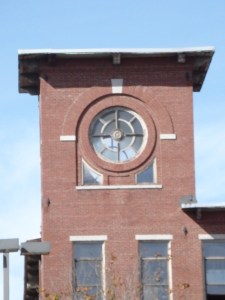
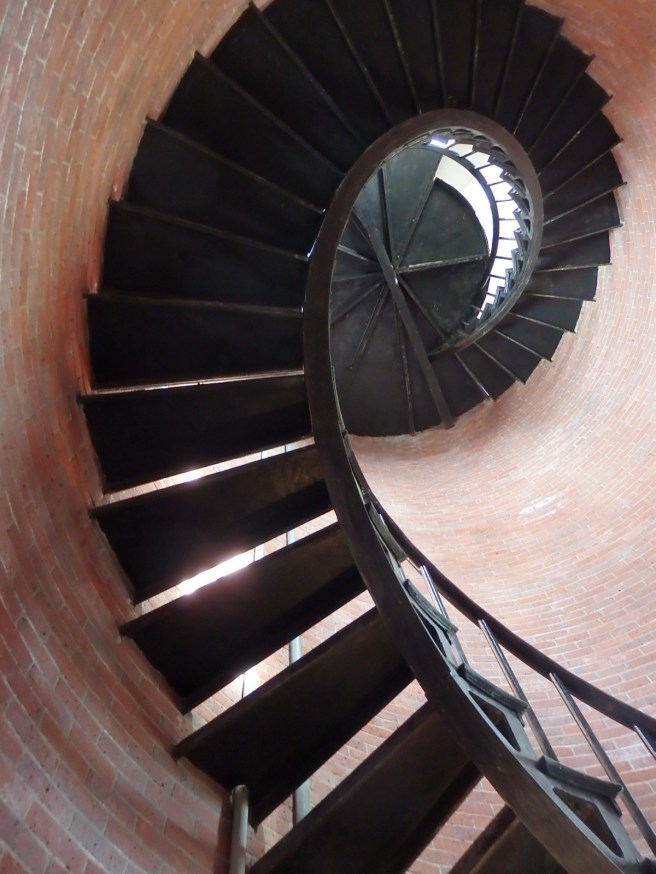
I still imagine living in a tower like this.
I still imagine living in a tower like this. The round window remains distinctive.


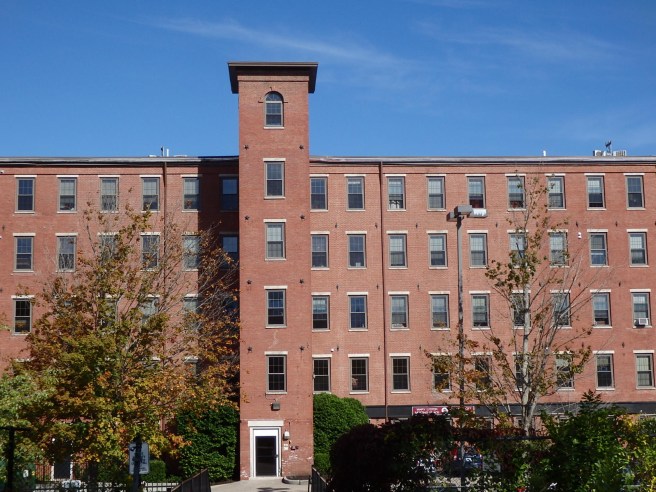
Right along the river.


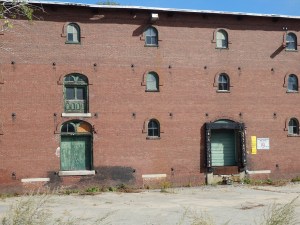
Restoration remains to be done.

The Great Falls once gave their name to the New Hampshire community also known as Summer’s Worth, now shortened into Somersworth. This being New England, the water itself was once put to work in the mills.

My fondness for old mills, by the way, did prompt a novel, Big Inca.

TURNING, RETURNING

My cultivated exercise of substance and spirit, my Dedicated Laborious Quest, is an interplay of natures — my own character and communities and varied ecosystems as they ultimately feed into our universe. As they harmonize, intuition leaps and skips; intellect dances with the heart. Emotions and each individual’s senses potentially humanize a fertile terrain rather than snagging within wildness. Wilderness, meanwhile, represents another order. In its sacred opportunities, the field of endeavor itself, whatever its name or specific form, becomes secondary to the abundance being disclosed around and within each practitioner. Indeed, many who participate and even excel in some activity where the D.L.Q. begins to appear — be it a gymnasium or playing field, a studio or stage, a laboratory or workshop — remain oblivious to the gateway my spiritual brothers and sisters and I have entered. When I meet a celebrated mountaineer who perceives icy heights, it turns out, the way a trucker regards a highway, I’m disappointed he failed to become a mystic seeking cosmic oneness. Accomplishment that’s solely technical remains devoid of unity. No, I’ve already learned that birds along the way are not just birds; my Teacher’s gardens nourish more than a stomach. In a circle of heavenly order as well as disintegrating debris, Kokopelli and I prepare a clearing and settle for the night. Observe planetary and lunar motions. Greet the sunrise. All natural phenomena give birth in an opening, should you find it. Likewise, locating a personal opening, an enclosed space within a universe, can bring recovery, renewal, healing, and salvation. To sit at the center of one’s birthright repeats an ancient journey made only on foot. There have always been charlatans who gain large followings by pandering to appetites for instant gratification, these days offering the comforts of jetliner or Interstate automobile. In reality, the aspirant must abandon even camel or mule along the way — eventually jettison everything, including his own backpack and affection for the very form he practices. In time, even his intentions. Step by rocky step follows a pathway that regresses through that origin. Perhaps the aspirant’s teacher has been there; perhaps he’s lost. At last, with his very life is at stake, if he turns back, he bears a haunted look in his eyes forever. I’ve come far, answering a call in the night, goaded by some deep wound and an overwhelming loneliness. In this exploration, dreams and mythologies correspond to trail markers. Once you discern how paradox differs from contradiction, you embrace its place in the teaching. To climb a higher ridge requires first descending to a valley.

Kokopelli, of course, knows all this and much.

He knows you may have taken any of a number of pathways to the holy garden. One may have played high school football — likely on the offensive line. One may have been an Eagle Scout, backpacking through winter forest. One may have built theater sets or lighting. Analyzed interstellar noise or constructed parquet flooring. One may have repeated violin scales, like me, or cared for younger siblings. The stories Kokopelli’s heard are endless. The common thread through all is this: the commonplace is never good enough. The spider’s thread climbs higher.

It’s no accident I came to dwell in desert, the timeless opening for religious surrender and ecstasy. By good fortune I also encounter great mountains, summer snowfields, crystalline air, unrelenting winds, a circle of fascinating comrades, and a new fullness of myself, no matter how briefly. From those heights, my art and intellect extract an essence, an inspiration to share with brothers and sisters who remain in suburbs and cities, often by necessity or by the duties of urban economy and civic obligation. My goal as poet, priest, artist, philosopher, naturalist, explorer, teacher, or prince — whatever that call — is somehow to preserve a sense of this supernatural potential and cosmic harmony.

Kokopelli says we can do all this when we play a dance. “They can feel it, and that’s enough,” he explains.

To be authentic, such an extended sojourn must somehow reflect other facets of existence as well: violence, savage revolt, a wide ranging lack of dignity or purposeful employment — at least, a recognition that socially valuable work seldom offers adequate compensation. In this preparation, the pilgrim may be propelled backward through history as well as forward into science fiction and interplanetary speculation. How curious that desert is so often perceived as a place of escape: gazing into its vast inhospitable space, you’ll detect nowhere to hide. Such terrain strips and confronts. No other environment, excepting surfaces of large water, is as mirrored with brilliant sunlight. All reflections turn back on the very thing you might most desperately seek to escape: yourself, especially.

If you hide behind a boulder, it evaporates. If you raise your hand to block glare, a Greyhound bus hisses past in a cloud of dust and thunder. If wearied by this torment, you retreat to the house, you’ll find that boulder waiting in the bedroom. A note on the kitchen table will divulge your beloved has taken that bus to the seacoast. You cannot sleep in her absence.

For more insights from the American Far West and Kokopelli, click here.
NOMADS

Some cultures believe a man’s spirit exists in the soil of one’s ancestors. My grandmother’s ground furnished my own, with her muddled knowledge extended in part through Grandpa. But I never knew Mom’s parents, who had been born in other states. Here, though, apart from the Indians, we are all nomads. Many of us, spiritless nomads.

~*~

In this Census round I ponder multiple categories of Hispanics: Mexican, Mexican-American, Chicano, Puerto Rican, Cuban, other Spanish, Hispanic. Also, some of the other categories I keep encountering in the Valley: Japanese, Chinese, Filipino, Korean, Vietnamese, Asian Indian, Hawaiian, Guamanian, Samoan, Eskimo, Aleut, other (specify). Indian (Amer.) print tribe.

I have no idea what I am other than a homogenous WASP. English? German? Norwegian? Czech? Not a clue.

Kokopelli, for his part, is offended there are no distinctions between Hopi and Navajo, even if he’d checkmark both and a few more.

For more insights from the American Far West and Kokopelli, click here.
EMPHASIZING THE LIVING WORD

One point Quakers have emphasized is that the Word of God is Christ rather than the Bible. It’s a point made clear in the first chapter of the gospel of John, where what is often translated as the Word – or the Greek philosophical concept of Logos – was made flesh and dwelled among us.

Fundamentalists, in contrast, insist the Word is the book, usually in a King James translation, or so it seems.

Some Christians, aware of the difference, will speak of the Living Word, meaning Christ, on one hand, and the Written Word or some variation, on the other.

The consequences of these differing understandings can be drastic.

In his book Seekers Found: Atonement in Early Quaker Experience, Douglas Gwyn cites another criticism of those who claim their religious authority springs from Scripture. Summarizing John 5:45-47, he says: “Moses, the legendary author of the Torah, will be the witness against those who have staked their salvation and spiritual authority upon Scripture.” It’s a remarkable turn in the argument. Moses, after all, had met the Holy One in the Burning Bush. There was something much more compelling than the written words to draw upon.

It was a first-hand experience rather than a retelling. For Friends, of course, the Holy One was (and is) present in Meeting for Worship and in faithful daily life.

Quakers advanced another concept they called gospel order, which was living in that faithful daily awareness. Again, citing Gwyn, the pivotal early Quaker George Fox “wrote of gospel order as the restoration of the relations between man and woman in Eden before the Fall.” For Friends, this became the basis for allowing women to establish and manage their own Meetings for Business at a time when the very idea was scandalous.

It all points to another central point of dialogue: the source of authority in our various identities and practices. These understandings are important, I sense, because they can profoundly affect our outlook on life itself and the ways we live within it.

And yes, no matter how much we might “question authority,” at some point we still need meaningful structure in direction – individually and collectively. Just where do you find it, in your own experience?

~*~

More of my own reflections on alternative Christianity are found at Religion Turned Upside Down.