SAGE COUNSEL

Master intricate knots. Trout flies, for example. Especially in your dreams.

Be astounded by what any feather can do.

~*~

Mice, even snakes, leave their tracks in the dust.

Follow them, to their hideaway.

Knock at the entrance and enter.

Come home, explaining, “Last night my mind blossomed.”

~*~

Pulling into the barnyard, I find another paradox of spiritual discipline: the practitioner becomes simultaneously rooted in flight.

~*~

By now, I’ve been away so long I no longer feel the memory.

How large was that spider?

If we had looked at each other, I would have seen. I was free to go home, even if it took another forty years to get here. March straight into that horizon? And then?

~*~

In cloud wisps two soaring ravens turn about.

They wheel from great land in the sky.

The black rings under my eyes are gone.

~*~

For more insights from the American Far West and Kokopelli, click here.

FIELD GUIDE

When you walk into the expanse, keep going. Maybe you’ll meet a dwarf at creekside. Maybe a bear. If you do, you must speak respectfully and listen closely to the reply. Even if they call you a yokel, as Kokopelli did.

~*~

A dust storm — sandstorm — and they close the highway.

You must wait. Cover your mouth and eyes.

~*~

On high ridges, bachelor Basque shepherds follow their flocks all summer. Each one and his dogs rarely encounter anyone who speaks Human.

~*~

Wilderness is about clouds, too.

Now what were you dreaming?

~*~

Guides do appear. Sometimes among fellow practitioners. Maybe even your landlord. Or Kokopelli.

~*~

“Who’s standing on my head?” a totem pole figure wonders.

Just like a typical office.

~*~

Blinking in my field of karma, the reminder:

PENDULUM
swinging
back
winter
NIGHTFALL

It’s not the first time.

Be faithful and wait.

~*~

Sometimes a lover becomes a place you want to enter.

Sometimes one’s the space the other envelops.

~*~

Where would I have been without her in that desolate expanse?

~*~

For more insights from the American Far West and Kokopelli, click here.

RECOVERING WHAT HAD BEEN LEFT UNSAID

Decades ago, faced with a question of just what Friends believe, I embarked on an exploration that might provide a more inclusive answer than “Some believe this …” or “Most do that …”

To the surprise of many, the Religious Society of Friends does have a rich underlying theology, one so radical our First Publishers of Truth (one of the original names for the Quaker movement) couldn’t voice it in its fullness in the earliest years before settling into a system of practice rather than fully pursuing its intellectual implications.

Call it an alternative Christianity if you will, but even Friends need to understand its dimensions.

~*~

For more, check out my essays, Religion Turned Upside Down.

DIMENSIONS OF ARTISTRY

The space of art also works in other dimensions. The artists themselves are rarely of the same social class as their benefactors or audience. We repeat the cliché of starving artist, even when some become comfortably wealthy and dwell in chic locales. Still, they’re employed in ethereal fields — actors, musicians, painters, the stagehands and gallery owners, box office managers, and a host of others. They work different schedules from the general populace. Many sleep late or stay up through the night.

There are even the spaces as a work moves away from its creator into other locations. A painting, for example, appears one way in the studio, another way on one’s walls, and still another way in a gallery — none of them resembling what happens when the same piece is hung in a major museum. Musicians and actors know the difference between the intensity and argument of rehearsal and the propriety of performance itself. An author can observe how different a piece appears in manuscript, in galley-proof, in a magazine or literary review, or in a bound book. A poet or a poetry supporter becomes aware of the differences between viewing a piece on the page, voicing it on the lips (either in a public occasion or for one’s own private pleasure), or performing it in a formal reading.

We can move outward, of course. Into ballparks or arenas. The loud crowds. But those are other spaces, in some ways overlapping fine arts and religion.

We might consider as well the ways the fine arts have been acceptable as civic religion. An Oscar or a Grammy is more valued than a Crucifix in our society. A comedian is a better master of ceremonies than a preacher or priest. We’re nervous about civic events held in houses of worship. A wedding or funeral, perhaps, though it carries a sense of crossing into something private.

On the other hand, as religion has retreated largely from public awareness, or perhaps simply to the suburbs and better parking, it has abandoned earlier houses of worship, especially those downtown or in the inner city. Some have been converted to arts spaces — galleries, concert halls, night clubs, theaters, restaurants. I regard these as being somehow different from structures designed and built for arts uses. It’s more than recycling, I’d say.

For more insights from the American Far West and Kokopelli, click here.

CAN WE BREAK THROUGH POLARIZATION?

A pointed observation from the concluding chapter of Douglas Gwyn’s Seekers Found: Atonement in Early Quaker Experience continues to echo in my mind. After noting that religion and spirituality, East and West, are being traded on a world market, a situation itself that reflects today’s dominant mindset of global capitalism, Gwyn remarks:

Global economic integration today is leading to social and spiritual stagnation, much as the progressive political consolidation of the Roman Empire slowly stifled spiritual energies in the ancient world. As the superstructure of the Roman Empire became increasingly otiose, cynical, and corrupt, men of rank increasingly withdrew from public leadership to pursue private life and philosophical speculation.

This immediately had me thinking of the nastiness of the current political scene and wondering why anyone of sensitivity or kindness would want to be subject to the abusive public glare that’s become the norm today. Gwyn continues his paragraph with a confirmation of my assumption:

Similarly, as multinational corporate conglomerations engulf the globe, we find people of means withdraw into private life, esoteric beliefs, and financial speculation. In both periods, the masses are left to seek truth in a din-filled marketplace.

Remember, this was published in 2000, and I’d say the situation has only intensified since then.

It’s a troubling situation, even before we get to the polarization now stressing the nation and much of the world. Gwyn sees much of that polarization and its way of captivating its partisans arising over the question of gnosis – that is, of knowing – with both sides disagreeing over essentially Platonic and Gnostic orientations toward truth. Crucially, he sees both sides assuming “that the truth is some static entity.”

At this point, Gwyn turns the perspective: “If we return, however, to the Hebraic and Johannine Christian sense of truth as something enacted through faithfulness and love, these polarities become academic. We act faithfully toward one another as we enter honest conversation with one another.”

The immensity of that task, I’ll admit, fills me with despair. It’s not just religion, which is largely marginalized from the dialogue; the polarization rips across economic, educational, geographic, and political fields as well. Looking around, I feel I might as well be speaking to a stone. A Wailing Wall would be more efficacious. Retreating from the public sphere makes all too much sense.

~*~

Here, though, the example of Jesus also comes into play. He, too, retreated to the wilderness, but he also returned to the marketplace and spoke truth, forcefully and ultimately with love. Moreover, he was willing to bear the consequences.

Anyone else want to elaborate? We live in desperate times.

~*~

More of my own reflections on alternative Christianity are found at Religion Turned Upside Down.
THE SPACE OF ART

This time, flipping through a glossy magazine, I confess to myself a sensation I’ve often experienced in the realm of the fine arts. It’s a consciousness I first associated with the hush of large museums, a rarified atmosphere that could well be pressurized. There’s a degree of trespass, moving from the everyday world into this temple, and an expectation of awe.

The museum itself could be dedicated to history or natural science or even military technology. We speak softly, walk slowly, reflect and absorb impressions.

There would appear to be similarities to religion in the expectation of awe or the ephemeral. These are holy places, consecrated and set apart. They are cathedrals built to preserve sacred relics — not just any bones or works, then, but all those who have advanced the cause. There are rituals, as well, in the progression through exhibit spaces or the celebratory openings. There’s also a sense of the departed, as though wandering through a cemetery; here the memorial names are included as donors of objects, rooms and wings, or endowments, in addition to the artists or high priests themselves. But there are differences, as well: where religion has at its core what is eternal, timeless, and righteous in the eyes of God, art often strives for a sense of progression, which fosters curiosity, novelty, play, even a touch of shock or scandal. Where religion imposes ethical behavior, art frequently excuses or even encourages the practitioner in indiscretions. In both, though, there’s an expansion of one’s field of awareness, however brief, and a moment of personal renewal and refreshment before resuming one’s usual activities.

These spaces are not just those for visual reflection. A concert hall, playhouse, or theater has similar dimensions. We settle in, become quiet, and the house lights go down as the stage lights brighten. We show reverence and appreciation by applauding at appropriate moments. Newcomers are initiated in the customs.

Layers of wealth and breeding also appear. The institutions typically originate in noblesse oblige. The patrons reserve box seating or receive invitations to openings, private showings, or galas. Members and subscribers enjoy their own privileges. Smaller spaces, such as art galleries, chamber music settings, or poetry readings extend the experience. Libraries, as well, can be seen in this light. The sensation often recurs when I’m handling a thick, refined, costly literary quarterly — one printed on carefully selected paper and published with an eye for expert, balanced typography. (Sometimes the work presented becomes secondary to the presentation.)

We might speak of the thoughts and emotions that arise in these encounters. The space of art can be acknowledged in one’s own life, then. We observe, but don’t touch. We listen, but don’t speak. We’re voyeurs who do not taste what’s on a plate before us. Here, in public places, we visit our own private musings. There is an outward uselessness in it, ultimately. Time in these spaces does not add to our wealth, our table, or the usefulness of our apparel. It does not transport us physically from one place to another, although it may do that in our imaginations. What does happen is our moving from our animal roots into uniquely human possibilities.

For more insights from the American Far West and Kokopelli, click here.

HARVARD’S GREAT THEATER

The aspirations are obvious.


Instead of gargoyles, just look ...
Instead of gargoyles, just look …


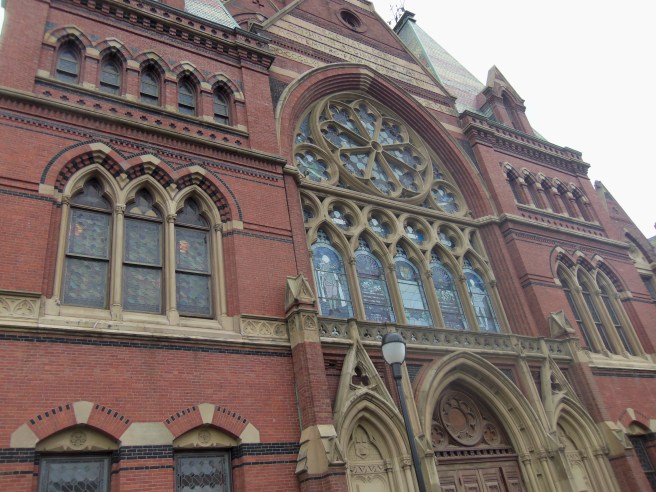
Memorial Hall in Cambridge is a high Victorian Gothic building erected in honor to the Harvard University men who died defending the Union in the American Civil War. One end of the structure holds Sanders Theatre, an intimate, wood-toned Globe-style auditorium – one we treasure for its Christmas Revels productions each year. The other half of the building embraces the Harry Potter-like Annenberg dining hall. The two parts connect at a marble-lined hallway engraved with the names of the fallen Harvard students.


Even on a cold, blustery day, it's hard not to be impressed when approaching its entrance.
Even on a cold, blustery day, it’s hard not to be impressed when approaching its entrance.


Imagine trumpets from every portal. Not that the Revels do it ... yet.
Imagine trumpets from every portal. Not that the Revels do it … yet.


Greater Boston is a rich and varied destination – the Hub of New England, or the Universe, as they used to say. Living a little more than an hour to the north, we’re well within its orb.

JUST WHAT, THEN?

In town, the side of one building has a ghostly paint on black brick. With difficulty I decipher

COMMERCIAL SALOON
T. MALLET PROP.
CIGARS NOW 5 c

across from the train depot and next to the OPERA HOUSE. Railroads, cigars, saloon, and opera all fit together in a remarkable calculation. Just where were women, besides up on stage?

What, precisely, mad the Far West so different? No family roots? It was all male: cowboys, loggers, miners, fishermen, soldiers, trappers. Even an orchard’s considered a ranch. You need only a few acres, Buckaroo. Where is my wife at this moment? Like Maya of Sanskrit lore, she’s a weaver. Like Maya, she had spun a web of entrapment. Maybe these open spaces aren’t really so open.

For more insights from the American Far West and Kokopelli, click here.

OF SOJOURNING AND EXILE

Kokopelli is not quite of this place, but he will stand in for the local hunchbacked flute players. As will Krishna, in tunes that begin slowly and build to ecstatic climax. Maybe they will be joined by a wandering sailor, looking for water. Maybe by fiddlers like me. Our melodies haunt and echo. This music demands dancing. The drummers appear.

You might ask what the Native American flute is made of. As well as Krishna’s pipe. What kind of bone or horn the sailor has carved. What opens as a simple, plaintive cry gains complexity and liveliness. Spider, in fact, weaves their intricate counterpoint.

The sailor knows sees their progression running from reel to jig to, ultimately, hornpipe. Who knows what the Hopi or Hindu call it — the effect is the same. Just look at a cow skulls and see where the horns were. Look at elk antlers. Look in his Bible, where horns are an image of power. Some who venture out into solitude return with their own power song. Begin wailing. Begin reeling.

I reflect. Suppose my children are born here? Is this really an arrival or a failed promise? What about the long exile ahead? The decades of trying to understand precisely what I’ve encountered in this desert and at its rim. Perhaps I will face a desert in my profession, as well. Perhaps I’ll find the sea is another kind of desert — one giving rise to the fishermen who were Christ’s first apostles. I already know of salmon returning to the desert.

I had believed this would be his Canaan — my place of milk and honey. I could spend the rest of this life pondering exactly what I experienced. Attempting, as well, to recover something of the encounter. The tune ends, but I remember its sound and its place on my maps. No matter that I might have even found this Canaan in a large city of orchestras and quartets, stages and screens, galleries and architecture, lectures and bookstores.

Maybe I’m merely sojourning here all along. In exile here as much as anywhere. And maybe it wasn’t the desert as much as the promise itself I explore.

At the end, a door closes. Maybe a gate. Like Eden, with its reality that I’ll never return. This desert is not a land that many visit. It reveals its true nature slowly, if you’re patient. If you’re reverent.

Actually, this might be just one more gate locked behind me. Even if I could return, I’d find everyone scattered. Or at least older. Here I haven’t even collected an antique basket or beaded moccasins or a piece of turquoise and silver jewelry to carry with me. Wherever I’m going.

Those were the days when I could read a totem pole and anticipate the stories. Maybe even name the children and their grandparents.

I should have known traveling with Kokopelli comes with risk. There’d be a price, eventually. Maybe it was while I was at the office or those other times when I turned, and he wasn’t there with me.

Now I come home and both Kokopelli and my wife are missing. I should have been suspicious all along.

It’s time for me to leave, then. I’m free.

For more insights from the American Far West and Kokopelli, click here.

RECONSIDERING THE NATURE OF TRUTH

Contrary to the opinion of many contemporary Quakers, theology among Friends did not cease developing after the death of George Fox. While I have argued that early Friends had their reasons for not fully articulating their radical vision publicly, they left us enough dots to connect to rediscover their revolutionary line of thinking. As I’ve written, this is built on three central metaphors: Light, the Seed, and the Truth.

Of the three, I’ve found Truth to be the most difficult to grasp. Metaphor typically builds around an image, but just what works for Truth, no matter how many layers of meaning and experience we compress into it? Moreover, metaphor rarely settles into something as comfortable as a noun. In other words, just how do we turn Truth into a verb?

I was delighted to see Douglas Gwyn pick up on in his book Seekers Found: Atonement in Early Quaker Experienence, with his own elegant turns. He begins with a concept of  spiritual formation: “The Quaker truth-stance was constituted by four distinct aspects, or ‘moments,’ … that can be related to four standard philosophical accounts of truth.” He addresses this from the psychology perspective of individual experience as a reality. Among them:

Powerful catharsis of being “convinced of the truth”

Gwyn begins with the sensation early Friends reported in their encounter with the Quaker apocalypse:

At that moment, the light of Christ gave them a searing, unmistakable knowledge of themselves. They were confronted as never before with their alienated conditions (including overt sins) and by the power of God to redeem them.

Yes, they were shaped by earlier teachings and beliefs:

The first moment of truth, therefore, was one of correspondence between propositional belief and lived experience. … The insistence on a lived experience of Christian beliefs … was an important breakthrough at the culminating – and self-defeating – moment of the English Reformation.

Coherence

Making sense of the experience presents its own challenges.

The truth of any proposition is established by its consistency or harmony with a larger body of previously established truths. Coherence, then, implies a framework within which one interprets either ideas or the data of experience (spiritual or empirical). But simultaneously, new experiences, while corresponding to elements within that existing framework, may also alter the framework (“shift the paradigm”), sometimes drastically.

Verification

Gwyn notes that Quakers could be more orthodox, especially in their insistence on moral accountability or the behavioral codes, which

not only expected outcomes of the convincement process but also the necessary means of conformity with Christ. This strong “process” aspect of Quaker truth has affinity with operationalist philosophical theories, which posit that a hypothesis must be verified by appropriate procedures of investigation. Here, the emphasis is upon the active means of testing the proposed idea or action, in contrast with the static framework of established truths suggested by coherence theory.

Pragmatism

But truth’s fourth moment is still rightly called pragmatic. … Like operationalism, pragmatism is concerned with action, but judges truth by end results, rather than means.

~*~

Gwyn delves deeply into the workings of these, and more, but as he observes,

these comprise the framework within which early Friends found, served, and remained faithful to the truth. The truth itself remains a divine reality, defined by God’s loving faithfulness to humanity and all creation.

Here, then, is Gwyn’s breakthrough key in approaching this Truth – it’s active, as love, allowing him to present us at last with a requisite image: Jesus himself!

While not all metaphors have to be visual – the ringing of a bell, for instance, might be a richer connection than the bell itself – I’d simply overlooked the idea of using a person itself. But why not? The English can speak of the Crown, after all, and in our times, a picture of the Queen comes to mind. Americans have long spoken of George Washington as the Father of Our Country and Gilbert Stuart’s portrait springs forth, along with statuary in parks and other public places across the land. We even have a major city and a vast state named in Washington’s honor, which simply magnify him as a metaphor.

To continue, Gwyn turns to the gospel and letters of John, who

portrays Jesus in conversation with a variety of individuals who take different positions in relation to him. A Christian dialectic emerges from these conversations. … John’s dialectical universalism contrasts with the syncretistic universalism of Hellenic culture, where various deities mixed and matched for the masses, while philosophy served the more refined pastime of the privileged. … The Gospel of John called various peoples into service to the one true God. … Again, this God who sent Jesus is less “true” in the sense of opposition to false gods, than in the Hebrew sense of faithfulness. … One did not choose Jesus from a long list of seeking options. Rather, “I choose you” (John 15:16). That call of truth was enormously energizing …

Gwyn’s insight certainly opens John 3:16 in a fresh light: “I am the way, the truth, and the light.” Look at the compression of metaphor!

~*~

More of my own reflections on alternative Christianity are found at Religion Turned Upside Down.