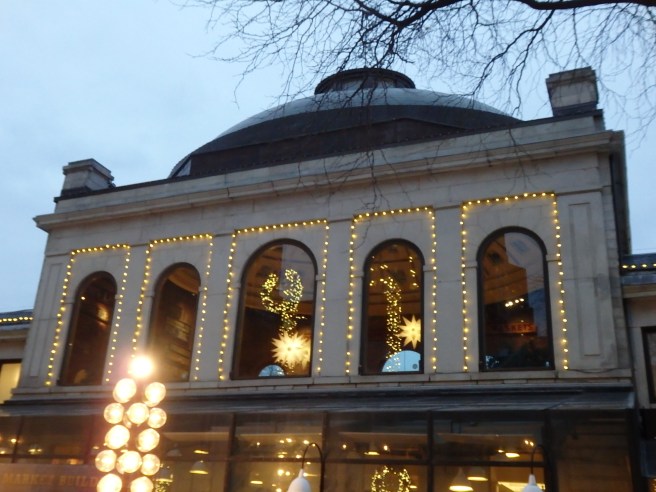
QUINCY MARKET IN LIGHTS

Thousands of lights.

Each year the city of Halifax, Nova Scotia, commemorates its gratitude for relief Boston extended in the aftermath of a deadly harbor explosion in 1917. The Canadians deliver a large Christmas tree, which is then erected and decorated in the heart of Boston.

The lighting itself is quite an extravaganza, as I learned the first time my choir participated in the event at historic Quincy Market. Imagine seeing yourself on the Jumbotron while you sing.

Boston is a rich and varied destination – the Hub of New England, or the Universe, as they used to say. Living a little more than an hour to the north, we’re well within its orb.

A perfect combination.

WHY HAVE THE YOUTH GONE?

Quakers are not alone in this regard, but what we’ve been enduring is that no matter how much effort we put into raising our children within the faith community, they disappear somewhere in their junior high years. For decades, we’ve been hoping they’d reappear as they started raising their own families, but we’re seeing little of that, and again, we’re not alone.

It’s all too easy to blame competition with Sunday morning soccer leagues and the like, although we might also argue that the values the kids learn in their athletic competition more closely fit those of the larger, secular society than those they are taught in religious settings. Rabbi Michael Lerner makes an extended argument in his 2006 The Left Hand of God: Taking Back Our Country from the Religious Right, as he contends that too often our children see all too clearly the dichotomy between what we say we believe in faith and what we actually do in a dog-eat-dog marketplace. It’s a harsh criticism. No wonder religion is losing.

As I gaze around our mostly graying worshiping circle, I wonder just where the young adults are today – not just within religious communities, but just about everywhere I venture. Maybe they’re all hidden away working multiple 24/7 jobs trying to make ends meet. I don’t envy them the economic scene they’re contending with.

But I also wonder about the message they carry about faith itself. If the teaching among youths growing up “under the care” of Quaker Meeting has been to build a hopeful, optimistic foundation of values, how do we help them survive the brutal struggles they’ll encounter in the wider world? How do we instill an awareness of the importance of religious community and shared discipline in maintaining a drive toward a more loving and just society?

Perhaps we’ve been too comfortable in our safe, middle-class, largely professional upbringings and neighborhoods and expectation of college and career.

In my own thinking, I keep returning to the concept of the two seeds, one of Christ and the other, call it what you wish – the point is, we face not just “that of God within each person” and its potential, but also a counter element to challenge. It was a line of thinking at the time the Quaker movement erupted in Britain. Think of the parable of the wheat and the tares.

Contending with the two may be what’s been missing in our teaching and example.

~*~

More of my own reflections on alternative Christianity are found at Religion Turned Upside Down.

WITH THE LOCO IN LOCOMOTION

My awareness of the importance of forested trails of my own sanity and balance has evolved slowly. I see two parts at work here.

First is the aspect of locomotion. I could begin with the fact I’ve never been an athlete. As a youth, I delighted in speed — as in running or riding a bicycle — or in swimming, with its parallel of flying suspended in space. But I’ve never enjoyed the repetition of exercise for its own sake, gym class was a bore, and team sports have largely eluded me. Since I existed largely within mental activities, such as science or the arts, the idea of doing something that involved a mindfulness to my own body in motion did not register with me, at least until I took up yoga after college. I could add to this a recognition that I’ve also been filled with nervous energy and general restlessness. Sitting still — and focused — is something I’ve had to learn in the course of practicing meditation and attending Quaker meeting for worship.

Second is an encounter with natural history. Somehow, at an early age, I was introduced to geology, birding, tree identification and the like. I’ve also been interested in maps and map-making. Human history, too, which often turns up as discards in places returning to the wild.

What I’ve come to appreciate, though, is largely an esthetic response in walking through places of repose. If forest trails are the symbolic ideal here, I must admit they are not the only examples. Walking miles along the Atlantic on the outer Cape Cod shoreline, for example, serves well (although walking on sand always presents an effort) or trekking above treeline or through wild meadow can be heavenly. Even a stroll through a wooded cemetery or a city park can be recommended. But I speak of forest because of its timeless nature, in both senses of the phrase; this is what this land would remain at climax, forever. Everything is in balance or harmony. There are, of course, seasonal changes, but these are within a rhythm or cycle of returning, much like the movements of a symphony played over and over. Somehow, this begins to merge with the rhythm of walking, which itself begins to pace my own thoughts and emotions. Nothing too rushed, too overwhelming: everything, one step at a time. Uphill or down, all within reach. Walking along a city street or even a country highway can induce some of the step-by-step rhythm, but the balance is off: traffic rushes past, always as a threat, especially at intersections; there’s too much commotion or stimulation; my soul’s not at rest. Look around and notice all the trash and discard, all the waste as a social illness. The wilderness, in contrast, is continually healing. “Come to the woods for here is rest,” John Muir counseled. “There is no repose like that of the deep green woods.”

For more insights from the American Far West and Kokopelli, click here.

PLACES OF RETURN

Years later, a friend relates an incident of telling his wife his intention of spending the day in a favorite place in the mountains, countered by her question of what makes him return there. Even though he’s a photographer, he replies by acknowledging that many of his writer friends have answered the question simply, saying it’s the surprises that draw them back.

Somehow, as one of his writer friends, I find the word “surprise” in this context jarring. For surprises, one would be better served by trips to new locations, rather than returning to an old favorite. Novelty, rather than familiarity. Upheaval or intoxication, rather than purity or sobriety. Even so, as I consider my own places of return, her question becomes increasingly kaleidoscopic.

First, there’s the very demand of naming a favorite place. In this context, he invokes wilderness, where return is a kind of pilgrimage. Here, return may be once or twice a year, if that frequent. I could counter that with an evening stroll, as I used to do along the canal bank at the back of the desert orchard, or sitting at the café downtown in the small New England city where I now dwell — activities that could take place daily. We could add to that an opera house or concert hall, museum gallery, or even places of dedicated labor: a studio, cabinetry shop, garden, kitchen, or laboratory. Even, though rarely for me, shopping destinations: a boutique or farmers’ market, perchance. A fair or festival.

So the question soon turns to a matter of one’s intention. What is one attempting to escape or encounter? What is one leaving behind and what does one face instead?

Continue reading “PLACES OF RETURN”

RAISING THE STAKES

The kids raise a valid point when they notice how much we teach them about Quakers back then – but what about now?

Yes, what about NOW!

We need to get our act more together and acknowledge many of the remarkable ways we continue to witness today, usually in individual callings that deserve more support from the rest of us. So maybe the kids’ question can help us better focus on our greater purpose.

I’d like us to proclaim more of the courageous work of Friends internationally, too – I can think of examples in Cuba and Kenya in our own time.

Not all of the action involves peace and forgiveness issues, either.

Consider, too, two points from a visit to an Evangelical Friends Church on the other end of the Quaker spectrum from my own Meeting:

“Is Jesus Christ going to be exalted and praised?”

Her shocked look haunts me, considering the big Quaker gathering where I’m headed. I think, Yes, but in ways you wouldn’t recognize.

Also, humbly, as another realizes from one difficult exchange with a customer at her business previously that week: “I may be the only Jesus they’ll see.”

Now we’re talking business.

~*~

For similar thoughts, check out Religion Turned Upside Down.