TEN WAYS THIS ‘DAFFODIL’ IS NEW

My newest novel, Daffodil Uprising, is a thorough revision of the earlier Daffodil Sunrise. Nearly half of the original book has been excised and replaced by twice that amount of new material, for good reason.

Here are ten of the big differences.

  1. The events and characters are now seen through the eyes and snarky voice of Kenzie’s daughter a generation later. They are Cassia’s discoveries about her father’s college years in the turbulent 1960s, pro and con.
  2. As the subtitle says, the focus is on the making of a hippie. The college and its good-old-boy network of abusive power and greed earn much of the blame.
  3. Kenzie’s growth as a budding photographer gets fuller attention, along with his artistic advances. It’s his basic reason for coming to Daffodil, after all.
  4. His girlfriend is a much more complex and troubled creature. She has good cause to be chafing in her relationship with him. And he, in contrast, is so truly naïve. Something’s got to give.
  5. Most of the characters have been renamed and are more uniquely defined. They and their actions have new grounding in everyday life.
  6. Kenzie’s buddies are no longer a pack of emerging radicals in action but rather a lineup of widely varied boyz stumbling along in a confounding environment. His dorm’s underground traditions are handed down through a band of quirky seniors and juniors who serve as wise elders and guides to neophyte freshmen like Kenzie. It’s a colorful crew – one that teaches him as much or more than his professors, in fact.
  7. The narrative’s giddy, upbeat, and sometimes sophomoric youthful optimism is now countered by darker forces of oppressive greed, violence, and despair. Bad drug trips and protest bombings accompany the scene.
  8. There’s now an element of Goth. This is a college campus, after all. Why should Hogwarts be all that different?
  9. There’s also a strand of the paranormal. You ever live in a creepy old apartment building or have the subject of a term paper start talking back to you?
  10. The work now stands in fuller correlation with What’s Left, a generation later, and the two other novels that follow him after college.
Daffodil Uprising

For details, go to Smashwords.com.

THE IMPORTANCE OF SMALL TOUCHES OVER TIME

From our perch today, it’s hard to believe that a Broadway musical like “South Pacific” could have been a bold statement on behalf of racial tolerance a half century ago.

I’m encouraged, of course, to see a Quaker connection.

First, even though the novelist James A. Michener, whose book was the basis of the show, had served in the U.S. Navy during World War II, he was raised by a Quaker adoptive mother and attended Quaker-affiliated Swarthmore College. In other words, he had been exposed to both pacifist and racial equality values.

Second, as Vanity Fair writer Todd S. Purdom notes in “The Road to Bali-hai,” is that librettist Oscar Hammerstein’s wife’s niece Jennifer attended the George School, another Quaker institution, one where Michener also taught briefly. The Hammersteins’ own son Jimmy also went there, as did a young family friend named and future Broadway great Stephen Sondheim. (And to think how vigorously earlier Quakers denounced theater as vain entertainment!)

Purdom’s article contains another telling point. The hit song “I’m Gonna Wash that Man Right Out of My Hair” was originally a flop. In the preview performances before the Broadway opening, director and co-author Josh Logan was perplexed to see it wasn’t connecting until he realized that star Mary Martin had the women in the audience so abuzz about whether she was actually washing her hair onstage that nobody ever heard the lyrics themselves. He fixed that by having her belt out the first stanza before working her hair.

I wonder about how many other small changes in any art form spell the difference between boffo hit and mundane shelving.

A similar tweak in “Wonderful Guy” changed the song to a soliloquy with the word “you” substituted for “they.” As Logan recalled, “That night they tore the house apart.”

As I was saying about small changes or a simple touch? Never underestimate the importance of revisions in art. Or maybe life itself.

~*~

Michener, by the way, wrote of his experience on the Electoral College elections with the telling title on his political science volume, Presidential Lottery: The Reckless Gamble on Our Electoral System.

He was so prescient there.

BE AMONG THE FIRST TO GET MY NEWEST NOVEL

Join with me in celebrating the publication today of my newest novel, Daffodil Uprising, at Smashwords.com.

A thorough reworking of my 2013 release, Daffodil Sunrise, it’s a tale of radical awakening in the 1960s now told from his daughter Cassia’s perspective a generation later. Her voice is snarkier than his, for starters, and she’s more willing to view the events with more grit than he had in the previous version. Oh, yes, the characters are definitely more colorful, vivid, and varied. Besides, there are now strands of Goth and the paranormal. What else?

You’ll have to see for yourself.

Daffodil Uprising

The ebook is available in the digital format of your choice at Smashwords and other independent digital retailers.

KEEPING THE COMPANY IN CHECK

Across New England, the spire on city hall typically had prominent clock. Its purpose, I’m told, wasn’t just civic pride.

No, it was to keep the mill owners in check, just in case they were tinkering with their own clocks to squeeze unpaid time out of their workers.

It’s comforting to know the town fathers could stand up to corporate powers. Most of the owners, by the way, lived far from these sources of their wealth. Many of them were Boston Brahmins clustered around Harvard.

In honor of the workers and those who stand up for them, Happy Labor Day.

WELCOME TO AMERICA

In my new novel, What’s Left, her mother’s grandparents sail from Patras, Greece, to America in the years just before the First World War. In contrast, her father’s side appears to have farmed the Midwest in the oblivion of forever.

In observance of Independence Day, here are images from the Library of Congress in homage to those immigrants who arrived in that period by way of Ellis Island in New York Harbor.

Greeks board rowboats to a steamer in Patras to begin their voyage to the New World.
The faces on these women still say everything.
Imagine the anxiety of approaching the registration desk, to learn if it’s yes or no or maybe.
The view of the harbor filled with hope and the unknown.
Think of all that’s left behind, too.


TWO BROTHERS/BROTHERS-IN-LAW ALONG WITH TWO SISTERS/SISTERS-IN-LAW

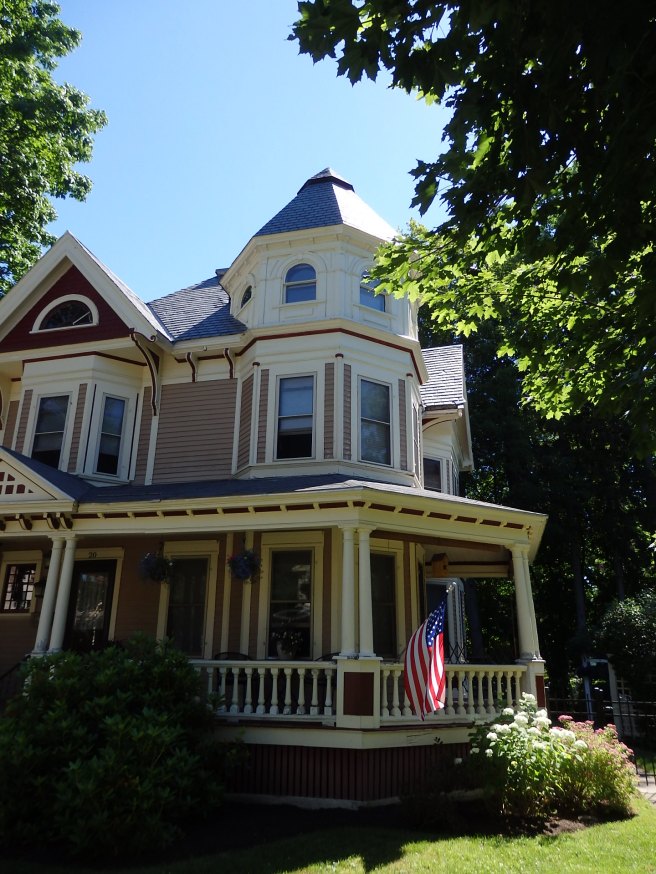
A large Queen Anne-style house with a distinctive witch’s hat tower something like this is the headquarters for Cassia’s extended family in my new novel, What’s Left. If only this one were pink, like hers.

Centering the story of my new novel, What’s Left, in a Greek-American family required me to consider just what each member might have undergone in the years from arriving in the New World up to her father’s introduction to her mother. (Or more accurately, before her father-to-be meets her mother-to-be.)

While creating a suitable scenario presented a fascinating challenge, I did have to start wondering just why Cassia herself – or the typical young adult reader, for that matter – would have any interest in such ancient history.

I hope a hint of scandal helps, along with a few other twists, before their curiosity kicks in.

~*~

Much of the novel revolves around Cassia’s prolonged examination of old family photos – images that might amuse younger viewers or even intrigue them. Think of looking at high school yearbooks from earlier decades. Yes, those geeky hairstyles are real. As for the dress?

Any collection of family photos is bound to include birthday parties. What’s your favorite cake for the occasion?

THE SILENCE IN BEETHOVEN

When it comes to the fine arts, we love our biographies of tortured genius, and Ludwig van Beethoven serves the storytellers admirably. Baptized December 17, 1770, in Bonn, his tempestuous and tragic life was one of failed love affairs, strained friendships, and especially the deafness that accompanied his greatest musical achievements. And yet many of us find him not only speaking for us but also extending inspiration in the quest for fullness and fidelity.

In part it’s a story of the way Bach, Mozart, and Beethoven reestablish the center of classical music, centering it in the German-speaking world far from its Italian roots and the Renaissance genius of Monteverdi and Palestrina.

As I discussed earlier this year, Beethoven’s popularity rests largely on works that he wrote in the second half of his life, past the age of Mozart’s death, the years that encompass what are known as his Middle (or Heroic) and Late periods. The years accompanied by deafness.

For much of my life, I’ve not been alone in finding that what most appealed to me were the works from the Middle period – the Fifth, Sixth, Seventh, and Ninth symphonies, the violin and “Emperor” piano concertos, the Rasumovsky string quartets – stirring works raging with dramatic struggle and promised victory. With all of their emotional parallels to athletic contests, these have justifiably ensured his enduring public adoration.

More recently, though, they’ve given way in my estimation as the Late period works have risen in preference. Quite simply, these have never been considered all that accessible. Many of them defiantly turn their back on the audience in a pursuit of boldly intricate, often extended, musical puzzles that plumb the depths of human despair, loneliness, resolve, as well as lofty heights. Indeed, for years the assumption has been that these are not for public consumption but are rather reserved for private investigation among the cognoscenti, should they be so honored.

Continue reading “THE SILENCE IN BEETHOVEN”

AND HAVE A GOOD DAY?

In the early days of Friends, they’d often greet each other with the question, “How does Truth prosper among you?” Not “How are you doing?” or even “Good morning.”

Strikes modern ears as puzzling, even problematic, beginning with that verb prosper, which we tend to consider along financial terms rather than thrive or even proliferate. Equally unfamiliar is the idea of Truth being active – alive – rather than static and unchanging.

To further thicken the plot, consider their linkage of Truth and Christ, so the question also asks, “How is Christ alive among you?”

How would you answer that!

~*~

For more along these lines, take a look at Religion Turned Upside Down.


ESPRESSO FIT FOR THE GODS

With a holiday touch.

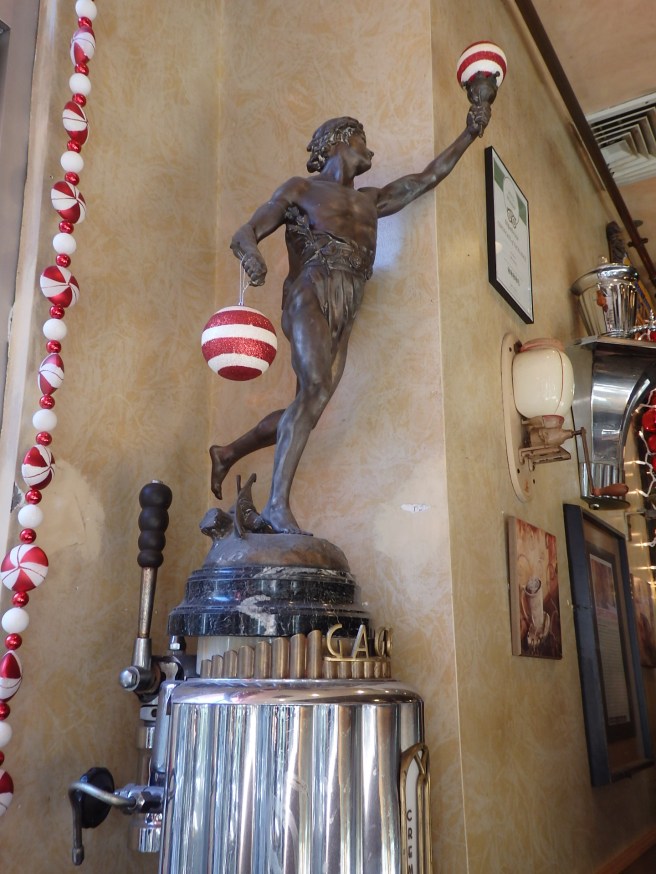
Vittorio’s in the North End is famed for its espresso and pastries. With Mercury as one of the coffee makers, you can see why the neighborhood is also renowned as Little Italy.

Boston is a rich and varied destination – the Hub of New England, or the Universe, as they used to say. Living a little more than an hour to the north, we’re well within its orb.

UNCOVERING THE PLACE OF STRUGGLE

In his Pendle Hill pamphlet last year, Marking the Quaker Path: Seven Key Words Plus One, Robert Griswold opens with the term “condition,” which initially seems familiar enough. Quakers often remark to a comment, “This speaks to my condition,” or even “the Friend speaks my mind,” conveying a sense of unity and affirmation.

Griswold, though, gives the concept a darker twist, noting that a meaningful spiritual journey requires seeing ourselves in our places of failure and weakness rather than a state of “being in charge,” as we so often do. Think of Anne Lamott’s “three essential prayers” — Help, Thanks, and Wow — and admit a long personal list invoking the first.

I would extend that awareness of condition not just to ourselves individually but to our families and circles of faith and then the wider society. I’d say there’s great need everywhere.

This, then, leads to the subsequent steps where we turn to the Holy One and our kindred spirits for direction and growth.

Curiously, condition is not a word I find used widely in either Scripture or early Quaker literature – not directly, that is – but it does fit the situation of many people as they set out in faith as recorded in both.

Could it be that in many of our religious circles, we’ve been running away from this very difficult but essential challenge? We go to worship looking for rest and renewal, not more turmoil and suffering.

O, Lord, give us strength!

~*~

More of my own reflections on alternative Christianity are found at Religion Turned Upside Down.