Is this it?

The Covid-19 devastation, already spread around the globe, is poised to inflict even greater damage when it ravages Third World countries, or so we’re reading. The impact is much more than grim death tolls. We’re hearing predictions of the greatest economic depression in a century.

In the United States, the virus is what finally exposed Donald Trump’s house of cards to full view. Not just his own illusions but his party’s, too. You know, the failure to plan. Failure to take responsibility. Endless stream of lies and fabrications. His scorn for fact, truth, scientific reality. Ridiculing and blaming others. Inability to steer a course. And so on. Feel free to add to the list.

For the past three years, I’ve restrained from commenting much on the outrage after outrage being inflicted on our democratic society. With his hooligans and their fellow cultists being so impervious to facts, I sensed anything that might break through their shells had to come from the right. The polarization of the country predates Trump, anyhoo, just look at the Congress dead set on obstructing President Obama from doing the will of the people, regardless of the ultimate impact.

From my viewpoint, what’s seemed obvious is that only something catastrophic might break through their state of denial and bombast. I kept wondering what that would be. What would it take to allow civil conversation again, one based on fact and not bullying and bombast?

In my years in the news business, I saw how difficult predicting public reaction could be. Big issues are commonly greeted with a yawn, while some seemingly trivial account unexpectedly gets everyone stirred up.

So here we are, with a medical crisis Trump arrogantly derided as a “hoax” and then claimed to have “under control” now exploding exponentially before our eyes. As it begins to hit closer to home, even his supporters can no longer poobah the epidemic as “liberal hype” to “discredit” their fuhrer. Not unless they can explain Italy and Spain’s suffering as part of a conspiracy.

Not unless they can explain why GOP senators were informing their super-rich backers of intelligence findings about the brewing virus storm and quickly selling off millions in stock while telling their voter constituents to stay calm. (Isn’t that insider-trading?)

Not unless they can explain why the markets and employers and local and state officials of both parties have independently taken the drastic actions they have, contrary to White House proclamations.

He still doesn’t have a clue, does he? This is the man who offers big aid to China after turning down any help for the most seriously impacted states in America. (Sorry, you’re on your own, guys.) What!

One of the reasons he’s clueless is that none of his incoming staffers who attended a big meeting with outgoing Obama officials eight days before the inauguration took the ebola lessons seriously. At least one future cabinet secretary dozed off during the briefings and their worst-case scenarios. Another reason is that Trump promptly eliminated the emergency preparedness coordinating office Obama had created for cases like this. What Trump touted as streamlining proves to be reckless disregard for reality and an exercise of personal spite. There was no planning, period.

Fellow Republican Susan Collins, a senator from Maine, even prevented epidemic response planning from being budgeted back in 2008. There’s a pattern.

Here we are, after being stuck with Trump’s obsession to spend billions building a useless border wall but do nothing on pandemic prep. Like that wall will stop anything.

I long ago saw that incompetent managers and executives feel threatened by competent people working below them – the very ones who could make their bosses look effective, if given the chance. Do I need to say more?

Smart management is taught to be proactive, not reactive, but that’s not what we’re seeing here.

The illness itself is only the face of the storm as we get glimpses of even bigger economic, political, and social ills that have been long festering.

Oh, yes, high turnover is another sign of mismanagement. Two-thirds of Trump’s team at that epidemic meeting three years ago are no longer part of the administration. Who’s in charge, paying attention to details?

Wall Street may have been soaring, and a “correction” had been long anticipated though not expected to kick in till after the November election, but for many of the country’s working class, full-time jobs – especially those with benefits – have been scarce. Minimum wage rarely covers basic living costs, and health insurance premiums often eat up a third of that income while imposing high deductibles few would ever be able to pay without going homeless or, if hospitalized long, losing their jobs. Many of those minimum wage jobs, by the way, require “reliable transportation” from employees, as if the pay actually covers as much as a clunker to get to worksites far from public transportation. Steps to improve their situation has not been presented from the current administration, even while cutting taxes for the rich and corporations continues.

Well, some of that finally has been acknowledged in the proposed coronavirus aid package, at least for this specific illness. Maybe it’s a start. Those low-pay, part-time jobs are a huge part of the workforce, and if they break down, even for two weeks, watch out.

That’s the real economy.

I could say more, much more, but let’s leave it at that for now. From all indications, this drama’s just starting.

There’s no disputing that bodies are piling up, even in the USA.
Inspired by a Shaker spirit

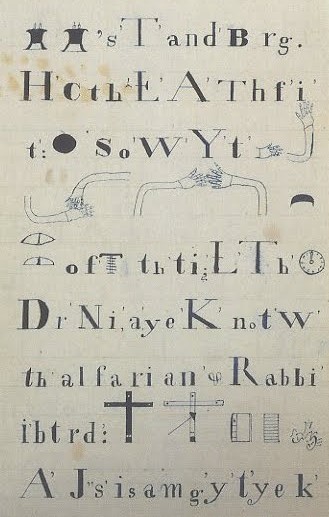
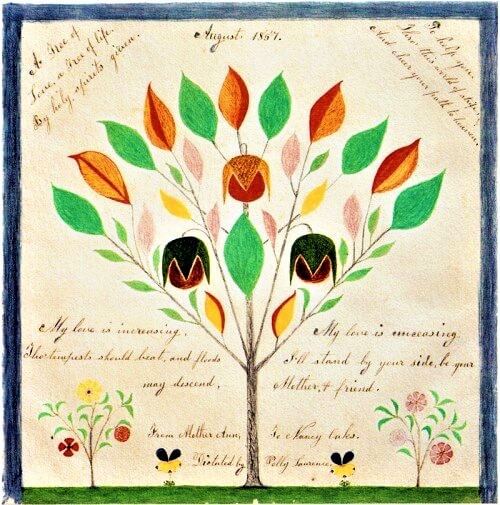
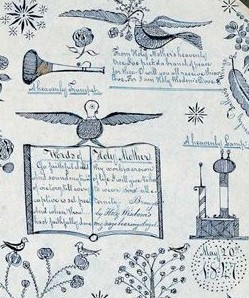
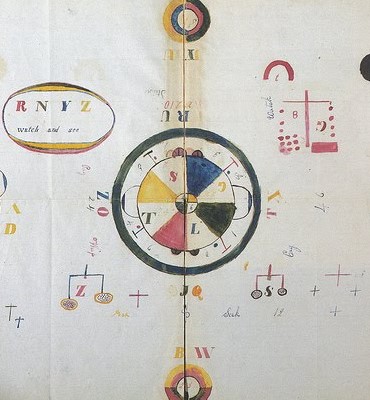
In my novel NEARLY CANAAN, Jaya searches in her spare time for an means of personal expression that isn’t quite poetry or prose but somehow truer to her spiritual stirrings. After I finished drafting the book, I came upon an exhibit of Shaker gift drawings and writings channeled by one member of the monastic community to be presented to another. Sometimes these would also originate as song, and an unique form of musical notation also arose.

Here are a few examples.

Spirit Message from 1843 appears to be a random series of letters or perhaps a new language akin to speaking in tongues.


Thus saith Holy Wisdom, detail


A Tree of Life, a central Shaker concept


Detail, To Sally Lomise, 1847


Mystical letters and images


What happened to the yogis and their dream?

We were wide-eyed and innocent as doves though not wise as serpents, as the Bible would add.

We had room for exploration, certainly, and for some of us that included yoga or Zen. Hitchhiking was part of the scene, too. I touch on those in several of my novels.

I realize that in posing the question as “yogis,” I’m focusing on a corner of the hippie experience. The dream I’m thinking of is a better world for everyone, and not just a few who wanted to drop out altogether.

I don’t see that among today’s youth, who have good reason to be more cautious about the future. Besides, they’re shackled by college debt, an outrageous amount compared to their income realities.

But it’s not all economic. I’d say much of the current malaise is spiritual.

Without that element of hope and universal love, how can we possibly overcome the forces that are dividing and oppressing us?


American yogis touring India

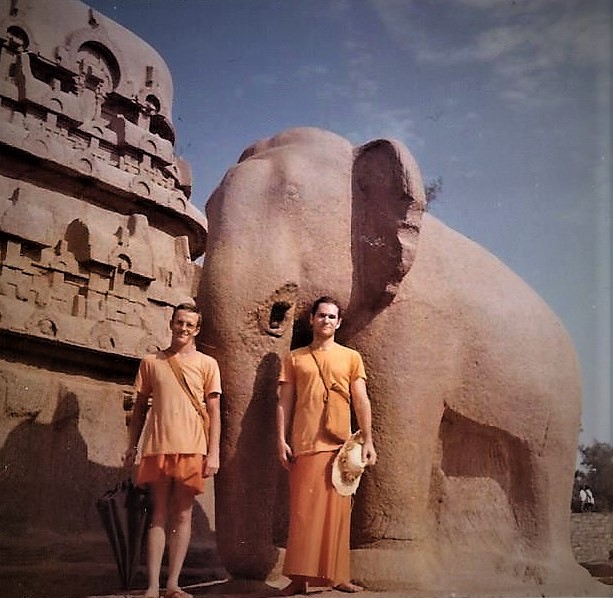
As young yogis living at the Poconos Ashram in Pennsylvania, Bhakta and Jay made a pilgrimage to India in December 1973. It was Bhakta’s first trip to the source of the religious tradition and Jay’s second. Unlike many young American and European aspirants who moved to India to study with a guru, they were teaching and practicing on a rundown farm not far from New York City. Their daily encounters in the household they shared resembled much of what I describe in my novel YOGA BOOTCAMP.

I remember our teacher, an American woman, telling of her first experience with a real elephant in India. I think she would have loved having one on our farm.

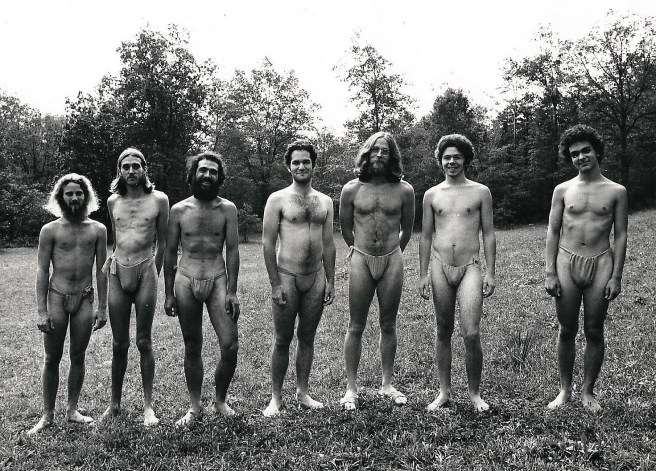
Standing in our brahmacharies

My novel YOGA BOOTCAMP describes the events of being initiated into brahmacharya and being given the two strips of cloth cut from the guru’s robe as our new underwear, supposedly to restrain our male sexual impulses. As a bit of real-life evidence, here we are at the Poconos Ashram in Pennsylvania in mid-1972. The girls found it highly amusing, especially since we were all living under celibacy.

At least I didn’t use the title of an old hymn here, “Blessed Be the Ties that Bind.”


Blessed bliss

My novel YOGA BOOTCAMP describes group meditation as a central discipline in the daily life at Big Pumpkin’s ashram. As a real-life example, here’s a photo taken at the Poconos Ashram in mid-1972. I’m struck by how young we all look and the fact that most of us could sit in a full lotus position. Makes my knees hurt just thinking of it now!

Yes, I really lived this.

Ten pioneering leaders in American yoga

When I took up yoga in the early 1970s, it was still pretty exotic. In fact, a fair question would ask if yoga was mostly happening in New York. That was my impression from the ads in the weekly Village Voice newspaper, which listed many visiting teachers from Asia, especially.

Not all of the teachers were exactly kosher, either.

The model of the maverick guru was Robert Crumb’s Mr. Natural cartoon, inspired by the Sufi and Zen Buddhist Samuel Lewis, but my own teacher, Swami Lakshmy Devi in the Pocono mountains of Pennsylvania, and Swami Rudrananda at Big Indian in New York’s Catskills, would also fit much of what I describe in my novel Yoga Bootcamp. All three were born in America.

Here are ten more teachers who advanced yoga’s popularity in that era:

  1. Richard Hittleman, New York, beginning in the 1950s. Hatha exercises.
  2. Walt and Magana Baptiste in San Francisco, early ’50s. Hatha exercises.
  3. Swami Vishnudevananda, arriving in 1958, San Francisco, a student of Swami Sivananda in the Himalayas. While emphasizing hatha, he also advanced other aspects of yoga, including meditation. My teacher was trained at Visnu’s Manhattan center. The network now headquartered in Montreal.
  4. Maharishi Mahesh Yogi and Transcendental Meditation in the early ’60s. With the Beatles and others as celebrity followers, his emphasis on teaching meditation rather than the physical exercises became trendy.
  5. Swami Satchidananda, arriving 1966, New York, also a student of Swami Sivananda. His invocation at the Woodstock festival made him celebrity material. With his big beard and smile, he looked the part.
  6. Swami Prabhupada, founder of what were best known as the Hare Krishnas, or the International Society for Krishna Consciousness. Arrived 1966, New York. Brought kirtan, or chanting, and the Bhagavad Gita scriptures to public awareness.
  7. Amrit Desai, arriving in 1968 in the Philadelphia area. His influential organization continues as the Kirpalu Center in the Berkshires in Massachusetts and is known for training and certifying yoga instructors.
  8. Yogi Bhajan presented his Kundalini yoga as hatha and chanting with a Sikh infusion. He founded his Happy, Healthy, Holy Organization in 1968.
  9. Ram Dass, formerly a prominent Harvard psychologist and psychedelic pioneer, published the seminal book Be Here Now in 1971 at the Lama Foundation in Taos, New Mexico. We all wanted to go there, wherever or whatever it was. Its focus was on the philosophy, rather than the exercises – a huge breakthrough, from my point of view.
  10. B.K.S. Iyengar, arrived in 1973 in Ann Arbor, Michigan. His focus on technical precision in the hatha exercises influenced many teachers.

The shrinking newspaper page

Cost-cutters have long found ways to shrink the product to meet rising costs or boost the profit. As was said years ago, “It’s getting hard to find a nickel candy bar for a quarter anymore.” I hate to think what it costs now, much less in a vending machine.

Newspaper pages are no exception. The first jolt to tradition came back in the mid 1970s when there was a newsprint shortage. The Canadian suppliers, for whatever reason – a labor strike? – just didn’t have enough to meet demand. One solution was to narrow the width of the page.

In recent years, as the Internet has disrupted the business model of the news industry, the pace of cost-cutting has quickened.

The ones around here are now 11 inches wide, versus 15½ when I started in the business or one paper where I worked where the page was nearly 18 inches wide.

In other words, today’s broadsheet is as wide as a tabloid was back then, only longer. It’s lost two columns of news on each page – or a quarter of its surface. It’s so skinny I wince.

We never had enough room to print everything we wanted as it was.