Why were so many people in Dover so willing to defy the Puritan authorities’ draconian anti-Quaker laws?

Dover Friends have long relied on the story of the three Quaker missionaries who came to town in 1662 as the origin of Dover Friends Meeting. They were severely persecuted and whipped, the subject of a well-known John Greenleaf Whittier protest poem, yet they were promptly followed by more itinerant ministers and soon a third of the population was Quaker.

The Puritan authorities had enacted harsh anti-Quaker laws. Anyone who even listened to a Quaker for an hour or owned a Friends book or tract could be imprisoned, fined, have an ear loped off, or have the flesh mutilated with a red-glowing branding iron. By the time the three women – accompanied by two men – came to Dover, four Quakers had been hanged in Boston. Yet in some places, a few people listened and even hosted them.

Dover, obviously, was one – and, as I find, had welcomed Friends even earlier than we’d thought. In 1659, some residents were fined for neglecting public worship, meaning the Puritans’ services, and attending Quaker Meeting instead.

My central question keeps asking what made Dover, of all places, so responsive to the controversial Friends message? What made some residents so willing to defy the prohibitions and risk the consequences? 

My upcoming book delves into the findings, but quite simply, the town had been rocked by divisions for much of its then-short existence. At one point there had even been an armed skirmish between rival ministers for the town’s tax-funded pulpit.

~*~

Merely listening to a Quaker could lead to this. Hours hanging in the town stocks.

Some grudges are harbored a long time, awaiting the right opportunity to flare up again.

Or, for repeated offenses, even being branded.

Another factor to consider is the ways that Dover’s settlers differed from the majority of the Puritans to the south. Dover’s came overwhelmingly from Devon, a large shire in South West England, while the Puritans were rooted in East Anglia, to the other side of London. Culturally, they differed strongly, from accents and cuisines to courting and marriage patterns to superstitions and social customs. It’s something Dover shared with two Quaker hotbeds nearby – Salem, in Massachusetts, and Hampton, down the coast of New Hampshire.

Frankly, I’ve been surprised by the degree to which Dover was a center of controversy and scandal in the mid-1630s and a bit on, all so early in New England’s history.

Much of the Atlantic coastline hadn’t yet been settled. What happened in Dover fuels a big part of my big book and definitely sets the stage for what follows.

Maybe you’ll be as startled as I’ve been.

It’s the book I didn’t want to write, but it wouldn’t let go  

I thought we Dover Quakers – or more formally Friends – had our long history covered. I had even helped Silas Weeks, way back, in some of his research for his definitive volume on New England Quaker meetinghouses and burial grounds.

Frankly, after revising and republishing seven novels after the appearance of my eighth, I wanted a break.

A big break.

These are supposed to be my retirement years, OK? Admittedly, I had long imagined devoting myself to the writing as a big part of that dream, but really!

But then a casual request for an overview of Dover Friends history changed everything. It came indirectly, through someone in another denomination who was active in our Sanctuary movement. But then, going back through my filing drawers, I came up empty – couldn’t even find my folders of notes. What we did have was mostly about our three meetinghouses over the years – especially the structure where we’ve worshiped since 1768 – along with a few prominent events.

This left me unsettled.

Unlike many other denominations, the Society of Friends, or Quakers, is first and foremost about its members. Our definition of church is the body of believers – not the building or the polity and definitely not the ordained clergy. It’s why we call our building a meetinghouse and why we organize as Meetings, reflecting the times and ways our church-people come together. Church can happen whenever and wherever we are, even over dinner in our homes or chance encounters on the street or in the midst of social activism. And vitally it’s not just us – we’re meeting God, too.

I spent a lot of time at my impromptu workstation in Eastport, Maine, last year working on a history of Quakers in Dover, New Hampshire. And I arrived with what I thought was a largely finished manuscript. I was mistaken.

~*~

WHAT NEEDED TO BE TOLD was the lives of the individuals and families who were the essence of one of the oldest Quaker Meetings in the world.

I resisted as long as I could but finally succumbed. Who were they? Why were they so willing to risk severe punishment and persecution imposed by the Puritan authorities? And in the face of that, how and why did a third of Dover’s population quickly become Quaker? And several generations later, start fading away?

With the 400th anniversary of the settling of Dover – and thus New Hampshire, too – coming up next year, the timing for our side of the history felt right.

Now that the book’s written and revised, I’ll be sharing some of my findings with you as well as news of publication itself as that nears.

~*~

WHAT EMERGED IS A PARTIAL HISTORY, as in partisan, with my focus on a radical religious subculture that thrived in a unique, out-of-the-way, locale. Partial, as well, to the independent streak of New Hampshire against more powerful Massachusetts authorities to the south. Partial even in being incomplete as well as lacking footnotes, and not even the work of a professionally trained historian.

The story is also partial in being biased toward a sequence of unusual, sometimes roughhewn, figures and their families – not all of them Quaker – and inclined especially toward the narrative they shape.

The roots, as you’ll see, arise in the very beginning of English settlement. Forget what you’ve assumed about New England before Paul Revere and Sam Adams and the American Revolution and Boston as the Hub of the Universe.

A lot had already happened before the first Puritans sailed into Boston Harbor. Let’s look instead to Dover, which lays claim to being the seventh-oldest continually inhabited European settlement in the United States.

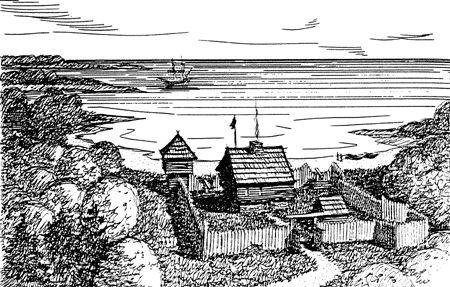
In the standard telling of the founding of today’s city of Dover, New Hampshire, two brothers arrived from England in the spring of 1623 and settled at the mouth of Great Bay on the Piscataqua River, upstream from the Atlantic Ocean. The brothers were fishmongers, members of one of the oldest and wealthiest guilds, or great companies, of London.

Except, as it turns out, one of the brothers didn’t arrive until a few years later.

Instead, the cofounder of the new settlement was a fishmonger apprentice who would be an important figure in the early years of the colony.

The meetinghouse, Dover Friends’ third, is home to the faith community today. It was erected in a single day in 1768.

~*~

YOU’LL PROBABLY BY AS SURPRISED by this alternative take on New England history as I’ve been. It’s not just Quakers. There’s much more to New England’s past than a Thanksgiving dinner and a riotous tea party followed by a midnight ride and the shot heard ’round the world or even the notorious witch trials.

Here at the Barn, you’ll definitely be hearing a lot more about this big project through the coming year. Believe me, some of the findings will be startling.

Passin’ dem family boneyards along the route

One of my more familiar drives while living in Dover meant crossing over into Maine on my way to or from the Antique House.

Within a seven-mile stretch of the roadway, there were at least 16 family cemeteries – some with only two or three visible stones.

It’s all the more striking when you realize that two separate two-mile stretches have none at all, so the burials actually occur in just three miles. In those parts, you probably couldn’t turn around without encountering a tombstone.

Many of the graveyards are overgrown, with some surrounded by iron railings.

I’m guessing there are more, if we were going more slowly and looking even closer.

Still, we’re left wondering about the families, some who settled the grounds in the 1600s, and how long they remained.

But on the drive, each one is gone in a flash.


Some facts about the Brethren

The Brethren resemble Mennonites in many ways, including their belief that baptism is for believing adults only, but they have their differences, beginning with the way they baptize. They traditionally do it by trine immersion, and historically that often happened in the dead of winter, once they broke the ice in the stream. Seriously.

Much of my ancestry on my dad’s side were Brethren, as I explain on my Orphan George blog.

Here’s a brief introduction to the faith.

  1. Alexander Mack (1679-1735) was the leader and first minister of a Pietist community that broke with the three state churches in Germany in 1708. Persecution sent them fleeing to the Netherlands and then, beginning in 1719, to Pennsylvania. Mack arrived with about 30 families ten years later, essentially completing the migration to the New World.
  2. They often resembled the Amish – and some still do – including the German-speaking identity. Like the Amish, Mennonites, and Quakers, they have upheld a peace testimony that rejects participation in war.
  3. They also led lives modeled on simplicity and a non-creedal belief, “No creed but the New Testament.”
  4. They were active on the American frontier and grew in numbers.
  5. There has often been an identity problem. They were often called Dunkards or Dunkers, for their mode of baptism, which some found offensive, or German Baptist Brethren – but please don’t confuse them with the Baptists or the United Brethren in Christ, which I was raised in, or the Brethren in Christ, an offshoot of the Mennonites. Or the Plymouth Brethren in Garrison Keillor’s past, who broke off from the Anglicans.
  6. Tensions between conservatives and progressives led in the 1880s to a separation that split off the Old German Baptist Brethren, on one side, and the Brethren Church, on the other, from the central body, now known as the Church of the Brethren.
  7. The Heifer Project began as a Brethren peace and social justice initiative in the 1950s.
  8. Denominational polity is through Annual Conference.
  9. The annual love feast includes foot washing.
  10. What others call sacraments the Brethren call ordinances. Among them are the laying on of hands and anointing for healing or for consecrating an individual for service.

Ten American gold rushes

In my novel Nearly Canaan, Joshua and Jaya settle into a place unlike anything they would have imagined. It’s desert, for one thing, where nearly everything has to be irrigated, for another. Quite simply, it’s a lot like Yakima, in the middle of Washington state. And yes, the state still has gold miners and prospectors.

Here are some significant gold rushes in U.S. history.

  1. Cabarrus County, North Carolina, 1799
  2. Sierra Nevada, California, 1848-55
  3. Colville, Washington, 1855
  4. Pikes Peak, Colorado, 1859
  5. Clearwater, Idaho, 1860
  6. Montana, 1862-69
  7. Black Hills, South Dakota and Wyoming, 1874-78
  8. Cripple Creek, Colorado, 1891
  9. Mount Baker, Washington, 1897-1920s
  10. Nome, Alaska, 1899-1909

~*~

British Columbia could have a Tendrils list of its own. And my family had a mine of its own in Guilford County, North Carolina, in the first half of the 1800s.

Meet the Mennonites

The early Quaker movement was heavily influenced by Mennonites via the early General Baptists in England. It’s a complicated story, but today Quakers and Mennonites still share some deep bonds, especially in the witness for peace. And yes, they’re both important in Pennsylvania. In fact, the first Mennonite congregation in America was a joint venture with Quakers in Germantown, then outside Philadelphia.

Here’s some background.

  1. Mennonites are oldest body of the Anabaptist movement, which rejected infant baptism, insisting instead the sacrament was only for believing adults.
  2. The denomination is named after Menno Simons (1492-1561), a priest who left the Roman Catholic church in the Netherlands and was persecuted as a heretic.
  3. Its followers have been heavily persecuted, especially in the early years in Switzerland and Germany. Many were burned at the stake.
  4. It identifies with an underground church going back to Waldo and the Waldensians.
  5. They are strong proponents of peace, refusing to participate in military service or to fight in self-defense.
  6. The Amish split from the Mennonites in 1693. Today some conservative Mennonites resemble the Amish, while others are urban professionals – most fall somewhere between in lifestyles.
  7. They are known for their four-part a cappella hymn singing, although that’s changing with the youngest generation. Lay ministry and mutual discipleship are common.
  8. Communion is celebrated as an annual love feast. Any lingering conflicts among the members of the congregation must be reconciled first.
  9. It’s no longer primarily German-speaking or German descendants, a consequence of active mission work and growth worldwide.
  10. Anabaptism is seen as the third stream of Protestantism – the others stemming for John Calvin and Martin Luther. Unlike them, it never accepted state sponsorship or endorsement.

When adventure called

In my novel What’s Left, there’s one big subject Cassia couldn’t ignore — not if she truly wanted to understand her father. It’s the whole hippie thing.

As he noted, in a sentence no longer in the text:

Will any of our inner music — our desires and activity — ever come into a reliably ongoing harmony?

As was this tidbit:

This is all new to him. The language, unfamiliar, even after the sporadic trips of his youth. The music, profoundly moving.

Take his hitchhiking. As her aunt Nita explained in yet another deleted text:

As for your body, well, you could go about anywhere on your thumb. Maybe not the Deep South or some of the big cities. But adventure called. Out in the countryside. And in the heart of the metropolis. There were moments when everything turned utterly surreal. It was a wild time, wasn’t it? You’re forgetting Nixon got reelected to the White House? If you were a freak — a hippie — you were part of a stream of kindred souls. You saw the world askew. You wanted to explore and discover new vistas, many of them psychedelic. You knew there was more — much more — than what your parents had ever imagined. The entire world was spiraling, about to go out of control, or so it seemed. And what difference does any veracity of hitchhiking in the subways make? Aren’t those some wild stories? Where does the line fall between what’s real and what’s imaginary? Didn’t your Baba land here after all? Return to build on earlier connections? Who cares how he got here as long as he did? You believe this is where he was destined, don’t you?

Admittedly, it’s a lot to take in. More than we needed, in fact. Even this flash:

Angels as hitchhikers! As subway riders! As candy store clerks!

~*~

These days, I’m left with mixed feelings.

Where do you think the hippie movement missed the boat? And what do you think it got right?

~*~

Hitchhiking might have led you to places like this.

Some things to consider about Pentecostals

When Jaya meets Joshua and his family in my novel Nearly Canaan, she’s introduced to their Pentecostal faith. It’s not like most Christianity.

Here are some points to consider.

  1. It’s more emotional than most churches, for one thing. Shouting, dancing, praying out loud during the service are common, along with applause, praise songs, and a rock band.
  2. The term comes from the Day of Pentecost in the second chapter of Acts and its events 50 days after the Resurrection of Christ.
  3. Pentecostalism’s principal defining trait is speaking in tongues as “Bible evidence” for the baptism of the Holy Spirit. The vocal utterances are rarely in a foreign language the speaker doesn’t know, unlike the Day of Pentecost, but in a stylized babbling known as glossolalia. The proclamations are usually translated by another into the language of the congregants – typically English, though the movement is rapidly spreading worldwide.
  4. In Brazil, an estimated 12 percent of the populace is Pentecostal and rising.
  5. The movement started at the 1906 Azusa Street revival in Los Angeles, led by African-American preacher William J. Seymour, or maybe as early as 1896 with the Apostolic Faith movement or maybe 1901 in Kansas when Agnes Ozman, a Holiness Methodist, was publicly recognized for speaking in tongues. It’s had more recent incarnations, such as the Charismatic strand among Roman Catholics and Episcopalians.
  6. Among Pentecostal churches, theological beliefs can vary widely. But the majority interpret the Bible literally.
  7. Women were ordained to leadership roles from the beginning of the movement.
  8. Some denominations place strict limits on personal conduct and attire, even forbidding sports and movies.
  9. Many Pentecostals are found as active members in non-Pentecostal congregations.
  10. Pentecostal denominations include Assemblies of God, Foursquare Gospel, United Pentecostal, Church of God in Christ, and Universal Church of the Kingdom of God, but there’s a raft of smaller ones, too. Congregations range from small storefronts to mega-churches.