One of my key insights into Dover’s early character came after noticing that the majority of its early residents came from Devonshire – or Devon – rather than the East Anglia shires of Norfolk, Suffolk, Essex, and Cambridge that dominated New England’s Puritan migration, construction, and social order.
And that holds for even the Puritans who take over Dover in 1633 (or so).
In his groundbreaking Albion’s Seed: Four British Folkways in America (Oxford University Press, 1989), David Hackett Fischer elaborates on what he calls the various folkways of four distinctly different regions of Britain, which in turn gave Colonial Massachusetts, Virginia, the Delaware Valley, and the Backcountry their unique natures – divergences that continue, to various degrees, today.
I had already observed that Dover and, for that matter, New Hampshire’s only other towns of the first 70 years – Hampton, Exeter, and Portsmouth – weren’t built around a definitive town square with its church, town hall, and common, as were typical towns in Massachusetts. It’s a hint that the differences run much deeper.
While Fischer goes into great detail on East Anglia’s impact on Massachusetts, he does not in turn examine Devon. At most, he touches on it as he turns to a larger and vaguer area that provided the Cavalier migration into Virginia, one with a center more in South England rather than the South West of Devon. And much of his presentation focuses on the ways they evolved in Virginia, contrasting life in Massachusetts.
Still, he points to differences that go back into antiquity. The language and laws of Devon and its neighboring shires for example, were shaped by West Saxons to the east and Celts to the north and west. In contrast, East Anglia’s are rooted in its Danish occupation.
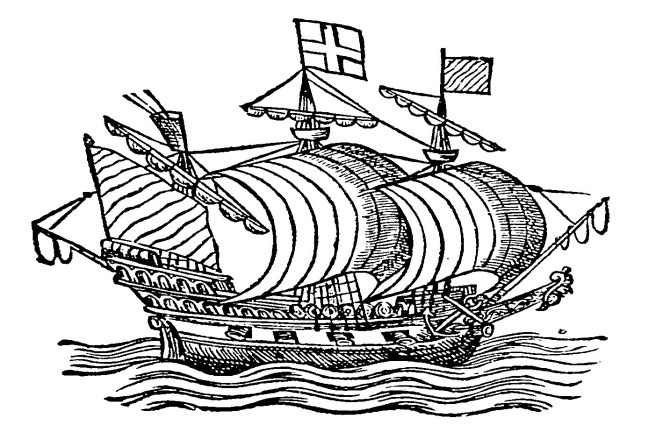
From the little I’ve been able to glean thus far comes statements that Devon was regarded as backward by many, a repository of the “old England” of superstition and legend. It was a place of seafaring, with Plymouth as a principal port and Bristol just to the north, and of large manors with their landed gentry.
The merchants of Devon sent ships far on the sea. It was in their blood.
There are also suggestions of crucial ways its social manners and religious affinities deviated, affecting how Dover residents interacted with the itinerant Quakers.
No, the English weren’t all alike, not by a long shot. Often, they couldn’t even understand the dialect from another part of Britain.
I would love to see a comprehensive study of those Devon folkways along the lines of Fischer’s earlier work. It would no doubt give us a much more detailed picture of life along the Piscataqua in those seminal decades of settlement. How they cooked and dressed, for instance, or raised their children or treated illnesses or buried their dead, as starters.
Still, my upcoming book shares what I’ve found so far.
The conventional explanation that the Puritans migrated to New England for religious freedom misses the obvious.
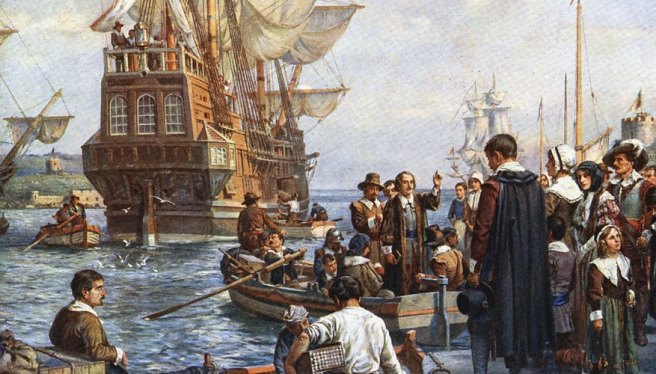
When the Puritans first arrive in 1629, followed the next year with the beginning of their great flood of migration, theirs is a well-orchestrated and well-financed scheme to establish a utopia, one based on their Calvinist Protestant worldview. In many ways, it ranges well beyond the confines of religion.
They set forth in droves.
Crucially, sensing that their mission could be corrupted by false teachings and practices, they squelch unorthodoxy and dissent early on. Within the first decade of their arrival along Massachusetts Bay, they banish Samuel Gorton, Roger Williams, and Anne Hutchinson, who find refuge in Williams’ new colony of Rhode Island. Early Quaker history turns its focus there and neighboring Cape Cod, for good reason, though much also happens north of Boston in Salem, Hampton, and Dover.
Hutchinson’s brother-in-law, the Reverend John Wheelwright, also takes flight and founds the town of Exeter, on the other end of Great Bay from Dover, in New Hampshire.
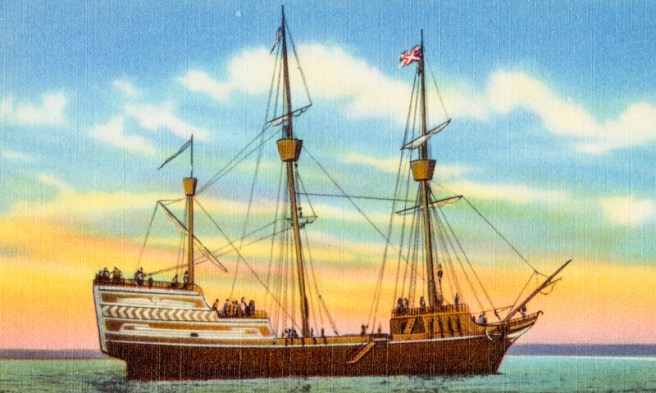
The Arabella, one of the Puritan fleet. Imagine spending two months confined to a vessel like this in often turbulent waters.
Others head more or less straight to Dover. Among them is Hansard Knollys, a minister whose evolving theology will lead him to being a founder of the Baptist denomination when he returns to England. He’s not quite there yet when he formally organizes the church in Dover as a congregational society just six years after its first services. Had he been a bit clearer in his theological evolution, Dover could have established the first Baptist church in America, a year before Williams in Providence. Oh, well.
But that does leave an opening for the Quakers a decade later.
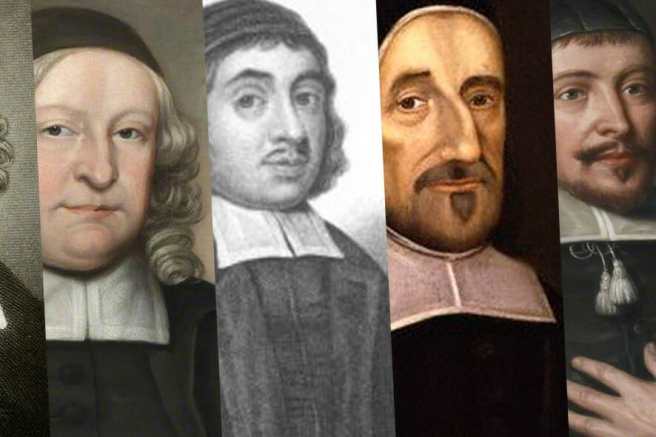
Yes, Puritans. They do look like a smug, judgmental lot. Of course, that’s a judgmental view on my part. I’d hate to get in an argument with them. Ahem.
All the more, I sense that Knollys leaves enough nonconformist thought in his wake to lead some independent spirits in Dover to privately question the ongoing Puritan preaching. As my new book will note, there are hints of that in the town records – supposedly subversive thinking that has to await the arrival of the itinerant Quakers for confirmation and action.
As we’ll see, it’s a volatile mix awaiting the spark for explosion.
Anchoring one end of Eastport’s main street downtown is the Post Office and former Customs House.
Though the Customs role has moved closer to the Breakwater but not so the mail, especially this time of year..
The building still bespeaks of a special authority and order.From the water, it’s a landmark.And inside, the post boxes are pure vintage.As is the staircase up the tower.
Maine is larger than the rest of New England combined, and except for much of Vermont, it was settled much later than the rest of the six-state region. That is, the parts of the state that were ever settled at all. Half of the Pine Tree State has no year-round population at all, for good reason.
The result is that there are paved roads where you can drive for miles and see nary a utility line or a mailbox, much less a house. Often, the only human activity you detect is timbering or mining. Hunting and fishing are a way of life. It wasn’t that far out of Bangor I used to see the bear-hunt guide sign.
Those roads remind me of driving from town and out toward a mountain pass on my way to trails in the high country out West.
There are trails for hiking or ATVs just about everywhere, many of them through conifer forests like those of the Far West. Here’s one at Shackford State Park within Eastport’s city limits.
Downeast Maine’s open blueberry barrens on the ridges, meanwhile, give me a sensation of the Big Sky Country of Montana or the Horse Heaven Hills of Washington state, except that the blue overhead isn’t the same deep intensity.
I believe that the presence of Indigenous peoples is another part of the mix. Eastport is adjacent to the Passamaquoddy’s Pleasant Point Reservation, as we’re reminded every time we drive to or from our island. They’re one of the four tribes comprising the Wabanaki Alliance in the state.
Yes, there is a kind of frontier feel around here. I’d suggest calling the area the Far East, but that name’s already been taken.
Fact is, many of the old ships that sailed to the Far East were built along these shores rather than those of the Far West.
Sandwiched in between the arrival of Pilgrims at Plymouth and the Puritans at the Massachusetts Bay colony, we have the libertine plantation at Mare Mount, or Merrymount, on Boston’s South Shore. It’s a provocative whiff of how New England life could have turned, had Thomas Morton successfully warded off the rival raiders.
The very name “merry” at the time was often a synonym for sexual trysting. As for Merry-Mount? It couldn’t have been more graphic.
Unlike Plymouth, this settlement was prospering and welcoming misfits.
Think of hippie. Maybe even commune. Dancing naked with Natives around a giant maypole, one that’s flagrantly phallic. Not just pagan but also reflecting some lingering Devonshire traditions taken to an extreme. (Significantly, for comparison, most of early Dover’s settlers came from Devon, not the East Anglia of Puritan culture.)
Thomas Morton, founder of Merrymount and a thorn in the Puritans’ side
That’s the short version, though there’s much more sketched out in my upcoming book.
And after Merrymount comes crashing down, its founder finds shelter in Sir Ferdinando Gorge’s Maine, not far from Dover.
No, early New England wasn’t all stern Puritans, not by a long shot, no matter how much they tried to keep a lid on.
Nearly two decades later, facing the Quaker outbreak, did Puritan authorities fear the Friends movement might trigger another Merrymount in their midst? As I’ll show, Quakers were anything but quaint and respectable when they show up, though I can assure you they stayed sober rather than make merry. Ahem.
But they were still an alternative to the Puritan rigidity.
When Edward Hilton settles on Dover Point, his brother William is dwelling in the Plymouth Bay colony. It’s one more suggestion, in fact, that Edward knew about the Piscataqua watershed before setting forth himself.
William arrives on the second ship to the Pilgrim plantation, followed by his wife and family on the next. They definitely aren’t Pilgrims (the term wasn’t even in use then – Separatists was more accurate). And, for that matter, despite sharing a basic Calvinist theology, the Separatists hold some sharp differences from the Puritans who show up later.
Critically, roughly half of the settlers at new Plymouth aren’t members of the Separatist faith. And that includes the only ordained minister in the colony.
Thus, when William and his wife arrange for a secret Anglican (that is, Episcopal) baptism for their infant, a scandal erupts that sends them scurrying northward and brings to light the sordid background of the now disgraced minister who is promptly banished. (No spoiler here – but you’ll still have to read the book.) These events do present a grittier alternative to the Thanksgiving scenario we usually trot out about the Pilgrim experience.
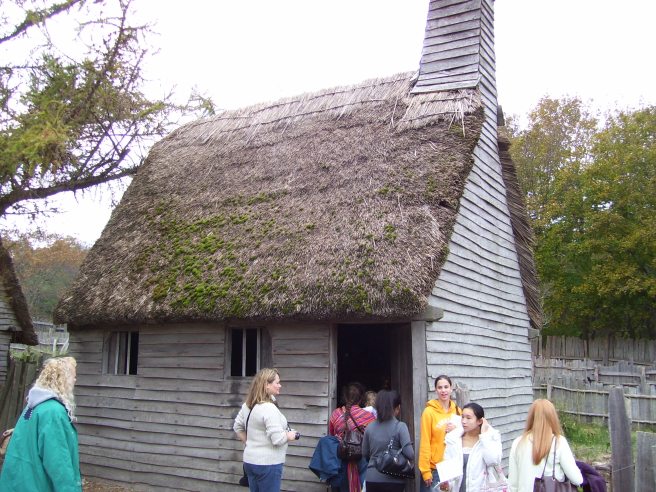
I wonder how much early Dover resembled the 1630 village at the Pilmoth Plantation living history museum. These houses were dark and drafty, at best. Photo by Swampyank via Wikimedia Commons.
William winds up in New Hampshire, settling at the Pannaway plantation at the mouth of the Piscataqua River, where he’s soon making salt to be used for preserving fish for shipment.
And then, in the demise of Pannaway, he’s finally at Dover Point.
This isn’t the way his arrival in Dover is commonly painted. Quite simply, he isn’t one of the first two settlers. Thomas Roberts, Edward’s apprentice, earns that honor.
Still, like his brother, William is both a member of the powerful fishmonger guild in London and literate. And things get a bit rowdy when he moves on from Dover to live on the Maine side of the river.
Yeah, if you’re looking for gossip, there’s some juicy stuff on his part, especially when we meet his last wife. She’s definitely not holier-than-thou.
It’s hard for modern Americans to understand a basic reality of European colonies in the New World.
None of the players in the story own the land they’re dealing with.
Not the settlers, even though they’re clearing it and building on it.
Nor the proprietors or investors, either. They’re more like developers who offer leasing opportunities. Think of rental agents.
Nor the Indigenous tribes, surprisingly, even though many of the settlers also negotiate a payment to them for their land. The use of their land, more accurately. Admittedly, the payments are largely symbolic – a bushel of corn a year, for example.
No, quite simply, all land “belongs” to the king, and he allocates the privilege of using it as a means of leveraging his own prestige and power.
Under the feudal system, that would mean grants to barons and other lords in return for their fealty.
They, in turn, could dole some out to knights, who then become wealthy, as well.
Add to that the gentlemen farmers, living off the rents to their estates.
And then yeomen, who are still free on their own tenants, as their small holdings were called.
And husbandmen.
And, somewhere below that, the serfs who are bound to the land and its holder. Well, by this point in time, they’d been freed but were still at the bottom of the ladder.
King James I
~*~
THIS IS THE MODEL OF LANDHOLDING – not landownership – up through the American Revolution.
Its assumptions are quite different from those of modern Americans. What do you mean? I don’t own the ground under my house and barn?
No, you don’t. And you still have to pay rent on it.
~*~
AS A FURTHER COMPLICATION, charters could be revoked or rewritten.
Falling out of the king’s favor would have costly and dire consequences.
As my upcoming book describes, this land arrangement affected Dover and the rest of New England through a series of realignments and controversies and attempted evictions.
In fact, it almost leads to a rebellion in Boston Harbor against the king a century-and-a-half before Paul Revere’s midnight ride. Well, that’s one aside I don’t develop. There’s too much else going on along the Piscataqua.
Now owned by the Tides Institute and Museum of Art, the post is being renovated to include a significant Civil War-era collection and display.
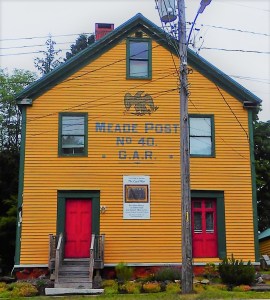
Eastport’s Civil War veterans had good reason for naming their Grand Army of the Republic post after Major General George G. Meade. Not only had he commanded the successful Union troops at the Battle of Gettysburg, he was stationed in Eastport after war to curb the Fenian Rebellion, an Irish liberation attempt that had organized in the United States and conducted raids in neighboring Canada.
During his time in Eastport, he caught pneumonia and nearly died, and some residents got to know him first-hand. One – the wife of the owner of the house where he was staying – complained bitterly for years afterward about his poor aim in spitting tobacco juice all over her home. Let’s hope he was better with a firearm.
The local post wasn’t the only one named in his honor, by the way, and the organization itself became a powerful force within the Republican Party, helping to elect at least four its members to the White House and pressing for progressive legislation.
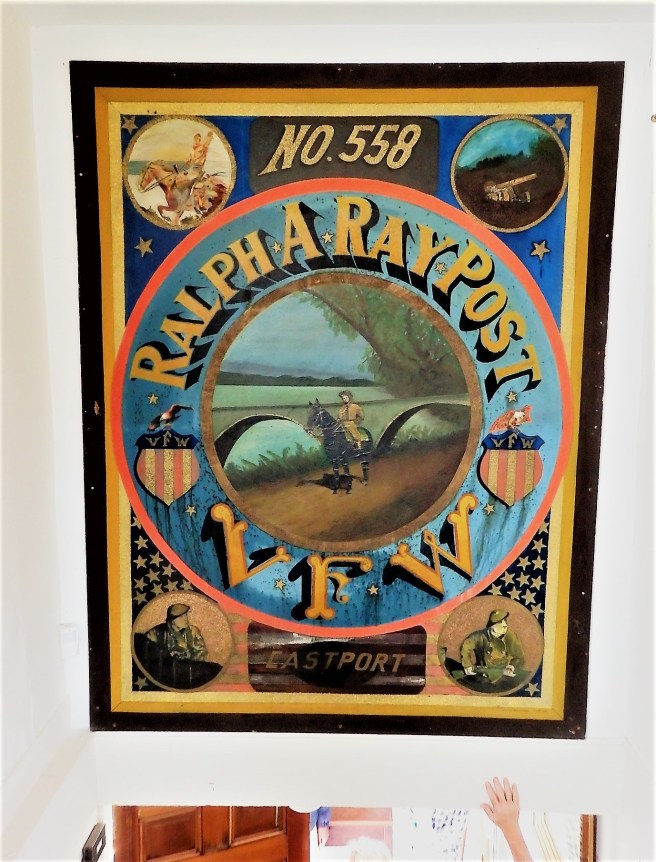
In 1881, the local post took over a two-story frame structure at 6 Green Street as its meeting hall. As its membership – limited to Union veterans of the Civil War – died off, the building passed to the local Veterans of Foreign Wars for its post. The building next door included a bowling alley, roller skating rink, and dance hall all fondly recalled by youths of the time.
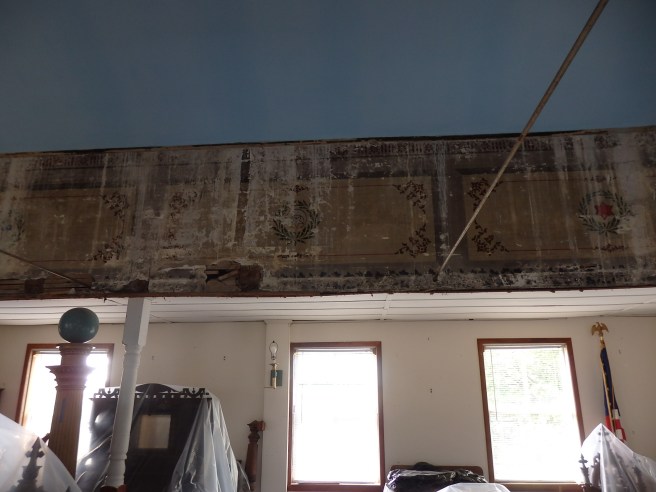
Nobody knew these were overhead.
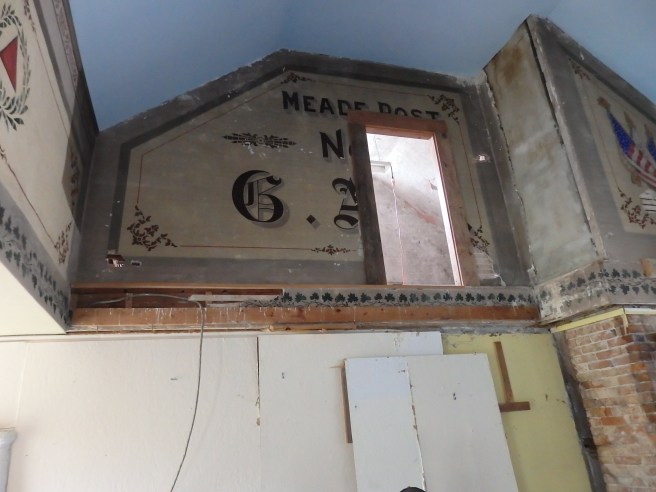
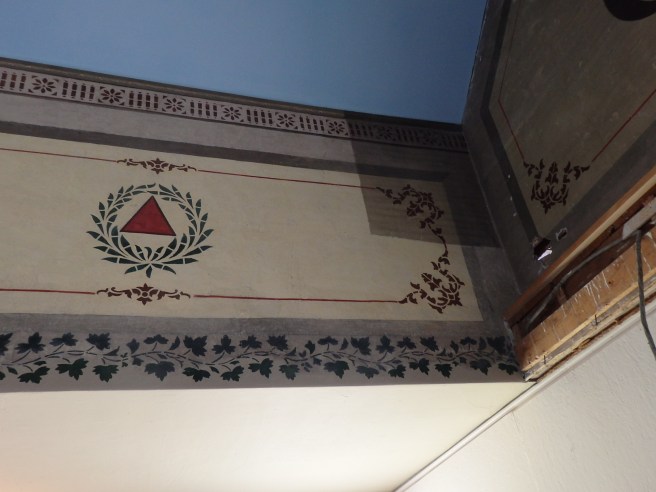
The murals and ceiling were long hidden by a dropped ceiling and rediscovered only shortly before 2014, when the building was gifted to the Tides Institute and Museum of Art.
The mural runs the length of the roughly 40-by-25-foot room and includes images of eight Army corps badges.
Tony Castro of New Gloucester, Maine, has been renovating the murals. Despite severe water damage, they may be the only surviving interior of their kind in the state.
The patch at upper right shows how this section looked before its restoration.
The Tides Institute has also been gifted with important Civil War artifacts and documents, which may be displayed as the museum adds gallery space.
A sign from the hall’s later use as a Veterans of Foreign Wars post.
From the git-go, there’s been a rivalry between Portsmouth and Dover, though a closer look reveals it’s more nuanced than what we usually think.
The 1622 contract for developing the Piscataqua watershed allows for more than one vessel to arrive and more than one settlement to be planted along the river.
Scotsman David Thomson is the head of the operation. He sets forth in the Jonathan and establishes his fortified Pannaway plantation at the mouth of the river in today’s Rye – not Portsmouth, contrary to the Port City’s claims of founding. He’s highly placed politically, somehow having the ear of King James I. And specifically, he’s the only one named in the grant.
Pannaway faces the open Atlantic, with salt marsh to its back.
As the scene stands today. The landscape has changed but not the waterways.
~*~
IN CONTRAST, when the Providence arrives a month later, she apparently sails straight up the river to today’s Hilton Point aka Dover Point, where Edward Hilton and Thomas Roberts then set up operations. They disembark at Pomeroy Cove, which they name for Leonard Pomeroy, one of the three principal backers of the project. He’s also Lord Mayor of Plymouth, England, home of the company, and co-owner of the ship that’s brought them this far.
As I detail in my upcoming book, Hilton likely knew of the site even before setting sail. It was far enough inland to be sheltered from violent storms. Vast forests extended from the riverbanks, with timber for shipbuilding, piers, and barrels as well as homes and bridges and wild game for the taking. Best of all, the point was a confluence of rich tidal waters, with the Great Bay estuary on one side along with its tributary streams and, on the other side, the Piscataqua and its Cochecho and Salmon Falls rivers. Cod, salmon, sturgeon, eels, herring, oysters, clams, and lobsters are bountiful. Why go out to sea when the fish come right up to you?
While Pannaway is thoroughly documented, in part through its stream of visitors, its existence is short-lived, and the site’s abandoned by 1626, when Thomson relocates to an island in Boston Harbor and disappears soon after. His widow then promptly marries Samuel Maverick – yes, the source of that word. It’s a rough-and-tumble world.
~*~
OUT OF THE SPOTLIGHT of documentation, Hilton and Roberts continue on, in time joined by Edward’s brother William and their sister or possibly cousin Rebecca along with more family.
Either way, Roberts and Rebecca soon marry and start a farm about a mile from the point – they later move it another mile-and-half – but theirs will still be the oldest family-owned farm in the future United States well into the 20th century.
The Hilton Point settlement as it’s commonly been envisioned.
It must have been lonely through much of that first decade. The Hilton-Roberts clan was definitely on the frontier, and ongoing war in Europe cut off much ship traffic.
How much, if anything, did Hilton Hall originate in the early settlement at Dover Point? If the house was anywhere near this size, my perspective changes completely.
Edward Hilton is, however, definitively rewarded for his six years of habitation and hard labor by a charter giving him clear control at Dover Point. And they must be prospering, as seen in assessments placed on their province or his brief return to England for the legal document, perhaps a fish delivery, and definitely a marriage.
While Thomas and Rebecca Roberts remain in Dover for the rest of their lives, her brothers eventually move on – Edward to Exeter and William, by degrees along the Maine side of the Piscataqua. All of their lives take colorful turns along the way, which I relate in the book.
Even though Portsmouth baldly claims 1623 as its founding date, it had no European settlement until the Laconia Company chose to set up operations there in 1629 or 1630, calling their site Strawbery Banke. Yes, that was one more convolution of investors.
~*~
AND THAT’S THE BARE-BONES VERSION. There’s plenty in my upcoming book to flesh it out, some of it rather earthy – especially when we get to the contemporaneous and scandalous Merrymount plantation down on Plymouth Bay.
Fact: New Hampshire is the second-oldest state to be settled in New England. Older than Connecticut, Rhode Island, Maine, or Vermont.