One of the unanswered questions in Colonial history is why the anti-Quaker acts weren’t applied uniformly. Only in bursts, apparently to curb their political influence. In small communities across New England, Friends were important parts of the economy and social life – and often related by marriage to the dominant Puritans.
Still, during the yearly years of Quaker existence, much of the activity continued more or less underground. Friends’ absence from the town church may have been condoned if for no other reason than to avoid their nuisance.
Then, in 1679, the revocation of the Massachusetts Bay colony’s charter reestablished New Hampshire’s independence and also allowed for Friends both there and in New Hampshire to finally formally establish their Meetings.
After decades of worshiping in homes, barns, outdoors, or other places, Friends could finally build their own meetinghouse.
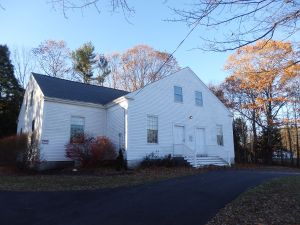
Dover’s first meetinghouse, just south of today’s St. Thomas Aquinas High School, was one of the oldest in the New World. After the erection of the town’s third Quaker meetinghouse, in 1768, the first building was shipped across the Piscataqua to a site a mile away up Sturgeon Creek.
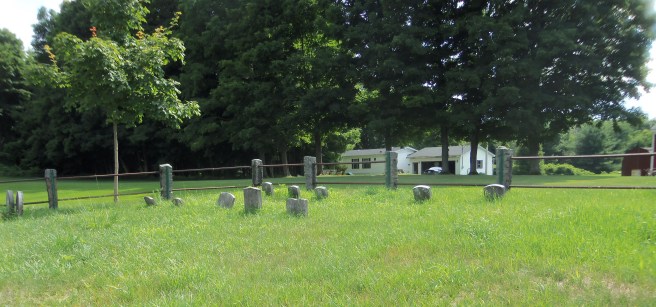
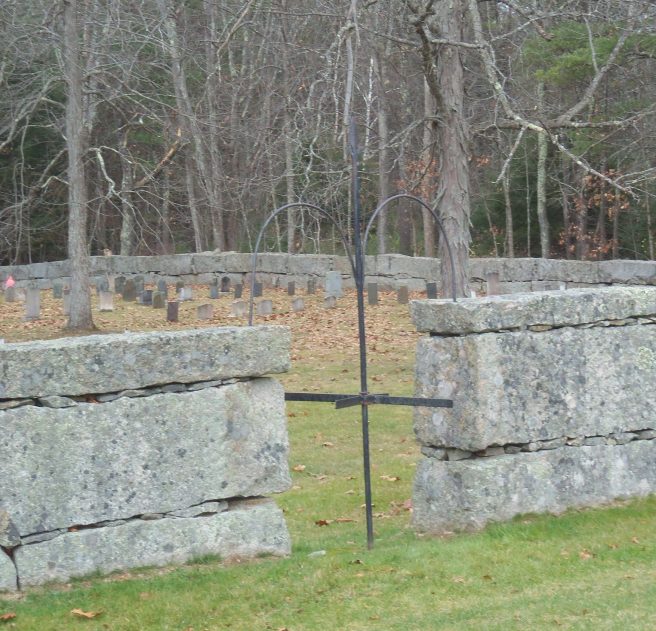
Dover’s first Quaker meetinghouse was to the right of the Pinkham cemetery.
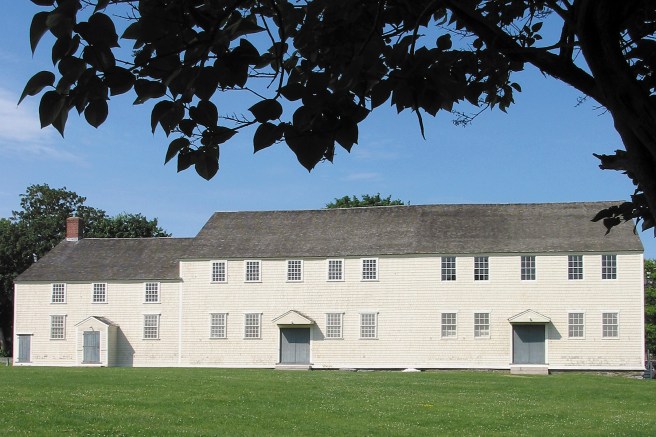
Salem, Massachusetts, claims to have built the oldest, but Dover’s may have been earlier – now, if only some solid documentation existed to support that claim.
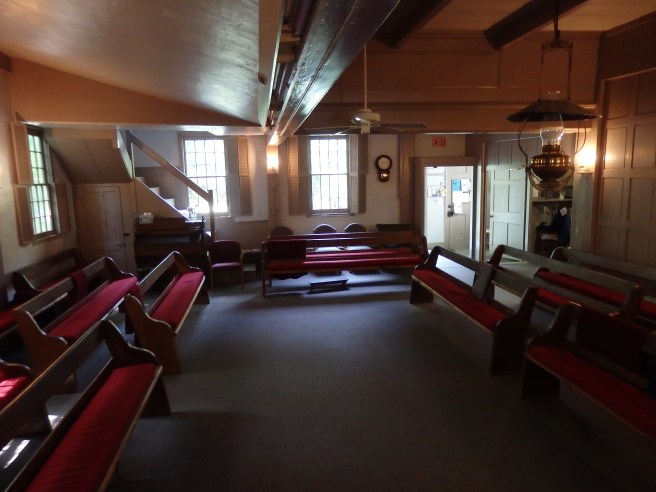
Did it resemble the one built about the same time in Salem, Massachusetts? (Photo by Kathleen Wooten)
Around 1680, with the lessening persecution, Dover Friends were able to formally organize into a Monthly Meeting, although they were already the fifth oldest worshiping body in New Hampshire. After years of gathering together wherever they could find, the Quakers erected their first meetinghouse, choosing a site on Dover Neck on a site between today’s Pinkham Cemetery (begun in 1700) and across today’s Dover Point Road from the Roberts farm and First Settlers Cemetery (1633). The structure remained there until Dover Friends erected a third meetinghouse in 1768, and the original was disassembled, ferried across the Piscataqua River, and rebuilt in Eliot – about a mile to the east, not far from the site of the Shapleigh manor where the three Quaker women had earlier found haven. By road, incidentally, the two meetinghouse sites are more than ten miles apart. Although Eliot/Kittery is sometimes honored as the first Quaker meetinghouse in the Maine colony, that designation may belong to Friends at Falmouth, who are believed to have constructed their own in the 1750s.
The Dover Neck Friends meetinghouse was among the first in the American colonies. Between 1672 and 1682, only seven had been constructed in heavily Quaker New Jersey, and perhaps only four in Pennsylvania. Third Haven, on Maryland’s Eastern Shore, was open by 1682 and remains the oldest Friends meetinghouse in continuous use. The oldest confirmed date for a Quaker meetinghouse in New England is 1688 in Salem, and a reconstruction of that building is on the grounds of the Peabody-Essex Museum.
~*~
Check out my new book, Quaking Dover, available in a Nook edition at Barnes & Noble.
Although it’s offshore of Cape Cod and close to Rhode Island, Nantucket Island was purchased by investors mostly from the Merrimack River watershed just south of the Piscataqua. Prominently, however, one was from Dover – Edward Starbuck. And his son-in-law, Peter Coffin, was another.
Edward’s the origin of the Starbuck surname in America, a signer of the 1640 Dover Combination, and a prominent figure in Dover’s early history. The name also shows up as Starbird or Starboard.
And, no, these Starbucks weren’t known for their coffee.
Before the arrival of the Quakers, Edward was an elder in First Parish, but historian George Wadleigh cites two curious controversies.
In 1648, “The Grand Jury presented Elder Starbuck for disturbing the peace of the church, and for refusing to join with it in the ordinance of baptism; for which he was admonished and discharged.”
Discharged, we can assume, from the office of elder, and not simply having the charges discharged.
(This was a month before future Quaker Richard Pinkham was ordered to start beating the drum to summon congregants to the Sunday service.)
In 1649, the baptism issue apparently involved the matter of children, perhaps his daughter Shuah, but then spread to his very hairstyle.
“The Court being informed of a great misdemeanor committed by Edward Starbuck of Dover, with profession of Anabaptism, for which he is to be proceeded against at the next Court of Assistants, if evidence can be prepared by that time, and it being very far for witnesses to travel to Boston at that season of the year, appointed Captain Thomas Wiggin and Mr. Edward (George?) Smith to take the testimony of the witnesses for the prosecution of Starbuck, whose offence, apparently, was the wearing of his hair beyond the statute length, ‘after the manner of ruffians and barbarous Indians,’ which had been decreed by the Court to be ‘sinful.'”
Let’s note that Anabaptism here doesn’t mean Mennonite. The term was applied to many who objected to the Puritan orthodoxy.
I suspect that some of Edward’s opposition to infant baptism was stimulated by Hansard Knollys before his hasty departure from the First Parish pastorate. Knollys, after all, then became a founder of the Particular Baptists back in England, and as elder, Edward would have been close to him.
Nantucket Island was soon famed for its whalers, and perhaps notorious as a den of Quakers.
I’m uncertain whether Edward had any connection with Quakers in Dover before he removed with his family to Nantucket around 1660, but his Dover-born son Nathaniel definitely identified as a Friend.
In fact, Nathaniel’s wife, Mary Coffin, was a powerful Quaker minister who’s credited with converting the whole island to adopt the faith or at least make it the official town church. Besides, by doing so they wouldn’t be taxed to support an ordained minister.
Mary’s father, Tristram, was one of the island’s proprietors and originally from Devonshire as well as the progenitor of a line in Dover.
Edward Starbuck, meanwhile, was from Derbyshire.
Further connecting the two families as the marriage of Edward’s daughter Abigail to Dover resident Peter Coffin, also prominent in the settling of Nantucket Island and a cousin of Mary.
Another daughter, Sarah, married Joseph Austin, who showed up in Dover around 1647 as part-owner of a sawmill. He was born about 1616 in Dover, Kent, England, and appeared in Hampton, New Hampshire, in 1642.
They had six children before his death on June 27, 1663. She then married Humphrey Varney. Many of her descendants by each husband were Quaker.
Four of the children moved to Nantucket Island: sons Benjamin and Nathaniel and daughters Mary, who wed Richard Gardner, and Deborah, wife of John Coffin.
Their son Thomas remained in Dover and married Ann Otis, daughter of Richard Otis and Rose Stoughton. Together they had fourteen children who then became the stem of the family that proliferated in Dover Friends Meeting.
~*~
Check out my new book, Quaking Dover, available in your choice of ebook platforms at Smashwords.com.
Welcome to Dover’s upcoming 400th anniversary. Its influence is wider than anyone I’ve found has suspected.
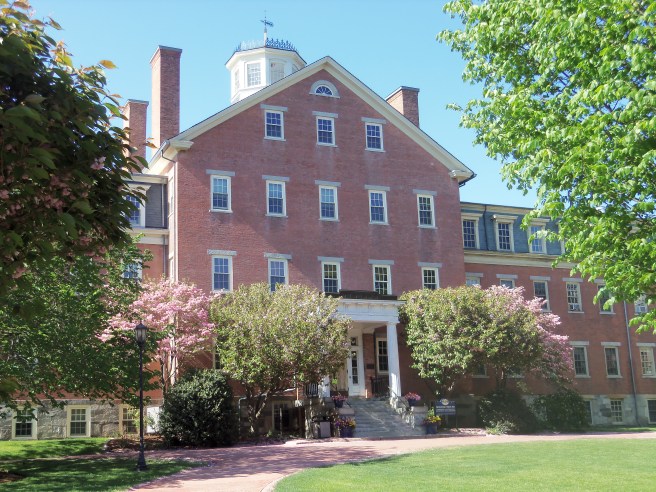
Some of these have already passed into oblivion, but they were still part of the transformation.
Window screening. Maine is loaded with black flies and mosquitos. Somebody still had to go outdoors, though.
Steamships. Not just allowing you to get away or back, but conveying the mail, especially. Think Internet and email for comparison. Remember, Eastport was a major port, including the exportation of canned sardines.
Railroads. Ditto for mail and newspapers. As well as exporting goods to market. Or deliveries back. (Think Amazon.)
Canning. Home canning, of course, but also grocery stores. Out-of-season food options suddenly exploded. Winter wasn’t mostly beans. Not that we’re so fond of it now that we have frozen food choices. But sardine canning also became the economic powerhouse of Eastport.
Sanitation. Let’s start with antiseptics and move on to indoor plumbing as well as the rotary washing machine. Nowadays, that also means the clothes dryer and dishwasher.
Electrical lighting. Especially in those truncated winter nights we have up here.
Linotype. I used to live in Baltimore’s Bolton Hill, where its inventor resided. Daily newspapers and cheap books became commonplace.
Telephone. Did any other invention save more steps? Or do more to relieve loneliness?
Sound recordings. You no longer had to be a musician to have decent music any time you desired.
Automobile. John William Lambert invented the first practical American gasoline automobile in 1891 in southwest Ohio and later moved his operations to Anderson, Indiana. I remember visiting a friend and seeing an old car with an impressive Lambert name in brass across the radiator sitting at an open garage door. “Ann,” said I, “is that car any relation to you?” She replied that her grandfather used to make them but otherwise conveyed no knowledge that he had been so prominent a figure.
And let’s not forget toilet paper to our roll of advances.
Devastating downtown fires were a big hazard for 19th century American cities, large and small, from New York, Chicago, Boston, Baltimore, Pittsburgh, and St. Louis down to Portsmouth, New Hampshire, and Portland and Bangor, Maine, closer to home. (For the record, San Francisco actually suffered more from the fires than from the 1908 earthquake just before them.) It’s a long list, actually, and some center cities were leveled by flames and intense heat more than once.
Eastport was one of them, with great fires in 1839, 1864, and 1886 – the last one barely missing our house but leaving the rafters spookily charred.
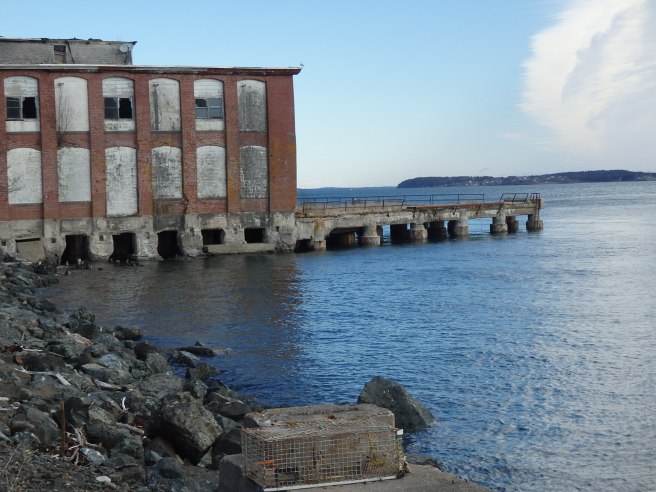
That blaze, in October, started in one of the sardine factories on the waterfront and spread quickly, consuming almost every building along the harbor.
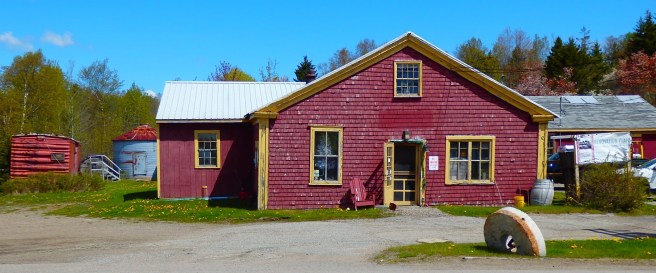
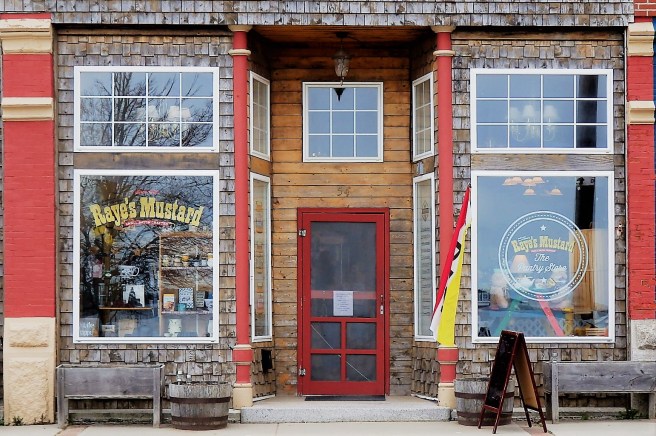
An antique store window is fun to browse, even when the shop’s closed.
Remarkably, the city rebounded quickly, with most of the Water Street buildings completed and reopened within the next year or two – many of them designed by the same architect and resulting in a visual unity for the five-block stretch.
Today the entire downtown district is on the National Register of Historic Places.
Still, here’s what we have. Put another way, every city needs a center, and a shopping mall just ain’t the answer.
The big challenge, of course, is finding the right mix of business and residence to keep it vibrant. Eastport’s off-season populace falls short of what’s needed but just may be changing in the aftermath of Covid-19.We have art galleries, thank you.
A downtown is more than a place to shop, for one thing, though that helps. It should be pedestrian friendly, with places to stop and sit and meet folks and chat or maybe just stroll afterhours. Cafes, restaurants, and pubs help, too. A post office and banks as well. Throw in a few theaters, nightspots, galleries, churches. Then offices, hair stylists and barbers, upstairs residences, even a hotel or more.
A tucked-in amphitheater overlooking the harbor actually has concerts in the summer. It also provides one more place to simply sit and relax.The street’s not one-way but should be, if we could only conveniently connect it as an easy round-trip..
Tell us something that makes your community special. Where would you take us if we visit?
Puritans had many fears regarding the Quaker outbreak and thus targeted Friends far more severely than any others. Quakers, for all their objections, were in debt to radical Protestantism like the Puritans’ more than they were (and are) willing to admit, yet they also stridently demanded that believers take holy perfectionism to a higher order than the Puritans would or could. More inflammatory, Friends openly criticized and even ridiculed Puritans for falling far short of that goal.
Puritans, in response, viewed Quakers as a chaotic threat to godly and social order and watched suspiciously and intently for signs of witchcraft.
Nothing, apparently, inflamed Puritan authorities more than the Quaker embrace of endorsing both men and women in public ministry.
Quite simply, Friends touched a sore, raw spot in the Puritan worldview. Sometimes, the ones you criticize most harshly who are those most like you. (That’s something that’s been observed in literature, especially.)
Preaching by Quaker women on the street and other public places was common at the outbreak of the movement.
~*~
WHILE FRIENDS DID NOT ORDAIN or hire individuals to prepare sermons for delivery from a pulpit each week, they did welcome appropriate vocal messages arising in their otherwise silent gatherings in worship. Appropriate were utterances deemed prophetic – explosive mixes of personal perception and Scripture that Quakers felt were being delivered by oracles of the divine – and those who voiced them consistently were endorsed as ministers. Quickly, a unique incantatory style evolved, regardless of the speaker’s background. It did, however, baffle many stuffier types, including the Puritan clergy.
The three Quaker women who were stripped and whipped out of Dover in 1662 were far from alone. Anne Hutchinson had already born its weight in New England earlier. Her adherents had, in fact, nearly toppled the Puritan polity from its position.
Other women Quaker ministers soon returned to Dover, notably the elderly Elizabeth Hooton.
She appears to have been a public preacher among the General Baptists in England, even before she took under her wing a young George Fox, who is generally considered the founder of the Quaker faith. Contrarian that I am, I consider her to the first Quaker, the one who converted you, George.
What she suffered in New England was horrific.
Quite simply, Hooten was a tough old bird. God bless her!
You’ll find a lot more about her in my new book.
~*~
MANY FOLKS THINK OF A QUAKER SERVICE as silent, or what we sometimes call “open worship,” and while many Meetings today have pastors, others – including Dover’s – observe mostly a profound silence occasionally punctuated by a vocal message, song, or prayer.
The practice continued once Friends had settled into more orderly Meetings.
Historically, though, a Friends Meeting often had long, impromptu preaching, often of a half-hour or more. Among the Dover members recorded in that role were Tabitha and Mehitable Jenkins, Valentine Meader, Mary Bunker, John Twombly, Benjamin H. Jones, and Amos Otis.
Dover Friends also welcomed itinerate ministry from visitors, some of whom spent protracted time in town. One was the English Friend Samuel Bownas, who may have “learned silence” here. He’s best known for his book, A Description of the Qualifications Necessary to a Gospel Minister, which sought to curb affectations that had crept into the practice. His guidance still helps.
From their journals, we glean sharp insights into the life of Dover Meeting and nurture of spiritual experience. Even their encounters addressing the wider rough-and-tumble community.
~*~
Check out my new book, Quaking Dover, available in your choice of ebook platforms at Smashwords.com.
Welcome to Dover’s upcoming 400th anniversary. It wasn’t just any old town.
Comedians Bob and Ray had a regular schtick involving a radio advertisement for Monongahela steel ingots as home décor. You know, “Hey, ladies, are yours getting rusty,” sort of spiel. Usually, it was sitting in the living room.
Having lived in the Rust Belt not far from the Monongahela River, I knew about the massive pig-iron ingots riding flatbed trailers from one part of town to another. Who knows how much they weighed – the trucks carried no more than two at a time – the beasts looked deadly foreboding.
Our equivalent was in the kitchen, though better dressed and somewhat smaller.
The Classic Round Oak Chief was a top-of-the-line cooking stove that ran on firewood, coal, or kerosene. After 1898, they were manufactured by the “estate of P.D. Beckwith” of Dowagiac, Michigan, and featured a popular mascot, fictional Native American Chief Doe-Wah-Jack – a sly way of teaching the pronunciation of the town. They’re highly collectible in restored condition, but that means getting to a buyer in some other part of the country.
I’ve used wood cooking stoves, back in the ashram, but I wasn’t so sure about this one. I didn’t like the way the stovepipe ran somewhat downhill – smoke rises, after all – or the way it vented into the same chimney the furnace uses, something that’s against building code today.
Besides, the weight of this one was definitely stressing the house structure.
Worse yet, it occupied the center of the small kitchen, and in our life focus, we need more space there – as well as a working oven, year-‘round.
Quite simply, it had to go. And it did.
We’re happy it found a new home – one being built, as it turned out – as well as a crew that knew expertly how to get it apart and out the door.
As for wood heat, which we truly enjoy, we’re planning on a Jotul in the front parlor and a new chimney or pipe to vent it.
When a commercial publisher issues a print edition of a new book, the process includes a long buildup. Advertising and press releases go out ahead of a release date, followed by the mailing of advance reader copies for reviewers, retailers, and involved parties to examine. The author might even be signed up and prepped for a book tour of public readings and interviews.
It hasn’t been quite that orderly for ebooks, though things are shifting.
~*~
Check it out at Smashwords and its associated digital ebook retailers.
A pre-release period is one alternative strategy. It gives booklovers an introduction to a coming attraction and an opportunity to be among the first line up for a new work, often at an attractively discounted price.
In effect, this creates two release dates – an advance ordering period followed by a second big occasion when the book itself is finally “published” and available to all. It’s one way for authors to build up a stronger initial sales tally on opening day, tweaking the important algorithms that determine the placement of the work in the digital lineup where it can be more easily seen.
Even a few buyers can make a huge difference, and this approach avoids the uneventful situation of simply dropping the book, ragtag, into the marketplace.
In my case, the big release date is set for September 8 at Smashwords and its affiliated digital bookstores, including the Apple Store, Barnes & Noble’s Nook, Scribd, and Sony’s Kobo. And until then, it’s being offered at half price.
~*~
This option also allows me time to tweak the text, if necessary, and invites you to share in building a buzz. Nothing beats word of mouth, for sure.
Quaking Dover is one work where people have told me they want to read the book when it comes out, and here’s their chance to confirm that.
We’ve been looking at fundamentals that set early Dover apart from the rigid Puritan culture that dominated the Massachusetts Bay and Connecticut colonies.
What we’ve also seen is that other localities settled before the great Puritan migration also had conflicts in the face of what is widely presumed to be characteristically colonial New England. Notably, these were Cape Cod; Salem, Massachusetts; Hampton, New Hampshire; and Maine – all of which harbored Quakers. Merrymount, we should note, was one settlement the Puritans outright eradicated through violence.
I’ve been arguing that folkways from Devonshire were far more influential in Dover’s soul than was the commercial nature of the early charters. The Puritans who put down roots in Dover were largely from Devon, not the East Anglia of the Massachusetts Bay arrivals.
One thing that puzzles me is the reticence of the Church of England to establish parishes in New England colonies before Massachusetts subsumed New Hampshire and then Maine. Many of the inhabitants identified as Anglican and preferred its rites but were without priests and guidance. They privately chafed at the Calvinist strictures, and some openly welcomed Quakers who ultimately entered as the principal alternative.
I suspect it wasn’t our message that attracted the early converts as much as our very presence and timing. You know, that “perfect storm” thing.
The upshot was that by the time Dover entered its fourth decade, it was primed for a Quaker seed to land and sprout, with roots here reaching all the way back to one of the very first settlers of the province as well as a few other independent spirits.
The ground itself and surrounding waters proved to be fertile for Friends. Not that the first decades would be easy.
Let’s just say it’s not just size that makes Dover different from Boston.
~*~
Check out my new book, Quaking Dover, available in your choice of ebook platforms at Smashwords.com.
Say what you will, the Chamber of Commerce lists the Hillside Cemetery as a thing for visitors to do here.
It’s unlike other celebrated burying grounds across New England I know of. There are no Colonial three-bump gray slate stones, the ones with the famed death angel heads, for one thing.
This one is newer, meaning mostly 1800s and Victorian, when the town thrived. Yet many of the inscriptions, in softer stone, have weathered to illegibility.
Many of them lean precariously or have toppled over, giving the site a spooky feel. Or at least neglected, even though it’s mowed regularly. The sandy soil itself is anything but level, instead mounded over many of the family plots.
Yet I keep going back, often reading between the lines.
Quite a flourish
Many of the men and women died young, along with a large percentage of children.
Young Sammy
Many of the stones tell of birth origins elsewhere in Maine or even New Hampshire and Massachusetts, as well as a few defiantly proclaiming “born in Ireland.”
A toppled memorial.
Many of the names begin with “Capt.,” sometimes followed with “lost at sea,” which is also found on other stones of first mates or sailors. Others tell of falling in Civil War action – many New England towns suffered heavy tolls.
Some of these markers were erected as memorials, with no bodies buried below.
Fittingly, in places as I walk, views of the ocean and islands in the distance open below me.
Alexander Shapleigh, an eminent merchant, sailor, shipowner, and shipbuilder from Kingswear in Devon, knew the New World coasts early. For instance, on September 20, 1610, he was recorded as master of the Restitution of Dartmouth when it was seized by the pirate Robert Stephens while returning from a fishing voyage to Newfoundland and bound for Portugal.
It wasn’t the only ship he owned. The largest was the Golden Cat, of 450 tons – twice as large as most of the ships of the time, such as the Mayflower, and three times as large as Sir Francis Drake’s Golden Hind.
Alexander and his descendants were soon pivotal in the founding of Maine. His son-in-law, James Treworgy, served as his principal agent.
Treworgy was instrumental in the purchase of five hundred acres at Kittery Point in 1636 and the erection of the first house in today’s town of Kittery – one that would later be occupied by William Hilton when he moved from Dover Point. Under the agreement, he was “to pay annually 100 of Merchandable Codde dride & well conditioned as Acknowledgmt to the Royaltie of Sir Ferdinando Gorges Knight … to be payd … uppon the Feast of St. Michaell ye Arch Angell. Moreover if hereafter there shall be any Profitt to be raised for Keeping a ferre within the sd Limmetts yt then Sir Ferdinando Gorges Knight … is to have One Halfe of the Benefit & Mr John Treworgy … the other Halfe.”
Perhaps the Hiltons had a similar agreement with Mason and his heirs.
On January 10, 1637, Shapleigh also obtained another eight hundred acres in today’s Eliot, where the next year he built a large dwelling known as Kittery House, named after his manor of Kittery Court overlooking the River Dart in Kingswear and lending the Maine town its name. The new house was two stories that included a kitchen, cellar, and garret – ten rooms in all, plus a brewhouse, barn, and outbuildings. It is said that the first cup of tea in this country was brewed here.
A stretch of Hilton Point, where Dover was first settled, is seen from the Maine site where Alexander Shapleigh erected his Kittery House and mills.
The Eliot site was on Sandy Hill straight across the Piscataqua from Hilton Point, at what’s sometimes referred to as Watts Fort or Point Joslyn. Here he also built a sawmill and another mill both powered by the tide at today’s Shapleigh Old Mill Pond, which adjoins the river. Tide pouring into the pond in one direction ran the mill, as did the release of impounded tidewater on its release. The Eliot estate soon emerged as the base of Shapleigh operations rather than the property at Kittery Point downstream from Portsmouth.
The proximity to the Hiltons across the river underpins a much different understanding of early development of the region than I’d previously imagined. Barely a mile separated the two settlements. The importance of today’s Eliot and the three Berwicks in those years turns out to be greater than the conventional histories convey when they refer to the locations as Kittery, the town that encompassed them, suggesting that those events took place far downstream in the shadow of Portsmouth. Not so.
Quite simply, the development Dover – and later, its Quakers – was closely intertwined with that of Eliot and the Berwicks along the river, and more flourishing than assumed.
~*~
Treworgy appears to have still been in the area in 1647 but disappeared sometime before July 1650, when his wife is described as a widow. As one genealogy notes tersely, “like other males of the family, he vanished early and without record.” Or, by another account, he was killed by Indians. Or a third, with him in Nova Scotia in 1650, where he had gone in the interests of fishing.
Nothing is known of Alexander after 1642, other than he, too, was deceased by 1650.
~*~
Treworgy’s widow, Catharine Shapleigh, then wed Dover founder Edward Hilton sometime after the death of his first wife. You could say it was an example of “marrying the girl next door.” They then relocate to Exeter, where their children marry eminently.
William Hilton, meanwhile, moved into the Kittery Point house after relocating from Dover, and then less conspicuously on into Maine. Makes me wonder about the nature of the brothers’ relationship – or how their wives interacted.
~*~
The figure who most interests me is Alexander Shapley’s son, Nicholas.
In 1641 Treworgye sold his holdings, including his boats and other fishing trade equipment as well as his real estate, to his wife’s half-brother, Nicholas, for 1,500 pounds, to pay off creditors.
Just north of the Kittery House compound on the Piscataqua riverbank is Sturgeon Creek, an impressive inlet at high tide and about two miles downstream from Newichawannock, or South Berwick, and it was soon attracting inhabitants. The neighbors dwelling around Sturgeon Creek even convinced the elder Shapleigh and Treworgy to enlarge the house into a garrison for protection against Native raids.
~*~
Once Nicholas Shapleigh arrived for good in his own vessel in 1644, he quickly amassed great wealth as a lumber merchant, building a sawmill and gristmill and gaining great influence. During the troublesome times of the changing governments in the in the Province of Maine, he was either elected or appointed to most of the offices in the hands of the government or the people. He was one of the first three selectmen of Kittery after its incorporation.
He managed to balance forces. He was a loyal follower of Gorges and his King, yet was among the first to take the oath of allegiance to Massachusetts after it took control of Maine in 1652. Despite being a leader of the Royalist movement that opposed Puritan rule, as Provincial Councilor, he nevertheless accepted appointment by the Massachusetts authorities to be treasurer of the Maine province and be the major in command of its militia. Nor did his strong royalist views prevent him from becoming business partners with Puritan merchant Humphrey Chadbourne, his niece’s husband. A staunch Anglican, he sheltered Quakers and yet owned slaves. As a soldier, he and Richard Waldron were appointed on February 21, 1676, to treat with the Indians for peace during King Philip’s War. (In September, however, Major Waldron shattered any hopes for ending the hostilities.) In 1678, with Captain Francis Champernowne, once of Dover, and Captain Fryer of Portsmouth, he was appointed by Massachusetts to settle a peace with Squando and all the Sagamore upon the Androscoggin and Kennebec rivers. They met the Natives at Casco and entered into articles of peace on April 12, 1678. This treaty put an end to the distressing wars which had existed three years and had greatly reduced the number of inhabitants in Maine.
Nicholas was sympathetic to the itinerant Quakers, so much so that he, too, was often considered one.
In 1663, for instance, when he was accused of favoring the Quakers, the town constable was ordered to go to Shapleigh’s house on First-days to prevent the holding of meetings there. In 1669, he and another selectman plus the town clerk were all accused of being Quakers and removed by the county court. The town then had to elect others.
In 1674 he was imprisoned in Massachusetts but released on the plea of his half-sister Catherine Hilton and the payment of two hundred pounds.
Nicholas Shapleigh died in 1682, age sixty-four, killed by a falling mast at a ship launching at John Diamond’s, across the river from Portsmouth.
The third house erected in the early 1800s on the site of the original Shapleigh manor still stands.
As I look at the many purchases and sales of lands by the Shapleighs and others, it appears unlikely they were planning to settle long there themselves. I’m left wondering if the real purpose had to do with shipbuilding – waterside sites where the vessels could be launched, as well as proximity to lumber. That would also explain the many sawmills we find mentioned, for more than just houses or barns.
~*~
Check out my new book, Quaking Dover, available in an iBook edition at the Apple Store.