When’s the last time you went bowling?

Well, the sport does figure prominently in the movie The Big Lebowski and the TV series Surreal Estate, a device that slyly dates the both stories.

That said, here are ten factors to consider.

  1. A realization that parking lots outside bowling centers were largely empty in sharp contrast to their crowded condition only a few years earlier prompted a landmark study by Harvard political scientist Robert D. Putnam. His 2000 nonfiction book, Bowling Alone: The Collapse and Revival of American Community, expanded on his 1995 essay, “Bowling Alone: America’s Declining Social Capital,” examining the steep decline of in-person participation in group activities pf all kinds by adults across the nation. It wasn’t just bowling but civic clubs, social lodges, churches and synagogues, labor unions, political meetings and campaigns, even neighborhood parties.
  2. In America, the sport usually refers to indoor ten-pin bowling on polished wooden lanes, although lawn bowling is popular in across much of the rest of the world. Think of the places named Bowling Green as a referent. Bocce and curling are close relatives.
  3. The pins themselves come in differing sizes, which then have matching balls to be rolled at the targets. The most common in the eastern United States and Canada are ten-pins – tall, fat, and the heaviest, matched with a large ball about 8.59 inches in diameter, weighing between six and 16 pounds, and having two or three finger holes. Duckpins, invented in Boston in the early 1890s, are shorter and like candlepins, invented in Worcester, Massachusetts, in 1880, are played with balls that fit in the palm of the hand and have no holes. Other varieties include nine-pin and five-pin.
  4. At its height of popularity in the United States in the years after World War II, hoards of players – men and women – participated in weekly leagues, wearing customized team shirts and their own bowling shoes and playing with their own balls. Non-league players could, of course, on a lark rent the shoes and balls, if they could find an open lane. For many, it wasn’t a bad date-night option.
  5. I won’t get into the intricacies of scoring – I never did figure that out, much less those for tennis. But I can admit that candlepins are tricky.
  6. Traditionally, the balls are constructed of blocks of maple glued together and then lathed into shape and covered with plastic, paint, and a glossy layer. Synthetics are now also allowed, depending, and rubber pins were once even in use.
  7. The sport has a long history in antiquity before some action moved indoors, as best as I can tell, in the mid-1800s. In 1875 in the U.S., rules for ten-pin play were standardized by the National Bowling Association in New York City, superseded in 1895 by the new American Bowling Congress.
  8. Chicago-based Brunswick Corporation was already well established as a maker of billiard tables when it began making bowling balls, pins, and wooden lanes to sell to taverns installing bowling alleys in the 1880s. The company became synonymous with bowling.
  9. The arrival of automatic pinsetter machines in 1952 eliminated the need for pin boys, a precarious and dangerous job for males who sat unseen above the pins to clear them and reposition new ones after each frame of play. (As I was saying about scoring?) The machines made by American Machine and Foundry of Brooklyn, New York, speeded the game and sent the sport’s popularity rocketing.
  10. The Golden Age of Ten-Pin Bowling took off around 1950, including weekly television coverage. Some professional bowlers earned as much as their colleagues in baseball, football, and hockey. The era ended in the late 1970s.
So much past under one roof

I never suspected our humble cottage would hold so many stories and twists. A sea captain’s home should have a widow’s watch, right?

Ours, as you’ve noticed, doesn’t.

Still, a single house like ours can be a miniature version of the whole island’s history.

There are still so many unanswered questions to work around in this puzzle, along with points that will require clarification and correction. Consider this, like the house itself, a work in progress.

Besides, we’re living out the next chapter, including the renovations and restructuring that’s occurring as I write this.

Meet patriot Lewis Frederick Delesdernier

In researching the history of our house, I learned about many of its earlier neighbors as well. Of note to the south was one with a rather exotic surname. Turns out he was a rather influential figure in the establishment of Eastport.

Here are a few points about him.

  1. He was born as Louis Frederic DeLesdernier in Halifax, Nova Scotia, in 1752 to Gideon de les Dernier and Judith Marie Madelon Martine. As for that French surname? The precise location at that time could have been under either French or English rule – the conflicts are quite tangled. He was, however, a generation removed from Geneva, Switzerland, by then. French-speaking, all the same, however anyone wound up spelling it.
  2. His uncle Moses was the first Protestant to farm among the French Acadians.
  3. When the American Revolution broke out, Lewis enlisted in an effort to bring the American Revolution to Canada. The attack on British Fort Cumberland in Nova Scotia was defeated and then, in retreat, Lewis ultimately wound up in Machias, Maine, where he was charged with maintaining good relations with the local Passamaquoddy to assure that they didn’t defect to the British. During this time, in 1779 he married Sarah Brown, the daughter of a fellow garrison member. For a Frenchman, attacking the English makes sense.
  4. After the war, he resettled on an island in the waters either in today’s Lubec or Eastport, Maine, one called variously Fredrichs or De Les Dernier island. There he was appointed as the first customs collector for the district, possibly encompassing both today’s Lubec and Eastport, and, in 1789, when the first post office was established, was named postmaster. Could that island have been what emerged as Moose Island, today’s Eastport?
  5. In Eastport, he was not only the first postmaster but also the first collector of customs. Case closed?
  6. The first owner of our house did have a ship named after him. In those days, naming a ship after someone often obligated them to buy a share in it. Did this present a conflict of interest for the custom’s collector?
  7. After Delesdernier’s first wife’s death in 1814, he married the widow Sophia Fellows Clark in 1817. Trying to determine the number of children remains elusive, but I’m finding no descendants in the region today.
  8. When he died in December 1838 at his son’s home in today’s Baileyville, Maine, a warm friend, Alfred A. Gallatin, the fourth U.S. Secretary of the Treasury (1801-1814) under President Thomas Madison, said, “He is to me of all Americans I have seen, the most zealous and full of enthusiasm for the Liberty of his country.”
  9. An 1803 arrival in Eastport of Harvard graduate Jonathan D. (the initial for you can guess what) Weston was auspicious. Shortly before his death, provided details on much of the early settlement of Eastport in a history published in 1834 and later woven into William Henry Kilby’s 1888 volume. He also hosted famed ornithological artist John J. Audubon at his 1810 home at the corner of Boyden and Middle streets. I’m not finding any direct relationship, but will venture that the middle name was in honor of Lewis, perhaps even hinting at the reason for Jonathan’s moving to Eastport.
  10. Lewis’ circa 1807 house was eventually moved from down on the water to higher ground. The only remaining evidence of its original location is in the naming of Customs Street, far from the later custom’s offices. Today, the Delesdernier home on the south end of the island is proudly owned by symphony conductor and cellist Dan Alcott, who anticipates moving into it year-round. We can’t wait!

Regarding Samuel Shackford and son Samuel

Captain John senior and Esther had one other son, Samuel, who died in South America in 1820. His wife, Elizabeth Lincoln, had been born in Hingham, Massachusetts, and died in 1884 in Eastport, age 90.

The only child, Samuel, became a ship captain and, in 1851 in Eastport, married Mary Tinkham. He was also the one who provided the Shackford family profile in William Henry Kilby’s 1888 Eastport history volume.

Samuel junior turns out to be a remarkable figure in his own right.

As the 1895 Album of Genealogy and Biography, Cook County, Illinois with Portraits detailed, “He was, like his father, a shipmaster, which calling he followed until he came to Chicago, in November, 1853. Immediately on reaching this city, he engaged in the commission produce business, an enterprise which he carried on until the great Chicago fire, after which he removed to Winnetka.

“While living in Chicago, he was one of the early members of the Board of Trade, and served two terms in the city council during Mayor Rice’s administration. For five years he was a member of the Cook County board of supervisors, serving on several important committees, and for a time was chairman of the finance committee. During the Civil War, over two-and a-half million of dollars of soldiers’ bounties passed through the hands of this committee. He served about four years as a member of the Chicago board of education. … For many years he was a trustee of Rev. Robert Collyer’s church in Chicago, and was an exemplary churchman, never noted for extreme piety, but highly respected for his practical ideas of Christianity. He has been for years a trustee of the village of Winnetka …”

In addition, “Mr. Shackford has always been highly esteemed as a public-spirited and useful citizen. Before the Great Fire he had, perhaps, the finest and most complete records of city and county affairs ever in the possession of any one person, and his excellent memory aided him in the recollection of important transactions, which made all very valuable to the citizens. The people seemed to feel, and often expressed themselves in saying, that if he was chairman of a committee, that committee would do its full duty in advancing the interests of the city. He was indefatigable in looking after the affairs of the public in general, nor was he negligent of his own business.

“He has the best genealogical record of the Shackford family, and more interesting family records and mementoes than any other man in the state. Members of the old Shackford family are related to the first families in New England, proof of which he has in his possession. Mr. Shackford has written and left to posterity many valuable genealogical records, which have been, from time to time published. Notable among these, because of national interest, is ‘The Lineage of President Abraham Lincoln,’ as published in the New England Historical and Genealogical Register for April 1887, in which the writer, whose mother was a Lincoln, proves beyond a reasonable doubt that the brothers Mordecai and Abraham Lincoln, sons of Mordecai and Sarah (Jones) Lincoln, of Scituate, Massachusetts, were the ancestors of the Lincoln families of Pennsylvania, and that Abraham Lincoln, the Martyr President, was descended from the brother Mordecai …”

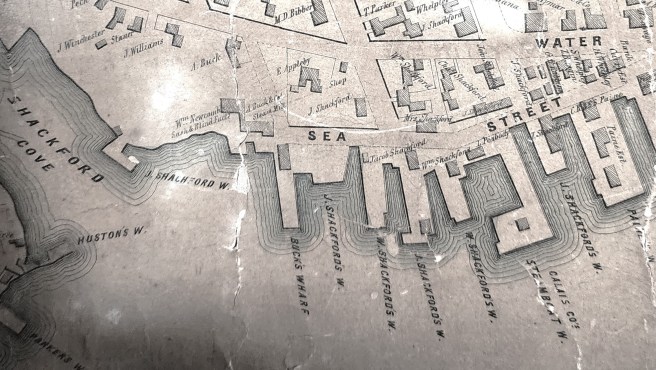
The 1855 Eastport map, produced shortly after Samuel had relocated to Chicago, illustrates how much the family had flourished. At least 13 buildings are labeled Shackford — most of them along Water and Sea Street just below our house. Many of the latter were likely warehouses and offices related to the six Shackford wharves and piers flanking the Calais Co.’s Steamboat Wharf, at the time owned by John junior.

The 1850 Census had eight Shackford households in Eastport. The 1860 Census had ten. And soon there were none.

So much for the Shackfords who grew up in the house we now own and their descendants.

To add the word ‘island’ to Grand Manan would be redundant

Despite our many trips to Cape Cod back when I lived not that far away in New Hampshire, I never got around to visiting tony and history-laden Martha’s Vineyard or neighboring Nantucket. It’s an oversight I don’t want to repeat when it comes to Grand Manan, an impressive Canadian island we can see from some points here in Eastport, Maine.

I am hoping to get there this year. Even if I don’t, here are some high points:

  1. Its closest point on the mainland is the town of Lubec Maine, nine miles across the Grand Manan Channel. For mainland New Brunswick, it’s Blacks Harbor, 20 miles over the Bay of Fundy. Yet if you look at most maps of Maine, it doesn’t show up at all, despite its proximity. That part
  2. As the largest of the 25-plus Fundy Islands, Grand Manan is 21 miles long and has a maximum width of 11 miles, covering 53 square miles in all. (Campobello and Deer Island, which border Eastport, are the second and third largest, respectfully.) It’s home to 2,595 year-round residents.
  3. The principal way of getting there is by a 90-minute ferry ride from Blacks Harbour. Reservations are recommended, both ways.
  4. For comparison, Martha’s Vineyard is 20.5 miles long, covers 96 square miles, takes a 45-minute ferry jaunt, and has 20,530 full-timers; Nantucket covers 45 square miles, is a 2¼-hour commute by traditional ferry, and has 14,444 residents. Both of the Massachusetts towns are much wealthier than Grand Manon, where most folks eke out their living “on the water.”
  5. The economy is based primarily upon commercial fishing – lobster, herring, scallops, and crab – plus ocean salmon farms and clam digging.
  6. For the traveler, the island is largely a step back in time, with a single highway along the eastern half, where most of the modest residents live. That leads to the rest of the Grand Manan archipelago of nearby smaller islands such as popular White Head (reachable by a second ferry ride), Ross Cheney, and the Wood islands, plus countless surrounding shoaling rocks. Meanwhile, the rugged and forested western side, with 300-foot-high cliffs, high winds, numerous passages, coves, and rocky reefs, incorporates wildlife-rich preserves.
  7. Tourism, the second source of income, provides unspoiled ocean views, whale-watch cruises – rare right whale breeding grounds adjoin its waters – as well as kayaking, hiking, camping, photography, painting, and bird-watching with more than 240 species, including nesting puffins in season.
  8. Among the lighthouses to check out are Gannet Rock, Swallowtail, Southwest Head, Long Eddy Point, Long Point, and Great Duck Island. Not all of them are what you would call picturesque or prime condition. Not to slight them.
  9. Linguistically, “Manan” is a corruption of mun-an-ook or man-an-ook, meaning “island place” or “the island” in the local First Nations’ language. The suffix ook, meanwhile, means “people of.” French explorer Samuel de Champlain recorded the place as Manthane on a 1606 map and later changed it to Menane or Menasne – close enough in sound. So if Manan already means “island,” why be redundant? You don’t need to add “island” to the Vineyard or Nantucket, either – everybody knows what you mean without it.
  10. Grand Manan’s not for everyone. As one review said, “A long way to travel for nothing. Nice rocks but you can see those in Maine. Sea glass was hard to find and sparse. Very poor, depressed area. Lighthouses are ugly and there is nothing to really do other than hiking, which you can also do in Maine. Ferry stunk and was disgusting. Never saw any whales or seals. Nothing on the island except rundown shacks. All the online promotions are just hype. Waste of a day. … Go to Campobello island, it’s 100% better.” In short, sounds right up my alley for adventure.

The first permanent settlement, by the way, was in 1784 by Loyalists fleeing the U.S. at the close of the American Revolutionary War, a common occurrence across New Brunswick.

Now for a touch of scandal in the family

The house at the corner of Water and Key streets came into the ownership of Jacob’s nephew, John Lincoln Shackford, who had married Elizabeth S. Clark in 1838 and, following the occupation of his father and siblings, became a mariner.

In 1847 Captain John Lincoln Shackford he was advertising freight and passage aboard the brig Carryl, traveling for Saint Marks and Newport and from Pennsylvania to the Isle of Lobos and Havana.  He also was reported as rescuing members of the crew of the bark Cambria and conveying them back to New York.

The 1850 Census recorded him living in Eastport with his parents, his wife Elizabeth, and three children. In 1860, they were with her parents and two children, presumably while he was at sea. Shortly after that, the family moved to New York, where he was recorded in Brooklyn at 111 Adelphi.  In 1863 he was listed on the Brooklyn Civil War draft registration, and in 1864, he was at Hamilton north of Fulton Avenue.

Among their children was Abby, who died at age seven in Cuba — suggesting that Elizabeth and the children had accompanied him on his voyages as a captain — and her twin Esther, who died in Brooklyn at 21, and sister Fanny, who died as an infant.

Shortly before February 1871, John’s wife returned to Eastport, where she filed for divorce, dower, and alimony, asking for all right title and interest in any and all real estate he had in the County of Washington, Maine. Before the case was settled, he died, December 20, in the Virgin Islands.

As the case was submitted, “To the Honorable the Justices of the Supreme Judicial Court next to be Holden at Calais, within and for the County of Washington in said state on the fourth Tuesday of April AD 1871.

“Elizabeth S. Shackford of Eastport in said County, respectfully represents that she was married to John L. Shackford now of St. Thomas, at Eastport in said County on the tenth day of December AD 1838 and had by him two children now living to wit; Joshua C. Shackford & Regina T. Shackford. That after her said marriage she cohabits with said Shackford in said State of Maine, and always conducted herself as a true and faithful wife.

“That the said John L Shackford unmindful of his marriage vows and covenants, and the duty affection and respect he owed her, deserted her more than three years ago, and has not supported her for the last three years.

“That he has been living with another woman to your Libelland Unknown in St. Thomas.

“That he has been married to said woman as he has declared in letters to others.

“That he has a daughter by said woman and committed adultery with said woman.

“Wherefore, because a divorce from her said bonds of matrimony would be reasonable and proper, conducive to domestic harmony and consistent with the peace and morality of society, she humbly prays your Honors such divorce accordingly …”

Additional documents listed John L. Shackford’s estate value at five thousand dollars (the number is crossed out and rewritten).  The court ordered payment to Elizabeth and ensured that the United States Consul to St. Thomas delivered a copy of the document to John L. Shackford (misspelled Schackford on the document).  The court then allowed Elizabeth to sell land to include property at the corner of Water and Key streets (formerly Greenwich Street), land on the northerly side of Shackford’s Cove, along with other property valued at $1,471.02.

Curiously, widow Elizabeth returned to New York, where she died in 1882.

The Eastport Sentinel reported, October 2, 1889, “Mr. T.M. Bibber moved last week from the Shackford house at the corner of Water and Key Streets to the Chapman house on Boynton St.” The Bibber connection may have been thicker than I’ve uncovered so far.

Obviously, Shackford descendants were ranging far from Eastport, never to return.

She did have quite the tongue

In the official statement marking the death of Alice Roosevelt Longworth, President Jimmy Carter observed, “She had style, she had grace, and she had a sense of humor that kept generations of political newcomers to Washington wondering which was worse – to be skewered by her wit or to be ignored by her.”

Just listen.

  1. When her father was governor of New York, he and her stepmother planned to send her to a conservative school for girls in New York City. Curtly, Alice responded, “If you send me, I will humiliate you. I will do something that will shame you. I tell you I will.”
  2. When her father became president after the 1901 assassination of William McKinley in Buffalo, she greeted the event with “sheer rapture.”
  3. She later said of her father, “He wants to be the bride at every wedding, the corpse at every funeral, and the baby at every christening.”
  4. When a prominent Washington senator was discovered having an affair with a young woman less than half his age, Alice quipped, “You can’t make a souffle rise twice.”
  5. Most famously, “If you haven’t got anything nice to say about anybody, come sit next to me.” She had that one embroidered on a pillow kept in her living room.
  6. On Calvin Coolidge: “He sprang from the grass roots of the country clubs of America.”
  7. Another quick character sketch: “He looks as though he’s been weaned on a pickle.”
  8. And one more: “Never trust a man who combs his hair straight from his left armpit.”
  9. As for Washington, D.C: “A town of successful men and the women they married before they were successful.”
  10. Through it all: “I’ve always believed that if you’ve got a good sense of humor, you can get through anything.”

Do note, her father was quoted: “I can either run the country or I can attend to Alice, but I cannot possibly do both.”

Jacob Shackford’s line

Captain John senior and Esther’s son Jacob commanded the steam brig New York, the first steam vessel to enter the harbor of Eastport.

He followed the sea up to 1832, when he and his brother established W.& J. Shackford & Company. Independently, Jacob did build ships, including four brigs in a few years in the 1850s. One of them was noted for riding out the devastating gale of 1854. He also dealt in real estate, as his running advertisements in the Eastport Sentinel of 1865 illustrate: “House lots on Shackford and Water streets. Also two lots. For sale on reasonable terms by Jacob Shackford.”

Jacob’s son, shipmaster George, died August 1, 1863, age 39, during the Civil War. I’m left wondering whether his death resulted from civilian or military seafaring.

Jacob’s son William did serve, from 1863 to 1865, aboard the USS Home, USS Winona, and USS Nahant.  In 1870 his residence was in Eastport; in 1880, Philadelphia; and 1890, New York, reflecting a successful shipmaster’s social mobility. His summer vacations at Cape May, New Jersey made the society pages of newspapers.  The August 2, 1897, New York Tribune reported the arrival of Mrs. William Shackford and Miss Carrie N. Shackford. An August 29, 1897, article in the Philadelphia Inquirer noted that Captain William Shackford joined his wife at the Congress Hotel to recover from “an attack of isthmus fever to regain his health.”

Back in Eastport, as Weston noted that Captain Jacob Shackford’s will, written on September 2, 1868, named his beloved wife Elisa D., his homestead on the corner of Water and Key Streets, a daughter Eliza A. Shackford, a son William Shackford, and another daughter Matilda, the wife of Charles B. Paine. It also left part of the estate to his son Henry Nevis Shackford, if known to be living at the death of his wife [Eliza]. Henry had left on a ship and never returned.

Son-in-law, C.B. Paine, husband of Matilda, had constructed the home on the corner of Water and Third streets, across from us, in 1841.

Jacob died June 19, 1869, age 79.

Over time, Jacob’s house at 4 Key Street grew from a federal style house and narrowly averted the devastating 1886 downtown fire. At some point, at his wife’s urging, the structure was turned 90 degrees, from facing the waterfront, to its present orientation, facing north, and drastically restyled.

When Eliza died on February 17, 1879, age 85, she was no longer residing in the house, as far as I can tell.

Remember, Jacob grew up in the house we now own.

Recalling an obscure West Coast vinyl record operation

Its albums stood apart from many of the others I borrowed from Dayton’s public library, with its fine record collection and its guardian.

Contemporary Records was the name of the company, founded in Los Angeles in 1951 by Lester Koenig and soon a leading advocate of what became known as West Coast jazz, including Chet Baker, Shelly Manne, Art Pepper, Sonny Rollins, Bud Shank, and Andre Previn. It was even the first jazz label to record in stereo.

It also ventured into classical, including guitarist Pepe Romero, perhaps joined later by his brothers and father, all of whom soon became famous.

The company also offered a Good Time Jazz label focusing on Dixieland, plus the Society for Forgotten Music in a classical vein, and a contemporary composers’ series.

I had thought one of its founders was American songbook master Vernon Duke – aka Vladimir Dukelsky, his Ukrainian name, used for his 12-tone pieces – but I seem to be wrong. I vaguely recall that one of the disks presented his work as played by the Hollywood String Quartet, but find no support for that now, either.

I have no idea what brought all of this to mind, all these years later. What I am seeing now is how easily so much falls into oblivion.