Must admit, since writing the book, I’m still learning

More accurately, I’ve become acutely aware of how much I still don’t know. Or even, does anyone see this fully?

The adage, “Write about what you know,” had me starting with my Quaker experience. But the adage should add, “Write about what you don’t know.” Frankly, that’s the part that’s exciting.

Think of it as working a puzzle, trying to figure out what goes in the gaps. You just don’t know without some hands-on trial and error. And perhaps a few friends or family members’ help.

From the other direction, I know a professional historian who quotes his mentor saying that if you think you have an answer nailed down, you’re badly mistaken.

I’ll spare you my list regarding the Quaking Dover project, for now.


Here’s wishing you all could be there

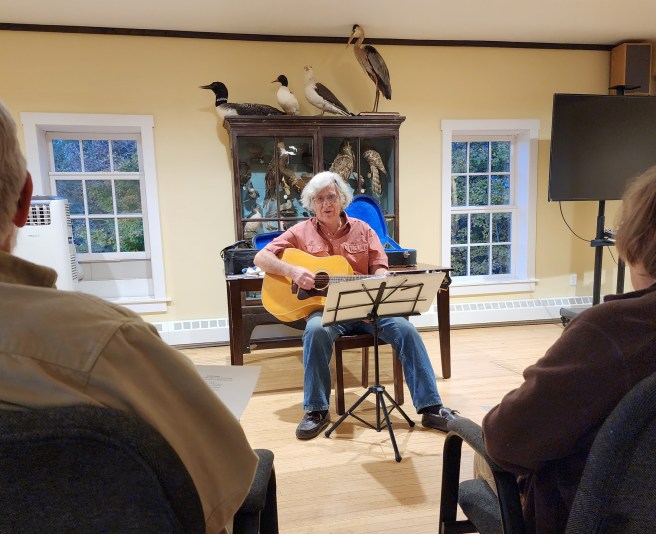
Stephen Sanfilippo is both a wonderful folk musician and a professional historian, two strands that weave together delightfully in his performances and recordings of maritime songs.

He’s a master of the sea chantey repertoire as well as many other seafaring tunes and lyrics – many of which, as he’ll explain, traveled far and wide into the American hinterlands but not back. He does prefer the spelling “chantey” and “chantey man,” for reasons I’ll leave to him to explain. And there are plenty of opportunities to sing along.

Here’s an invitation to his free appearance on Wednesday, January 25, at 6 pm at the Pembroke, Maine, public library, itself an appropriate venue. (I do love the stuffed birds displayed behind him.) The event will be followed by a series of more monthly concerts. Yay!

From his previous appearances here, I can acclaim this is one more facet of what makes living Way Downeast Maine so special to me.

I never expected so much Donizetti

I’ve posted previously on the outstanding and often original finals’ week programming on Harvard’s student-run FM radio station. Each December and May, the regular schedule shifts to a few weeks of special blocks of classical, jazz, rock, folk, world, and many other strands of music I hadn’t even heard of for something the station has trademarked as Orgy, as in “Donizetti Orgy,” which I’ll explain. For accuracy, we should note that final exams really cover closer to two weeks or a tad more.

One year, for instance, they played everything Bob Dylan had recorded. A few years later, a much shorter sequence introduced many of us to Florence Price, a significant Black American woman composer who has since been receiving a posthumous flowering. The decisions are often based on anniversaries, as happened a few years ago when we got to hear everything Beethoven had ever written, in chronological order. Musically speaking, of course. I have no idea about his letters. A year ago, Schubert got the same treatment, meaning a lot of art songs in German, especially. That one nearly became an Orgy of its own for the baritone Dietrich Fischer-Dieskau, whose son once told classmates what his dad did for a living was make records. Let’s just say that many of these Orgies are highly eclectic.

I did raise my eyebrows in the last round when well over a hundred hours of airtime were devoted to the 225th anniversary of the birth of Domenico Gaetano Maria Donizetti, known largely for a dozen or so marvelously florid operas. Turns out he created nearly 70 operas plus symphonies, string quartets, concertos, piano scores, songs, and so on, which were presented, again chronologically, in big blocks over two weeks. Where do the programmers dig up all of the recordings? Is this really some Harvard grad student’s thesis project?

Donizetti (1797-1848) is renowned, along with Rossini and Bellini, for a specialized style of opera called bel canto, “beautiful singing,” which has had a major revival in the past half-century. Today its embellishments, soaring lines, and vocal athletics have become widely embraced, but back when I was first listening, it was all revolutionary. And, among the three, Donizetti was far and away the most prolific.

What made the series significant to me was the way it revealed an evolution over his 29-year career from formulaic provincial stage comedies to what we recognize as Romantic opera. It filled in a gap in operatic history for me, getting from us classical Mozart to gripping dramatic Verdi and beyond. Composing at fever pitch, Donizetti often churned out four new operas a year, many of them in one-act pieces plus others that recycled earlier material before he reached a more sustainable stride. Think of a rock band or pop artist turning out an album, which is only an hour or so compared to a three-hour opera. Or a movie composer, for that matter, who has to create a similar amount of music. Nobody does four a year, right?

In the broadcasts, Donizetti’s early works sounded serviceable but not memorable. They were built on strings of solo arias, choruses, and recitative, which I streamed while working on my own life. That would mean one character in the spotlight, exit stage, and then another. Laundry, cooking, vacuuming, or washing dishes anyone? You know, everyday stuff, with music in the background. Midway into the series and his career, though, the dramatic level rose immensely and caught me in my tracks, especially with the appearance of ensembles of simultaneous conflicting emotions and motivations. Yes, there were hints of things ahead, like the flash connecting one faintly familiar tenor aria with what would emerge later, with nine high C pings inserted as “Ah! Mes mis,” and eventually launch Luciano Pavarotti into international household fame in 1972. (We did hear him in that role around 6 am the final day, when “La Fille du Regiment” aired from a recording of London’s Covent Garden production with Joan Sutherland and Richard Bonynge costarring.)

Quite simply, those were the flashes when I recognized we had crossed over into everything today’s operagoer anticipates, even with Mozart, Gluck, and Handel remaining glorious within their earlier realms.

Many of the Orgies really are once-in-a-lifetime events. With Donizetti, for example, it’s unlikely that I’ll ever again hear most of what was introduced. Simply tracking down rare pieces would be an overwhelming challenge.

Let’s see what May brings. Those kids at WHRB really do deliver.
Dover’s prominence in the early province is typically overlooked

Not only is Dover the oldest permanent settlement in New Hampshire, it’s also the largest city in the Seacoast region today, with more than 30,000 residents. The region, however, adds to way more.

An hour northeast of Boston and with proximity to both Atlantic Ocean rugged shoreline and beaches as well as New Hampshire’s White Mountains, Dover has also become the fastest-growing city in the Granite State.

The town originally encompassed what’s now Durham (home of the University of New Hampshire), Barrington, Lee, Madbury, Rollinsford, Somersworth, and parts of Newington and Rochester. It also interacted heavily with the earliest settlements of Maine across the Piscataqua River, back when fishing was a leading business, followed by logging and sawmilling.

Still, there has also been a longstanding rivalry with Portsmouth just downstream, ever since its enterprising merchants rose to the fore. You know, uppity. Well, they do have the Music Hall.

Dover, I’ll insist, has been more modest. I’ll refrain from adding more for now.

For perspective, the region today has more than a half-million residents.

I like to think the center of gravity is shifting back to Dover. We’ll see. In the meantime, there’s that big 400th anniversary to celebrate.

Please stand by, as they used to say on radio.

How about a few more readers’ candid responses to my new book?

In case you’re wondering how things are going with Quaking Dover, here are some early reactions:

“The book purports to be merely a history of the Quakers at Dover, New Hampshire, but it is much more than that. It is a history of the beginning and spread of the Religious Society of Friends (aka Quakers) in the USA, the best exposition of their faith that I have read so far, a history of their persecution by the Puritans, and of the bloody conflicts between the Puritans and the native peoples. …

“Most of all, I had not previously been exposed to the reality of the Quakers’ faith, revealed in their own words. Jnana Hodson, himself a Quaker, has done extensive research in old records and journals and includes extensive quotations that bring the faith to life. Including their peaceful acceptance of persecution, their prudent approach to courtship and marriage and their belief in the work of the Holy Spirit in the heart.” – Bob Goodnough, Saskatchewan

(For his full review, visit his Flatlander Faith blog post of Dec. 12, 1922.)

~*~

“I enjoyed your conversational writing style – sharing the research that you did — and confidentially whispering (in your writing style), ‘This is what this finding means and how it should be interpreted.’ … To ascertain what really happened you checked primary documents, read previous accounts of Dover, New Hampshire – triangulated your sources and showed us readers how you reached your conclusion. A very enlightening read – well researched, well written.” – Joe Clabby, author of A History of Eastport, Passamaquoddy Bay, and Vicinity

~*~

“Love it!” – Susan Wiley, Sandwich, New Hampshire

~*~

“Deftly told. I really like your voice. It’s engaging, light, and easy to read.” – Jim Mastro, science fiction novelist

~*~

“An enjoyable book!” – Arnie Alpert, longtime peace activist

~*~

“A rich feast of a book.” – one of my favorite authors and fellow Maine resident

~*~

“I truly appreciate all the work and careful thought and interpretations you put into it.” – Canyon Woman, New Mexico

~*~

“I enjoyed your book very much. I particularly liked relearning about early life in Dover and surroundings, and was impressed by how much research you did to fill in details. Not only about the life of early Quakers and their trials and tribulations, but the connection they had to the rest of New and Old England. I did not understand how important the settlement of Dover was compared to Portsmouth, Exeter, and other towns.” – John Dawson, Lee, New Hampshire

~*~

“Thank you for writing this record of Dover Friends Meeting. The ‘Children of the Light’ had me on the verge of tears as I read it to Andrea.” – Harvin Groft, Berwick, Maine

~*~

Considering the play, ‘Mother Whittier’s Meeting’

In timing my book for Quaking Dover for the 400th anniversary of English settlement in town, I gave myself a deadline that ensured it would actually be done. Otherwise, I’d still be researching it.

In some cases, that meant I didn’t simply follow a conventional account but came to my own original conclusions. In others, post-publication findings confirmed in what I’ve deduced. Besides, in a period of Covid restrictions plus my own relocation to the other end of Maine, opportunities in the archives were limited.

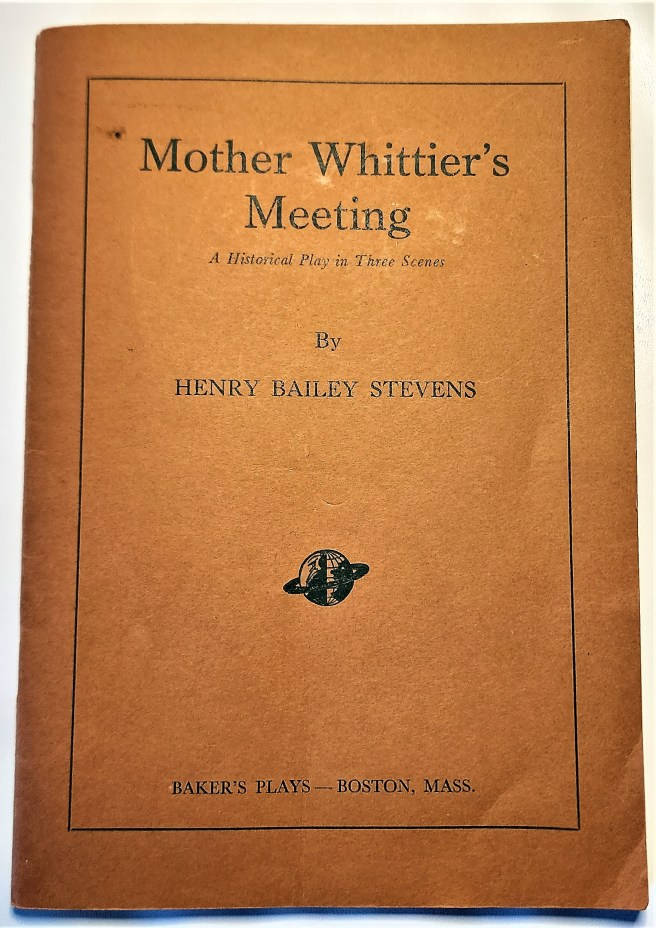
One of the works I’m glad I waited to read until my own work was done is Henry Bailey Stevens’ three-scene play, Mother Whittier’s Meeting. It was premiered outside the Dover Friends meetinghouse on August 17, 1963, to mark what he thought was the 300th anniversary of the Quakers’ presence in town. As I now see, the celebration was four or five years late.

Had I read the play first, I might never have written my own take of the history. He covers the heart of the plot in 200-some fewer pages.

Stevens himself is an interesting character who turned up around the time that the Dover meetinghouse was reopened for regular worship in the 1950s. He was the head of the Cooperative Extension Service at the University of New Hampshire in neighboring Durham but also harbored a deep interest in both history and dramatic literature, as well as an ardent vegetarian and pacifist. He even penned a series of Quaker family profiles for Dover’s daily newspaper.

The play itself is what we’d call “talky” – more dialogue than action. There’s no dancing or sword-fight scenes, as it were. The central focus shifts between Meeting as the community and as the house itself, or even turns to Abigail Hussey Whittier herself. Not that you really notice as you follow along.

There are points I’d heatedly contest. The first meetinghouse, for instance, was most likely not a log cabin.

But then I feel like cheering when Annie Pinkham shows up as a character. Her mimeographed brief history contained tidbits that would otherwise be lost to oblivion. She had every reason to believe she’d be the last Quaker in town once she locked the meetinghouse door.

Not so, as things turned out.

As for Stevens? His play, published by Baker’s Plays in Boston, isn’t his only significant book-length publication. Finding those, though, can be a challenge.


Starting with a wedding certificate

Join me online from the Whittier Birthplace Museum in Haverhill, Massachusetts, on Thursday, January 26, at 7 pm.

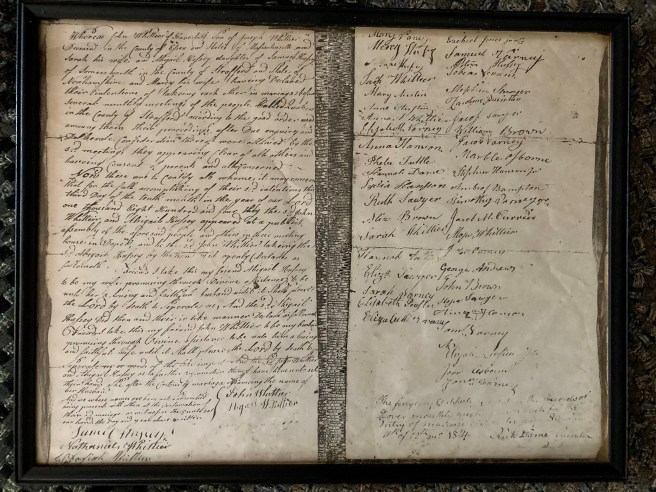
My presentation in their virtual lecture series via Zoom will explore the celebrated abolitionist and poet’s many connections to Dover, starting with an examination of his parents’ certificate of marriage in the Quaker meetinghouse in 1804. His mother grew up in the Dover Quaker community, and his Whittier uncle, Obadiah, was already living in town at the time of the wedding. In fact, Whittier Falls and Whittier Street weren’t named for the poet but his uncle and cousins.

There’s a lot packed into this historic document. Join me to find out.

Once we’ve gleaned insights into seemingly quaint Quaker practices of the time, we’ll turn to the signatures of the witnesses – that is, all of the Friends in attendance – and learn about some of them, too, as well as a few who weren’t present but were still members of the Meeting living in a town to the west and definitely of interest.

And then it’s your turn to ask questions or make comments.

The event does require preregistration and a suggested donation of $10 per household. Go to whittierbirthplace(dot)org and click on Events to learn more.

Here’s hoping you can make it. Putting this together has been a blast.

Ten major American religious dissidents

Who says you had to conform growing up? Here are some people who made America the land of the free, not that I agree with all of them. Still, it really does come down to language and how we use it. Especially when religion and politics are mixed in.

  1. Samuel Gorton. Just plain onery in early New England.
  2. Roger Williams. Leading to a progressive movement then known as Baptists.
  3. Anne Hutchinson. Pointing the way to New England Quakers.
  4. John Woolman. A Quaker who worked ardently against slavery and other economic perils.
  5. Henry David Thoreau. It’s a Unitarian thing, ultimately.
  6. William Miller. The foremost of the voices that would become the Seventh-day Adventist church. Ellen G. White emerged as an essential proponent in its development as it organized in Battle Creek, Michigan, and then Takoma Park, Maryland.
  7. Joseph Smith. You know, the Mormons. Along with Brigham Young and Utah.
  8. Dorothy Day. Catholic Workers, a truly radical movement.
  9. Martin Luther King Jr. Civil rights and much more.
  10. Bayard Rustin. Gay Black Quaker ahead of his time on many fronts.

Who am I overlooking?

For tiny Dover, why all the hoopla?

As improbable as it would seem now, Dover was a throbbing center of dissidents and misfits in its early years, at least from the perspective of the Puritan authorities to the south in Boston.

Nor would I have expected a settlement inland from the ocean to be the one that took root, rather than the companion complex facing the ocean, but the Dutch trading post at Albany, New York, was even further up a river and survived.

There are good reasons that Dover became the center of action north of Salem, Massachusetts, and of Boston further south, not that you were taught any of that in your history classes.

I have to admit, it’s taken a while for the fact to sink in. Dover was the heart of the New Hampshire province, not that we see that today. Still, the roots remain.

My book, Quaking Dover, looks at the history from a minority viewpoint that leaves most of the last 200 years pretty wide open. Yes, there’s so much more to examine and include in the full picture leading to the rebirth of the community in recent years.

But what I’ve found is still pretty remarkable.

To think, it was such a humble and audacious start 400 years ago and counting.

It’s gonna be a big year!


Ring in the big celebration

My first New Year’s Eve in Dover was filled with wonder when all of the church bells burst out ringing. The next year, however, they were silent.

The occasion, I learned later, was the new millennium, even if technically 2000 was the last year of the old millennium while the actual arrival went unnoticed as such.

This year, Dover’s churches have been asked to ring their bells at 9 pm as a prelude to a fireworks presentation to welcome in the city’s 400th anniversary year observations.

Here’s hoping the weather obliges.

From many miles away, we’ll be thinking of folks there and hoping for a most exciting new yar.