There were no banks and you couldn’t write checks.
Were dried fish and lumber so valuable in Britain and the Continent that you could still make a fat profit shipping them across the ocean? Furs, I can understand, as well as the hunger for gold and silver, which may have fueled speculators who were inevitably disappointed. Plus fish, likely dried.
As for paying your workers? A daily portion of rum or the like was apparently often part of the deal.
By the way, Quakers were in the forefront of developing banks and insurance and even packet shipping in time.
The early colonies had layers of ownership, starting with those demanding annual quitrents for the land you would clear and build on or have “purchased” with any improvements. Then there were the chartered investors, like Lord Saye and Sele and Lord Brooke in New Hampshire’s case, who somehow expected to make a profit overseeing the place. They still had obligations to other investors, like the Council for New England. I’m really unclear how all of that worked in practice or what they got from “selling” their charter to Massachusetts.
The best I can come up with is that it was a kind of private enterprise tax, though I’m not sure what was offered in return. Like Mafia “protection” or layers of graft?
And that’s even before getting to England’s heavy mercantile system that hampered American entrepreneurial opportunities. The colonists were expected to provide raw materials for manufacture in England before being sold at hefty markups in the New World, too.
How did the colonists ever thrive, all their hard work aside?
So much of the classical music scene focuses on revisiting a core repertoire of masterpieces and their composers. Ideally, that leads to deeper understandings and discoveries within the most inspired scores, although superficial repetition and familiarity are more common. Even so, it is exciting when new faces are admitted into that circle. Within my own lifetime I’ve seen that happen with Mahler and Vivaldi, as well as to a lesser extent with Charles Ives.
Adding to the excitement is the reality that the repertoire is no longer exclusively dead white (European) males.
Americans, north and south, are gaining recognition after having long been excluded, though it should be much more. From a more global selection, so are women and people of color.
Sometimes, a composer can embody all three, as is the case for Florence Price (1887-1953). A substantial portion of her surviving work, discovered and recovered in 2009 in her abandoned summer home, is only now gaining an airing and a growing admiration. This Little Rock, Arkansas, native was, it turns out, the first Black American woman to have a symphony performed by a major orchestra – Chicago – and her style has a lightness that blends her own roots, the America of her time, and classical expectations. As a choral singer, I can attest to her unique touch underpinning the scores we’ve performed.
Among other Black composers finally gaining overdue attention, let me mention:
Julius Eastman (1940-1990), an eclectic, genre-crossing American trailblazer whose tragic life included seeing his own works largely scattered to the wind when he was evicted from his apartment and officials threw his possessions out into the street. What remains of this Curtis-trained original is well worth exploring in its large, provocative vision of time, space, classical, jazz, pop, politics, sex, and utter wonder.
Edmond Dede (1827-1903), a New Orleans-born Creole who lived much of his life in France as a successful pianist, conductor, and composer. If he sounds a bit like toe-tapping John Phillip Sousa, remember he came along a generation earlier. He emerged from a lively scene of free Black classical musicians in New Orleans who even had their own symphony orchestras. As far as serious music in America goes, only New York seems to have had more going on in the years before the American Civil War. Don’t overlook this when you’re thinking of the origins of jazz, either.
Joseph Bologne, Chevalier de Saint-Georges (1745-1799), is remembered as a man of many talents in Paris, including his abilities as a fencer and as the French Mozart. Among his many achievements are commissioning and premiering Haydn for what are known as the Paris symphonies. For his own work, I’d start with his 14 violin concertos, especially as championed by soloists Randall Goosby or Rachel Barton Pine.
The one who excites me the most is Vicente Lusitano (roughly 1520 to sometime after 1561). He was the first Black to have his music printed, along with some crucial musical theory texts. A Portuguese-born priest and musician, his sonorous choral pieces are said to equal Palestrina’s. I’d agree with that. After some intense rivalry in Rome, he turned Protestant, married, and moved to Germany, where he disappeared. The little we know of him still redefines the history of Black composers as existing all the way back to the high Renaissance rather than being much more recent and marginal. Oh, my, I am hoping my choir will soon be attempting something of his, no matter the challenge.
~*~
While that’s a sampling of Black masters from the past, a lot is happening now, too. Two living composers of special note I’ll mention are Jessie Montgomery and Terence Blanchard.
Yeah, I know about the adage, “Write about what you know,” but I’ve come to see that advice needs to be balanced by “write about what you want to know.”
What we might call a creative tension. If you’re a writer, I hope that helps.
My latest book, which started out as a humble and brief profile of Dover’s Quaker Meeting but turned into a contrarian New England history, could be presented as one example.
I mean, Dover is still seen as a shadow to neighboring Portsmouth, which is much smaller and more uppity. Get real!
Back to the book at hand and the research that’s gone into it. Here are some things that surprised me.
Thomas Roberts as a cofounder of the settlement, rather than William Hilton. That alone alters the traditional telling.
The Devonshire connection, which gave Dover a much different culture to build on rather than the one the Puritans presented.
The extent of New Hampshire’s role as a haven for dissidents and misfits.
Puritans as less than monolithic. They were primed for revolution but full of insecurities.
Richard Waldron’s power in Boston. He was more than a rich hick in the sticks.
The crucial impact of a few key provision in New Hampshire’s agreement to come under Massachusetts management. A male didn’t have to be a member in good standing in the town church in order to hold land or to vote in town affairs.
Dover Friends Meeting as one of the seven oldest in America. It has a more prominent place in Quaker history than has been recognized.
Early English resettlement of Maine after the French and Indian devastations coming around 1730 rather than 30 years later.
Dover’s textile mills’ predating those in Lowell, Lawrence, and Manchester. In fact, the founders of Lowell looked to Dover for inspiration. In other words, we weren’t a small, insignificant mill town.
The Sorcerer who was a member of Meeting. You’ll have to read the book to find out about him.
Order your copy of Quaking Dover at your favorite bookstore. Or request it at your public library.
As a commercial book venture, my Dover history would be considered marginal at best.
Quite simply, short of a breakout, it targets a tiny audience.
The city itself is small – a population of slightly more than 30,000. And while the surrounding area runs around a half-million, that’s still small by book publishing markers.
Additionally, my work focuses on the city’s second-oldest congregation, an even tinier potential readership. While that element opens another market of fellow Quakers around the globe, it’s still small.
As for history buffs? They have their niches.
At the outset, at least, any for-profit book publisher would see this as a high-risk, losing bet.
I am, of course, hoping Dover’s 400th anniversary this year will give it a bounce.
And, as a microcosm of a snarky, contrarian New England history, Quaking Dover just might entertain a wider reception.
I mean, how many people do you think would have been interested in covered bridges in Madison County, Iowa?
~*~
One commercial publisher specializing in local histories did take a look but quickly backed off. The editor didn’t like the first-person voice of my book, for starters, and got spooked by the fact this volume hadn’t been vetted by religious authorities.
A few others were simply looking for an author-subsidized co-publishing deal.
That returned me to the self-publishing world I found in ebooks and then, for paper editions, at Amazon’s Kindle Direct Publishing.
As much as I like ebooks, for reasons I’ve previously discussed here at the Barn, I very much felt this was one that needed to be available primarily in a hands-on physical book form.
While Amazon has no upfront costs for an author in its print-on-demand paperbacks, physical bookstores refuse to carry them because they would have to buy the volumes at retail and then add a markup to the price to cover their own costs. They rightly complain it puts them in an unfair position.
But then came the announcement that my ebook flagship, Smashwords.com, was merging with Draft2Digital, which specializes in producing print-on-demand. Both companies have arrangements with distributors and retailers, and both offer their services to writers for free.
The arrangement also gives me more flexibility in marketing and special sales opportunities.
In short, count me in. I’m truly proud of the result.
Check it out through your favorite bricks-and-mortar bookstore.
Although he is best known for his persecution of the three Quaker women missionaries and his mock war game that captured hundreds of Natives, which led in time to the devastating attacks on Cochecho Village and Oyster River as well as decades of violence ending in 1763 with the French and Indian War, Major Richard Waldron (or Walderne, in its alternative spelling) could easily be the subject of a fat biography of his own, if a very resourceful historian would rise to the challenge.
His influence and power ranged far beyond his mills at the great falls of the Cochecho River. He was Speaker of the Massachusetts General Court, or Assembly, for multiple terms and even owned a substantial house in Boston. His ships ranged the seas, where two of his children died doing commerce. And there are good reasons I call him a perfect villain in my book Quaking Dover.
Through him, though, I sense that Dover had some solid connections with the powers in Boston, rather than existing just an outpost on the frontier. It alters my perception of sparsely settled colonial New England.
Just how did he amass so much wealth, especially? Were his leadership skills mostly along the lines of a bully or did he have some sophisticated means of influence?
It’s fair to ask if anyone else cast such a long shadow over New Hampshire’s course or how he would stack up in comparison to better known Boston figures.
Let me be clearer, he could be the subject of a hot book or movie or maybe a mini-series.
My first-ever Zoom presentation is now available for streaming, thanks to the Whittier Birthplace Museum. The presentation on January 26, “Starting with a marriage certificate: Why Whittier was no stranger to Dover,” focused on the famed poet and abolitionist’s many connections to, well, my new book Quaking Dover.
John Greenleaf Whittier is hardly the central theme in the book, but for me, developing the topic for this show, along with the accompanying PowerPoint slideshow, another personal first, was fun.
If you’re a regular here at the Barn, you know I do lag behind on the tech front. One step at a time, right?
I didn’t expect an unusually itchy nose and scratchy throat resulting from our dry indoor air. So much for my up-in-the-corner-of-the-screen stage presence.
On top of that, with the PowerPoint up in front in me, I couldn’t see who was attending. Oh, well, I had my hands full anyway.
Earlier, behind the scenes, there was concern about a possible power outage on my end as unusually warm temperatures dropped below freezing amid heavy rain. We did have a contingency plan, just in case.
Readers of my new book are telling me how shocking they find the Puritans’ cruel persecution of the up-and-coming Quaker faith. That reaction is quickly followed with their disgust that the Puritans came to the New World for religious freedom but then refused it to others.
What we need to acknowledge, though, is how deeply our outlook is engrained with an expectation of freedom of speech and religion, something that would have been foreign to mindsets back in the 1600s. There, religion and politics were one, as in a one-party state. In England in the early 1600s, the king had the state church, what we know as Anglican or Episcopal, well under his thumb, while the Puritans had Parliament and its armies. It was a volatile mix, even before we get to New England, where my book is set.
I should emphasize that for us, as modern Americans, it’s all too easy to condemn Puritans as backwater bigots, when in fact they were radical progressives on many fronts. They were decidedly anti-monarchy and proto-democracy, and advanced a less feudal, more equitable economy and society. They championed education and literacy for men and women alike and founded Harvard College within their first six years in New England despite deep divisions within their attempt to establish a godly Utopia. Boston was even prepared to fire cannons at Royal Navy ships in the mid-1630s, had they arrived to revoke the colony’s charter, which the Puritans had obtained from the king in an end-run around the man who was responsible for New England’s development – Sir Ferdinando Gorges, the father of Maine and first cohead of New Hampshire, as you’ll find in my book. He definitely would have torpedoed their application. (Whew! The amassing details do thicken the plot, hard as they become to follow.) A Puritan wife could actually divorce her husband if he failed to fulfill her. And they loved their beer.
In other words, Puritans weren’t nearly as awful as we want to portray them today, even if they do come across as villains in my book, Quaking Dover.
Since its release, I’ve been coming to believe the Quakers pressed the Puritans simply for not going far enough in their reforms and intended Utopia. Historian Carla Gardina Pestana, in her wonderful “Quakers and Baptists in Colonial Massachusetts,” even came to the conclusion that the Quakers (or Friends, as we more often refer to ourselves) went out of their way to provoke the Puritan authorities. Ouch, I’m thinking that’s true.
More recently, in revisiting Kenneth Carroll’s book “Quakerism on the Eastern Shore,” meaning Maryland, I felt affirmed by his statement, “Quakerism was, in some ways, an extreme form of Puritanism,” followed by, “It is not surprising, therefore, to discover that Quakerism, in its opening days in Maryland, reached into the centers of Puritanism … for a great number of its converts.”
Well, that latter point was surprising to me. I do see Friends blending Mennonite strands via the English General Baptists into what emerged.
~*~
While my book is focuses on New Hampshire and its adjacent provinces, I’m finding that religious restraints in the southern American English colonies of the time were far harsher than those in New England. For instance, a provocative essay by Marilynne Robinson, “One Manner of Law, the Religious Origins of American Liberalism” in the November Harper’s Magazine, notes that the under the repressive laws in Virginia the penalty for missing church services three times or speaking ill of the king was death, along with the harshest penalties for minor infractions of other laws. She adds there was no mention of trial or appeal and much of what we consider Common Law was nebulous. The Carolinas were just as extreme.
Carroll, for his part, finds that in contrast to New England’s persecution of Quakers, “there may be a skeleton in the closet of the southern colonies also.” He remarks, “The intense persecution experienced by Friends in Virginia soon drove many of them into Maryland,” followed by a series of drastic laws that even kept Quakers from being allowed to enter the colony. “There was to be no challenge to the Established Church as the one religious institution in Virginia,” something that excluded Puritans, Presbyterians, Baptists, Quakers, and Roman Catholics alike. Carroll then states, “The full nature and extent of persecution suffered by Quakers in Virginia is not known. … We do know that William Cole, of Maryland, and George Wilson, of England, were imprisoned in a ‘nasty stinking, dirty’ dungeon in Jamestown where Wilson was whipped and heavily chained so that ‘his flesh rotted from his bones and he died.’” A number of Indian converts to Quaker faith may have also been sentenced to death because of their conversions. And Maryland for a while also imposed harsh persecution, including the banishment and whipping of Quaker “vagabonds” from constable to constable through the colony.
Among those in the South who had visited Dover were William Robinson, before his execution in Boston, and Alice Ambrose and Mary Tompkins, once they left the north.
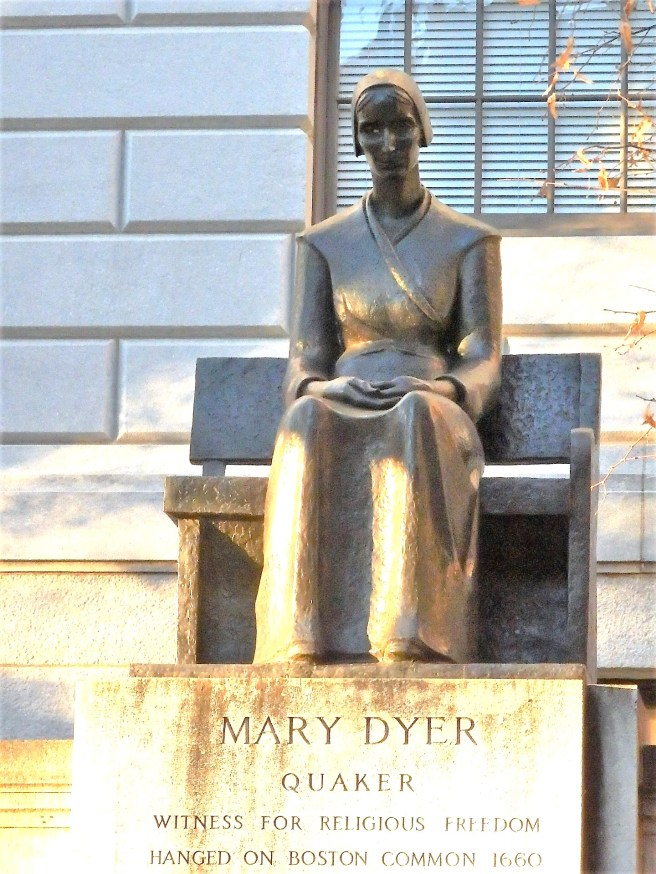
This statue by Sylvia Shaw Judson sits in front of the Massachusetts statehouse, with copies in Philadelphia and Richmond, Indiana. Mary Dyer was one of four Quaker missionaries hanged in Boston because of their faith. She’s the only one who hadn’t visited Dover, New Hampshire, although the site of the gallows later became known as Dover Street. As a fine point, she didn’t offer her life for religious freedom but rather as a sacrifice to a Truth she espoused.
~*~
To see how this played out in Dover, please turn to my book, Quaking Dover.
I, for one, would definitely like to see a fuller understanding of how religious liberty came about in the Southern colonies and also a presentation of how Puritans in New England evolved to emerge, in one strand, as Unitarians.
Learning of the length and bloodshed of border warfare between New England and New France comes as a surprise to many Americans.
One of the more startling facets is the tales of English hostages who were taken to Canada by Natives receiving payment for each person they brought north.
Some captives were ransomed by family and returned home, leaving the impression that the French were interested mostly in added revenue. You know, like legal piracy, or a landbound privateering. Maybe even as a kind of generous sympathy on behalf of the captors. Many, as I’m seeing, were wives.
Others, though, never returned, leaving the mysterious impression that they chose to remain, perhaps indulging in a more sensually rich culture than the Puritan world of their past. And perhaps some did.
The French were, however, at a distinct disadvantage in the colonial warfare and settlement. They were outnumbered by the British four to one, by many estimates. Or five to one, from another I’ve encountered.
One way for the French to build up their population was by immediately baptizing the Protestant captives into the Roman Catholic faith. For single women, this could soon be complicated by marriage and childbirth – she would not be allowed to take her children if she was “rescued” or “redeemed” and returned to New England, perhaps as a widow. Becoming a nun was another option.
Yes, further complicating the picture is the fact that some of the captives did in time become Catholic priests or monastics. As a consequence, there would be no place for them in New England without their renouncing that faith.
So far, I’ve come across no indications that the kidnapping ran in the other direction.
~*~
The definitive examination of the cases seems to be Emma Lewis Coleman’s two-volume New England Captives Carried to Canada between 1677 and 1760 during the French and Indian wars (published in 1925).
My book Quaking Dover presents two of the attacks, though there were other serious incidents in the town.
For most of the first century, Dover dominated both New Hampshire and neighboring Maine.
It was the core of population, for one thing, as well as the oldest continuing settlement.
It also had significant water power, unlike Strawbery Banke, the future Portsmouth.
But Portsmouth, in turn, was closer to the Atlantic and had a viable harbor, leading it to become a center for adventure capitalists and merchants plying the ocean for trade at the same time Dover’s fishing focus diminished, in part a consequence of the sawdust in the water from the lumber trade.
Hampton (1636) and Exeter (1638) were both founded by men seeking religious freedom from Massachusetts. How’s that for a turn of affairs as well as a challenge to the argument that the latter was established in a quest for religious liberty while New Hampshire folks were interested only in lucrative gain?
Hampton long remained the most agricultural of the lot. Exeter did have water power for mills both there and in today’s Newmarket, yet it soon aligned with some powerful Puritan families. As did a elite portion of Hampton.
There were even the poor collected off the streets of London and shipped to New England, who may have then drifted northward.
Maine, meanwhile, began to coalesce around York, one town over from Dover.
Today, each of them remains somehow unique, within a New England identity.
Hampton, for instance, has a suburban sprawl feel with colonial touches. Exeter, with its prestigious Phillips Exeter Academy, could easily be one of the old towns abutting Boston but yet isn’t. The novelist John Irving calls it Gravesend. Continuing on, Portsmouth is a magnet for wealthy residents and resembles wealthy port towns all along the New England coast. George Washington, after all, did both sleep and worship there. It definitely has a superiority complex. And Dover, once a major textile mills and railroad center, is taking off as a family-friendly town with a viable, pedestrian-welcoming, downtown. It has, to me, the most practical yet visionary community spirit.
The differences are a subject well worth investigating. In the meantime, I’m keeping my focus on everything touching Dover.
It is, after all, the center of my new book and the city’s 400th anniversary as the oldest of all.


 Jnana's Red Barn