‘It’s all fiction’

As my new book came together in its revisions, I began to feel some parallels to John Baskin’s 1976 New Burlington: The Life and Death of an American Village, a non-fiction opus based on what was then the new field of oral history.

The village he examined was largely Methodist and Quaker, the latter having come en masse from South Carolina as their rejection of living in a slave-holding countryside. In fact, when they relocated as a Quaker Monthly Meeting, they carried their treasured minute book with them and continued their records in Ohio.

His book became something of a classic and was even excerpted as a popular series in the Dayton Daily News.

While relying heavily on quotations from his sources, he did knit the interviews together with some heavy interpretation on his part. And here I was, becoming an active narrator in the action in my own work.

My book, as it stands, is heavily influenced by what I’ve learned writing fiction, in addition to my lifetime career as a newspaper journalist. I view the result as a story.

More to the point, when Quaking Dover came out, one longtime friend asked me if it was another novel. I bristled, I think, “No! It’s a history! Non-fiction!” While also thinking, “Didn’t you read the description? What did you miss?”

~*~

I am trying to remember the first time I mentioned Baskin’s book, probably in a Quaker circle in another part of the state, and hearing the response, “It’s all fiction.”

Huh? It seemed pretty solid to me, and the asides on Quakers were rather informative for a newcomer, as I still was then.

A decade or so later, visiting family back in Ohio, I ventured off to worship at the New Burlington Quaker church, which had rebuilt out by the highway after the village had been flooded by the U.S. Army Corps of Engineers.

At the close of the service, I was asked why I chose them rather than the more silent Friends in nearby Waynesville. Well, I had worshipped in that historic meetinghouse years earlier but, as I replied, I enjoyed visiting other branches of the Quaker world. And then I added, “Besides, I have the book.”

A moment of awkward silence struck the circle around me before the oldest person, a woman perhaps in her early 90s, softly pronounced, “It’s all fiction.” Obviously, they all knew what I meant by “the book.”

Oh? I was in no place to argue and accepted her verdict as literary criticism. In some ways, I took it as advice, not that anyone knew I, too, was a writer. Those of us in the news biz were already treading on thin ice in too many ways.

Still, as I retold the encounter to a reliable bud, he inhaled sharply and noted, “That’s strange. It’s the same thing Aunt Cecille said. Her words, ‘It’s all fiction.’”

Well, she did live in a town only a few miles up the road, one where the local Friends church had recently petered out. She, too, had Quaker roots and community creds.

~*~

As a journalist, I can relay one fine reporter’s observation that he knew he was on course with a controversial issue when he found both sides of the story were upset. Not that I want to go there. Still, I do know that we humans have a hard time accepting our own shortcomings and follies and that we view events through our own lenses.

I should add that Quakers, as a whole, write a lot. It’s a crowded field.

How crowded? The primary Quaker history journal takes this stand: if a book hasn’t been vetted by a peer review panel of historians, it’s taking a pass.

As they did on mine.

 

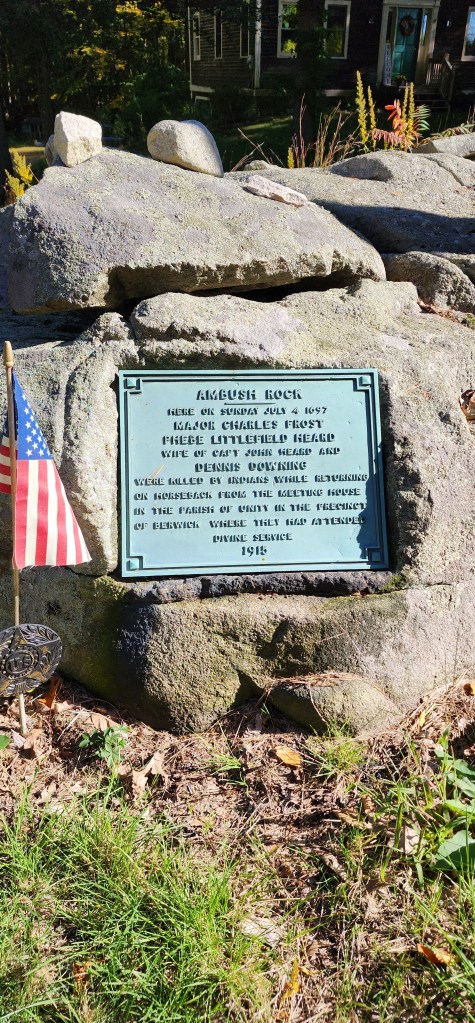
Ambush Rock

What the marker in Eliot, Maine, doesn’t mention is that Major Charles Frost and Dover’s Richard Waldron concocted the mock wargame that led to the hanging of Native men sent to Boston and the sale of about 350 Penacook women and children into slavery in the West Indies.

This was hardly an attack on an innocent party, then. The Natives waited years to extract revenge, and did it at a time and place that spared others.

My history Quaking Dover adds details.

For me, it’s a big meet-an-author event

A program Thursday night at the Dover Public Library promises to be lively fun.

Hosted by Dover 400, the folks behind the year-long celebration of the town’s settlement 400 years ago, I’ll be one of three authors of new books about the community’s past. Each of us brings something different to the table, and I’m really looking forward to meeting the others, as well as an audience full of additional insights and angles.

The program will allow each of us to address some prepared questions and briefly discuss our book before turning into wider discussion and an audience Q-and-A.

Retired librarian Cathy Beaudoin, the unofficial (and unrivaled) Dover historian, will be moderating. As an aside, I do wish she’d write the big volume about the city’s textile mills and the ways they transformed the community. She’s already curated a comprehensive lode of entries you’ll find on the public library’s website.

As a handy book you can follow around town, J. Andy Galt contributes an updated set of neighborhood walks that were originally conducted by the Dover Heritage Group. As I’ve previously posted, the city is pedestrian-friendly and has quite a range of architectural styles. In many neighborhoods, every house you pass seems to possess a history, if you stop, look, and have a few tidbits of info in hand. From the directions to one of those walks, Dover Friends Meeting finally learned where our second meetinghouse, from 1720, had been moved and now sits as a private residence.

Former Woodman Institute trustee Tony McManus brings a newly published, wide-ranging collection of newspaper columns he’s written on local history, especially the people involved.

And I’ll be there looking at the early developments from the perspective of the Quakers, for decades the town’s biggest minority.

As a grand finale, there will be an opportunity to sign books we’ll have for sale and meet one-on-one with readers. I couldn’t do that with ebooks.

(The snow date is March 9.)

English relations with the Natives were strained from the very beginning

One of the troubling revelations I found in researching my new book Quaking Dover is the depth of the English injustice and violence toward the Indigenous people of what we know as New England. It goes all the way back.

Forget the happy images of that first Thanksgiving feast where the Natives are portrayed as the special, very welcome, guests of the Pilgrims.

Squanto, after all, had been kidnapped, enslaved, and spent five years in England before the first English settlement took hold on Plymouth Bay.

Explorer Martin Pring, who established a fortified camp at Truro on Cape Cod in 1603, fled under attack by enraged Natives after he had set his mastiffs on them and fired his cannon in their direction.

The Pilgrims’ military leader, Myles Standish (not one of their faith, by the way), led the 1623 Wessagussett massacre, prompting Natives to abandon their villages for safer ground.

The Pequot war, 1637, was ultimately a land grab ending with the construction of New England’s first slave ship to trade the Native survivors into slavery in the West Indies in exchange for Africans.

And that’s before King Phillip’s war, with the mock wargame in Dover, or the waves of combat across northern New England until the treaty ending the French and Indian wars in 1763.

The outlook, of course, of “savages” and “heathens” was only part of the problem. The English insisted on addressing legal conflicts only in colonial courts. Not surprisingly, the decisions all seemed to come down against the Natives, with no independent course of appeal.

The pressure finally exploded in 1689 with the devastating raid on Cochecho Village and then Oyster River, both in Dover – hostilities that would continue another seven decades.

Are you ready for a fuller story?

Going, going, Gohn

About halfway back in my life, I found myself among Plain-dressing rural Christians. Some of them were also Plain Quakers who retained the “thee” and “thou” speech of Friends’ tradition. My bff of the time was one of them.

Plain dress, should you ask, is what the Amish wear, as well as old-order Mennonites, Brethren, and some other strands, in their own subtle distinctions.

There were reasons I didn’t go all the way, but I did acquire some items, including broadfall pants that have no zipper or belt loops. They were surprisingly comfortable and very well made, in America, no less. After 35 years or so, my denim and blue corduroy pairs are finally showing some wear. I have no idea how many regular brand-name blue jeans these have outlived, but now it’s time to order more of the Plain style.

For many folks, that means Gohn Bros. in Middlebury, Indiana, whose no-nonsense, illustration-free catalog can be downloaded online or ordered by phone or mail. The owners of the store, we should note, aren’t Amish, though they’ve served that demographic for generations. I’ve heard of other faithful buyers who found the store through the Whole Earth pages of hippie lore. Maybe this post will add to it.

I am happy to see that the small-town emporium survives. A few minor changes appear in the options as enhancements rather than copouts. For instance, I can now substitute belt loops for the suspender buttons or opt for gray or black denim rather than blue. My, my.

Here I am, actively paring down my possessions, trying to use up what’s already on my hangers and in my dresser drawers, yet I’m feeling tempted to order a few new shirts, maybe a dress coat, too.

Don’t worry, it’s not Armani. Instead, these selections are much more everyday practical me. Just think, too, they’ll always be in timeless style.

Seems the concept is related to rebels

As I drafted a recent post agonizing over the future of Boston Revels – and by implication, other performing arts organizations – I found myself pondering the origin of the reveling tradition itself. I kept mistyping “revel” as “rebel,’ only to learn that the two words share a common origin. Aha!

Surprise?

A online little research soon led to the Inns of the Court in England and Wales – places that were both a kind of law school and a professional association as well as lodging for members – and to their elaborate entertainments and wild parties that included a lord of misrule.

Suddenly, I was connecting to Thomas Morton and his Merrymount settlement in early New England, something I discuss in detail in my Quaking Dover book.

I’ve long been aware of an irony in the Boston Revels esteem, knowing how alien a Christmas or Midwinter celebration would have been to the city’s Puritan founders, even before getting to any riotous misrule. Now the plot thickened through an awareness of the way Morton was persecuted and his colony forcibly destroyed by Myles Standish at the helm of the New World neighbors.

Today’s family-friendly holiday Revels shows are greatly sanitized from their Medieval forerunners that would have been presented any time between Halloween and Groundhog’s Day – Morton’s big celebrations were for May Day, a seasonal stretch adding yet another pagan dimension.

Moreover, their ancient roots reveal ways English law was independent of the church, diverging the church courts that ruled in continental Europe. The Inns of the Court also nurtured Elizabethan theater and their revels are mentioned in Shakespeare.

Could they even be the source of a rebellious thread in our laws and courts? Or at least of what passes for drama and theatricality therein?

Massachusetts’ treasonous coins

One of the many surprises I encountered in researching my book Quaking Dover was the fact that the Puritan authorities in Boston were ready for revolution from the git-go, way before Paul Revere.

I’d like to see more of their history presented from that riotous side.

There were the cannons they set up on Boston Harbor in 1634 to fire on Royal Navy vessels, should they come to follow up on the king’s voiding their charter. As things developed, Charlie the First got distracted from his problems over here and thus those volleys were never fired.

For another example, we can look to the coins John Hull produced from 1652 plus others for the next 30 years, even though the new king, Chuck Two, soon declared the practice treasonous.

Yes, treason. Off with your head or mere imprisonment in the Tower of London, that sort of thing.

Leap ahead, I’m wondering how he would have handled credit cards and their depths of debt and to me, at least, usurious rates.

Looking at some of those figures today, is anyone ready to say “Off with their heads?”

Maybe ancient history isn’t so far back there after all.

On top of it, the colonists had no representation in Parliament. That had to chafe on their identity as Englishmen through and through.

That was compounded by the costs London imposed on the Americans in defending themselves from the attacks by the French and their Native allies in the decades of warfare prompted by petty European royal succession and alliances. The New Englanders were definitely on their own.

A big question is what made the ruling Virginia Cavaliers turn from Loyalist to revolutionaries? Plus, why did it take so long?

I’m still in the dark about how they actually conducted business

There were no banks and you couldn’t write checks.

Were dried fish and lumber so valuable in Britain and the Continent that you could still make a fat profit shipping them across the ocean? Furs, I can understand, as well as the hunger for gold and silver, which may have fueled speculators who were inevitably disappointed. Plus fish, likely dried.

As for paying your workers? A daily portion of rum or the like was apparently often part of the deal.

By the way, Quakers were in the forefront of developing banks and insurance and even packet shipping in time.

The early colonies had layers of ownership, starting with those demanding annual quitrents for the land you would clear and build on or have “purchased” with any improvements. Then there were the chartered investors, like Lord Saye and Sele and Lord Brooke in New Hampshire’s case, who somehow expected to make a profit overseeing the place. They still had obligations to other investors, like the Council for New England. I’m really unclear how all of that worked in practice or what they got from “selling” their charter to Massachusetts.

The best I can come up with is that it was a kind of private enterprise tax, though I’m not sure what was offered in return. Like Mafia “protection” or layers of graft?

And that’s even before getting to England’s heavy mercantile system that hampered American entrepreneurial opportunities. The colonists were expected to provide raw materials for manufacture in England before being sold at hefty markups in the New World, too.

How did the colonists ever thrive, all their hard work aside?

I’m thinking it’s almost as vaporous as bitcoins.