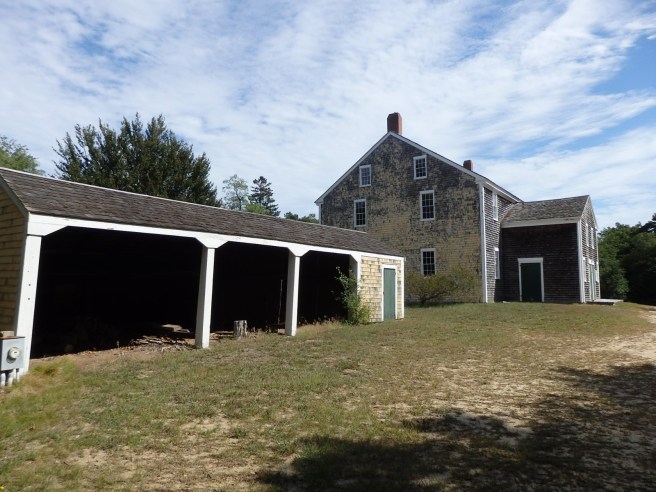
Next door to the Dover Quaker meetinghouse

When I first became active in Dover Friends Meeting in the late 1980s, a group of members and attenders seriously explored the possibilities of creating a  cohousing project. Their minutes filed in the meetinghouse could provide the foundation for a fascinating master’s degree exposition, but the wide range of differences in the participants’ needs and dreams proved to be too diverse to accommodate into joint action. Perhaps economic resource differences also came into play. On my end, I was single but had to consider what might happen if I met the ultimate partner and she had six kids. Ahem.

As it was, when I finally met and wed the almost perfect woman, she came with two marvelous daughters and a German mother-in-law, plus she needed or at least dreamed of and deeply desired space for a large garden. My ultimate party obviously would have required much more than a single bedroom with kitchen privileges.

Still, when I looked at what was then the Stringfellow house next to the Dover Quaker meetinghouse, I mused about how it might have evolved as the Friends shared housing project.

Maybe, as I’ve later learned, I wasn’t that far off target.

Better known as the Osborne-Cartland house, this was built by one prominent Dover Quaker and later owned by others with Friends’ connections.

In fact, it’s one more place the celebrated poet John Greenleaf Whittier likely stayed in his many visits to Dover, thanks to his Cartland cousins.

And it had carved off a slice of the original meetinghouse property.

Yes, it plays into my new book, Quaking Dover.

By the way, I should note that it suggests a Quaker neighborhood around the meetinghouse.

Between it and the Isaac Wendell home I recently posted about across Central Avenue was the Stephen Hanson house where Saint Joseph Roman Catholic edifice now stands. Hanson was somehow prominent in introducing manufacturing to Dover and built the house with his wife, Lydia Brown, after razing two smaller dwellings.

Wish I could show you what they, too, built.

As I wrote to somebody, somewhere

“Gimmicks” is, of course, a loaded word, pejorative, “cheap tricks,” say in contrast to “devices” or structural support or a Greek chorus or some such. In Vonnegut’s day, his repeated quips made him hip, sassy, cool, droll, fun to read, on the same shelf as supercharged Tom Wolfe and Hunter Thompson. They were never dull, archly serious, overtly pedantic. Oh, maybe strike the last item, in retrospect. But somehow we always wanted another hit. I don’t mean that in the best-seller sense. No, that would be a sell-out. (Maybe that’s the crux of the issue you’re raising.)

As much as I loved Vonnegut’s work, especially Rosewater, I’m surprised how little I remember all these years later, apart from the asterisk, just don’t ask me which novel that punctuated.

By the way, I am taken with the ideal of a short novel, though obtaining that can be elusive.

One facet to consider is the way Vonnegut spoke from the Midwest, a region largely ignored or overlooked in American literature, in contrast to New York City mostly Manhattan but rarely Queens or the Bronx. That in itself was a major accomplishment, even if it was from his firehouse on Cape Cod, Massachusetts. So it goes.

Well, his father did run a hardware store and had to sell, uh, useful gimmicks. Drain stoppers, screws, nuts, hammers. (Bang, bang, expletive.)

It is amazing how much “bad writing” fills “great literature,” or even the New York Times Magazine, as one of my ambitious writing teachers led us to see. (He, too, had his own addiction to cool as in gimmicks.)

One question you stir up is how much a piece works for the time when it’s published and how much will still work (function) in later eras? And why?

What did your daughter think of the book, anyway?

An awakening awareness from a Native perspective

The realm of religion can certainly express our highest aspirations as well as manifest some of our darkest fears, as I feel I’ve examined in my new book Quaking Dover.

In my research of early New England, for instance, I see too clearly how often the differences between the Calvinist Protestants known as Puritans led to violent clashes with the French Roman Catholics to the north, as well as the other way around. (Not that I’d expect it to have differed if the Anglicans/Episcopalians had been in charge rather than the Puritans.)

Through their mindsets, the English, in their negotiations with the Indigenous tribes, crudely failed to acknowledge intricacies of decorum or ceremony that included food and dancing. Not so the French, whose missionaries to the Natives established bridges between the Native and Christian faiths. The priests even lived in tribal villages.

More critically, the English failed to impose the moral standards of their faith in their transactions with the Natives. Fair trade rather than widespread cheating would have been a start.

~*~

Where I’m now living, reciting the rosary is an important ritual among the local Passamaquoddy, especially at wakes and funerals. One late tribal leader was also a deacon and has left notes of his efforts to his blend Native religion and his Roman Catholic teachings. I’m hoping that some of this will find publication.

What’s the hold?

Are there comforting commonalities of rosary with chanting or even drumming? Or, from my end, might something connect to the long-lost art of Quakers who preached in “tones,” otherwise called sing-song?

Considering a young cousin’s ability to mimic one minister’s exhorting preaching style I encountered among Ohio’s remaining Wilburite Friends, I’m left wondering how much of the Quaker’s messages was formulaic and how much original, either way an emotional outburst not found in academic sermons and homilies delivered from a pulpit.

I suspect there’s a lot to be learned through what Quaker Douglas Steere called “mutual irradiation” when we do what’s sometimes called “listening in tongues” here.

It doesn’t always have to be about religion, either, though it may underpin much of the historical thinking.

One fascinating new voice from the Indigenous view is Lisa Brooks, author of The Common Pot: The Recovery of Native Space in the Northeast. Her websites – lbrooks.people(dot)amherst.edu/thecommonpot/ and ourbelovedkin(dot)com/awikhigan/index – continue her presentation.

I believe we can all be enriched by participating in such sharing.


Our fair little city has its tribulations, too

Heaven forbid I give anyone a false impression of the place I’m now residing. With all of its isolation from much of the rest of the nation, Eastport can be way too small for many people, though for a few others that adds to the appeal, even in the depths of a very long winter, which for some of us has a charm all its own.

For a sense of our life, find and then stream the Northern Exposure television series, and throw in a demographic that skewers heavily toward retirees and too many summer people, many of whom we’d love to have year-round. We’re not even as faraway as Cicely’s Alaska, either.

One of the unanticipated dramas is at the local government level. While Eastport is organized as a city, our ruling council has had more than its share of friction going, well, far back, as reflected in the ongoing turnover of our city managers and police chiefs. Last I heard, the assessor/building code inspector was also open.

Pay scale is only part of the problem.

Council meetings are often reported, in print and by word of mouth, as contentious, so much so that one member was forced off the council altogether after obscenity-laced outbursts, another fine councilor resigned in utter exhaustion, and one resident once again started recall petitions after being cut off in public discussion.

There are good reasons a popular bumper sticker does say “Don’t New York My Eastport.” However you want to interpret it. I hope it doesn’t include poetry in our monthly open mic sessions.

Not only is there a tension between the born-and-raised here locals and those of us who are from away (PFAs), or those who pinch pennies and those who see investing in the future, the tension can be seen between paying the bills now versus long-term vision.

~*~

One bit of contention that came up since my moving here has been the painting of a downtown crosswalk by a volunteer group. Their color scheme was a rainbow, emblematic of their identity. I thought it was great, in part because drivers wouldn’t be able to overlook it. Safety first, right?

But then the blowback came, and the council backtracked.

I can understand the opposition, which saw the colors as a partisan statement, something I would resent if someone were in turn to paint a crosswalk in some kind of Trump support. Perhaps, more neutrally, a sexual abstinence outside of marriage stance? These were, in other words, gut-level issues that led to a slippery slope or the proverbial can of worms.

Not that there are easy solutions.

~*~

I’m not about to run for city council or the school board – we need younger blood than I’d offer, and someone more focused on detail than I’d muster these days.

But I’ll certainly back others who are willing to embrace the challenges openly.

How long did wooden ships last?

In one recent historical society presentation looking at locally constructed ships, we learned that a working span of 50 years or so “was a long time” for such vessels.

Many went down at sea, of course, and captains routinely expected to lose a proportion of their crew to death on each extended voyage.

I suspect hard numbers are hard to find, though I’m curious.

Besides, are there really as many retired boats propped up in yards and boatyards around here as there are people? Sometimes it seems that way.

And I can think of the remains of three sailing vessels that are visible at low tide.

So here I am, out on the waters for the better part of the week on a 152-year-old schooner, assuming that the odds are in our favor.

The Pine Tree State was a shipbuilding mecca

You wouldn’t believe how many incredible seagoing vessels were built in the Pine Tree State. Maybe it’s because we have thousands of miles of coastline and tons of trees.

Just consider:

  1. The first ship built in Maine was at the failing Popham colony in the winter of 1607-1608. Where did they even get the sails? Yet the pinnace, the Virginia of Sagadhoc, was not only the first ocean-going ship built by English in the New World, but it returned to Jamestown the following year.
  2. In colonial days, the tallest, straightest trees were set aside as King’s Pines, reserved for the masts of the Royal Navy. Conflicts with the French kept many of them from being harvested before the American Revolution.
  3. From the 1830s to 1890s, Maine built more ships than any other state. More than 20,000 ships were launched from Maine shores, many from impromptu shipyards built along tidal rivers.
  4. Bath, with more than 22 shipyards at one time, was arguably the center of action. The town isn’t far from the former Popham colony, where the first ship had been built.
  5. During the Civil War, Confederate cruisers captured more than 100 Maine-built or Maine-owned vessels.  Coastal forts built during the war included Gorges at Portland, Popham at Phippsburg, and Knox near Bucksport.
  6. In 1862 the screw sloop-of-war U.S.S. Kearsarge built at Kittery sank the C.S.S. Alabama in a crucial naval battle.
  7. Maine accounted for 70 percent of the ships, barks, and barkentines built in the U.S. between 1870 and 1899. On the East Coast it also could claim to have built half of the three-mast schooners, 71 percent of the four-mast schooners, 95 percent of the five-mast schooners, and 90 percent of the six-mast schooners. I’m guessing a lot of those tall, straight pines could still be found.
  8. At one time, tiny Shackford Cove here in Eastport had four boatyards. And nearby Pembroke was also prolific.
  9. The shift to steel vessels largely decimated the yards building wooden ships, which capitalized on the state’s deep forests. Unlike most of the state, the shipyards at Bath, Kittery, South Portland, Woolwich, and East Boothbay successfully converted to metal at the end of the 1800s. 
  10. Today the state has an estimated 200 boatbuilding firms, most of the small and working with composites like fiberglass, laminated wood, and resin-based composites.


Where were the schoolhouse and horse sheds?

Or maybe a large outhouse, as one map indicates.

I keep wondering if the Pine Hill school, at the fringe of the city cemetery, was originally one of Dover Friends early schoolhouses.

The Meeting apparently had a second one in Maine.

But horse sheds were also common around Quaker meetinghouses.

East Sandwich on Cape Cod, which has a lot more

Not that I’ve found any evidence of these now.


America’s most celebrated wildlife artist was a Frenchman

Or more accurately, the bastard son of a Frenchman in Haiti.

Yet, despite the iconic honor given his name, few have seen his legendary work in its full glory.

I’m speaking, of course, of John James Audubon, in the anglicized version of his name.

While I had viewed his work behind glass framing in art museums, nothing prepared me for my hands-on encounter with the four folio print volumes. That happened in Indiana University’s rare book Lilly Library when a librarian interrupted to ask if I would help her return two of the volumes to the cart so she could take them by elevator back to the stacks.

Yes, they really did need two people to move. As I’m seeing now, the books measured about 29½ inches by 39½, otherwise known as double elephant paper, the 435 prints being the same size as the original drawings.

We decided to take a peek and were both blown away. It was as if the birds had been pressed full-size onto the plate. You could actually see the veins in each feather. And that was, it turns out, a copy of the original. Oh, yes, and each species was presented full size, with some favored vegetation.

As for the color? Unbelievable. You have no idea how much is lost through any glass.

We both admitted it was too much for a single viewing.

Well, we had an acquaintance who was terrified of blue jays.

Now, for ten more facts.

  1. As an 18-year-old, Jean-Jacques Audubon was sent to Pennsylvania on a false passport to avoid conscription into Napoleon’s army.
  2. A feud originating during his research in Kentucky closed off American support for young Audubon’s work. Instead, his backing came from England, where subscribers underwrote the classic Birds of America.
  3. One bookseller claimed it would never succeed because the book took up an entire table to view and would render other volumes useless.
  4. A reduced-size two-volume collection, a gift from my younger daughter, has me appreciating the radical design and style of many of the images. There was no way, after all, to approximate the original color, yet any approximation opened other dimensions.
  5. He worked from actual specimens he had shot and killed, arranged in lifelike settings.
  6. He did create a controversy regarding the smell of turkey vultures, or what some of us call buzzards.
  7. Some of the birds he discovered remain a mystery.
  8. He’s known mostly by copies of copies or even additional copies, each time diluting the impact of the originals.
  9. He had nothing to do with the national Audubon Society or its Massachusetts and New Hampshire spinoffs.
  10. He’s buried in New York City.

I’m rather glad I waited to read the First Parish history

As a parent, you really try to keep your kids from a lot of painful encounters but they never listen to your advice, as far as you can tell, which seems to be futile no matter how hard you try, and then the next thing you hear is crying.

Maybe that’s a good thing, if from their experience they learn more than you knew.

There are several books that fall into that model. Had I read them before completing Quaker Dover, I might have overlooked some fresh insights. But now that my book’s out, I really appreciate what else I’m finding.

Donald R. Bryant’s History of the First Parish Church is one of them. The 160-page volume, first published in 1970 and enlarged in 2002, offers another side of my argument of the Quaker invasion in town, for one thing, while relating other parts of the early years with, well, perhaps more discretion. And, my, I do admire his resources and tenacity.

One of my favorite sections is the profile of John Williams that Bryant works into the narrative. Williams, a member of the parish, was, as he says “a visionary, a leader in bringing textile manufacturing to America,” and a cofounder of what became the big millworks in today’s downtown.

But he also became part of the faction of 26 male members who announced in 1828 they were leaving the church to join the Unitarian Society in establishing a new congregation. The split among the heirs of the Puritans into Unitarian or Trinitarian Congregational at the time paralleled a similar one among American Quakers into Orthodox and Hicksite. New England somehow remained Orthodox, as far as Friends went.

The plot within First Parish further thickens over the kind of minister it needed along with the construction of a new, and present, house of worship. What follows in the parish history is a turmoil that includes the changing economics of the town I haven’t yet found in the Quaker Meeting.

Bryant’s history then turns largely to the successive ministers rather than the congregation’s members and their influence in the community.

Still, I appreciate the comments by David Slater at the end of the book. He was First Parish pastor when I first came to Dover and quite engaging. He offered a checklist on how church life was changing that remains relevant, though nothing hit me more than this:

“Christianity is becoming more and more counter-cultural.”

That takes me back to the Quaker invasion into Dover, back in the mid-1600s.

As for the city’s other congregations? I’m anxious to hear more.

Forget what you think you know about pirates

The popular image, shiver me timbers, comes straight out of Disney.

To set the record straight:

  1. They didn’t punish people by making them walk a plank blindfolded. Instead, the victims were killed immediately or keelhauled – tied to a rope and dragged behind the ship.
  2. They didn’t say “Ahoy!” or “Matey!” I’m not so sure about “Argh!”
  3. Female pirates had to disguise themselves as men to protect themselves. But, by some accounts, there were many of them.
  4. Forget the buried treasure. And their loot was often something other than gold or jewelry.
  5. In fact, maps and some books were more treasured as booty than gold.
  6. Captains were elected and could be removed. Who would have thunk?
  7. The eyepatch wasn’t to hide a missing eye but rather to allow for rapid visual adjustment between above deck and below. Anyone want to try that for verification?
  8. Conditions aboard a pirate ship were often more civilized than those on merchant vessels, where lousy rations and low pay were often common.
  9. The skull-and-crossbones Jolly Roger wasn’t the only terrifying pirate flag, by far. How about Black Bart’s one having himself holding an hourglass with the Devil? Or Captain Low’s blood-red skeleton standing at the ready?
  10. Pirates still flourish today, especially in the Indian Ocean and parts of the Pacific.

Well, Eastport’s annual pirate weekend festival’s coming up. We’re bracing for the invasion.