Let’s fill in some more blanks

Some people sit down in the depth of winter to peruse seed catalogs and dream of harvests. We’ll be doing some of that in our household, and you’ll no doubt sample some of the results here.

Some find it a good time to revisit highlights from the previous year or further back. Yup, that too.

The snowy months also offer delightful travel opportunities, and not just to warmer climes. Even if you stay close to a wood fire or the equivalent, taking time to sift through brochures can stimulate plans for trips long or short later in the year. Consider my upcoming posts based on my week on the waters of Penobscot Bay at the beginning of autumn in that vein.

Quite simply, retirement and winters aren’t a blank stretch in my life.

~*~

One movie I viewed as a kid in the Dayton Art Institute’s tapestry-walled auditorium left a lasting impression on me. I think the film was scheduled to be shown outdoors but this was the rain site. What I do recall is its presentations of windjammers racing along under full sails. I was still far from any actual encounter with the ocean or sailing, but from that point on I did realize I had no interest in a traditional cruise, or what I’ve seen as a floating nightclub. No, if I went out on a cruise, it would be under sail. Not that the option quite came in front of me.

Instead, the closest over the years were jaunts on ferryboats in the Pacific Northwest and then the Northeast, along with whale watch daytrips and, especially, my boss’ 32-foot sailboat in the Gulf of Maine.

One impression I gleaned from those outings is how differently a geography fits together when it’s experienced from its waters rather than its land. That awareness certainly came into play in my history research for Quaking Dover.

Being on the water filled in some blanks.

~*~

As a lover of maps, from childhood on, I’ve also learned how the mere fact of being in a place transforms the charts. A location becomes real when I’ve walked around in it. Or, as I learned in my time on Penobscot Bay, if I’ve walked around in a boat just offshore.

Listening to new friends in Maine presented a series of towns I could place only vaguely – Castine, Stonington, Brooklin, Islesboro, Southwest Harbor – along with related locations like Vinalhaven, Isle au Haut, Blue Hill, Swan’s Island (not to be confused with Swan Island in the Kennebec River), or Little Cranberry. I could nod along with a blank look. My week on the water filled in more of that comprehension.

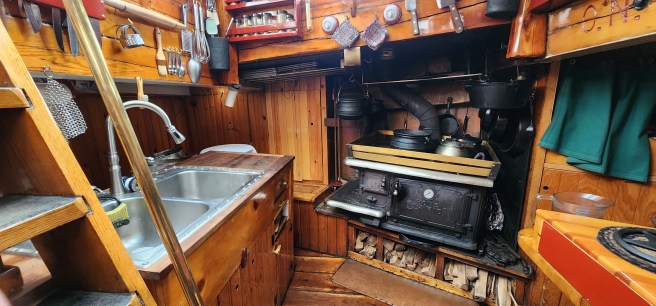
Now, let me fill in the name of the ship in question here – the Lewis R. French – and the fact she was a schooner, a very special distinction, as I would learn.

And as you’ll see.

I hope this won’t be polarizing

Seems fitting in this presidential election year that we revisit what the Founding Fathers envisioned in crafting their new nation.

I was fortunate to study under and work with Vincent Ostrom at Indiana University. As a professor of political policy and administration, he led me in a close examination of the logic underpinning the Federalist, a series of historic papers that argued for the passage of the proposed Constitution. His resulting book, The Political Theory of a Compound Republic (1971), and later volumes presented a much different understanding of the workings of democracy in the United States than I had found in the more conventional, top-down perspectives. He dubbed the overlapping jurisdictions a polycentric system, or a “compound republic” in the words of the Federalist, and found in it flexibility as well as layers that ultimately enhance democracy.

Through the coming year, the Red Barn will present weekly excerpts from the arguments written by James Madison, Alexander Hamilton, and John Jay but at the time attributed to the nom de plume Publius.

Let me admit that it’s been years since I last opened my thoroughly marked up copy of the collected papers, a trade paperback I bought for $2.45 back in 1968. I’ll probably be embarrassed by some of my notes in the margins and perhaps also surprised by some of the phrases and sentences I underlined while overlooking more profound insights on the same page.

In this round, we’ll stick with the original text, apart from the titles I’m applying. The prose looks quite different to me than it did more than a half-century ago, even without all the recent political turmoil we’re seeing.

Oh, there could be so much more

If you’ve wondered about the many unanswered questions in my book Quaking Dover, let me say I’m hoping they become a prompt for other history fans to follow up on.

Frankly, if I hadn’t given myself the deadline of Dover’s 400th anniversary, I’d still be in the research stage rather than having a published book in hand.

I would especially be interested in pursuing what happened to Friends who were disowned by Meeting, especially over matters of marriage. How many joined other congregations – and which ones? How many drifted away from religion altogether? How many Quaker values did they continue, as well as which ones did they reject?

There are also the things from our own time that we might answer, if asked, but that will fall through the cracks. Ours are truly fast-moving times, and I’ve often been startled when presenting my own poetry and fiction to find points I have to explain to younger ears in the room. Transistors, the forerunner to computer chips, was a prime example.

So here we are once again, looking ahead and looking back in our own lives.

As for Dover, as the big 400th anniversary wraps up?

Happy New Year, all!

In all of the holiday festivities

In the colonial era, neither the Congregationalists/Puritans at First Parish nor the Quakers/Friends observed Christmas.

So much for singing festive carols or decorating a tree.

The Friends didn’t sing at all, actually, unless it was somehow spontaneous.

At First Parish, meanwhile, a bass viol was introduced in the 1700s to accompany the hymns.

That gave way in 1829 to an organ built by Bostonian William M. Goodrich. In 1878, the instrument was rebuilt and repositioned by Hutchings-Plaisted of Boston, with alterations in subsequent years.

In 1995, a thoroughly revised instrument was unveiled, the work of Biddeford, Maine, Faucher Organ company. A hybrid of the original pipes and of newer electronic and computer elements, it’s a monster machine capable of rattling the house and shaking the bottoms of your feet.

I am glad we simple Quakers don’t have to pay for its routine maintenance, though I am grateful for those who do.

Not bad for holiday festivities, including accompanying a community-wide Messiah sing.

It’s not the only option in town, either. For some, those carols have to wait till the end of Advent, when the Twelve Days begin.

And, for the record, the Greek Orthodox start celebrating Christmas 12 days later.

How comforting when a few others independently come to my conclusion

Two examples:

  • The Dover Historical Society’s now ancient trolley tour that mentions the Providence ship’s landing. (Now, where did I come up with that?) It is crucial in establishing the early settlement date for what’s now the oldest city in New Hampshire, as I detail in my book Quaking Dover.
  • Someone else seeing the similarities between the slow movement in American composer John Knowles Paine’s second symphony and in Gustav Mahler’s much more famous and more popular fifth two decades later. Give originality and genius its due.


As for some of Dover’s conventional histories

I’ve previously mentioned newspaper editor George Wadleigh as a fascinating source of Dover historical narrative.

The Rev. Jeremiah Belknap, a renowned historian, proved far less helpful when it came to the Quakers. They seemed largely invisible to him.

I largely ignored the Rev. Alonzo Hall Quint, another Congregational minister, whose historical notes had been read by Wadleigh, probably when they were originally serialized in the Dover Enquirer from 1850 on. One of my reasons was practical: the scanned ebook edition of the book is nearly unreadable. Besides, even in retirement, I have only so much time. One point worthy of revisiting in the original would be the use of “inner light” in 1855 – if accurate, that would be the first reference to the Quaker doctrine anywhere. Previously, it was Inward Light, with a much different focus. I’m assuming this was a “correction” by John Scales in editing the full book edition published in 1900. Scales himself authored an independent colonial history published in 1923.

One source for later research would be the journals of the Rev. Enoch Place, a pioneer of the Free Will Baptist movement. He visited Friends Meetings in his travels from Strafford, which would offer a fresh perspective, as well as presiding at thousands of burials, baptisms, and weddings from 1810 to 1865. His might balance the histories of the period that revolve around Dover’s downtown mills.

Opera fans have their memories, but few are like this

Thinking about arts performance scheduling and audiences has had me recalling some of the first operas I attended.

They were at the Cincinnati Zoo, at the corner of Erkenbrecher and Vine.

Don’t laugh. The performances were top-flight. The Cincinnati Summer Opera, as it was commonly known, was informally considered the summer home of New York’s Met, and it provided seasonal employment for members of the Cincinnati Symphony Orchestra.

The company had an impressive pavilion on the grounds, and visiting the animals before watching the singers was part of the experience, if you allowed yourself time. I especially remember being amused by the monkey island antics at intermission. And many of the singers, so I’ve read, humorously came to think of themselves as a special kind of animal.

Especially notable was the first time you heard a roving peacock screech. It sounded like somebody was being murdered and could happen at any time during a performance. Veteran singers used to wait to see if newbies could maintain their composure when the cry rang through the theater. In the opera world, this was an inside joke and a rite of passage, at least for those who passed the test.

I’ve been trying to remember how long the season ran, but there were usually four performances a week – one production on Thursday and Saturday, and another on Friday and Sunday, if I have it right. In the late ‘60s, that spanned six to eight weeks, best as I can recall.

Think of that – 12 to 16 different productions each year. Only a few big houses in the world surpass that.

But at its height, there were 18 different offerings over 61 performances in a ten-week season. Where did that many operagoers come from out in Ohio and neighboring Kentucky and Indiana?

The tradition originated in 1920, making the Cincinnati Opera Association the second-oldest opera company in the U.S., and continued until moving into the renovated and air-conditioned Music Hall in 1972, where the season still happens each summer, though on a much different scale.

For the history student, I see some doctoral dissertation possibilities

There’s so much more I’d like to know about details related to my Quaking Dover story, but I’m not a professional historian.

Some of these could be fodder for a Ph.D. dissertation.

  • An examination of Dover Friends book of minutes dealing with young men who enlisted in the Revolutionary War would be one.
  • Or of where individuals went in their religious affiliations after leaving Friends.
  • Even Richard Waldron’s full biography.
  • A list of the clerks of the Meeting and another of the recorded ministers and elders would be helpful.
  • Or an examination of the actual functioning of the provincial charters, especially the so-called “proprietary colonies.”
  • And, oh yes, a genealogical index of New England Quakers like William Wade Hinshaw’s encyclopedic indexes of New York, Pennsylvania, Virginia, the Carolinas, and Ohio.
  • I would even like to see an understandable examination of English settlement in Maine in its colonial years. Where, for instance, did the settlers go after watching from sea as smoke and flames rose from what had been their homes and villages in a fateful five-week period of 1676, eradicating all English from east of Casco Bay?