I have to wonder whether my book Quaking Dover is my way of saying farewell to my Friends and congregation in Dover – or of staying in touch, now that I’ve moved further east.
Only time, of course, will tell.
You never know what we'll churn up in cleaning a stall
I have to wonder whether my book Quaking Dover is my way of saying farewell to my Friends and congregation in Dover – or of staying in touch, now that I’ve moved further east.
Only time, of course, will tell.
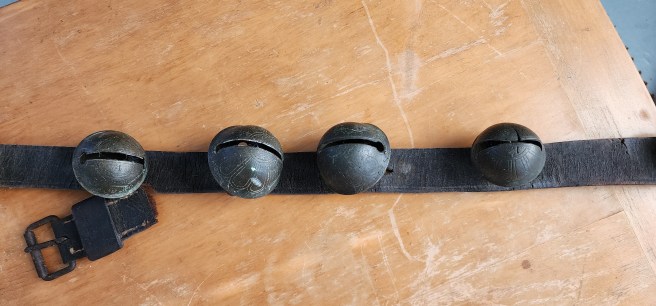
These belonged to the wonder horse Prince, who appears in my genealogical blog Orphan George. As a figure in our family, he was owned by my grandfather, who picked him up from two older brothers in succession. And now they’re going on to my daughters. Bet they cost a pretty penny, back in the day.
In the colonial era, neither the Congregationalists/Puritans at First Parish nor the Quakers/Friends observed Christmas.
So much for singing festive carols or decorating a tree.
The Friends didn’t sing at all, actually, unless it was somehow spontaneous.
At First Parish, meanwhile, a bass viol was introduced in the 1700s to accompany the hymns.
That gave way in 1829 to an organ built by Bostonian William M. Goodrich. In 1878, the instrument was rebuilt and repositioned by Hutchings-Plaisted of Boston, with alterations in subsequent years.
In 1995, a thoroughly revised instrument was unveiled, the work of Biddeford, Maine, Faucher Organ company. A hybrid of the original pipes and of newer electronic and computer elements, it’s a monster machine capable of rattling the house and shaking the bottoms of your feet.
I am glad we simple Quakers don’t have to pay for its routine maintenance, though I am grateful for those who do.
Not bad for holiday festivities, including accompanying a community-wide Messiah sing.
It’s not the only option in town, either. For some, those carols have to wait till the end of Advent, when the Twelve Days begin.
And, for the record, the Greek Orthodox start celebrating Christmas 12 days later.
Two examples:
I’ve previously mentioned newspaper editor George Wadleigh as a fascinating source of Dover historical narrative.
The Rev. Jeremiah Belknap, a renowned historian, proved far less helpful when it came to the Quakers. They seemed largely invisible to him.
I largely ignored the Rev. Alonzo Hall Quint, another Congregational minister, whose historical notes had been read by Wadleigh, probably when they were originally serialized in the Dover Enquirer from 1850 on. One of my reasons was practical: the scanned ebook edition of the book is nearly unreadable. Besides, even in retirement, I have only so much time. One point worthy of revisiting in the original would be the use of “inner light” in 1855 – if accurate, that would be the first reference to the Quaker doctrine anywhere. Previously, it was Inward Light, with a much different focus. I’m assuming this was a “correction” by John Scales in editing the full book edition published in 1900. Scales himself authored an independent colonial history published in 1923.
One source for later research would be the journals of the Rev. Enoch Place, a pioneer of the Free Will Baptist movement. He visited Friends Meetings in his travels from Strafford, which would offer a fresh perspective, as well as presiding at thousands of burials, baptisms, and weddings from 1810 to 1865. His might balance the histories of the period that revolve around Dover’s downtown mills.
Thinking about arts performance scheduling and audiences has had me recalling some of the first operas I attended.
They were at the Cincinnati Zoo, at the corner of Erkenbrecher and Vine.
Don’t laugh. The performances were top-flight. The Cincinnati Summer Opera, as it was commonly known, was informally considered the summer home of New York’s Met, and it provided seasonal employment for members of the Cincinnati Symphony Orchestra.
The company had an impressive pavilion on the grounds, and visiting the animals before watching the singers was part of the experience, if you allowed yourself time. I especially remember being amused by the monkey island antics at intermission. And many of the singers, so I’ve read, humorously came to think of themselves as a special kind of animal.
Especially notable was the first time you heard a roving peacock screech. It sounded like somebody was being murdered and could happen at any time during a performance. Veteran singers used to wait to see if newbies could maintain their composure when the cry rang through the theater. In the opera world, this was an inside joke and a rite of passage, at least for those who passed the test.
I’ve been trying to remember how long the season ran, but there were usually four performances a week – one production on Thursday and Saturday, and another on Friday and Sunday, if I have it right. In the late ‘60s, that spanned six to eight weeks, best as I can recall.
Think of that – 12 to 16 different productions each year. Only a few big houses in the world surpass that.
But at its height, there were 18 different offerings over 61 performances in a ten-week season. Where did that many operagoers come from out in Ohio and neighboring Kentucky and Indiana?
The tradition originated in 1920, making the Cincinnati Opera Association the second-oldest opera company in the U.S., and continued until moving into the renovated and air-conditioned Music Hall in 1972, where the season still happens each summer, though on a much different scale.
There’s so much more I’d like to know about details related to my Quaking Dover story, but I’m not a professional historian.
Some of these could be fodder for a Ph.D. dissertation.
I don’t mean the cracker company, either, the one known as Nabisco, for National Biscuit Company. Or was that Baking?
No, I’m thinking of what was once the broadcasting monolith, first in radio and then in television, the one that projected a peacock logo at the onset of color programming.
The financial struggles for traditional mass media in the digital age are well-known, but broadcasting has been hit perhaps even more drastically than newspapers.
As a child of the ‘50s and ‘60s, I’m still shocked at the disappearance of AM radio, especially its powerhouse clear-channel signals. My daughters, savvy as they are in tech matters, don’t even know what AM is. These were coveted media, and getting a license for even a daytime frequency in a metropolitan market could be a coup. Think of WKRP in Cincinnati for the insider view. Instead, though, owners have allowed many of these to go silent. As for FM? The real competition is from streaming and satellite.
We gave up our TV years ago after realizing that whatever we wanted to watch was available online. Still, I was stunned the other day to discover that NBC no longer has an on-the-air outlet in Boston. That was unthinkable. Nobody would give up a network affiliation and go independent. Yet, as I learned, it isn’t anymore.
The trigger came the other morning when I was gazing at my Yahoo news feed and clicked on the latest Patriots football gossip from NBC Sports Boston, one of the primary regional sources. Wait, I thought. Why isn’t this identifying a station? Or at least a channel?
And that’s when I went down the proverbial online rabbit hole and found out that the once mighty network exists solely on cable in the nation’s tenth largest media market. Even the Tonight Show.
As for its entertainment lineup?
There are good reasons we’re turning to the new seasons at Amazon, Netflix, Hulu, etc. Besides, we can watch those shows at our convenience, not the network’s.
I must admit finding it hard to keep up with all of these changes. How about you?
More officially, it’s the Aroostook War a.k.a. the Pork and Beans War or Madawaska War of 1838-39 over the international boundary between Maine and the British province of New Brunswick.
Although militia units were called out, no actual fighting took place.
Well, there was a skirmish between armed lumbermen, the Battle of Caribou, in 1838.
The dispute was settled by negotiations by British diplomat Baron Ashburton and U.S. Secretary of State Daniel Webster in an 1842 treaty.
Without getting into the myriad details, it is how the Aroostook County towns of Fort Kent and Fort Fairfield got their full names. And most but not all of the disputed territory wound up in the USA, with Aroostook County being formed in 1840.
Reported casualties came from accidents and disease rather than actual combat.
From Bowen Alpern’s book, Godless for God’s Sake:
“Much of what we tend to regard as the achievement of Friends as a whole was, in fact, the work of individual Friends, or small groups of Friends, often in the face of opposition or neglect of their monthly meetings. (One of the most positive – if often tedious – aspects of Quaker culture may be its capacity to produce or attract individuals who are willing to stand up to it).”
 Jnana's Red Barn