Now, for some background

While we wait for the continuing renovations to catch up with these weekly reports, let’s change the focus to the history of this old house itself. Give us a better idea of what we’re working with, too.

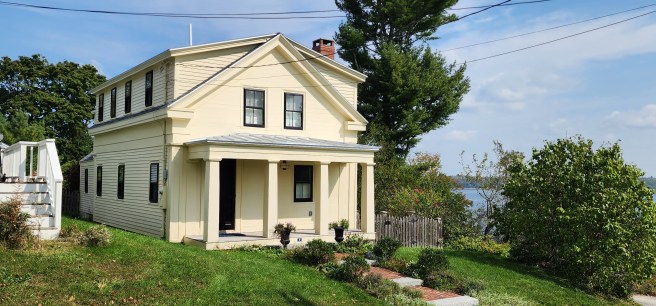
When we bought our full Cape at the end of 2020, the real estate listing dated its origin in the 1860s. As we became familiar with the home’s bones, we saw details suggesting construction as early as the 1830s. While the pedigrees of a few neighboring houses have been catalogued by local historians, ours was not one of them. The dwelling did appear more modest in comparison.

We did have to wonder if the dwelling had been rebuilt after one of the catastrophic fires swept the downtown and its fringes in 1886, 1864, and 1839. Some of our stone foundation is 18 or more inches thick.

The house did appear on a widely reproduced 1879 map of Eastport, one that gave a birds-eye view of the city. The two dormers may have come later – it’s hard to tell from the map.

An earlier historic map of 1855 not only had a house fitting the footprint of ours on the lot, but with two wings, accompanied by an identifying script “Shackford Est.” The difficulty came in trying to figure out which Shackford that would have been — the family was prominent and prolific.
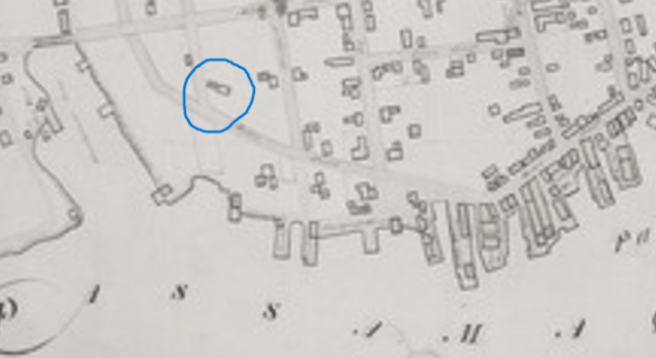
An earlier Plan of the Village of Eastport, 1835, by William Anson presented rough designations of the structures in town, including a house where ours is and only a few others in the blocks around.

Thus, we do know the house was here before 1886, as the charred rafters affirm, reflecting the great fire that destroyed the downtown. Local history dean Ruth “Ruthy” McInnis, owner of the Todd House bed and breakfast, had primed us to look for that detail when we were considering whether to bid on the place. Other dwellings, as we’re learning, share similar damage.

What I’ve uncovered is that this house is even older than we suspected, and more historic. In many ways, it tells the story of the town, too.


Shelter-in-place boredom? You kidding?

This post was supposed to appear four years ago but somehow it fell through the cracks. With a few tweaks, it retains relevance, IMHO.

Here goes, from back in Dover, New Hampshire:

~*~

Catching up with my dentist, now that his office is open again, we noted our astonishment that so many adults were complaining of being bored during the official shutdown of most businesses, schools, churches, and public services.

Bored? I repeated my adage that boredom is a luxury of the teenage years – most adults I’ve known simply don’t have time for it. Alas, it must say something about the people I associate with. (Well, frankly I find most TV to be boring, but others might say the same thing of the operas I’ve been streaming every night. ‘Nuff said there.)

My dental doc, meanwhile, expressed his gratitude for the time off as “paternity leave” he suddenly had to devote to his two- to four-month-old daughter, a once-in-a-lifetime opportunity, as well as time to catch up on a pile of desired novels. Not a bad combination.

We also touched on studies of the eye damage being done to children under age two by their extensive use of digital screens. Well, and their need for boredom to allow essential self-exploration, discovery, and growth, too.

On my end, I have to acknowledge how little cash I’ve used since March 11, the last time I went to the bank. Mostly, it’s been plastic, which fortunately hasn’t spiraled out of control.

What did you discover in this period of changed focus?

In more than one swirl

I’m turned about so much
we don’t connect to the guidebook
in my hand

across from Brooklin
on Blue Hill peninsula
wooden boat school renown
and the magazine

I’m so turned around
the overnight air was humid
we thought the early morning sun
was the moon
we could look at straight
like the nearly full moon

Keeping justice in mind

Justice is the end [goal] of government. It is the end of civil society. It ever has been, and ever will be pursued, until it be obtained, or until liberty be lost in the pursuit. In a society under the forms of which the stronger faction can readily unite and oppress the weaker, anarchy may as truly be said to reign, as in a state of nature where the weaker individual is not secured against the violence of the stronger …

James Madison in Federalist No. 51

National or state identity first?

If, therefore, … the people should in the future become more partial to the federal than to the State governments, the change can only result, from such manifest and irresistible proofs of a better administration, as will overcome all their antecedent propensities. … But even in that case, the State governments could have little to apprehend, because it is only within a certain sphere, that the federal power can, in the nature of things, be advantageously administered.

James Madison in Federalist No. 46