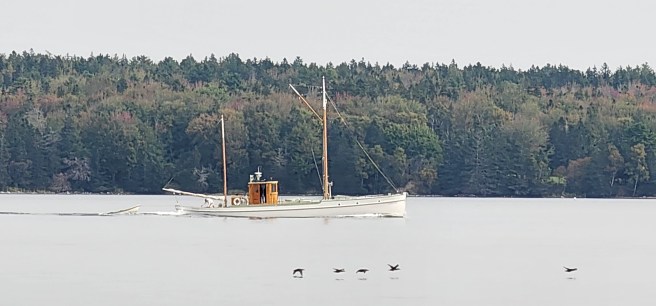
Reclaiming Passamaquoddy

Living adjacent to the tribe’s Sipayik reservation opens new perspectives in my awareness. It’s not quite osmosis, but perhaps a willingness to listen.

One of the big breakthroughs for the tribe has involved access to 36 wax cylinders from 1890, the first field recordings ever made, when anthropologist Walter Jesse Fewkes came to Maine to test the Edison equipment before he headed off to Navajo and Hopi lands.

For decades, the recordings were kept in museum vaults, unknown to the tribe. And then, slowly, they came into consciousness, first through taped copies full of scratchy static and more recently cleaned up into digitalized files that tribe historians are carefully gleaning.

As a writer, I believe in the power of stories and the importance of language itself.

Here are some of the insights I’m hearing from my neighbors.

  1. Dwayne Tomah’s reaction on hearing the recordings the first time: “I wept. These were my ancestors speaking and singing to me.”
  2. The language has only two genders – animate and inanimate.
  3. Its wider family, Algonquian, features prenouns, a form shared only with Japanese and Korean.
  4. Translations from a tribal side, rather than a nontribal institution, can be revealing. For instance, rather than “Trading Song,” it’s more accurately “Let’s Trade.”
  5. The recordings preserve more than the language itself. There are also the stories, songs, and advices, sometimes with context.
  6. The Tides Institute’s latest map of our region portion of Maine and New Brunswick includes the Passamaquoddy place names. Tribal historian Donald Soctomah has used that to explain hard-to-translate subtleties, such as those describing qualities of water encountered in canoeing in a specific location.
  7. A Passamaquoddy-English dictionary, still growing, is available online. It has a range of expressions for anger that are totally missing in English.
  8. The language is being taught in elementary schools. (For generations, it was banned, even in homes.)
  9. The recordings are helping the tribe’s branch in neighboring Canada in its quest to gain First Nations status. One song, for instance, refers to what’s now the location of Saint Andrews.
  10. Even a few commonly understood words spoken among the tribe are rebuilding identity and pride, even when the rest of us watch on.

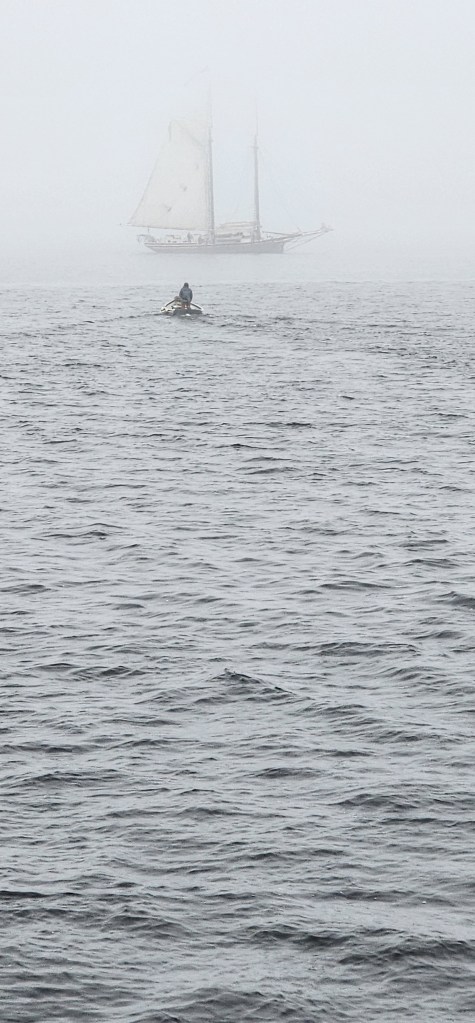
Let’s put Moose Island in perspective

Since relocating to Eastport at the close of 2020, I’ve been posting about the place where I now live, but this may be the time to present a slightly broader perspective.

Officially, Eastport is both a small city and an archipelago. It comprises 3.63 square miles of land, mostly on Moose Island, and 8.7 square miles of water. Moose Island is extremely irregular in shape, with multiple inlets, or coves, and corresponding points, or heads, largely lined with a shore of rock walls and scattered pocket beaches. The island is 4½ miles long and no more than a mile and a quarter wide, depending.

You don’t catch much of that from land, even with the zig-zag state highway into town. That is, emphatically, the only route to or from the mainland. Viewed from the water, of course, a much different picture emerges.

Today, the island is connected to the mainland via a causeway. The roadway passes through the tribal reservation at Pleasant Point, or Sipayik. They, too, are a presence.

In an unusual twist, the Passamaquoddy name, Muselenk, is derived from the English “moose island,” so we glean no ancient nuances there. The waters, on the other hand, are varied and rich, as the Native names reveal.

As you’ll see when we peel away the layers of our old Cape, its orientation – like those of the community’s European descendants over the years – gravitates increasingly to the waters, especially the sheltered, ice-free harbor a block from the house.

Moose Island is described as being on Passamaquoddy Bay, which technically borders the island on one side while Cobscook Bay hugs the other, though both are extensions of the famed Bay of Fundy and its extreme tides. Thanks to Fundy Bay, our tides are the largest in the continental United States, as you’ve seen in some of my posts here. We do face Campobello Island, Deer Island, and a few others only a mile or two away in New Brunswick, Canada, and they shelter us from the open Atlantic. Again, you’ve met them here at the Red Barn.

Campobello, in fact, is a mere mile or two away, across the deep channel, and can be seen from our house.

Legalistically, the border between the United States and Canada slash Britain remained somewhat fluid through many of the early years. Earlier conflicts between France and England precluded permanent settlement before the end of the French and Indian wars in 1763 and few others came in until the end of the American Revolution in 1783. There were also four years from the War of 1812 when Eastport was under British jurisdiction – making the city the last location in the continental U.S. to be under foreign rule.

Perhaps that was a factor in making the harbor the second busiest in the U.S. in 1833, much of it smuggling with New Brunswick.

The line between the U.S. (meaning Eastport) and Canada wasn’t fixed until 1842. Canada and Canadian-born people play a significant role in the evolution of the town.

All of this, as I discovered, plays into the history of our house and its inhabitants, too.

What do you know of the history of your home?

When our planned substantial renovations finally began last autumn, our contractor began uncovering particulars that indicated the house might be even older than we had reckoned.

It was enough to prompt me to follow up on friendly banter by more than one person who asked if I’d ever gone to the county courthouse to “run the deeds” back to the original owner.

Quite simply, no, not here or in the previous two homes I’d purchased and later sold as I moved on.

While I’ve done a great deal of genealogy, courthouse records were one line of research I’d never pursued. I had encountered other researchers who specialized in family properties and last wills and testaments, and I was grateful for what those legal documents added to the family picture.

Even so, do accept my disclaimer regarding some of the dates and locations that pop up as I applied that line of inquiry to our old residence. What I’ve gleaned and present here is in an attempt to get a big picture of the lives that have intertwined with the house we purchased and renovated. Some of the connections are admittedly soft and subject to further revision. I am surprised by how many gaps remain.

Keeping that in perspective, I did finally trot off to the Washington County courthouse in Machias, an hour away. Let me say that digitalizing the archived records has made this field much easier and more accessible, and the registrar of deeds and her staff proved to be very helpful and friendly.

The fateful day my curiosity about our house finally led me to the registrar of deeds in Machias came about while I needed something to round out the day while my computer was in the repair shop a mile or so away.

To get the bigger picture, I set forth with a sense of trepidation. Armed with little more than the plot number of our lot, I anticipated technical complications, a tangle of legalese requiring translation, and dark, dusty confines. Instead, I was pleasantly surprised to find the room well lighted and organized the staff both friendly and helpful. Better yet, the transactions have been digitalized in an easily navigated system. The original records were also at hand, should I desire, and I wouldn’t have to interrupt anyone to help me follow these.

Each transaction included a reference to the book and page numbers of the previous purchase, which was all you needed to trace the line of owners.

If only it were that easy.

~*~

Running the deeds means starting with the most recent transaction and working down through time, document by document.

Despite its modest appearance, our house has an unexpected significance, as you will find.

There are good reasons I’m calling my findings a genealogy of an old house. We’re surprised by some of the characters who’ve lived here.

Being subjected to the laws they pass, too

The House of Representatives … can make no law which will not have its full operation on themselves and their friends, as well as on the great mass of society. This has always been deemed one of the strongest bonds by which human policy can connect the rulers and the people together. It creates between them that communion of interests and sympathy of sentiments of which few governments have furnished examples; but without which every government degenerates into tyranny.

James Madison in Federalist No. 57