PARTISAN PERSPECTIVES

As I said at the time, a question raised in a Quaker Life letter-to-the-editor a while back keeps nagging at me (the magazine, not the cereal). It said, essentially, that in light of all he keeps hearing and reading, he wonders if there’s still a place for a Republican like himself in the Society of Friends. (Obviously, he hasn’t seen the bumper sticker, either: Real Friends don’t let Friends vote for Republicans.)

It’s troubling on many fronts. For all of our claims of “seeing that of God in all people,” we can be pretty one-sided in our public views. Ditto for our proclamations of “inclusiveness” – we do carry a number of exclusionary issues, often subtle, and not just political. And we do know that many Friends are  involved in party politics – to the best of my knowledge, all on one side of the political spectrum. In support of the letter writer, let me point out that Friends were instrumental in founding the Republican Party, and I believe the last two Quakers in Congress were GOP members. In addition, the Friends Committee on National Legislation makes an effort to cite individuals on both sides of the aisle when their votes coincide with Quaker values – for the record, you’ll see New Hampshire’s congressional members sometimes named there. I certainly don’t want us to be blind to the fact that saints and sinners can be found in all parties. To say nothing of the principle of the separation of church and state.

Besides, I’ve heard it said – not just of my Meeting – “I know what they believe in politically. I just don’t know what they believe in” – meaning religiously. That part really troubles me. I would hope that our faith experience is guiding our individual social activism, rather than being limited within it. Maybe we need to be more vocal about our spiritual roots and motivation in our witness, too. I would also like to hear more from the letter writer for his reasons for deciding to stand where he does.

I also keeping remembering a newspaper column a while back that argued an apocalyptic faith – one that believes in the immediacy of Christ – demands social activism. Thy kingdom come, as the prayer goes. And peace on earth. In these little newsletter essays, I’ve tried to steer clear of straight-out theology, but sometimes there’s no way of avoiding it. I really do believe ours is an apocalyptic faith, no matter how we define our individual religious convictions. Maybe the real reason that “politics and religion” are so avoided in polite conversation is because they are so intertwined and so vital, tapping into some of our deepest emotions. How many of our own hot buttons have been pushed already in this brief discourse? Maybe the letter writer also hints that the Republican Party needs more Friends, as witnesses or agents of change. Hey, has anybody noticed I got all the way down to this point without using the word Democrat?

HAS THEE BEEN REFRESHED?

It’s an ancient question after the hour of worship, along with “Has thee been fruitful?” or “How has Truth prospered?” A related question would ask just what draws each of us to sit in the communal quiet in the first place. On the one hand, there’s a need for relief from the conflicts of daily life – a desire for a time of lightness and joy. But ours is not a religion of escape, and I’ve become quite aware that the quest for social justice is also a central Biblical theme. Some weeks, in fact, we come quite close to “praying the newspaper,” as our hearts carry a world of suffering to the invisible altar.

While we reflect on the world, on one hand, we also examine ourselves in our worship. Maybe it’s impossible, if not just difficult, to be as thoroughly honest with ourselves at the deepest levels as we’d like. A therapist, after all, keeps redirecting the client back to the questions being skirted. Still, it’s important we try. Salvation, including being saved from our own negative thoughts and actions, has a root word related to healing. As I’ve been sitting on a succession of Psalms week after week, I’ve come to appreciate the authors’ growing candor – first, to admit the array of enemies, something many of us might have difficulty addressing – and then, in asking that they be smited or the petitioner be sheltered from their assault, which becomes an act of distancing and handing over the desire for revenge; it’s not, after all, no longer, “Let me smite them!” As we survey the realm of struggle around us, let me suggest that saving the world has a direct connection to saving ourselves, in all senses of the meaning. (I’ve always liked the bumper sticker, SAVE THE WHALES.)

Placing the question “Has thee been refreshed?” within this framework has a dimension of renewal and recharging for the work at hand. It’s for more than an hour, then, isn’t it.

NAMING THE CHANGES

My fondness for mountain laurel goes back to my days of living in the ashram in the Pocono Mountains of Pennsylvania. There, the undergrowth of the forest was filled with these blossoms in season.

Over the years, my own spiritual practices have undergone many changes. Even in a tradition like the one I’ve embraced, seemingly free from the annual routines of a liturgical calendar or outward emblems, there appear cyclical changes mirroring those of the seasons. Cycles, too, like those of progressing from childhood and parenthood into retirement or release. In Salem Quarterly Meeting in Ohio, the session each Fifth Month meant rhubarb in the applesauce. See it as sacrificial and special.

There are times of struggle, doubt, and distrust. Times of whirlwind passion and excitement. Times of discovery. Times of drought or deep winter, relying on what’s brought out of storage. Times of renewal and recharge.

This has manifested as periods where I’ve been able to dedicate significant time to meditation, solitude, travel in ministry, prayer, Bible study, research into history and theology, organizational service, teaching, correspondence, or writing, as well as to regular disciplines such as fasting or physical spiritual exercise (the hatha yoga sessions or even wilderness hiking). Emphatically, however, one would predominate while others would likely be absent or greatly diminished. In addition, they would be strongly impacted by the events of my daily life itself – whether I was single, married, divorced, or “in relationship,” my hours and nature of employment, my friendships and faith community, my driving patterns through the week.

The result of all of this would be a crazy-quilt tapestry or a ricochet trajectory if it weren’t for a spiraling within it. That is, over the years, various periods and interests begin to overlap one another, creating a kind of harmony or accumulated depth. My asparagus bed in New Hampshire has roots in my experience of asparagus along irrigation canal banks in Far West desert three decades earlier. A dog sitting through Quaker meeting here is a reminder of dogs sitting through predawn meditation sessions in the Pocono Mountains, or of the cats aligned on the scaffolding outside the windows, as if they, too, were deep in concentrated worship. I read a particular Psalm and see the passage taking twists I hadn’t perceived earlier.

In my own life, my childhood was filled with natural science, hiking, and camping, each with its mystical visions and moments. Adolescence led into politics, classical music, opera, and writing complicated by unrequited sexual yearning. Without romantic companionship, a Lone Ranger journey. Rejection of existing creed while ensconced in church office was followed by flight into atheism and hippie excess landing, inexplicably, in a yoga ashram with its Hatha exercises and sustained meditation. From there, into Quaker practice, though of the ABC – or “anything but Christ” variety. The ashram lessons were applied here, in circles of deepening prayer life. By steps, I moved toward Christocentric and Plain speech, and an especially faith fervent language. Among the Wilburite Friends as well as Mennonites, especially, I came to wrestle within Scripture while similtaneously undergoing repeated Dark Night journeys and questioning. Turning to therapy, I wondered if anyone could come along with me through all of this. By now I was no longer meditating to get high, or transcend, but rather to center down to the Seed. Here, with all of its committee work, I was engaged in a religion that combines mystical experience with social witness and activism. In a nutshell, then.

Each swirl also stirs up something from before. What failed in earlier marriage or relationships reappears. What has been left unfinished is not left entirely behind. What has been shredded remains to be woven. I heard this opera in its entirety a hundred times. Have I ever heard this note before?

I moved from the Midwest to the East Coast and back before heading on to the Pacific Northwest in what seemed an epiphany but instead shattered amid volcanic eruption and devastation. I left the wilderness for another kind of wilderness, back across the Midwest to the East Coast. The pendulum, as they say. Here, I now see life as both linear and circular – that is, spiraling. The spirit requires flesh, or is it that flesh requires spirit? Seasons include times that are full or overflowing, and times that are barren or dry. I now welcome the questioning that is not hostile is both essential and healthy.

My first spring in the orchard, I expected all of the trees to blossom simultaneously. They don’t. The apricots and cherry petals give way to plums, pears, and peaches. The apple blooms arrive last, when others are already gone.

Experiencing a new place through a full year or repeated years provides a much different understanding than a tourist gets – even one who spends several months there. Relocating requires a year-and-a-half to gain familiarity with the new surroundings – to get beyond the obvious, to establish friendships, to be oriented with the elements one finds essential or special. A favorite restaurant, a woodland pathway or place to swim, a boutique or gallery.

There are seasons for a person of faith, from winter to spring elation and then into fullness, dryness, struggle, or disillusionment. To harvest, perchance. Marriage? Family? Children? Extended into joy, compassion, humility, appreciation – one begins observing and naming.

The turning point in my own journey came when I accepted a new name.

MARIAH WATKINS

One of my wife’s childhood heroes, George Washington Carver, is proof that some of the best mothers never have children of their own. After his own mother’s death as a consequence of being stolen from one slave-owning family and carried off to a plantation, before being bought back – how vile, the entire institution – young George was cared for, first, by the sickly wife of the slaveowner, and third, by an art teacher who directed him on to her own father, a college professor of botany. But most important was Mariah Watkins and her husband, Andrew.

We know very little about this black couple, except for her influence on the boy who emerged from spending a night in their barn. In another circumstance, George might have been shot. Instead, she called out for him to wash up and come inside for breakfast. What’s your name, she asked. Carver’s boy George, came the reply. No, she corrected, from now on you’re George Carver. (The Washington came later.) He lived with them while attending the Lincoln School for Negro Children. She gently instilled a deep religious awareness in him, presenting him with her beautiful, large family Bible, which he used daily for the remainder of his life, and also nurtured a sense of responsibility for the advancement of his own people. Essentially what we know about her comes in the correspondence they continued over the years. (Among the few other bits we know is that she was a midwife who cared for about 500 babies, including the painter Thomas Hart Benton.)

You can also trace the two connections between George and another great agricultural reformer, Norman Borlaug, whose Green Revolution is credited with saving the lives of a billion people.

Indirectly, then, by feeding a single child that first morning, Mariah put into motion events that would feed a billion humans – a miracle overshadowing the multitude Jesus’ disciples fed with those few loaves and fishes on the banks of Galilee.

HOW HUMBLING

Even though I’ve never asked previous clerks how they experienced sitting at the head of an institution founded in the 1660s, I found it humbling. The mere thought of superintending the construction of our present meetinghouse (1768) is overwhelming, as is the faithfulness that led the congregation through the Revolutionary and Civil wars. To think of the succession of mighty Quakers who came here in traveling ministry reflects the history of the movement itself, beginning with Elizabeth Hooton, who first nurtured George Fox in the emerging faith. Dover Friends sat down to worship originally in homes and barns, then in our first two meetinghouses, and finally in the room we know so well.

Visit historic Plimoth Plantation, and you get a taste of what Dover must have been like – already four years old at the time those enactors portray. It’s probably not that different from what the first Friends encountered just 3½ decades later when they stirred up what would become our Meeting. Just think of the differences in dialects and vocabulary. (Plimouth, to represent a population of slightly more than a hundred people, employs seventeen dialects, moderating them enough to make them understandable to modern visitors; Dover was likely no less divergent.) From all the evidence of smoke-filled houses, bitter winters, mosquito-infested summers, this must have been a rough-and-tumble community where Friends required generations to evolve into the sedate image we often treasure.

There aren’t many places in the United States having organizations with such long histories. We know only a portion of ours. Even so, we’ve been entrusted with this legacy, and to fulfill it and pass it on. How humbling, indeed.

MYSTERY SOLVED?

While Dover Friends (Quakers) proclaim that we worship in our third meetinghouse, erected in 1768, our history of the previous two structures becomes a bit foggy. Even so, ours is the oldest house of worship in use in the city.

In his authoritative New England Quaker Meetinghouses (Friends United Press, 2001), Silas Weeks mentions that our first house of worship was built about 1680 on Dover Neck, just south of the present St. Thomas Aquinas High School. Correcting an earlier version of the relocation of the structure to Maine, he writes that in 1769 “the 1680 house from Dover Neck was taken apart and re-erected in Eliot at the corner of what are now State and River Roads. There is a bronze plaque marking the site …” (Alas, there goes the tale of its being skidded by oxen across a frozen Piscataqua River. Taken apart and put on a boat now seems more likely.)

Apparently, when our current house was built, we had no need for the smaller structure. I suspect that until our current meetinghouse was available, Dover Friends met for worship in the two smaller structures and gathered together for business sessions.

The disposition of the second house, though, had eluded his investigation. It had stood at what Silas “believed to be the present corner of Locust and Silver Streets,” but there was no indication it had been incorporated in later buildings on the site.

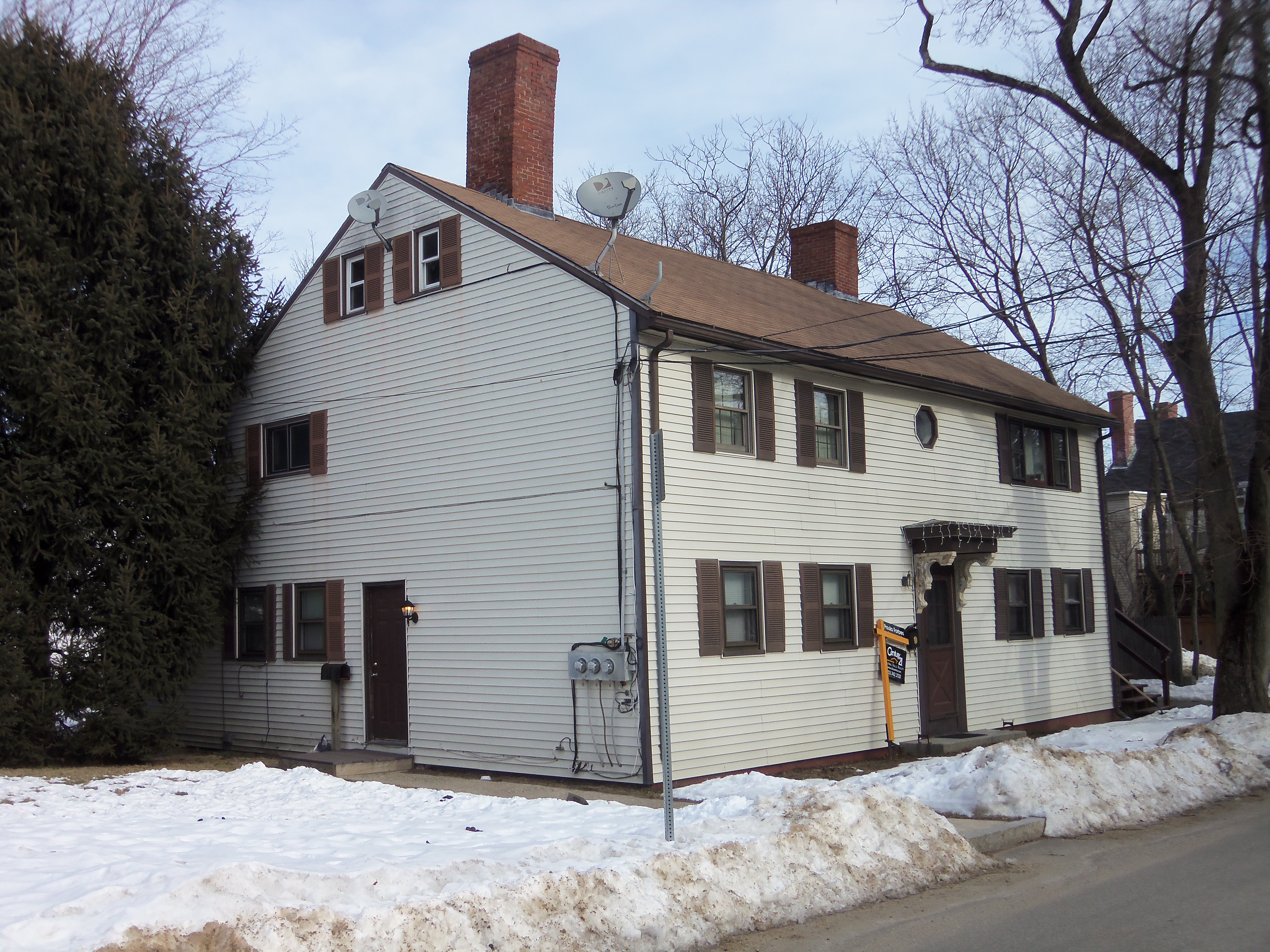
A publication from the Dover Chamber of Commerce, however, may have the answer. Dover’s Heritage Trails, a guide to historic walking tours through the city, notes this at 3-5 Spring Street: “This old dwelling was Dover’s second Quaker Meeting House, built originally at the corner of Silver and Locust Streets and moved to this location in 1728, before Spring Street existed.”

Silas reported “The second was erected in 1712 on land belonging to Ebenezer Varney. The deed, transferred to Friends in 1735, described the site …” in ways that support the Silver and Locust location. My guess is that the structure was moved in 1828, since the Chamber pamphlet mentions that neighboring houses were built in 1810 and 1811.

The building has no doubt changed a lot, inside and out, since it was erected three centuries ago -- including the addition of chimneys. But the shape is right for a Friends meetinghouse.
The building has no doubt changed a lot, inside and out, since it was erected three centuries ago — including the addition of chimneys. But the shape is right for a Friends meetinghouse.

As they say, the plot thickens. And to think, the answer to our search may wind up just a bit more than a block up the street from where we gather.

WATERTOWN AND THE BOSTON MARATHON BOMBING

When I awoke this morning, my wife greeted me with the words, “You missed it last night; all hell broke loose.” I thought she was talking about her board meeting or maybe a big fire, but instead she told me that all of Watertown, Massachusetts, and several surrounding towns were locked down. And then she related the news of the Boston Marathon suspects, the subsequent shootings in Cambridge, the carjacking, the mad police chase down Mount Auburn Street, and all of the activity taking place around the Arsenal Mall.

The developments are still unfolding – and likely will continue to do so for days – and I won’t attempt to relate what’s being reported. What is difficult is trying to imagine the challenges of coping with the shutdown of a very active community. One I’ve been coming to know with some affection.

This year, my Thursdays have wound up in Watertown, where the Revels Singers rehearse for two hours each week in St. John United Methodist Church on Mount Auburn Street. The choir, ranging up to 80 voices, many of them very fine, is led by George Emlen in works from the Renaissance to the present spanning many nationalities and languages. Last night, for instance, we tackled Welsh and French-Canadian as well as English, and the musical experience was exhilarating. No, I’d never even dreamed of being part of such an ensemble.

Rather than getting stuck in rush-hour traffic, I try to arrive early enough to have dinner at one of the inexpensive but excellent restaurants a block or two down the street. (Don’t let looks deceive you: follow your nose instead.) Watertown is an older suburb of Boston, one with substantial houses typically on small lots, and has become a haven of many ethnic cultures. The church where we practice, for instance, also houses a Korean Methodist congregation. Buses pass by frequently, and pedestrians fill the sidewalks. In one block I pass the Greek kabob and gyro emporium I’ve come to habituate, an acclaimed Chinese storefront with tables and takeout (yes, some of it goes back with me to New Hampshire), a Japanese fusion eatery, an Iranian bakery, an Hispanic-focused grocery, several hair and nails salons, a cigar store or two. (I’d planned to make a list someday.)

Yesterday I even arrived in time to tour the Armenian Library and Museum of America,  which incidentally had free admission this week as an offering of a quiet public place for the community to heal from the tragedy on Monday. (The irony of the free admission now comes, of course, in the closing of the town itself.) As the center of Armenian culture in the New World, Watertown has much to say about genocide and suffering over the centuries.

I was still reflecting on that experience as I ate, until noticing the repeated images on the large-screen TV on the restaurant wall as it showed footage of the two suspects shortly before Monday’s bombings. A man at one table got up, pointed to something on the screen, and commented on a detail, which prompted discussion from other tables. People were paying attention.

From there it was on to rehearsal. A magnolia and the daffodils in front of the church were in full bloom. Spring was in the air. Even afterward, as we returned to the street, we wanted to linger.

Who could have anticipated the state of siege that would erupt a few hours later?

POINT OF REVOLUTION

A lighthouse has stood at this site along Portsmouth Harbor since 1771, where fortifications were first erected in 1632. The long dark stonework along the water was part of Fort Constitution. Historically, it was the site of Fort William and Mary, the first armed skirmish of the American Revolution.

This year’s Patriots’ Day comes next Monday, a holiday in Massachusetts and several other states to commemorate the April 9, 1775, Battles of Lexington and Concord that inaugurated the American Revolutionary War. These days it’s also the occasion of the 117th annual running of the Boston Marathon as well as a late-morning Red Sox game at Fenway.

New Hampshire, on the other hand, traditionally marked the event obliquely, with its own Fast Day the following week, ostensibly originating in 1680 and officially abolished in 1991. We got Fast Day as a holiday free from the office, but the only way we knew when it would fall in a particular year was by paying attention to the Marathon — and we’d get the following Monday off.

While Patriots’ Day marks the historic “Shot Heard Around the World,” the actual first armed skirmish happened months earlier at Fort William and Mary along the Piscataqua River in New Hampshire. On the evening of December 13, 1774, Paul Revere rode north from Boston with reports of the latest British actions, especially in Rhode Island. The news sufficiently angered 400 Sons of Liberty led by John Langdon to march on the fort, one of several protecting the mouth of Portsmouth Harbor, and raid it, carting off 98 barrels of gunpowder, roughly five tons. The next night, a small party headed by John Sullivan carried off 16 pieces of small cannon and military stores.

These supplies were then distributed to hiding spots, including the cellars of Boston churches and at least one New Hampshire home, before being used in the Battle of Bunker Hill on June 17 the next year.

Known as the Powder Major's House because of the gunpowder secreted in its cellar after the attack on Fort William and Mary, the residence of Major John Demeritt in Madbury likely originated around 1723 as the wing now attached to the larger Colonial home.
Known as the Powder Major’s House because of the gunpowder secreted in its cellar after the attack on Fort William and Mary, the residence of Major John Demeritt in Madbury likely originated around 1723 as the wing now attached to the larger Colonial home.

POSITIVE AND NEGATIVE POTLATCH

Among the coastal tribes of the Pacific Northwest was a custom known as the potlatch. Essentially, it was a way for the wealthiest members to enhance their status by redistributing the wealth downward. Starting with blankets and maybe a festive meal.

But then things got out of control. The way things do at a party when you forget about tomorrow, again.

Still, you first need to know everyone in the village and the fact it’s your home. Yes, the way families and neighbors just might function together.

Even so, remember. Maybe it was all Coyote’s fault, after all.

ON THE PICKET LINE

As I said at the time, carrying a picket sign, after all those years as a professional journalist, crossed a barrier. We don’t take sides, in public, so what does one do in a labor impasse? I realized this is what my younger stepdaughter, the political activist, called a “viz,” for visibility event, and that we could add more posters to our sticks, to create a “totem pole.” I also recalled a Friend, speaking of driving along and seeing a vigil and then stopping and opening his car trunk for the sign he always carries, just so he’d always be ready to join in anywhere. There was something liberating in this, even if it was an “informational picket” rather than a straight-out strike line.

Now, having retired from the profession, I sense another opening. A return to an earlier calling. My entering journalism, as a public witness and service, is restored to its original prompting of advocacy and reform, before it was confined by corporate media – the very bottom-line organizations right-wing critics overlook when they accuse “liberal media” of, well, reporting both sides. Maybe I’ll become a Quaker agitator, after all. (As the retiree activist, I might say: Thank you, Megan. And Iris. Especially.)