NO MATTER THE PRICE

Inscribed on gravestone of John P. Hale (1806-73) in Dover:

He who lies beneath surrendered office, place, and power rather than bow down and worship slavery …

He was the first United States senator to take a stand against slavery.

Earlier, while serving in the federal House of Representatives, he refused to follow the New Hampshire legislature’s directive to support the admission of Texas as a slaveholding state. In the following election, barred by his party from running under its banner, he ran as an independent; none of the three candidates won a majority and the district went unrepresented.

Kodak26 071

Kodak26 068


DECORATION DAY

As I settled into my bench on a clear Sunday morning, my thoughts kept returning to a disquieting subject. Perhaps it had something to do with the Psalm facing up from the open Bible beside me, beginning with the line, “Deliver me from mine enemies, O my God,” or an acknowledgement of the city cemetery just beyond the trees outside our meetinghouse windows. Perhaps it was a continuation of a thought I’d had the night before, how the event being observed this weekend was originally called Decoration Day, conducted to commemorate the Civil War dead. The act of decorating gravestones seems to me to be superficial or even, in some perverse way, profane – and yet, as the subject kept returning in the stillness, I realized there’s one pilgrimage I would make, to leave a flower on the neglected stone.

I had uncovered much in the previous six months, delving once more into my genealogy research. There was no intention of resuming intense investigation and writing at this point when I responded to a few innocent online queries, which unexpectedly snowballed. The project itself had begun a quarter-century earlier with the surprising discovery that my Hodson ancestors had been Quaker, the faith I had also joined after a circuitous spiritual journey. The historical research later expanded into my grandmother’s Dunker (or German Baptist Brethren/Church of the Brethren) lineage, which also came as a revelation. Here, much of my fascination has been with the dynamics within communities of faith and the ways the members extended their religious practice to all facets of their lives. Crucially, both churches maintained that bearing arms and military service are contrary to the spirit and teaching of Christ, and both churches were based on traditions of lay ministry.

Once identified as a genealogist, however, I soon became the recipient of family miscellany, regardless of value. That is, one becomes the guardian of last resort, or all that stands between antiquity and the dump. Somehow, I’ve become the caretaker of a flag draped over a great-uncle’s casket for military burial, a scrapbook of a great-aunt’s post-World War I newspaper clippings, and many curling photographs of unidentified people and places – things that presently add nothing to the ancestral story. On the other hand, I took up the project just a few years too late to save a great-aunt’s correspondence with my great-great-grandparents, who remained in North Carolina after their sons moved to Indiana and Ohio. Even so, I have also come to possess a few priceless letters and photos and other bits that allow sharp insights into lives that would otherwise be unknown.

In August 1985 I received a package with a note that said, “I am also sending a copy of someone’s journal. It is either from Grandma Hodson’s or Ralph McSherry’s papers. I thought we might be able to figure out the author. Or whatever?” At the time, I transcribed the photocopy of the handwritten memoir, A Journal of My Experience in the Rebellion of 1861-2, and attempted to analyze its curiously bland text. The opening paragraphs went into almost agonizing daily detail of marching across Kentucky, setting up camp, and moving on, often with no sight of the enemy. By the time the unit moves to the Battle of Shiloh, however, the descriptions are brief, even rushed, as if the writer were embarrassed of being ill in the infirmary rather than fighting, even if that illness likely saved his life. And then the text trails off. Since this manuscript would have been from my great-grandmother Alice McSherry Hodson’s line, I tentatively thought it might have been written by her father, who would have then come home to Ohio to marry, but I could find no record of his serving in the Civil War. I identified some other possibilities in her family surnames and had to leave it at that.

Much later, when I reopened my genealogy reports, I decided also to clean up materials my mother had collected on her side of the family in Missouri. With an array of new source material available online, I found myself sifting through Census reports and death certificates and then Civil War records and Census slave schedules – the latter items things I’d never previously encountered, and many of the details troubled me. In the practice of genealogy, you build a personal history that somehow invests you in the unfolding action; sometimes it stands at odds with the general history you were taught in school, or sometimes it allows you to see individuals moving within a larger picture. As I looked at my ancestors in Civil War Missouri, I was surprised to learn that illness killed more soldiers than the fighting did; in my case, John Gilmore died in camp a month after enlisting. I had no clue of the extent of Confederate guerrillas until learning of my Gatewood kin’s clandestine ambushes of Union soldiers. Still, I’ve argued that if one undertakes genealogy, one must be prepared to accept the facts one uncovers.

But that’s not exactly where my thoughts kept returning this morning. Rather, it was to the consequences of one website I had come across while working on my mother’s ancestors’ Civil War service, which now allowed me to consider the possible authors of the memoir I’d transcribed. The movements it detailed matched those of the 1st Ohio Infantry and 2nd Ohio Volunteers, units my great-grandmother’s uncle, John Z. Bahill, served in – back on my father’s side of the family.

The Psalm describes enemies, but that morning I was not led to ponder my own potential enemies. Besides, they would be nothing like the enemies Bahill encountered. His memoirs break off on June 17, 1862, in Alabama before the actions at Battle Creek and then pursuit back to Louisville, Kentucky, the Battle of Perryville, or the march to Nashville before coming to Stones River near Murfreeboro, Tennessee – his second round in that locale. That is, his chronological narrative breaks off before the real action begins.

If you can’t identify the Battle of Stones River, you’re not alone. Neither could I, before Bahill led me to it. The fighting began in the sleet, rain, and fog of New Year’s Eve morning in 1862, and erupted into what would stand as the eighth deadliest battle of the Civil War. It was a crucial victory for the Union forces, coming half a year before Gettysburg and denying the Confederacy the essential agricultural resources of Tennessee. When the three days of fighting were over, there were 24,645 casualties – more than one in every four participants.

You can look at hour-by-hour analyses of the campaign. The opposing strategies, too: the Union plan foiled when the Confederate forces made the first move. Read the reports. As the Union flank collapsed, Bahill’s unit was part of the force that held ground at all cost. No one can imagine being in close fighting where your own death is imminent. Even the description of the deafening cannon fire is beyond comprehension.

This is what I was sitting with, in the quiet of a Sunday morning. Not the noise or the blood but an awareness of the dedication of one’s life to a larger cause.

This was also at crosscurrents with the stream of vocal ministry that morning. One Friend spoke of the importance of having all people agree on a set of basic rights for all humans. Later, another recalled the New Testament scholarship of Albert Schweitzer, which led another to speak of an uncle who gave up university prestige and security to become an inner city pastor instead, where he was murdered in murky circumstances.

I wonder if the Civil War might have been averted by nonviolent movement. The first speaker reminds us that rarely does anyone give up a position of privilege voluntarily. Not unless he sees himself gaining something better. I think of the slaveholders’ great capital wealth combined with the unequal political clout it had given them in the nation’s affairs, and their ruthless efforts to expand it. The witness of Mahatma Gandhi and Martin Luther King seem all the more miraculous in contrast. And I wonder what might have happened if Bahill’s unit had crumpled under its relentless assault. And those are the thoughts I kept circling back on in the silence.

Bahill was among the wounded. I have no idea what his wounds were, precisely, or if he underwent amputation. Still, from the title of his memoir, he apparently knew that his war service was over. The officer commanding the 2nd Ohio, Lt. Col. John Kell, had been killed in action, as had the lieutenant leading Bahill’s company.

But I had been wrong in my initial analysis of the text. I now assumed this was something Bahill undertook on his hospital bed, before the infection set in. Something he undertook, in other words, on his deathbed. He died 2½ weeks later, before he could finish his memoirs. He was 26.

From another website, I view a section of the National Cemetery in Murfreesboro, where he is buried, far from his family in Ohio. He was the last male in his Bahill line and unmarried. The memoirs have come down through my great-grandmother, born 2½ years after his death.

Decoration Day, initiated to remember people like Bahill, seems a more fitting name than Memorial Day. One conveys an action, even if it’s more ritualistic than I would embrace. Memorial Day, in contrast, feels cloudy and unfocused. Who can say if his gravestone was ever decorated by his family? A farm boy, without his garland.

Later, recovering in the hospital from surgery, I would wonder if Bahill had the strength or clarity to write on his deathbed. More likely, it seems he drafted what he did before re-enlisting, perhaps even as an exercise convincing himself to do so. We’ll never know for certain.

LEGACY FROM THE ’60S AND ’70S

One of the lingering questions asks, “Just what happened to the hippies in the end? Where did they all go?”

It’s a complex question, of course, which in turn leads to a range of possible answers.

One of them, though, would say that hippies never actually went away, not entirely.

Yes, many donned business suits or the like and were submerged into the broader economy. I’m hoping that as retirement hits, many of them will return to their idealistic and communal roots, especially in the face of the financial realities of living on Social Security, shrinking pensions, and meager investments.

Many others, though, despite their more conventional attire these days, have focused on a particular strand of the hippie legacy.

Among them:

  • Peace and nonviolence witness.
  • Racial and sexual equality.
  • Environmental and “green” concerns.
  • Back-to-the-earth living, including organic farming, natural foods, and vegan.
  • Alternative economics, including sustainability, co-ops, and nonprofits.
  • Music and the arts, often including folk traditions.
  • Healthy exercise, from hiking and camping to bicycling and cross-country skiing to contradancing and yoga.
  • Educational reform, including charter schools and homeschooling.
  • Spirituality, including meditation and chanting or Spirit-infused Christianity.
  • Boho fashion.

You can add to the list. While I touch on many of these as they were unfolding in my Hippie Trails novels, there’s no way I could capture everything, much less discuss the current incarnations.  For example, every time we see a Prius, just think: it’s what the Bug was back then.

I’m curious, though, about which ways you find the hippie experience echoing in your own life. What issues and themes are you continuing? And which ones do you miss? I bet you’re still wearing those blue jeans, too … most likely without the bib.

Me? It starts with being Quaker. And stretches through much of my work as a poet and author. Or even my focus when I was still in the newsroon.

AN ILLUMINATING DIALOGUE

I’ve suggested meeting with some of the historic Friends sitting on our meeting library shelves, and mentioned the possibility of finding one or two who converse intimately with you, usually in the English of another era. (I’ve seen this happen rather frequently, even if it takes time to find the unique voice.) In this sense, one or two may become timeless companions in your inward growth. Or maybe an old Quake is simply a mentor along the way.

Knowing them can also help us as a PEOPLE of faith. Their range of experiences and concerns provides insights into other streams of Friends today, as Dover Friends have found in our relationship with Cuban Quakers. It also gives us a basis for renewed dialogue on everything from worship and teaching to outreach and social justice issues. We quietist Friends have as much to learn from Evangelical Friends as they do from us – even as we explore our branching out from the same powerful roots.

I’ll leave this for now, saying only that in digging for Quaker roots, it’s possible to find yourself jolted, like grabbing onto a live wire. And who knows where that will lead.

*   *   *

Now, for an update. For ease of convenience, let me point you to overviews of these earlier Friends, all at my As Light Is Sown blog:

MEETING WITH HISTORY

Some have observed that Friends look to their history more than most other denominations do. They say a group that lacks dogma, creed, or liturgy will by necessity rely on its tradition for its guideline and authoritative reference. Well, maybe so. After all, to function as a Society of Friends, we need a common language that enables us to convey our diverse experiences, insights, desires, and needs in ways that knit us together. English Quaker Caroline E. Stephen (1835-1909) was amazed that any group of mystics could actually operate together at all, yet Friends do – and have. Eventually, I think, that functioning becomes part of the attraction early Quakers, especially, extend to us.

While much can be learned by exploring the history of Friends, there’s even more to be gleaned by uncovering a historic Friend who resonates especially with YOU. Sometimes these appear in the published journals, which relate inward and outward journeys through life (a gem may pop up in the middle of an otherwise tedious stretch of travel). Other times, they’re in memorial minutes, letters, or tracts. Sometimes, the words of an obscure Friend begins a lifetime dialogue. Ask around meeting, and there will be many suggestions. Or simply delve into the meeting library (the leatherbound collection holds many surprises, too).

In my experience, I can say that in actively invoking these ancestors, we cross a point where they’re no longer quaint (that nostalgic view of the smiling Quaker Oats man or people in some country meetinghouse) but instead astonishingly revolutionary. Their struggles and discoveries may suddenly speak to our own, even if what erupts is a loud argument – like the one Lewis Benson and John Curtis had in the mid-20th century before concluding that George Fox meant exactly what he was saying, scriptural citations and all. To speak of walking cheerfully in the face of brutal oppression and imprisonment is startling – and a starting point for transformation. It’s beneficial, too, when we discover we don’t need to constantly reinvent the wheel in our practice of faith, but also disconcerting when we realize how much of the work they began remains for us to continue. At least they stand ready to help us.

WHEN LEADERSHIP GOES WRONG

Leadership is a fascinating subject, not just the source of many intriguing biographies but also corporate case studies and political histories and military campaigns and religious movements and … well, feel free to add to the list. We’ve all been in places where we’ve worked with admirable leaders, as well as places where we’ve suffered – perhaps even leaving in despair.

Outstanding leadership is, of course, a rare and wonderful occurrence. Mediocre is, by definition, the norm. And then there’s the kind that worms itself into position and sets about doing destruction.

Lately, I’ve been reflecting (again) on the last one. Not just inept, but destructive. I can work around one, but the other one makes for an impossible situation. Think Moby Dick.

It doesn’t always start off as badly as I’ve portrayed. Sometimes the individual begins gangbusters, doing everything right, before something goes seriously wrong. The person may simply burn out or lose interest. Conditions may change, so that the fit no longer works to the organization’s advantage. (Corporate organizational consultants have elaborate charts of the qualities needed for a startup versus a maturing company, or one shifting from private ownership to a public stock offering or the reverse.) Sometimes the person is fine for when everything’s going smoothly but has no ability to adjust for necessary – and often painful – restructuring, especially when layoffs and shutdowns are involved. Or there may be a buried demon that is let loose somewhere along the way, perhaps triggered by a divorce or death or temptations such as greed or power-hunger or sheer arrogance or flawed leadership techniques such as bullying and abuse or deep-seated insecurity or an untamed ego or, well, again the list goes on. Feel free to add or amplify. This, too, is a source for many great works of literature, operas, plays, and movies. The dark side comes forth.

My big question is whether an organization reacts in time to save itself, and what steps can be taken before it’s too late.

One of the first signs of trouble is the departure of key personnel, often lower-level individuals on the front line – or at least a failure to hear their complaints without retaliation. Sometimes it’s flight at some of the highest levels. After all, their jobs are at stake.

Usually, however, the awareness comes later.

The New York City Opera, for instance, appointed a new CEO whose brief tenure was disastrous. His flamboyant, extravagant vision for the company sent it straight for the cliffs, and the trustees’ decision to terminate his reign ultimately came too late to prevent the train wreck. This was a company, we should note, founded by visionary leadership that continued through several administrations. RIP.

I’m thinking, too, of situations where one of the top leaders engages in clandestine conflict – often backstage, one-on-one building alliances – that’s ego-based to the detriment of the organization. Commonly, the player lacks an appreciation for the culture and values of the organization and seek to turn it toward his or her own goals, including self-power enhancement, regardless of the trustees’ projections. Removing such a toxic manager, however necessary, produces ill feelings and misunderstanding all around, especially when the others are prevented by legal constraints from speaking openly of their underlying reasons.

Sometimes I think it’s a miracle organizations get anything done, top to bottom or, more accurately, bottom to top. There’s far more to leadership than barking orders, for sure, or undue frugality. I’d put mutual understanding high on my list of leadership qualities.

How about others?

~*~

I looked at something similar – good bosses and bad – back on June 28, 2013. To take a look, just click here.

LITERATURE ACCOMPANYING THE HIPPIE EXPERIENCE

A shelf of books was often part of the hippie scene, and I suppose many of the novelists and poets were technically beatniks, but they shaped our journey as well. I think, especially, of Richard Brautigan, Jack Kerouac, Allen Ginsberg, Gary Snyder, Richard Farina, and Gurney Norman, as well as the German Herman Hesse of an earlier era, and Tom Wolfe’s Electric Kool-Aid Test Acid Test. There were also many non-fiction works of influence, including the Whole Earth Catalog, and the Lama Foundation’s Be Here Now.

Which authors and volumes would you add to the shelf if you were trying to give a fuller picture of the experience?

I suspect there are some fine reads that need to be recovered, and blatant self-promotion is also welcome.

This book swap’s open!

HOMAGE TO THE BEST … AND BACK TO THE SCREENING ROOM

We sometimes express a yearning for the return of the Renaissance Man – the individual who could be conversant on all fronts of intellectual inquiry – but the reality today is that it’s impossible even to stay abreast of the developments in one’s own field, much less other more widely shared interests.

Just ask folks who read if they’ve read your latest hot discovery, and you’ll likely get blank looks. It’s just a fact of life, even for works that are in the basic canon.

It extends to the other arts, too, and we won’t even raise the frontiers of science.

That reality hit home the other night when we sat down (finally!) to view Citizen Kane. I knew from my cinema studies (uh, 44 years ago) that the work was then considered one of the four greatest movies ever made, but somehow it had slipped through my viewing. Yes, I’d seen Birth of a Nation and the Battleship Potemkin and likely the fourth work on that tally, though I can’t remember what it was.

And now? I’m in the camp that considers Kane the most important movie ever made. Period. And, as my viewing companion said afterward, “I was ready to respect the movie, but I didn’t expect that I’d enjoy it as much as I did.” Which was immensely.

If you want to know how Orson Welles and his team changed the face of movie-making so utterly profoundly, go to the Wikipedia entry for the movie and then watch Peter Bogdanovich and Roger Ebert’s running commentaries, which are included on the Netflix DVD. Apart from the advent of color, there’s really nothing they didn’t revolutionize. (If you see something they missed, speak up.)

I’m glad we saw Kane after we’d watched The Grand Budapest Hotel. For all of Wes Anderson ‘s wonderful quirkiness, we could now appreciate the ways he and his team paid homage to Welles and the incredible cinematographer Gregg Toland at the head of that list.

We’re now going to have to watch both movies again.

SPRING MILL

kodak1 022

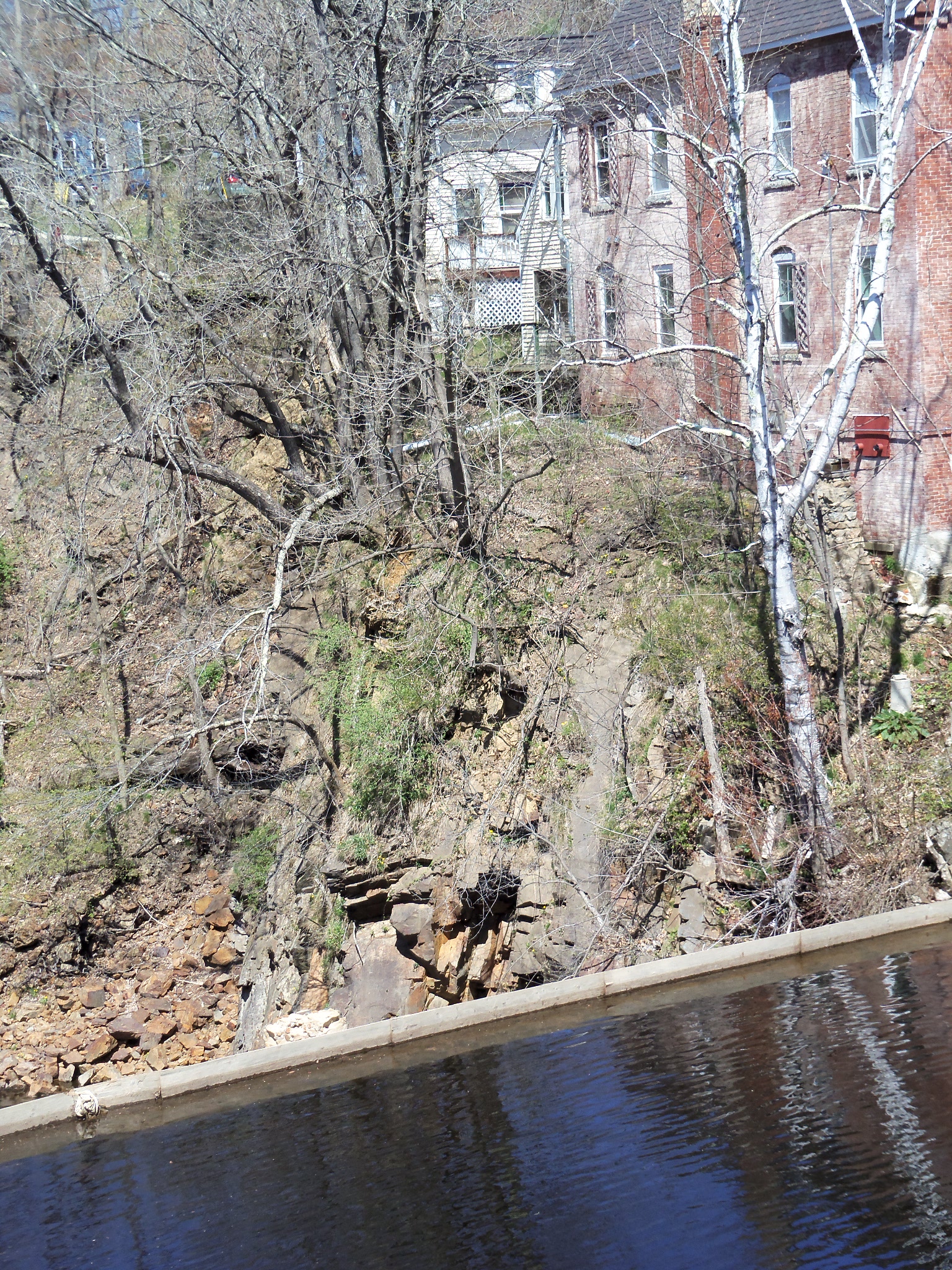
Streams that could be harnessed for water power were prized in earlier periods of American history, perhaps nowhere more than in New England. Here are views of a mill on the Great Works River (fittingly named by Quakers) in South Berwick, Maine.

The leafing trees will soon obstruct this view of the mill perched on the edge of the falling water.
Houses, too, perch at the edge of the drop-off.

HOW DID THEY AFFORD IT?

Viewing several documentaries on the writing life in Manhattan in the 1950s leaves me wondering just how anyone could afford it. Yes, the world was quite different then and, if we can believe their arguments, the written word was king the way it would no longer be by the late ’60s.

Still, it’s hard for me to believe that writing would have paid that much more in the era than it did when I entered the profession. How many plum magazine assignments were there, anyway? Or how many lucrative book advances?

The argument that rents were low, especially in Greenwich Village, is hard to believe for anyone who tried to find a decent place upstate in the early ’70s, as I did. Even for a full-time journalist working for Gannett, the best the pay would cover was a slum where a heavy rain would leak on my typewriter.

And that was without the heavy drinking that we’re told was required of the New York literary set, as well as the psychotherapy, sometimes daily. Plus the heavy smoking. Did I add, all the men wore suits and ties. (And all of the writers and editors, it was emphasized, were males. Women were employed as “fact checkers.”)

Still, when I run the numbers, they don’t add up. Can anyone tell me what I’m missing?