It’s tune in, turn on, and take action in this tale of campus intrigue. Little does a small band in a remote college town realize its opposition to small-ante bureaucracy goes straight to the state capital. And then Washington and the Mekong Delta are another matter as the hippie movement hits tranquil Daffodil. Nothing will remain quite the same.
As the headline said:
BOTCHED DRUG BUST BACKFIRES.
When narcotics agents made an early morning knock-down-the-doors raid on the twelfth-floor of one of the high-rise dormitory towers, they turned up nothing – and were surrounded by irate residents before they could frame anyone, either.
“If you think the slaying of innocent students at Jackson State University was merely a racial atrocity,” Lakasha proclaimed, “you’re not seeing the big picture. It’s about an attack on civil rights – freedoms that belong to all of us. You don’t have to live in a big city to live in ghetto housing. Every student in Daffodil lives in a ghetto. Where I come from, we have a word for high-rise housing like these big dorms – the Projects. And the pigs who come charging into the Projects act just like those who busted in on the twelfth floor the other night. Never mind whether they find anything or not. Look, the university’s demanding that the students pay for the busted doors and busted furniture and busted walls. That’s why they call it a bust in the first place. Wake up, America! Demand the names of the ‘unnamed informants,’ the ones who were so wrong about the presence of illicit substances in those rooms. Wake up, I say! Mississippi’s closer to Daffodil than you think!”
~*~
To learn more about my novel, go to my page at Smashwords.com.
Rockport, Massachusetts, sits at the end of Cape Ann.
Mention “the Cape” anywhere in New England and people assume you’re talking about Cape Cod, that marvelous arm extending from southeastern Massachusetts. (Well, it does have its own dictionary entry.)
Mention “the Other Cape,” and a few knowing heads will nod or smile in recognition of Cape Ann, jutting from Boston’s North Shore.
It’s not that those are New England’s only two points of land extending into the ocean – the definition of a cape. For perspective, two of Maine’s most photographed lighthouses are on Cape Elizabeth and, close to us, Cape Neddick.
What Cape Ann and Cape Cod share is a certain ambience, a feeling that – well, you’re in a unique place and not just anywhere in New England.
If you’re not familiar with Cape Cod, let me say there are many fine guidebooks that describe the experience. Today’s gallivant, though, takes us ever so briefly to Cape Ann, which by its most generous definitions (probably mine) can be no more than a third the length of its famed rival. While Cape Cod is neatly demarked by the Bourne and Sagamore bridges, Cape Ann is a bit more diffusive. Since we come down from the north, we find that “Cape” familiarity in the air as we come into Ipswich, which claims more “first period houses” (1625 to 1725) than anywhere else in America – 58 in all. It’s a charming community and, like most of Cape Ann itself, has a more varied mix of social classes than you typically find on the bigger peninsula.
My introduction to the town came last fall when K. Peddlar Bridges invited me down to do a poetry reading on his Roadpoet cable-access television show – and we had a blast. Before the taping, I went for a walk through some lovely year-round neighborhoods that could stand as textbook tours of American architectural styles. I crossed a stone arched bridge as geese took V-formation and honked low above me. Turns out the 1764 Choate Bridge is the oldest double stone arch bridge in continuous use in the country. (I don’t make this up, nor do I challenge the accuracy of the claims.) Leading to an impressive Colonial-era garrison house, the span connects to Turkey Shore and Labor in Vain roads. You get the picture. And, yes, you don’t get a better sense of that Puritan outlook than “Labor in Vain,” do you?
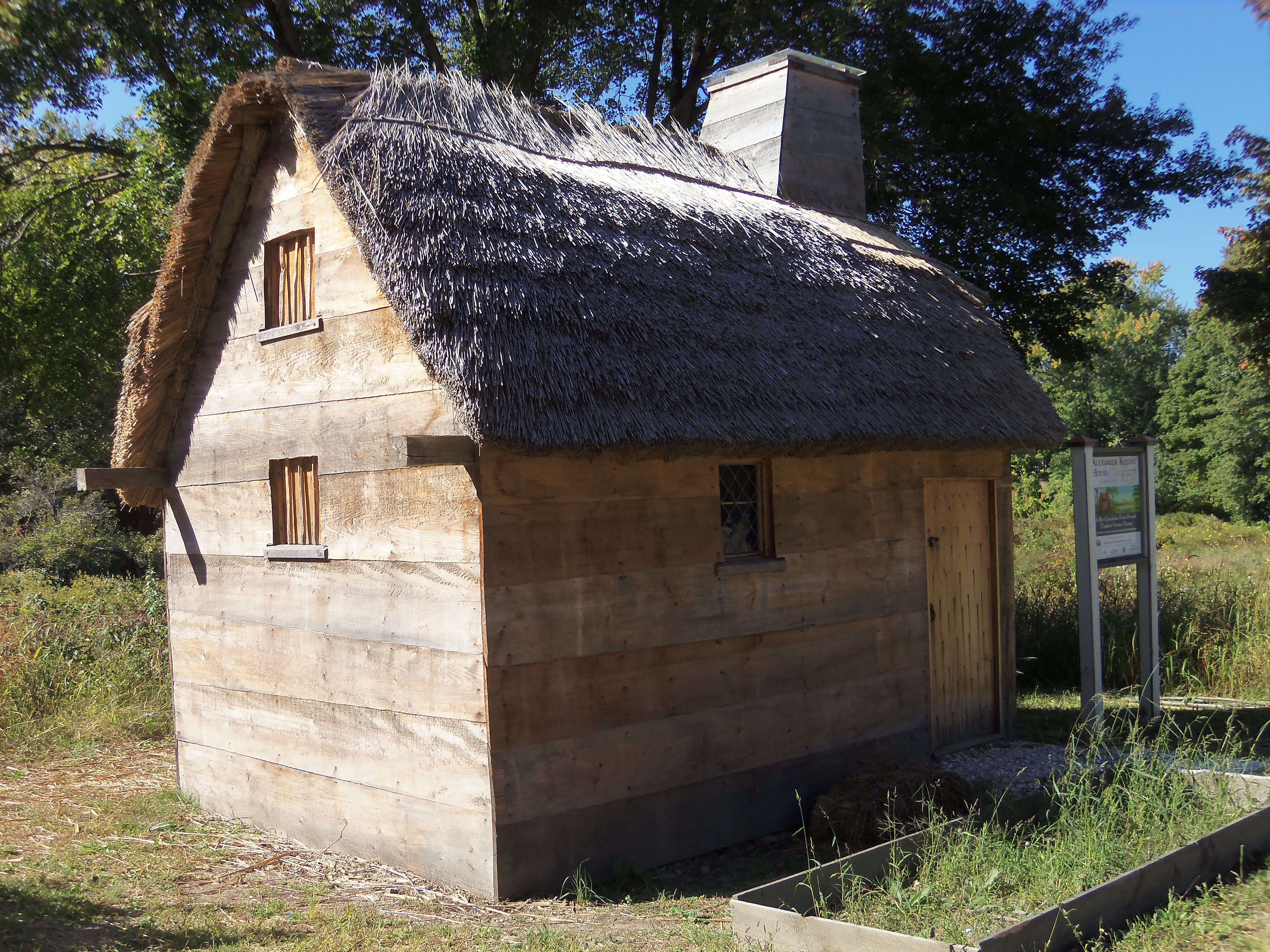
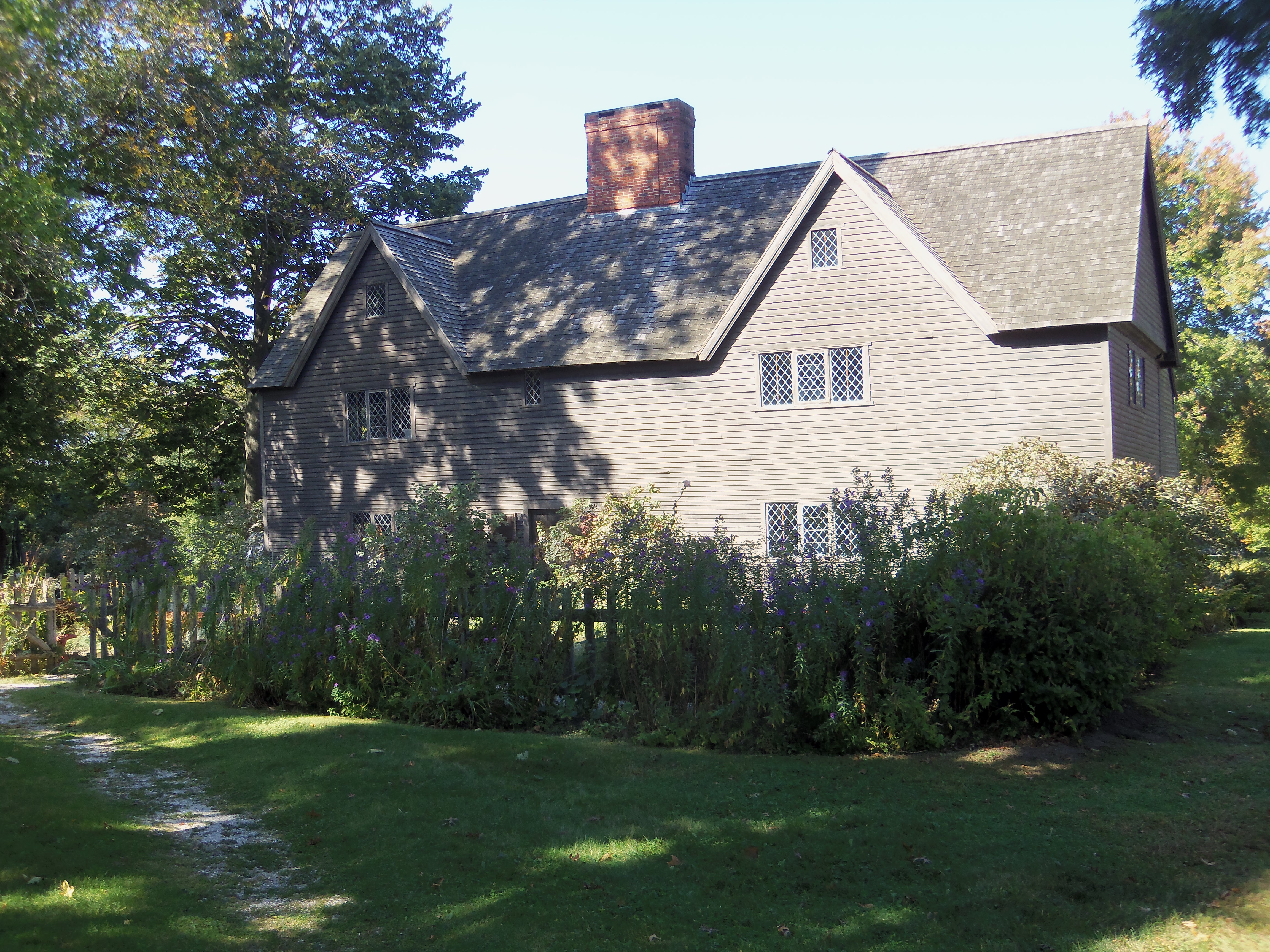
The reproduction 1657 Alexander Knight house in Ipswich, Massachusetts, suggests the difficult life facing the early settlers, especially through a New England winter.The elegant 1677 Whipple House in Ipswich is considerably smaller than the House of the Seven Gables in Salem but similar in style.
So the next week, my wife and I took off for a fuller exploration. We headed on down the road through gentleman farms and veered off for Crane Beach, passing long vistas of salt marshes where prized hay was once harvested. (It was high in mineral nutrition but gave the milk a salty taste, according to the tales.)
The beach itself was once part of the Crane family’s Castle Hill summer estate, which is another destination. The estate, the 1,234-acre Castle Neck dunes and beach, and adjacent 700-acre wildlife preserve are part of the Trustees of Reservations holdings. (Be advised, there’s an admission fee to the park – $8 a car when we went; up to $25 a car on summer weekends.)
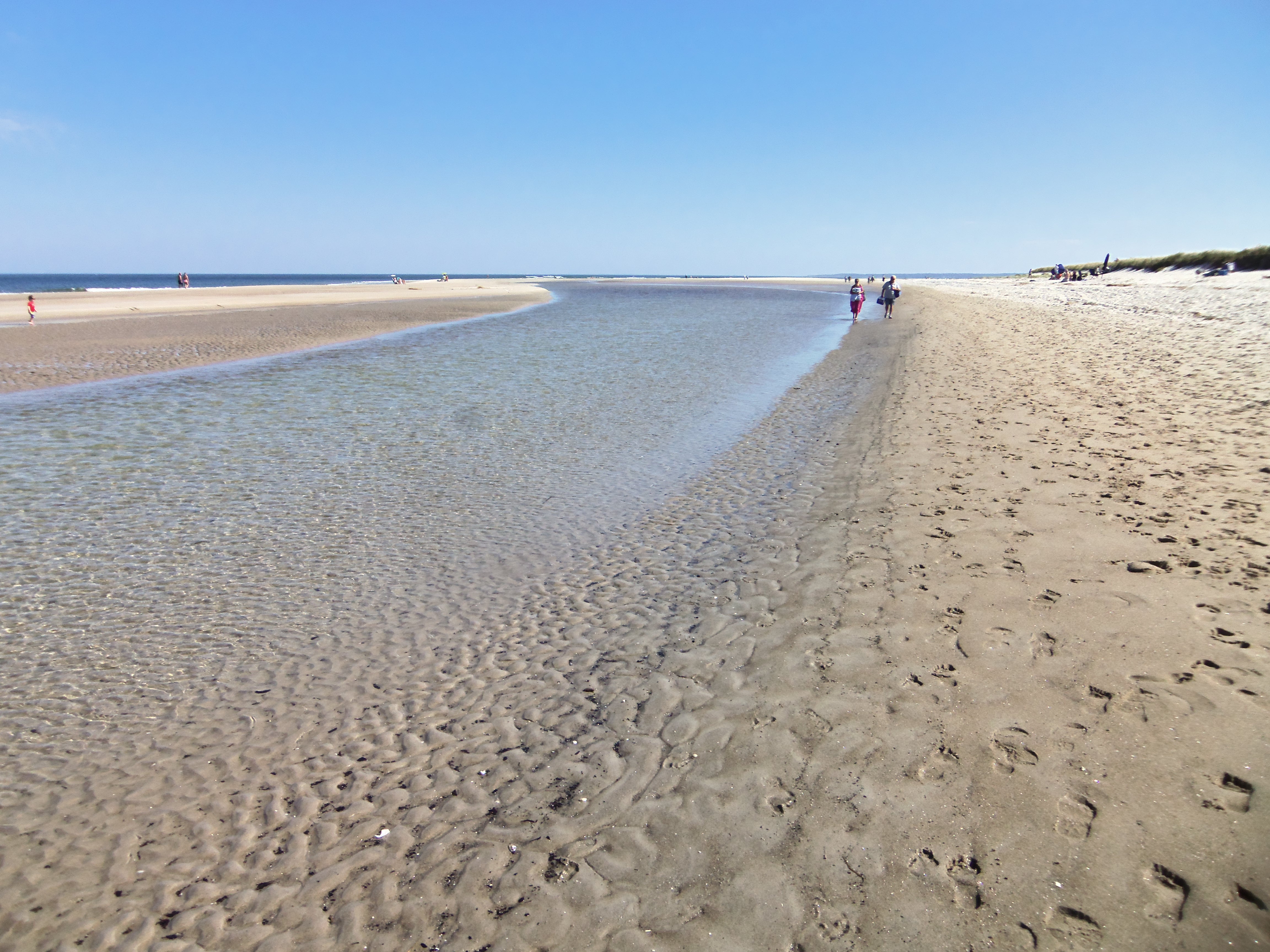
But what a beach! My wife was overjoyed to see white sand, like those of her native North Carolina, rather than the usual gray or brown of New England. And that sand seems to run on forever, with fascinating patches of rippled washboard, tufts of sea oats, and an array of shells we don’t find in our usual rounds of the coast. It may have been October, but our nostrils were greeted with that distinctive Coppertone aroma, and our eyes viewed an array of sun worshippers extending their tans as well as a few daring souls in the water. We walked and walked and, well, might still be walking if we hadn’t felt hunger kick in.
We’ll be back.
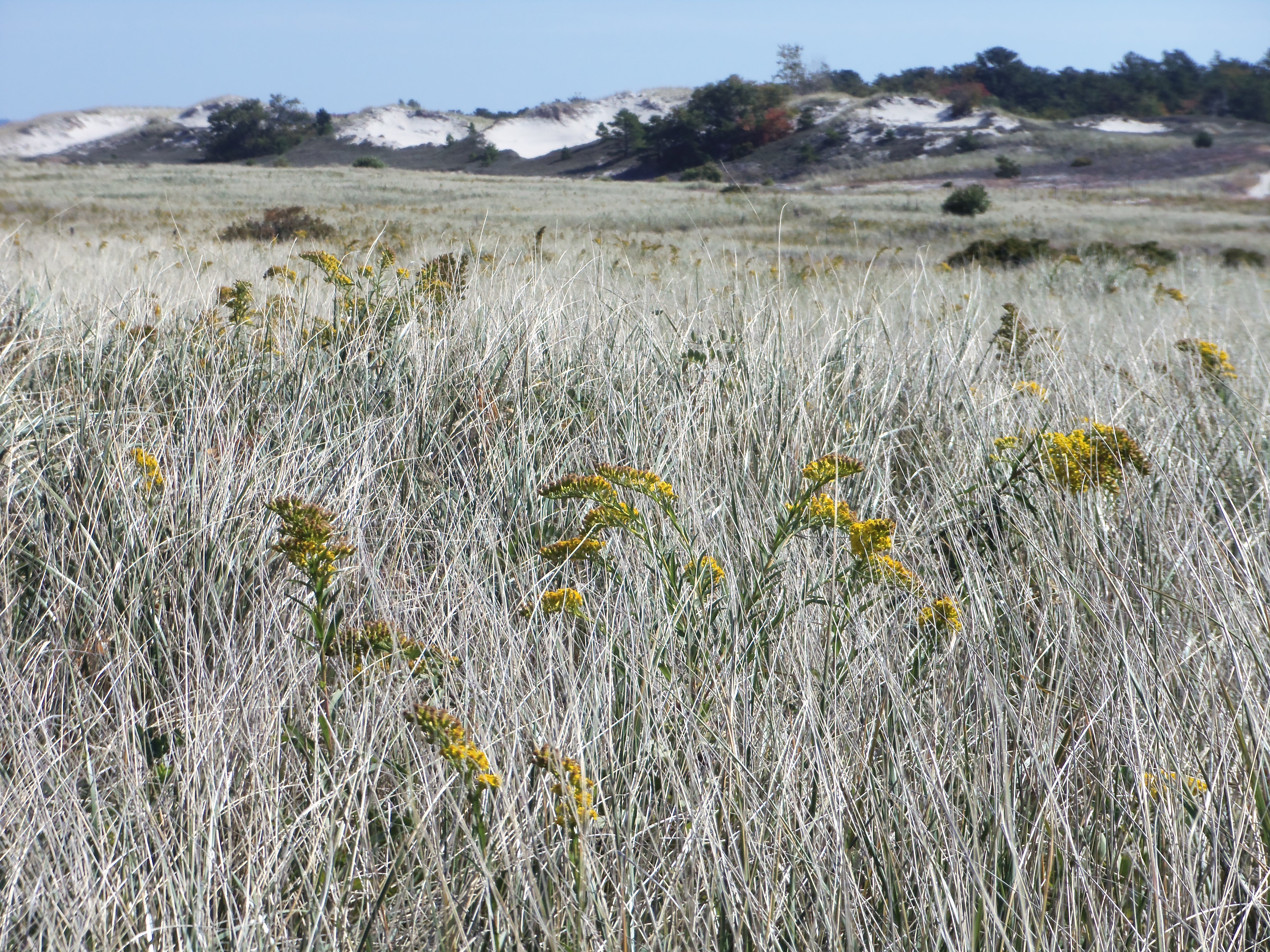
Washboarding and footprints decorate the sand at Crane Beach.Here’s a view looking into a dune behind the beach.
Venturing on, we came into the small waterside village of Essex, where we poked into Woodman’s “in the rough” for a seafood lunch. “Rough,” which is also in the name of an outdoor haunt we love in York, Maine, seems to indicate ordering and picking up from a counter rather than wait staff service, as well as a picnic-flavor rustic decor. As we looked at the blackboard and its prices, we nearly left for cheaper fare, but Rachel caught a posted review by food gurus Michael and Jane Stern – and I knew we weren’t leaving. I’m glad we stayed.
It was fun and filling – they don’t skimp on their portions. We can see why it’s a classic destination for the traditional regional seafood, especially of the “messy” sort. And, as she said, they “know how to do batter.” That’s a high compliment on her part. (Onion rings, anyone?)
The heart of Cape Ann is the city of Gloucester and its varied neighborhoods around the waters. It claims to be from the same year as Dover, although unlike my city, it was abandoned for a period, and is about the same size, roughly 29,000 residents. It lays claim to being America’s oldest seaport and has always been a busy, often brutish, fishing harbor. Gorton’s Seafood uses the city’s sea captain sculpture as its emblem. The Perfect Storm movie captures some of this legacy. These days it’s also the home to a number of whale-watch operations, due to its proximity to the famed Stellwagen Bank fishing grounds. In the 1950s and ’60s poet Charles Olson sought to capture the local spirit in his Maximus series, drawing on Ezra Pound’s literary foundation.
For us, though, the glory of the place is its three large wind-generator turbines rotating gracefully from the highest points along Route 128. They are immense works of art, comforting, landmarks. How anyone can oppose their construction baffles us. And, yes, they do sing … softly.
The trees might give you an idea of the scale and majesty of these Cape Ann landmarks.
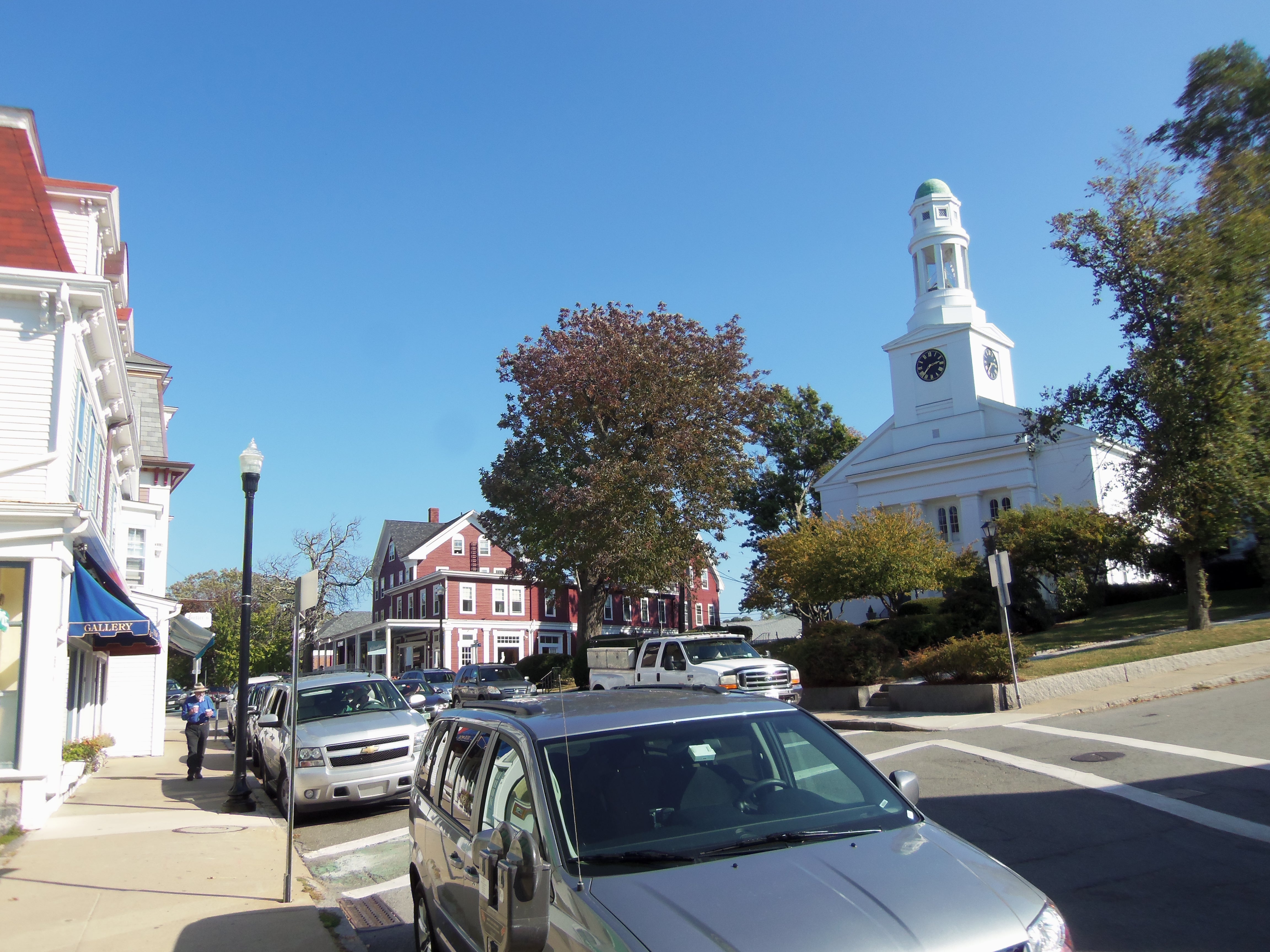
Cape Ann culminates in the town of Rockport, which has long attracted summer artists to its shores. More recently, the three-decade old Rockport chamber music summer festival has developed a loyal following, which led to the 2010 opening of the 330-seat Shalin Liu Performance Center and its year-round offerings that include classical, folk, blues, and jazz. When they say “intimate,” it’s true. What makes this hall truly amazing is that the back of the stage has wooden panels, for acoustical purposes, that roll away to reveal a panorama of the harbor. Maybe the Santa Fe Opera surpasses the view, but I bet you can find folks who can quibble.
The village itself has much of the Cape Cod shopping flavor of boutiques, restaurants, artist galleries, jewelers, and so on – especially in its Bearskin Neck district.
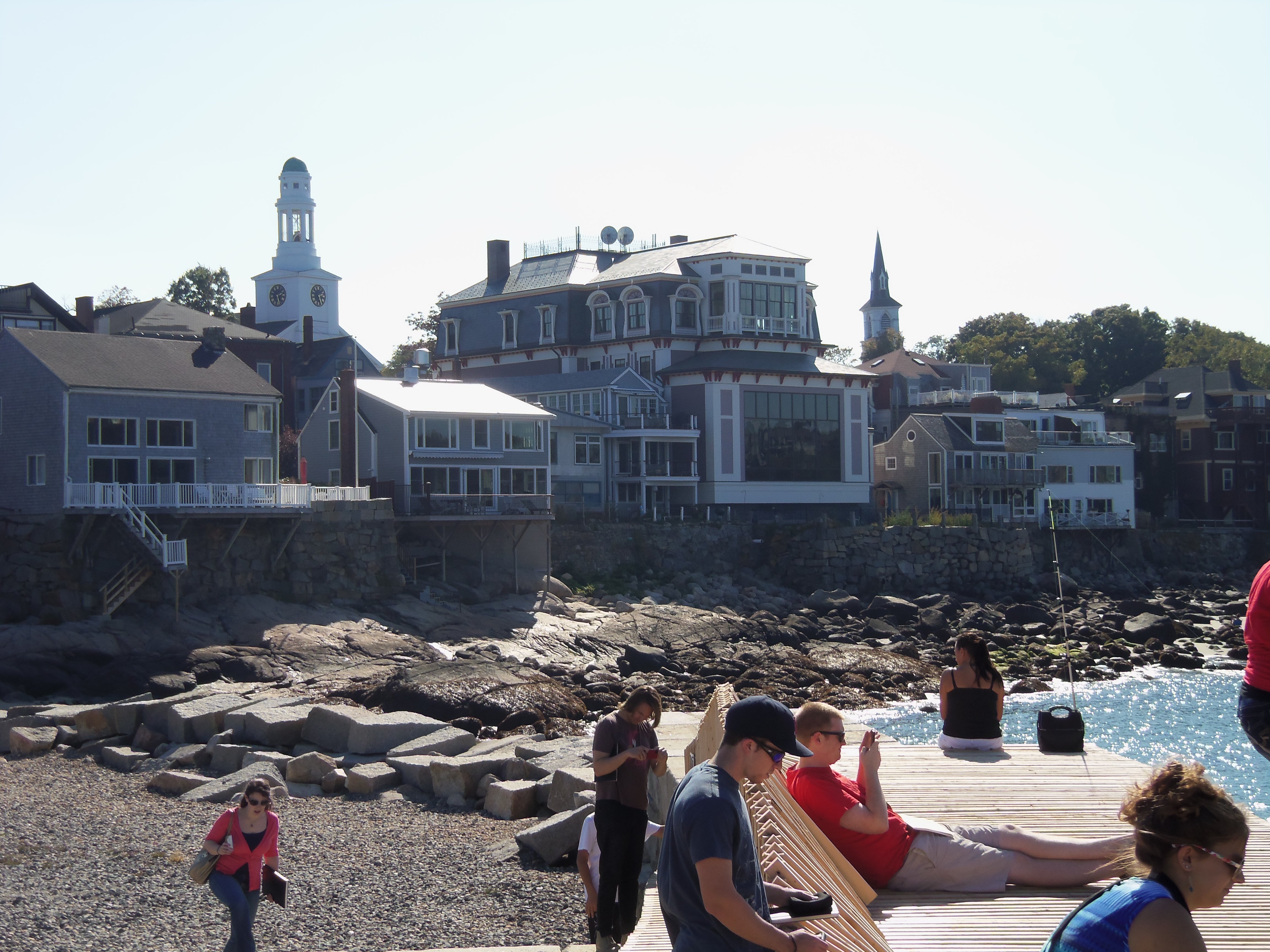
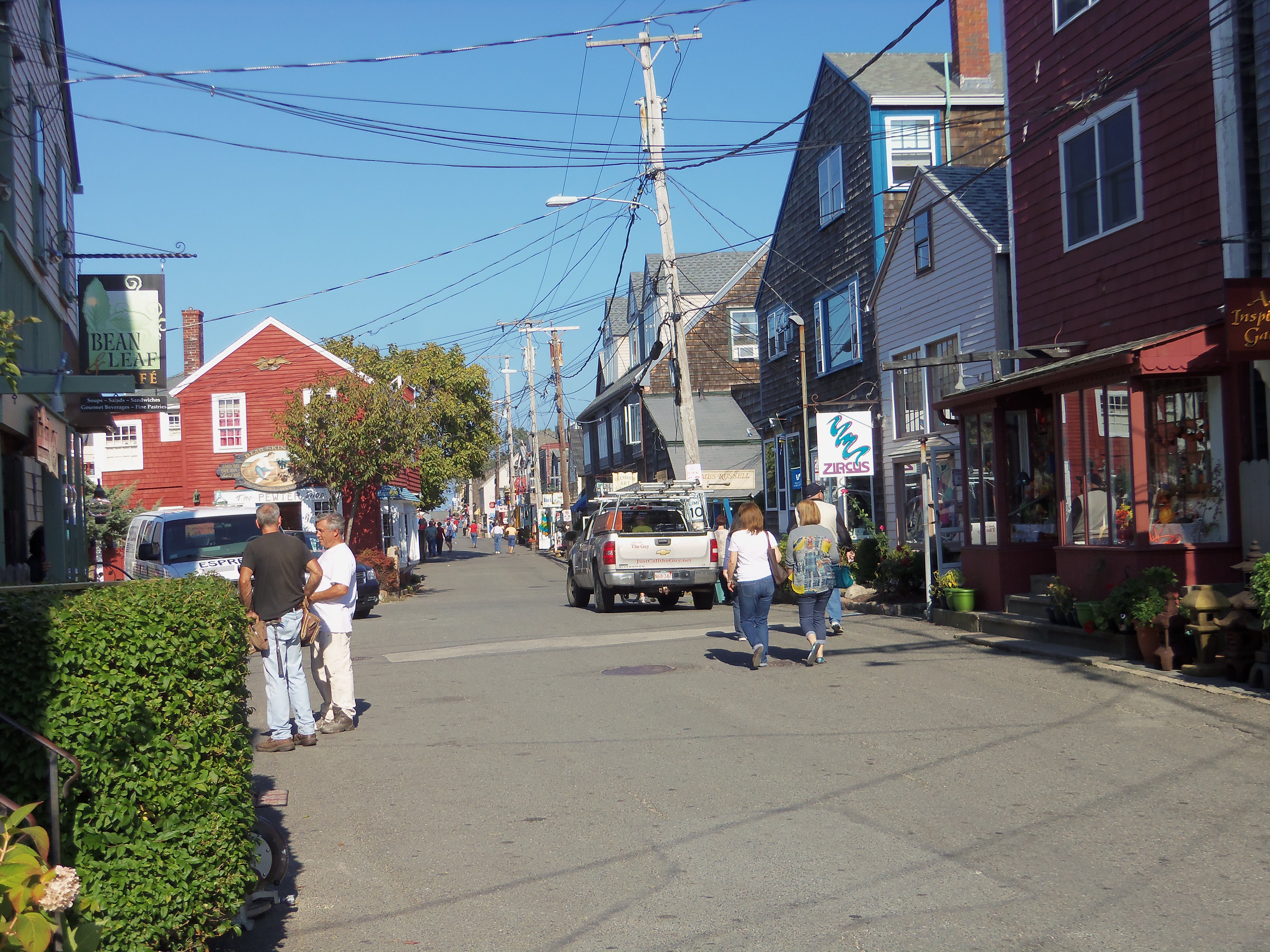
The big window in the largest building overlooking Rockport Harbor is the back of the stage at the Shalin Liu Performance Center. By the way, the tide’s out. We were among a crowd enjoying an art installation that doubled as sunny seating on one of the stone wharves.Downtown Rockport has a traditional blend of resort retailers … and shoppers to match.
By the way, Massachusetts Bay Transit trains run from Boston’s North Station to Rockport, with Cape Ann stops along the way.
While I mentioned whale watches, I should note we prefer to venture out from Newburyport to the north, in part because the vessel there has the option of heading to either Stellwagen Bank in Massachusetts Bay or Jeffrey’s Ledge in the Gulf of Maine. When it goes to Stellwagen, though, it cruises around Cape Ann and offers fine views of the Straightsmouth Island and Thacher Island twin lighthouses – the 1861 replacements for the 1771 originals – closer to Gloucester Harbor.
Even as a cub reporter, I loved writing long pieces. It’s what I prefer to read, really read, when I have time. By long, I don’t mean pointless minutia or the trivia of, say, a public hearing, but rather the probing look at how and why a thing has happened and maybe even what to expect as a consequence. Add to that the human dimension, especially from the point of view of those most impacted by the action rather than those at the top of the pyramid.
One model of this style of news writing came in the three stories on the front page of the Wall Street Journal each day – what they called their “leaders,” back in the era before Murdoch. If you looked closely, you’d see how each one was composed of several smaller stories, each one telescoping into the next. The reporters could joke that their work was so heavily edited they no longer recognized the finished version, but for those of us reading, the result was rewarding, the way a good meal is.
As a journalist, the irony has been that I spent much of my career crafting headlines and photo captions … short, short, short … and that was even before I relied more and more on news briefing columns to get the day’s world and nation reports into the paper at all.
Not that I lost my love of long writing. My “shelf” of ebook novels is proof of that, including my most recent, which delves into the news business itself.
As a blogger, though, I’m also admitting pleasure in composing shorter postings like the ones that appear here at Jnana’s Red Barn. Apparently, from the stats, they must be connecting.
My other four blogs provide venues for the longer writing, and the results to date are mixed.
To my surprise, my genealogy blog, The Orphan George Chronicles, has drawn far more hits than I’d anticipated. I figured its appeal would be to a few dozen fellow researchers, and having the results online would be much easier to find than if the files were archived in a few libraries somewhere. As for publishing them in paper editions, the likely audience would never cover the expenses.
My Quaker blog, As Light Is Sown, has shifted from the two book-length presentations that appear as the initial postings to a year-long Daybook of short postings, so I must admit that trying to analyze the results there can be inconclusive.
Thistle/Flinch exists to present book-length PDF editions of poetry and fiction, so I guess you can say that’s writing long.
And the remaining blog, Chicken Farmer I Still Love You, is still taking shape, as the numbers show. The first part, Talking Money, presents essential material for addressing the material sides of life … income, spending, wealth, possessions, labor, time, goals, and the like … followed by a close look at New England’s famed foliage. These days, it’s taken on a new focus in reconsidering the hippie outbreak and its renewal. Again, many of its postings are chapters for book-length presentation.
What I am finding in general is that even without the demands of daily employment, time is still the most precious commodity in my life. There just ain’t enough of it for what I hope to accomplish these days – including reading or writing, much less in any length.
So I guess that’s the short of it, for now.
~*~
Hometown News
To find out more about Hometown News or to obtain your own copy, go to my page at Smashwords.com.
Returning to my native corner of Ohio, I’m astonished by its flatness; what had seemed to be large hills or significant valleys now appear embarrassingly horizontal.
On the other hand, as I’ve uncovered my ancestral roots in that land, I’m finding a lost and untold richness in what was essentially a Pennsylvania Dutch heritage continuing in western Ohio. Feel free to take a look at my findings at the Orphan George Chronicles.
For much of its history, the Society of Friends forbid the use of engraved gravestones, deeming them vain and superfluous. Even so, another custom emerged, the drafting of memorial minutes for Quakers whose lives might serve as an inspiration for others.
The result was quite different from either the typical obituary or eulogy, and many of them prove surprisingly candid, as genealogists discover. If a eulogy celebrates the person, the memorial minute focuses on the individual’s spiritual life and service, especially in the ways these play out in the world.
Often, the minute would be approved by the local Quaker Meeting and entered into its records. If the individual had been active at a wider level, the minute would also be forwarded to the Quarterly Meeting (a gathering of local meetings that comes together four times a year), where it would be shared and, in due practice, approved. If appropriate, this would be repeated at the larger Yearly Meeting level.
As an example of the practice, here is the nearly finished draft of the minute for one Friend. As a member of the committee that prepared this, I’d like to show the “long” version that includes more of her remarkable career, in contrast to the shortened versions that were approved by the circles of Quaker meetings.
Alanna’s minute was approved by Fresh Pond Monthly Meeting and endorsed by Dover Monthly Meeting, and then accepted by Salem Quarterly Meeting, before being included in the minutes of New England Yearly Meeting’s sessions last month.
Alanna and me early in our friendship.
ALANNA CONNORS
September 25, 1956 – February 2, 2013
From an early age, Alanna Connors discovered a need and a capacity to trust her own compass. She was a mathematician at a place in time where women were seldom found. When her high school math teacher flunked her for excellent work, another teacher told her: “You know he’s giving good grades to boys and not to you, because you’re a girl.” Recounting the story in later years, Alanna said, “I didn’t need that; I knew I could do the math.” She held true to her course.
Long before finding Quakers, Alanna lived the testimony of experiencing God in everyone. While most of us have tight circles of caring – our family, friends, coworkers – Alanna’s circles were as unbounded as a wave expanding to all of space. It seems no accident her profession became looking at objects distant in the universe: across the many communities of her life’s paths, she welcomed all beings. Living with her was a joy; her love for others was never abstract but a centered flame close to her and everyone she touched.
Alanna was born September 25, 1956, in Hong Kong to Richard and Sonia Mitchell Connors. Her mother, who herself had a degree in mathematics and studied with Jean Piaget at the Sorbonne in Paris, ultimately worked as a font designer. Richard learned to fly in his youth and became a pilot with Pan American Airways, stationed in Hong Kong. Through his delight in sailing, his five children all learned to sail. Alanna took the lead, becoming a competitive sailor in her time at the Massachusetts Institute of Technology.
Returning to the United States in 1963, Alanna’s family settled in Greenwich, Connecticut. Living with four siblings – one older, Cynthia, and three younger, Kathleen, Noirin, and Patrick – in environments not always centered on these children’s welfare, Alanna developed an immense capacity to listen and extend empathy. Imagination shone through her grade school writings; her elaborate, award-winning gingerbread houses; and family-staged dramas.
Alanna was irrepressibly fascinated by math and science. She thrilled to the elegance of mathematics in expressing, revealing, and predicting physical behaviors. For her, mathematical physics was inseparable from the playfulness, color, artistry, and imagination by which she produced it. Whether it was classroom notes, derivations on scratch paper or napkins, or formal solutions, her handwritten analyses were crafted in flourishing script, vivid with colored pencil illuminations, and playfully annotated with such characteristically inventive words as “whatsit.”
Alanna’s dorm room hosted a wide array of human spirits. Her hotplate, washstand, handmade teapot, and mismatched cups provided hearth and an excuse for tea and convivial warmth at all hours of the night.
She met fellow student Phillip A. Veatch while they were both organizing MIT’s first on-campus food cooperative. After a year of courtship, they exchanged private vows of marriage in 1978, on a basketball court in East Cambridge. Alanna was opposed to the state-sanctioned institution of marriage because of its historical role in the oppression of women.
Communal living, conceived around Alanna’s dorm room, continued into her committed life with Phil through group houses with shared vegetarian cooking. While in Maryland during her doctoral years, they asked all prospective housemates: “Can you have: 1) too much garlic; 2) too much chocolate?” A no answer on both questions was mandatory for joining the group house.
With one housemate, Alanna went “church shopping.” While appreciating the wide span of worship experiences, Alanna gravitated to the Religious Society of Friends in 1982 in Adelphi, Maryland, dragging along her then-reluctant partner. A deep commitment to the Quaker principles of simplicity, peace, integrity, and justice soon enriched both of their lives. They continued at Dover Monthly Meeting in New Hampshire and finally settled at Fresh Pond Monthly Meeting in Cambridge, Massachusetts, in 1998.
Wanting to understand stars, she became a groundbreaker in charting the sky of X-ray sources. Being of a mind to “like thinking we are all professional visionaries,” Alanna’s deep searches into the distant sky uncovered new observations and questions. After earning her doctorate at the University of Maryland, Alanna made significant contributions to the Compton Gamma Ray Observatory as a research scientist at the Space Science Center at the University of New Hampshire. She introduced astrophysics to Bayesian methods of statistics, which start from an assumption that knowledge about a problem is always incomplete. Applying this rigorous data analysis to X-ray and gamma-ray astrophysics, she provided a foundation for statistical methods generally unknown to astronomers in the early 1990s.
As a banjo player, she encouraged use of the Rise Up Singing songbook, learning by heart its song “Julian of Norwich.” Original lyrics and tunes came to her, either fully formed or developing through writing. Alanna’s spirit still comes to us through the texts and music of the dozen songs she set down in composition.
Despite being an intense introvert, she harbored a lifelong belief in the importance of community-building. She cofounded an astrophysics statistical working group at the Harvard Smithsonian Center for Astrophysics. As a senior scientist, she was known for her support of young graduate students. She founded a singing group at Dover Meeting, and while living in Arlington, Massachusetts, enjoyed singing with Nick Page’s Mystic Chorale Singers. After the birth of her son, Roy, in 1999, she worked with other parents to reform special education in the Arlington public schools. She volunteered regularly at New England Yearly Meeting annual sessions working both in child care and the bookstore. She regularly attended the Women’s Group at Fresh Pond Meeting, where she spoke regularly about her concerns in raising her gifted son.
Alanna envisioned and encouraged public science education. She taught astrophysics at Wellesley College as a visiting professor, participated in university physics instruction at UNH and UMD, contributed to public education in science through projects at the Christa McAuliffe Planetarium in Concord New Hampshire, c0-organized family science days at her son’s elementary school, and encouraged exploratory science learning and teaching through many other avenues. She had an abiding interest in the history of physics and astronomy from its ancient origins, in welcoming women’s participation in physics, and in celebrating stories of diverse contributors to science.
Alanna was first diagnosed with breast cancer in 1995. She lived with the disease for 18 years. Characteristically, through its recurrences and treatment, she refused to be defined by the disease and conceived her son, Roy, born in March 1999. To her, the illness was but a single strand of her life. When Roy was 4, her disease recurred, and she took him with her to treatments, where he found the hospital’s high-energy accelerator intensely interesting. Whatever life brought her, she lived with it; she saw illness as no excuse to build walls. When her disease recurred for the last time, in an advanced form, Phil asked if she wanted to go on a special vacation. She did not, preferring to live in her callings.
At Dover Meeting, 1988-1998, she rotated through nearly every committee but also stayed long on Buildings and Grounds. During the first Persian Gulf War, Dover Friends called on her to write a compelling minute explaining the Meeting’s opposition to the invasion of Iraq and Kuwait. Phil and Alanna were lifelong advocates of same-sex marriage. When they decided for Roy’s sake to get legally married, they would not seek marriage under the care of Dover, as that meeting had not yet completed its process of hosting marriages for same gender (it has since done so).
During her time at Fresh Pond, her participation in committee work was limited by parenting and the recurrences and treatments of breast cancer. She was, however, a quiet and regular presence at Meeting for Business and an infrequent but powerful minister during Meeting for Worship, where her ministry was often structured around song.
Just as she knew not to take to heart a teacher’s censure that could have devastated a young mathematician, Alanna maintained integrity without ceding herself, her work, or others to be diminished. Mathematics was one route by which she independently investigated, questioned, and confirmed the truth for herself without relying on the claims of teachers and other external authorities. She stood up for discovering and expressing the full potential of one’s mind and heart, inspiring those around her to undertake aspirations and risks of which they did not suppose themselves to be capable. She knew greater being lies imminent within us all. Whether it was the rights of any couple to publicly live their committed love or a child’s mind emerging along ways and curiosities differing from the school norm, Alanna honored and worked for the fuller life she knew to be there.
Alanna’s spirit lives with us and continues to teach us. We remember her implacable but gentle striving to see the truth and to tell it. The women of Fresh Pond recall Alanna’s intense, powerful mothering, against all odds. Throughout her life she resisted the limits and distortions that social norms can impose on our vision of others. Knowing that a prism takes a beam of light and separates it into many separate parts, Alanna lived her life striving to bring the many separate parts of our world together into one shining beam.
Her memorial service was March 2, 2013, in the Wellesley Friends meetinghouse under the care of Fresh Pond Meeting. She was 56.
Longtime visitors to the Red Barn are likely aware that I spent four decades as a newspaper editor – experiences that feed into my latest novel, Hometown News.
It’s meant working nights, holidays, and weekends – rarely on a schedule matching the general public’s. And it’s always meant “working under deadline,” where an internal clock is always racing to finish the task on time (or else!). In addition, it’s also given me some insider looks at the surrounding world itself: having a celebrity standing a dozen feet behind your back is just another regular occurrence. (For the record, they often look quite different than they do on television.) Even as a cub reporter, I saw dead bodies, got inside the county morgue, checked out small plane crashes, met ex-movie stars, faced some stiff competition from the pros on the rival paper. Looking back, I sense how often I was in over my head and wonder how I ever survived.
These experiences have also fed into the Red Barn’s category of Newspaper Traditions, where I’ve written about:
The best newspaper ever” The glorious final days of the New York Herald Tribune were like no other newspaper. Nothing like fighting hard to the bitter end.
Chancing Upon a Profession: Glenn Thompson’s influence hit me, among many others, in one medium-sized city. He had a knack for finding talent.
Hot Type: In the days before phototypesetting and then digital publishing, newspaper production was a highly skilled craft. Here’s an admiration for the long gone masters.
Living Under Deadline: When your career hangs on meeting deadline after deadline, with no room to spare, you begin to live differently from other people.
The Art of Writing a Headline: Trying to steer readers to a given news report with just four words can be a real challenge. Take it from a pro.
Editing Obituaries: Announcing someone’s death and funeral arrangements can be more precarious than you’d imagine. This post, one of the most popular at the Red Barn, became a WordPress Freshly Pressed selection.
Four Measures: Just what makes “news,” anyone? Here’s one take.
Police Calls, 10 P.M.: Well, there is some behind-the-scenes banter, even when calling the cops.
One Phone Call Too Many: And then sometimes the facts get in the way of what looked like a great story.
Local, Local: How you define “local” news can backfire when it comes to your readers. Especially when it’s boring.
Bias: Sometimes those who accuse journalists of being biased should first look at themselves in the mirror.
The Shrinking Page: Like many other products, the newspaper page has been shrinking. It’s about half as wide as it was when I entered the trade.
The Human Imprint: Not too long ago, the editors and publishers were well-known public figures.
Objectivity, for Starters: There really were some strict standards and practices.
Windy City Perspectives: The tower of the Chicago Tribune holds some special memories for me.
Painful Neutrality: Again, maintaining a discipline of objectivity comes at a personal price.
Free of the Entourage: David Broder was the best of the breed. I wish I’d said hi.
End of the Line: One of the last editors who put a personal stamp on a paper was David Burgin. Maybe that’s why he was always getting fired.
Get Out of the Way: Real reporters are invisible observers. TV’s imitation inserts itself on the story.
You Read It Here First: Plagiarism has always been a dirty practice. Here are a few examples.
Reality Check: When it comes to seeing “liberal media,” some people fall off the far right of the world. The one that’s still flat.
A Logical Conclusion: The more conservative the nation’s editorial pages become, the more circulation declines. Think about that.
Death in the Afternoon: The newspapers published in the afternoon once had the blockbuster circulation. Here’s why they vanished.
Beware of Unintended Consequences: There are times embarrassing things slip into print. Lewd expressions, especially.
Beware of Survey Conclusions: Marketing research can lead to bad choices. It helps to put the findings in perspective before taking action.
So Much for Romance: And then there was the reporter’s lament as he returned from covering a large singles’ mixer.
I invite you to visit or revisit the postings, especially if you’re new here. And I promise there are more ahead.
~*~
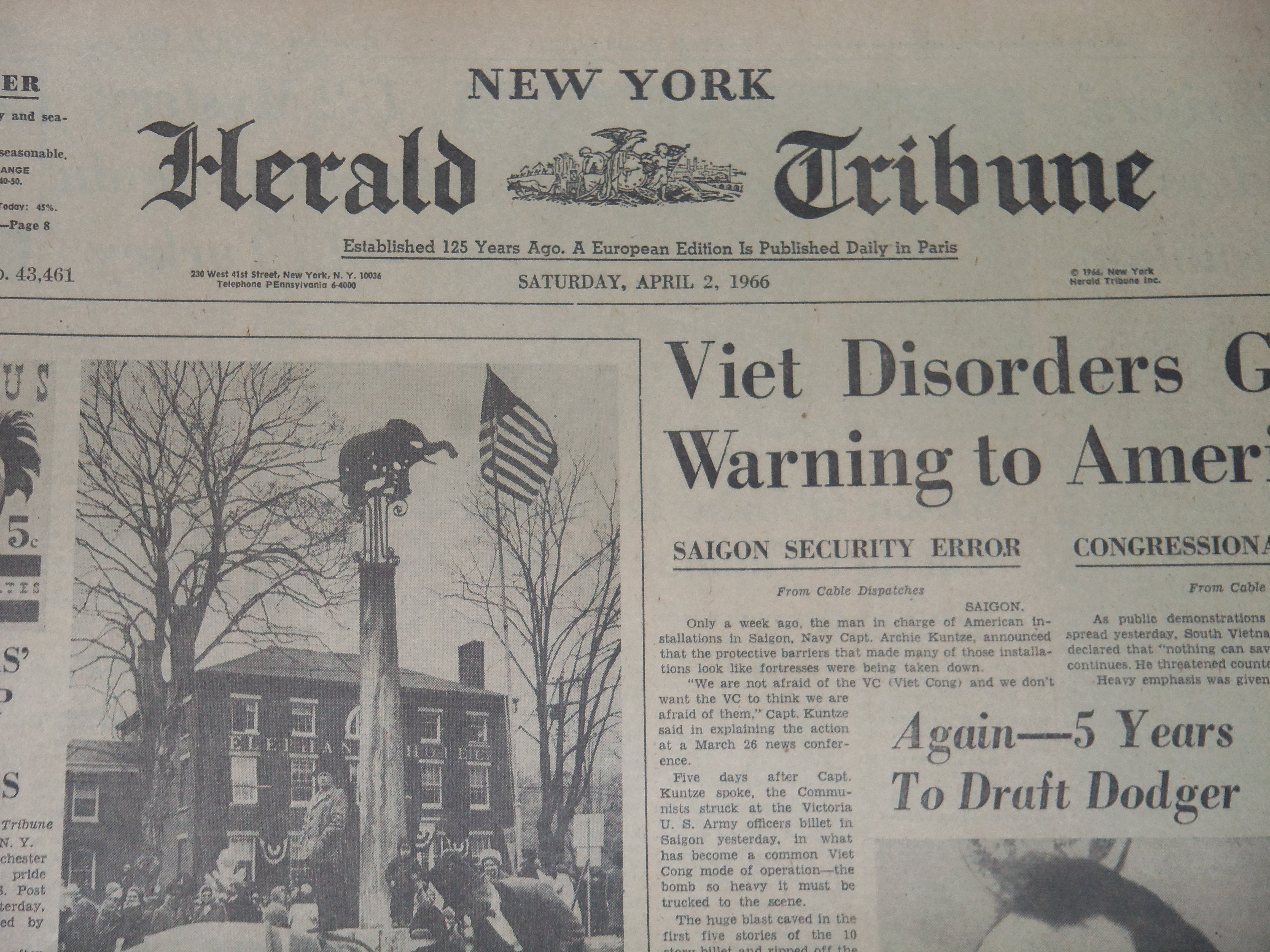
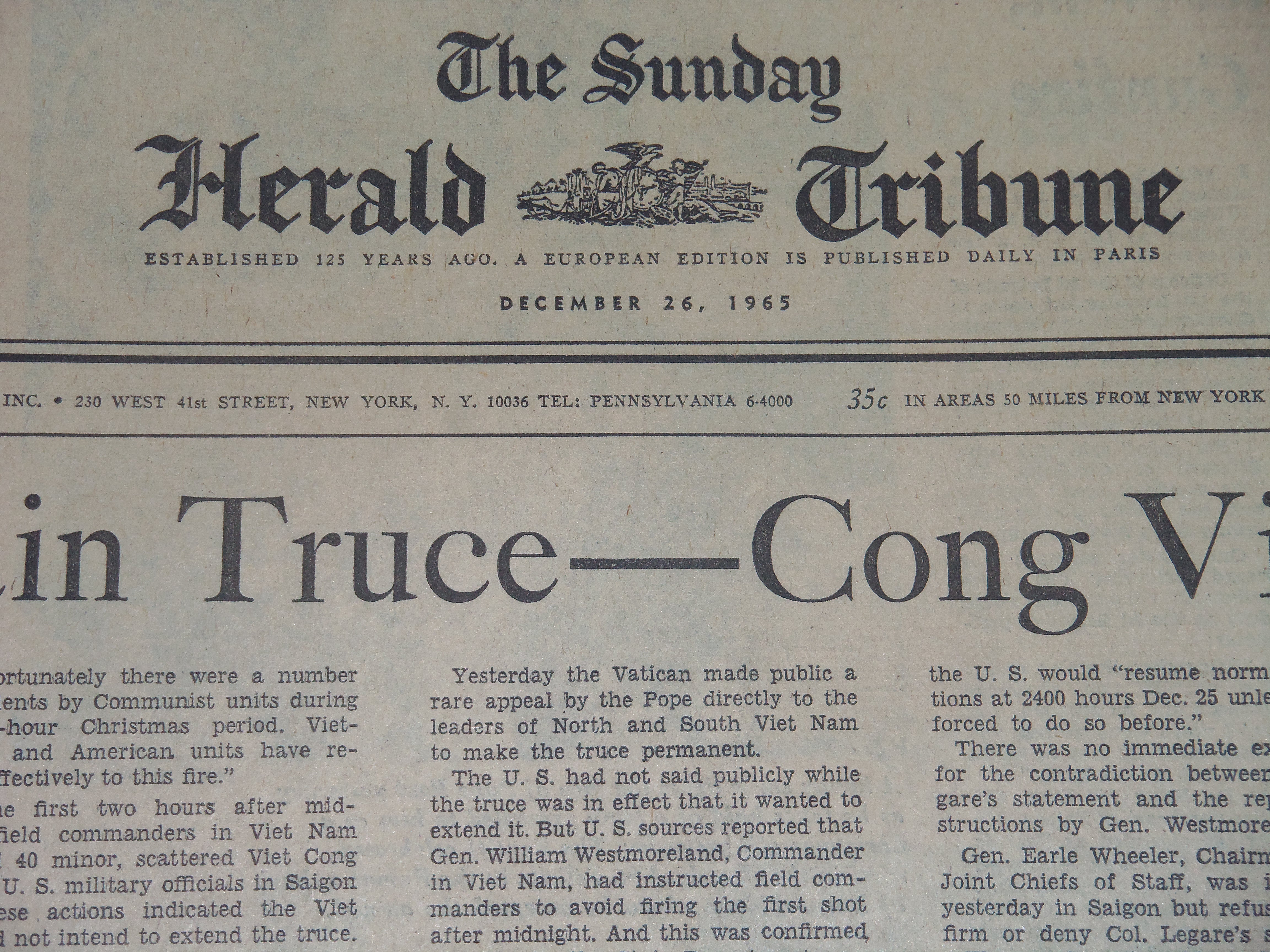
While we’re at it, here are some pages from the New York Herald Tribune’s final years, when it established itself in my mind as the most elegant and exciting newspaper ever. (Remember, I was still a teen and a budding journalist.)
The daily edition.And Sunday.
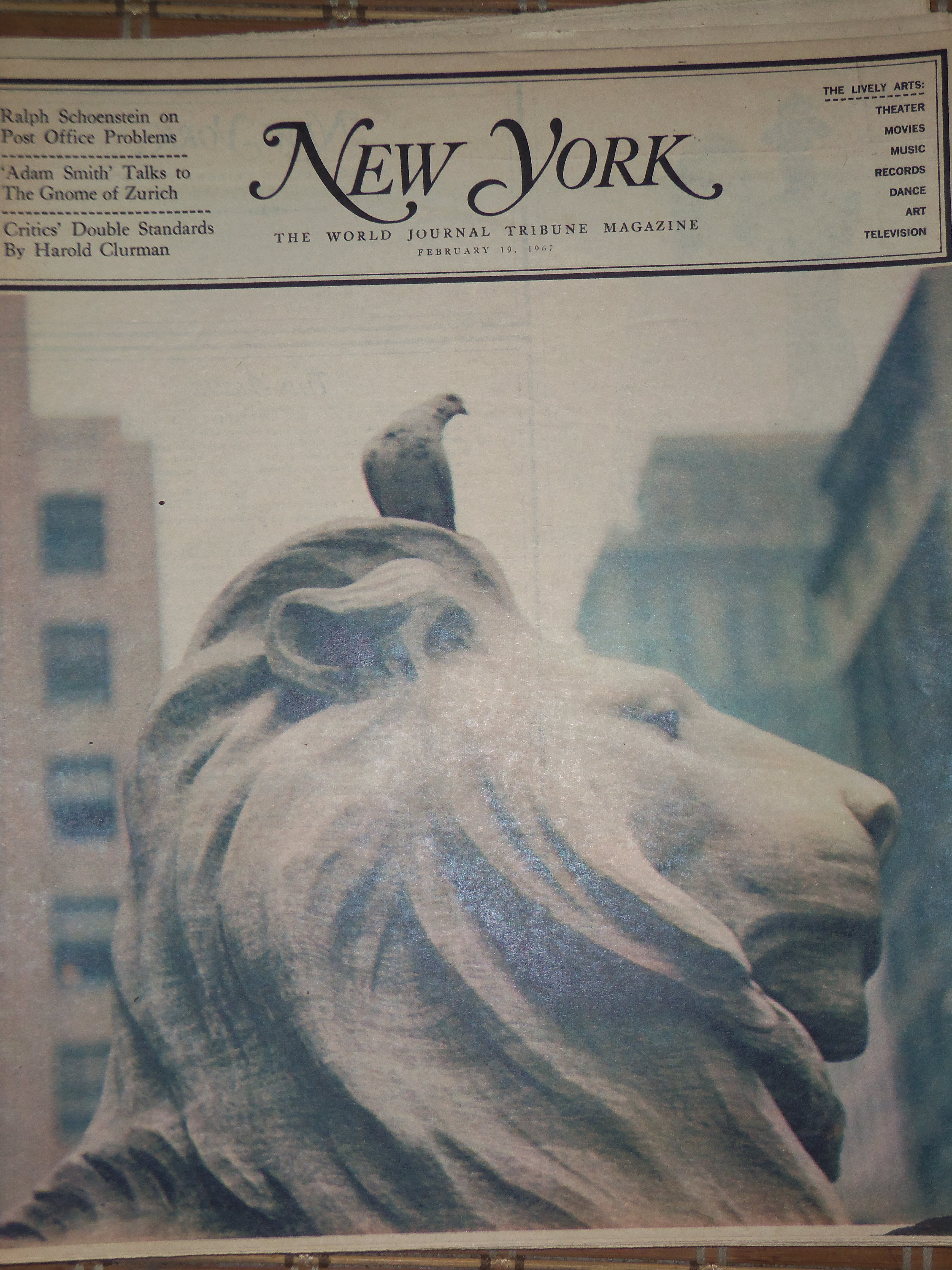
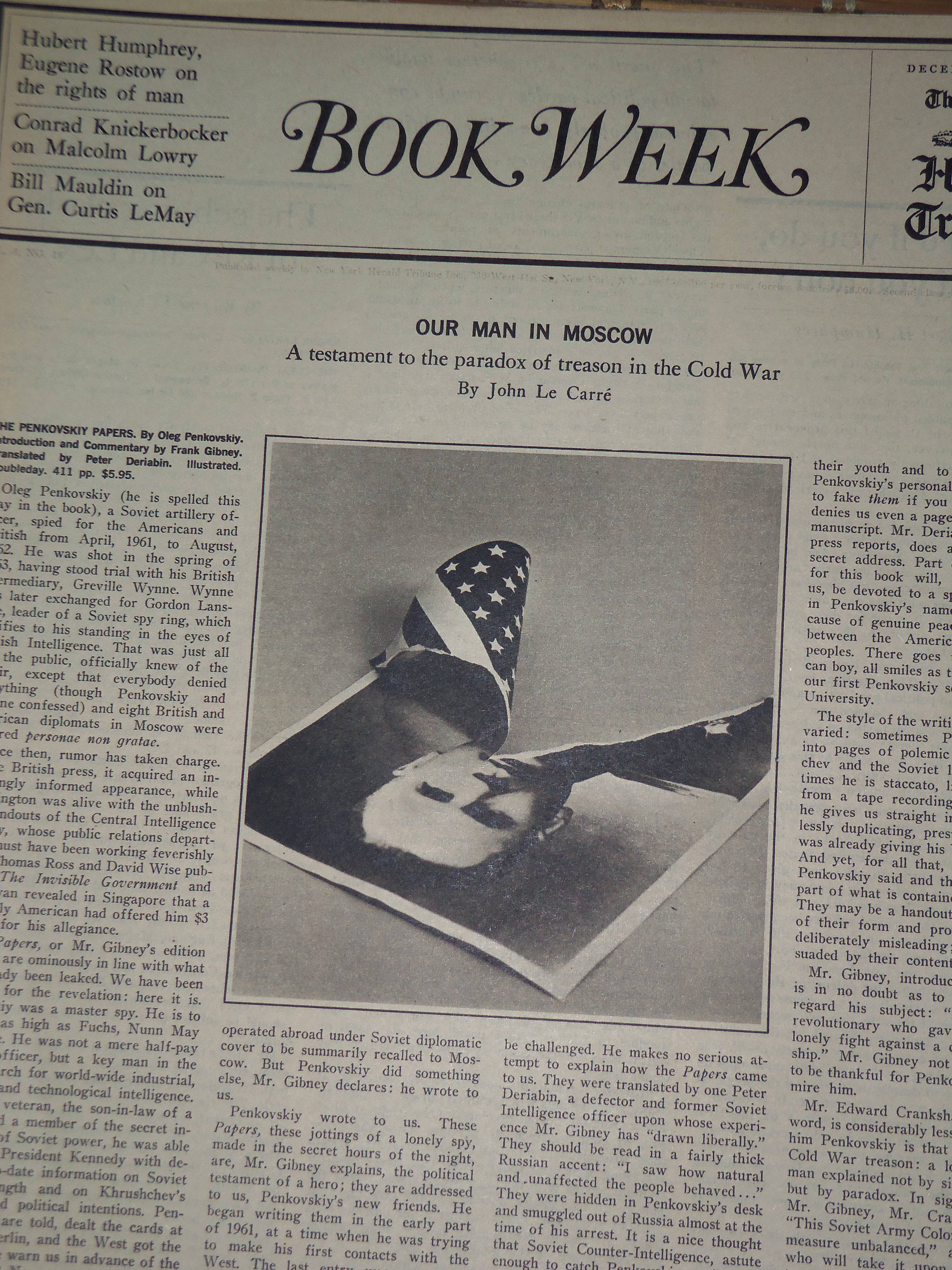
Among the Trib’s legacy was New York Magazine, which originated as the Trib’s Sunday glossy magazine. It was classic. And Book Week reflects a time when books were really important, at least in the eyes of the informed public.
The Sunday mag.And the books review section.
~*~
Not all of the exciting journalistic action took place in Gotham or Fleet Street or Chicago’s competitive shootouts, though.
Much of the most dedicated and innovative work emerged in small communities in the heartland where a few individuals could make an obvious difference. That’s the story I explore in my latest novel. In some ways, it’s Tom Peters’ Pursuit of Excellence meets Dilbert on steroids. It might even resemble some places you’ve labored.
~*~
To find out more about Hometown News or to obtain your own copy, go to my page at Smashwords.com.
Dover, where I live, is proclaimed as the oldest permanent settlement in New Hampshire and the seventh oldest in the United States.
Counting gets tricky, because there were earlier settlements that were abandoned. As best as I can determine, then, here’s the list the counts to seven:
St. Augustine, Florida, 1565
Santa Fe, New Mexico, 1607
Newport News as Hopewell or Elizabeth Cittie, Virginia, 1613
Albany, New York, 1614
Jersey City, New Jersey, as Pavonia, New Netherlands, 1617
Plymouth, Massachusetts, 1620
Dover, New Hampshire, 1623
While I found Weymouth, Massachusetts, as Wessagussett, 1622, the town itself notes 1630 as its settlement. And Taos, New Mexico, 1615, was abandoned by its Spanish missionaries in 1640. As I said, counting gets tricky.
We share a debt of gratitude to your grandmother, who has spent many hours assembling a remarkable gift for you – a knowledge of your ancestors. I hope you will come to treasure her findings, and the love she has put into this project.
Through Eide Henry Hopke, you and I also share a common bond, although our legacy from him varies in one crucial aspect. For you, he provides not only your surname, but also some distinctive DNA strands that come only through the male line. For me, he is part of a maternal genetic mix that is ever-expanding, the further back we go. (For example, while Eide Henry is one of my sixteen great-great-great-grandfathers, only George Hodgin carries the equivalent DNA strands for me; Eide Henry’s endowment, meanwhile, comes down through my mother’s father’s mother’s mother, in a bit of a zig-zag path.)
I hope you won’t look at your genealogy simply as a long list of names and dates – a sort of variation on the Biblical begats. (That’s not to deny the frustration and pleasure that goes into the investigative digging and puzzle-solving involved along the way of gathering these details.) Rather, the power comes in building the story of these seemingly common people and the ways they addressed their time in history and the places they dwelled. Researchers who try to connect their ancestry to ancient royalty or who stop the moment they find an ancestor hanged as a horse thief need to rethink their vision. In this venture we need to accept the facts, good or bad, in their full truth; what we eventually have is a personal history, one that will often stand at some distance from the one taught in schoolrooms or give us some insight into a greater framework. As you read historical accounts, you may find that through these ancestors, you, too, are in their time and place. Oh, yes, and as stories go, genealogies can turn up the most unexpected twists. For instance, the first of my Hodson surname ancestors in America arrived as the only surviving family member after their ship had been captured by French privateers (pirates); his great-grandson, a miller, owned a gold mine in North Carolina; and, on my dad’s side, all of my ancestors until the Second World War were staunch pacifists in their religious principles – I knew none of this when I was growing up.
On my mother’s side, Eide Henry emerges as a remarkable figure. Maybe you’ll be the one to figure out how he arrived in the New World, whether he came alone or with family, how he paid for his journey, or what led him to St. Louis; there are certainly many details to fill in about his life, and every answer seems to produce more questions. But what we already can sketch from the facts at hand point to an enterprising character who adapted himself well to his new surroundings. While we don’t know for certain what prompted him to leave Prussia, we can imagine the values the place instilled in him – truthfulness, modesty, self-control, and loyalty, in the words of Peter F. Drucker. “This Prussia had been a military state” and “was not educated, let alone cultured; but it was pious, with a narrow and sentimental Lutheranism,” Drucker notes, including an observation credited to Bismarck “that the Germans require a father figure, and that they will fall victim to a tyrant unless they have a legitimate and lawful king.” (From “The Man Who Invented Kissinger” in Adventures of a Bystander.) We can ask ourselves how much of this played out in Eide Henry’s life – in his decision to serve in the Mexican-American War, for instance, or in naming sons during the Civil War Robert Lee Hopke and Jefferson D. Hopke. This, despite the reported universal opposition to slavery by the German population in St. Louis during this period. (As you grow older, you may come to realize how often our values conflict or how much ambiguity arises in daily life; black-and-white decisions seem to be far rarer than we’d like.) We can also imagine that Eide Henry knew sorrow, in the death of his first wife or young children, and perhaps in the separation from his homeland. He must have known loneliness, too, in those times when he lived apart from his family in order to earn an income. We can look at the portrait your grandmother has collected and see all of these things in his face.
He also opens us to the pervasiveness of German civilization on American life, something that World War I erased from public awareness. Actually, I can speak of two major streams of German influence, the first being what we would consider Pennsylvania Dutch and including the Anabaptist traditions most visible now among the Amish, and a second, which settled largely in Midwestern cities and carried a deep sense of “good living,” meaning learning and progress. Eide Henry would have been part of that second movement, while many of my father’s ancestors were part of the first.
Sometimes we will glean background for our story from the most unexpectedly sources. One of my wife’s favorite books, for instance, is Stand Facing the Stove: The Story of the Women Who Gave America “The Joy of Cooking.” While Anne Mendelson is writing about her mother and grandmother, her opening chapter examines “The Golden Age of St. Louis,” which did “indeed – at least in a brief and glorious interval after the Civil War – seem one of the finest spots on earth to dwell … “ She then turns to Lebenskunstler, “as untranslatable as any word in the German language, which is saying a good deal. It implies a civilized command of living as an art form like singing or painting. German-English dictionaries lamely offer explanations like ‘one who appreciates the finer things in life.’ ‘Life artist’ is the baldly literal rendering, and perhaps as good as any.” Mendelson then goes to present the story of her genealogy in a thoroughly engaging manner, one that can be seen as a model for this enterprise. What interests us most, however, is the points where it overlaps on our own story. For instance, she mentions “Thousands of poor Irish had also come to the region, especially after the potato famine of 1845-46. They competed for work as laborers, artisans, and servants with large numbers of Germans fleeing comparable poverty.” And then she notes “a very different community brought by the abortive stirrings of liberal German nationalism after 1830 and more markedly 1848. They were articulate professionals, or sometimes minor nobility, who rejoiced in a particularly German marriage of cultural ideals, consciously enlightened convictions, and creature comforts.” At this point, it seems more likely that Eide Henry was one of those “fleeing comparable poverty,” yet he still would have been part of that mixture of German life in the city, with its “life artist” influence. While my mother probably had no idea of her Hopke ancestry, she always spoke of St. Louis in almost reverential tones; meanwhile, her mother – who married a Hopke descendant – strikes me as one who hungered for that “life artist” ideal, even though she had not been born into it.
Maybe you forget that St. Louis was once the largest and most important city west of the Appalachian mountains, after supplanting Cincinnati for the honor. Chicago took the lead only later. By 1860, Mendleson writes, St. Louis “had a population of nearly 161,000, and supported a small handful of theaters and a large handful of music societies (well populated with Germans), a library, the new St. Louis Academy of Sciences, Washington University, several foundries, the Pacific Railroad (stretching a magnificent 176 miles westward), a noisy range of political opinions, and sundry German- and English-language newspapers.”
She relates that a “traveler reaching St. Louis by steamer saw first the broad man-made plateau of city levees, swarming with teamsters’ wagons and lined with warehouses. The land rose to a modified grid of streets, orderly enough on paper but at most seasons of the year fed by an inexhaustible supply of mud reputed not to differ greatly from the St. Louis drinking water.” As a teamster, Eide Henry may well have been one of those with a wagon waiting at the wharf; we can imagine, too, what he said of the water.
Much of what I know about Eide Henry is thanks to your grandmother’s generous sharing of material she’s gathered for you. Along the way, she has also filled in large gaps in my knowledge of Eide Henry’s son-in-law, David W. Ward, and even my Munro ancestors from Scotland – all of which somehow come together in Pike County, Missouri, in what can be seen as the northern shadow of St. Louis. None of these people are among her own bloodlines, either, yet she has been faithful to the larger task of bringing their lives to the light.
How it all comes together is largely up to us. Jeremy, I hope you find much in this legacy that will inspire you, add perspective to your own life decisions, and give you an appreciation for the blessings we have because of their efforts.
I’ve spoken of Eide Henry as a remarkable character. I think we can add Patsy Lynn to that list, as well.
A while back, while reading a selection of letters by the itinerant Quaker minister Elias Hicks (1748-1830), I was impressed by the length and quality of some of the individual correspondence. These were pieces that could have been published essays, yet were addressed to a specific individual – pieces, I should add, from a farmer by trade.
I’m left wondering about the amount of time some Friends (and others, of course) spent daily or weekly in reading and writing as well as reflecting on the issues at hand.
Don’t tell me it was a slower era or that they had more time to employ – labor was more demanding and often tedious, after all. I think something else is at play here.
For past several weeks, the hottest news story across New England has been over what will no doubt be a textbook case of how to kill your own golden goose in corporate America.
The business is a family-owned chain of 71 supermarkets that has somehow managed to carve out the region’s highest profit rate in a notoriously thin-margin field while simultaneously paying its workers more than its rivals — along with profit-sharing and bonuses — while keeping its prices well below those of the other grocers. (You can imagine, for one thing, that the pilferage that undermines many groceries is nonexistent at Market Basket. Its workers are loyal, at least to the executive responsible for the success — a man who seems to know not just each of them but their family members as well.) Add to that a great deal of flexibility for store managers to respond to customer requests and you can understand the wide variety of ethnic foods found on the shelves; consider the fact that our local Asian restaurants choose to buy their tofu supplies at Market Basket rather than the wholesalers, and you get a sense of how that policy pays off all the way around.
In recent years customers have turned in droves away from the competition, and their loyalty is palpable. Lately, I’ve found parking spaces are always available right by the front doors of those underpopulated stores, unlike Market Basket, where the parking lot and aisles are always overflowing.
Given the win/win/win realities of the still growing Market Basket chain, nobody was prepared for the directors’ decision to ax its successful president. Well, half of the board’s decision.
The half that wasn’t prepared for the impassioned backlash from the public or its own workers, who have essentially shut down the operation.
The board’s decision, as far as anyone can see, was based more on lingering bad blood in the Demoulas family that had previously erupted in a notorious 1990 lawsuit that nearly forced the sale of the company, this time apparently heightened by greed. Seems there’s a $300 million reserve fund, for one thing.
But if the side that ousted Arthur T. Demoulas and his top aides thinks it can manage the company better than he did, it’s produced no evidence to date. Indeed, each day brings another public relations debacle that has gone unchallenged and signs the victorious side of the board is unaware of what’s happening on the streets. Brand loyalty, as the lore goes, is priceless. And it’s hard to win back. If they’re hoping to sell the chain, its value is plummeting by the hour. How often, after all, have you seen managers and workers stand together in solidarity as they are now?
The daily drama is not subsiding.The region’s newspapers, led by the Boston Globe, have been covering the details thoroughly, and I’ll point you in that direction.
For now, there are the petitions to sign and emails to send.
Here’s one example that was sent to the independent board members:
~*~
Dear All,
I have shopped at Market Basket for 30 years. I appreciated the low prices as well as the availability and quality of ethnic foods. When I learned that the employees were also the highest paid of any grocery in New England, that cemented the choice. I’ve barely walked through the door of a Hannaford or Shaw’s in 15 years.
Yesterday, I went to my local Market Basket, but only to sign the petition and cheer on the workers. I then I bought my groceries at Shaw’s and planned a trip to Costco.
You have had a business model that serves customers, employees, and owners. That this model would be thrown over for no discernible reason except personal animosity and greed is beyond me. I do not know or care if ATD is a good or terrible human being. I do believe he is a supremely competent one. He has run a business that gives customer the lowest prices, employees the highest compensation, and the owners considerable profit, while maintaining zero debt and ensuring the stability of the company. I have paid close attention to every news report I can find to see if there was any substantial reason for ATD”s removal. Nothing I have heard or read has indicated that new management has better ideas, or for that matter any ideas at all. That, in addition it cared so little for the loyalty and dedication of its employees that made the model work is the final straw.



 Jnana's Red Barn