More than colorful pins stuck on the wall map

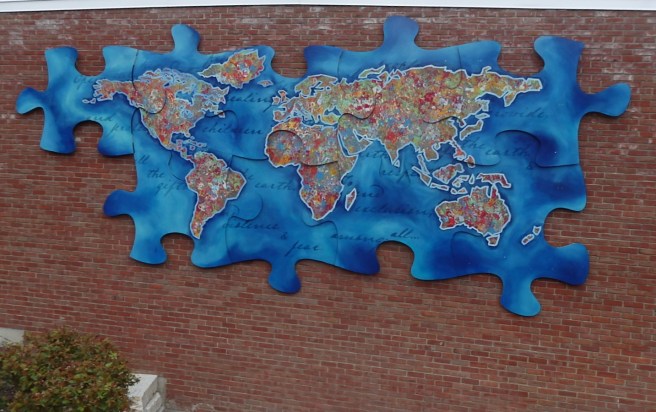
Wow, I really have been all over the map in getting to here. That’s what’s stirred up as I look at the range of experiences reflected in my novels and poetry as well as here at the Barn. That ‘scape has covered a childhood in the Midwest, college in a Big Ten school, an inner city ghetto during my hippie years and then the farms that followed, as well as desert and mountains, more Midwest and then Baltimore, along with my first marriage and some wild romances, and finally New England and my little city farm here.

Sometimes I wind up feeling dizzy. Those pins and needles are all over the place.

Are you one of the lucky ones who got to stay put?


Heart-stopping moment

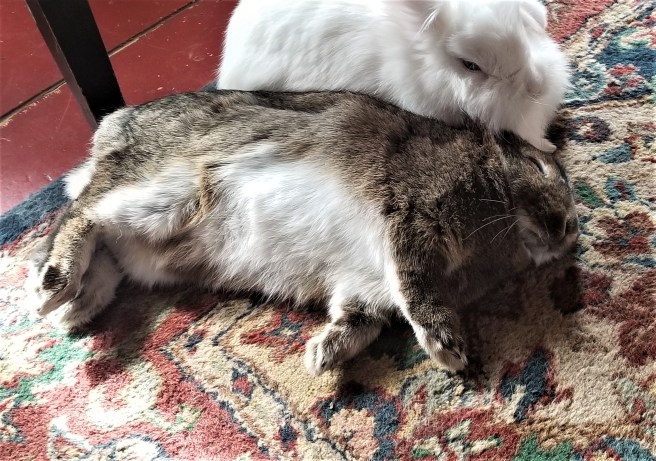
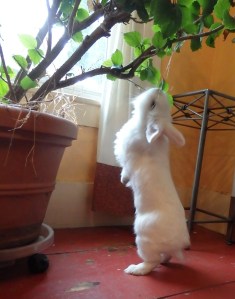
We’re still learning not to panic at scenes like this, where one of our rabbits looks like rigor mortis has set in. It’s even scarier when one’s running about, stops, and then flops over into a deadly pose like Pepper’s here. That’s when I look closely at her side to see if she’s breathing. Grab a camera, though, and the subject pops right up like nothing’s ever happened just as you’re ready to click the shot. My wife finally caught this instance, and I’m envious.

Kinisi, from Greek for ‘motion’

I’ve long been fascinated by the inner workings of English in very short segments. Typographical errors, for instance, when they seem to release some other possibilities. Aram Saroyan’s Lighght would be a prime example, presented as a poem in its entirety.

We accept the silent “gh” without question in conventional writing, but a second one brings us back to the perplexity we had as children learning some very strange spellings. And then, maybe, it points to the wonder of light itself.

There’s also the question of just how short a poem can be. One word? Two? A single line? Two lines?

Beyond that is the concrete poem, including those where typography itself seems to embody its own beauty, apart from any obvious meaning.

More recently, I’ve become fond of two or three synonyms or antonyms in juxtaposition.

I’ve played with all of these concepts, some of the results now appearing in my Thistle Finch chapbooks and others in my Kinisi series here.

And some of them could simply be prompts for a writing exercise.

Trying to figure out what to call them has always been a challenge. I wound up with Kinisi, from the Greek root for kinetic, when I noticed what attracted me to these fragments was some mysterious innate motion generated by the bits.

Here’s hoping they leap and dance in your imagination, too.


IKEA, where small is stylish

The Swedish retailer of low-cost home furnishings, appliances, cookware, and the like is a magnet for folks trying to make the most of tight spaces like apartments. Say a challenge like a 400-square-foot apartment.

Even if you have an old five-bedroom home like ours, the interiors can be challenging. IKEA has frequently come to our rescue. Yes, some assembly is usually required, and I can attest it’s not always idiot proof, but overall, we’ve been pleased with the results.

The closest IKEA superstore to us is located south of Boston, and since deliveries aren’t cheap, it’s worth the four-hour round-trip, even if you get lost inside once you’re there, as I have. The cafeteria, by the way, is quite the bargain.

Are you one of those intrigued by the small-scale living space displays in the IKEA superstores?

What’s your experience been?

A new kind of doctor’s house call

When I was a rug rat, family physicians would still visit patients in their homes. The docs even carried little black bags, as I remember, along with a different demeanor than we see today.

And then all of that became history. The front-line medical personnel even became referred to as primary caregivers or physician assistants or nurse practitioners rather than docs.

The Covid-19 outbreak, though, has it returning with a twist. The medico in question, even a specialist, is now calling some patients at home. Yup, on the phone. Voice, not texting. I’d say dialing them up, except nobody has a dial phone anymore.

And that’s what’s happening with my latest cardiologist checkup.

OK, I did have the echocardiogram at the hospital lab, so he has those results to work with. I’m wondering if he’s going to want my latest weight and blood pressure readings. I do have the home kit for that. There will be no listening to my breathing and other internal sounds.

Well, I’m also told of psychotherapists who are conducting their sessions over the phone, though I have trouble imagining that going very deep. Dunno. There are just certain things that come up in face-to-face interactions that don’t happen by telephone.

Spending nights at the opera on my laptop

When I graduated from college 50 years ago, I expected to wind up living and laboring in a major metropolis like New York, Chicago, or Seattle where nights at the opera or symphony would have been part of the package. As you can see, my life took a much different direction. In fact, working weekends and nights along with the bottom-tier professional wages of my profession curtailed much of my attendance where I was, even for the Metropolitan Opera’s Live in HD showings in local movie theaters.

Surprisingly, now in the midst of our Covid-19 cloistering, I’m relishing in daily free online streaming of past performances from the Met’s series, and what a revelation they are.

Each show gives me a fuller awareness of the stellar productions than I could ever get from listening to the Saturday afternoon radio broadcasts – incidentally, available where I live only by streaming. Well, that’s another rant, though I’ll send out a shout to both Harvard’s student-run FM station and New York’s WQXR for their participation.

The university I attended was acclaimed for its opera department, with a show every Saturday night and, as I recall, seven productions during the regular school year. Each of these was in English, which I found made the experience feel more like going to a Broadway musical rather than an esoteric ceremony. It was pointedly called opera theater, with an emphasis on blending music and showtime, abetted by stage directors like Ross Allen who insisted on historically correct motions for the periods being presented. A woman wouldn’t have shown her ankle while dancing, for instance, or sat in a particular posture, that sort of thing. As for facial expressions or delving into the psyche of a role? That wasn’t widely valued in earlier incarnations of the art form. But today?

Back to the Live in HD.

Imagine a Hollywood movie being filmed straight-through in a few hours like this, rather than gleaning only a minute or two of usable film a day, as is standard in the cinema biz. There’s no room for retakes in a live performance, and yet what I’m viewing is cinematically gripping. The acting is extraordinary, and the stars are visually and vocally convincing – something that wasn’t often the case when I got hooked back in the ’60s. I’m enthralled simply considering the camera work (and planning) behind each of these. (I have a feeling we’re deeply indebted to NFL and MLB technology and practice on this front – think of those crisp facial closeups shot from the other side of the field.) As for the lighting? Wow.

Opera is often discussed as the pinicle of the arts and their muses – vocal, choral, and instrumental music conjoined with drama, dance, poetry, scenery and costumes in the theater itself. It’s a collective enterprise, the way movies are. Well, I often consider it as the movies of the 19th century and, let’s not forget, the distinctively operatic singing style evolved to project into a hall long before electronic amplification existed. The vocal style is not as frilly as you might think but is actually quite flexible and expressive, even if it’s often an acquired taste.

As I was saying about these productions?

Continue reading “Spending nights at the opera on my laptop”