


You never know what we'll churn up in cleaning a stall
Vermont may be renowned for maple syrup and skiing, but Maine lays claim to a very dry humor as well as lobsters. Maybe they’re somehow connected.
When I first moved in New Hampshire, I learned much about the region through the Humble Farmer, Robert Skogland’s weekly hour on Maine Public Radio. But his comedy act wasn’t the only one in the Pine Tree State.
Tim Sample remains the epitome, even though his time was cut unfortunately short.
Another now classic run was “Men from Maine,” a one- to two-minute comedy segment that opened with soap opera organ music and something varying along the lines of, “And now for another thrilling episode of the exciting adventures of Men from Maine. As today’s action-packed drama begins,” which aired on a morning radio show in Boston.
The episodes typically revolved around Lem and Ephus and others in backwoods Maine. While the humor was essentially redneck, it was opposed to that of the American South. Episodes ran all the way from industrial accidents handled in incompetent ways (many residents, including Lem and Ephus, worked in the local sawmill, though the canneries could be equally hazardous), to bestiality, but, as observers noted, the humor always came from the stupidity of the characters and their obliviousness.
After I’d been introduced to the men via Clackity Jane’s show on Eastport’s little FM station, I discovered how much they’re stilled treasured in these parts, maybe because they struck something true.
Laugh on, dude … and dudette.
Like eagles, they can have long wingspans that stretch straight out when soaring. And unlike eagles, they can hover, as they do over water before plunging in a power dive and coming up with a fish. Not that I’ll ever get a shot of that with a simple camera.



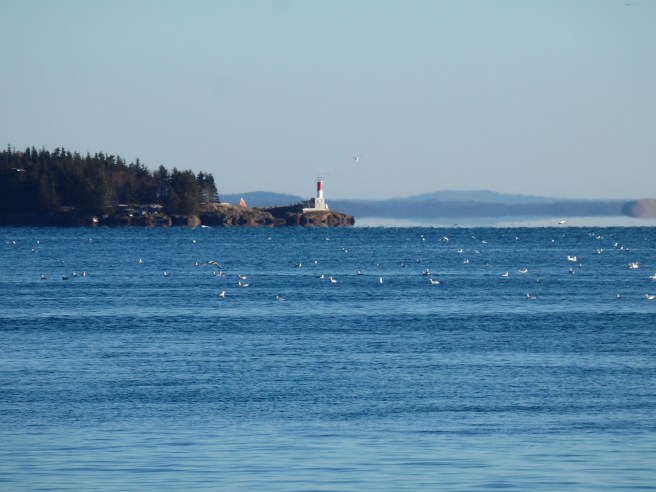
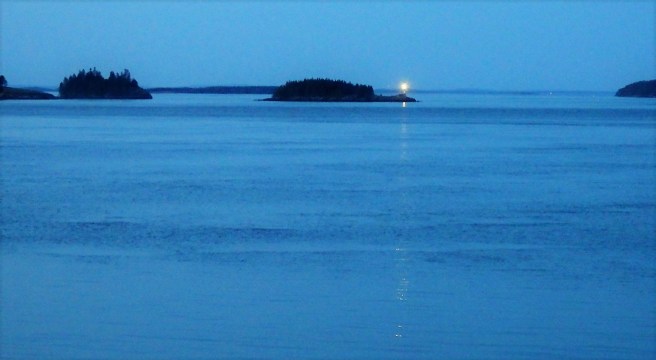
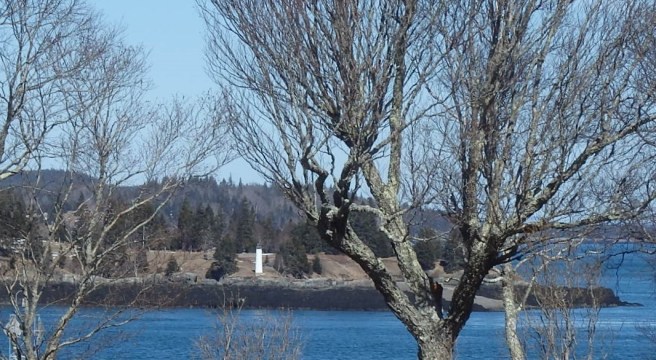
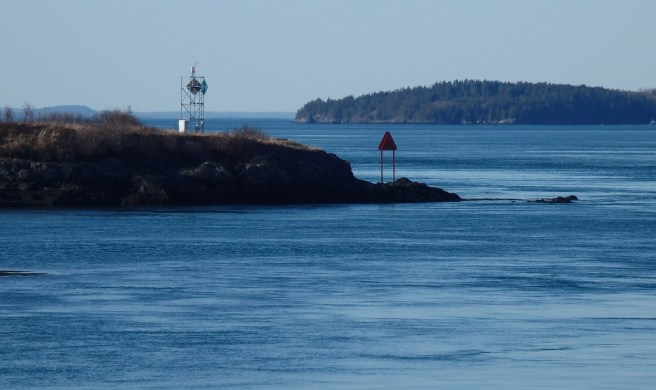
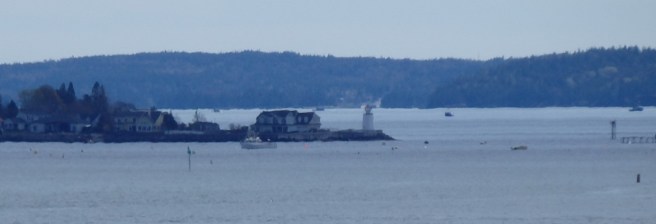
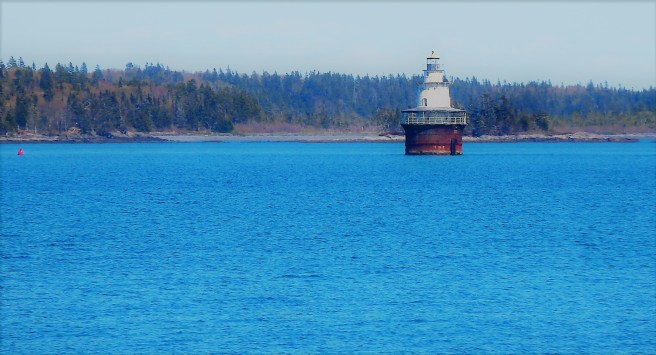
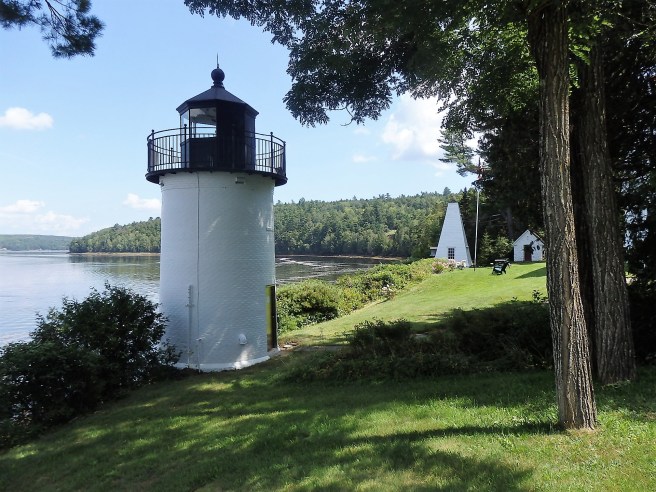
Unlike the two most photographed and visited lighthouses around here – East Quoddy on Campobello Island, New Brunswick, and West Quoddy in Lubec, Maine, both of which have been featured here at the Barn – the remaining lighthouses I encounter locally are small-scale. They’re beacons, all right, but to call them houses may push the definition.
You be the judge. Here they are.

Eastport is a city, after all, and many of the homes are packed in close together. Not that it matters to our local wildlife.


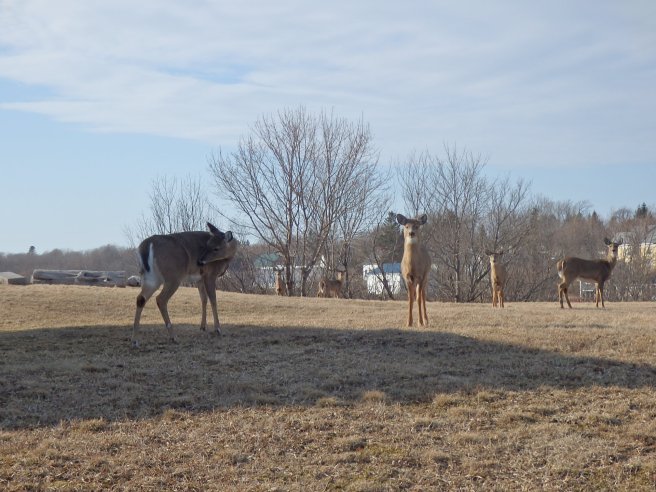


They’re so much a part of the place they even have their own Facebook page, Deer Eastport, and it is very active.
No matter how cute, though, they’re a gardening challenge. As are the raccoons.
The catalyst of re-envisioning Eastport is the Tides Institute and Museum of Art, founded in 2002 by director Hugh French. Its mission has been in acquiring and presenting wide-ranging collections of artworks and historical documents reflecting the coastal region, as well as educational and preservation efforts that include eight significant buildings in the town – four of them in the downtown district – and guest artists residencies each summer.
The leadership is rounded out by French’s wife, Kristin McKinlay, who is director of exhibitions and the StudioWorks residency program, and by Jennifer Dolanski, Artsipelago/program specialist, plus eight trustees, only one of them living in Eastport. The others reside in places like Boston and New York City.
There are also concerts in its 1818 church that housed the Free Will Baptists, plus other events at its 1828/1829 Seaman’s Church, which housed the Congregationalists.
Oh, yes, every New Year’s Eve there’s the maple-leaf drop at 11 pm Eastern – midnight for our Canadian neighbors – followed by the giant sardine an hour later. Both the maple leaf and sardine were commissioned creations.
I suppose TIMA was inspired in part by the Island Institute, founded in 1983 to help Maine islands from Portland to Acadia tackle pressing environmental and socio-economic issues. The Rockland-based organization’s impressive publications include the annual magazine, Island Journal, as well as data analyses to guide public policy. Its focus is on sustainable livelihoods and communities in changing times that include rising sea levels, bringing together marginalized communities, and economic survival.
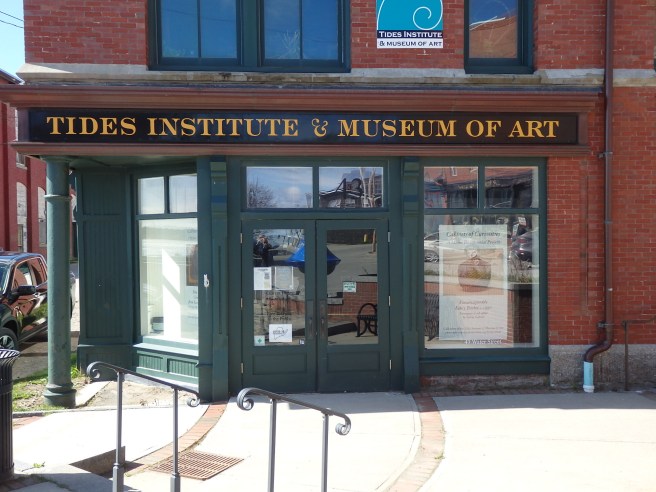
In contrast, for now, TIMA’s focus seems to be more on art and architecture, principally – especially the small downtown on the National Register of Historic Places.
In essence, it’s building a future rooted in the past but not stuck there. It’s really the way every art moves, too, no matter how revolutionary some of the leaps may seem.

I do have to wonder whether TIMA has taken on too much. The restorations appear to have stalled, perhaps before Covid set in, and both of the churches need significant repair, inside and out. The institute has, all the same, helped distinguish Eastport as a fine arts center in a visually stimulating setting in Maine, an identity that may attract new residents in a time of national population change.
Frankly, it was one of the things that lured me here, as well as my wife and elder daughter.
The mystics and traditions I’ve encountered are anything but airy-fairy. In fact, they can be pretty down-to-earth and practical, based on personal experience and testing rather than empty speculation or dogma.
As George Fox said at the beginning of the Quaker movement, “This I knew experimentally.” That is, by first-hand experience including trial and error. Or as was said a few years later, “Some of the best barns in Rhode Island were designed during Quaker Meeting,” during quiet meditation.
Never underestimate the importance of the disciplined circle of fellow practitioners, either. Anyone who says “I’m spiritual, not religious,” but lacks that communal base is headed for trouble.
I learned that 50 years ago in a yoga ashram – see my novel Yoga Bootcamp for unorthodox examples of how it works – and have seen it in other traditions since, especially my Quaker circles.
One of my favorite stories comes via fellow blogger Tru-Queer, who relayed the incident this way:
A Tibetan lama and a famous Korean Zen master in the Rinzai school were to have a debate.
The Tibetan lama sat meditating, counting his mala. The Zen master produced an orange from his robes and asked the lama, “What is this?” It was a famous koan. Waiting for a response, the lama continued meditating. The Zen master asked again, “What is this?”
The Tibetan lama spoke with his translator for a moment, who said, “Do they not have oranges where he is from?”
~*~
I suppose I should explain that a koan is a kind of mental puzzle intended to push a student beyond rational thought. Zen is essentially black-and-white ascetic, while Tibetan Buddhism is full of colorful esoteric teaching and drama. Yet here the roles are reversed, in a great joke.
But it doesn’t end there. When’s the last time you really looked at an orange? How many varieties can you identify, much less their differences in uses or subtle flavors? Does your recognition that it’s “an orange” put a stop to regarding it fully? That is, when’s the last time you had an “OH WOW!” moment with something so seemingly commonplace.
Gertrude Stein was aiming at something similar with her “A rose is a rose is a rose,” which blows open when you learn she was also speaking of a friend named Rose and not just the metaphors associated with a specific flower that somehow too often gets lost in the entire equation.
So just how do we live full of wonder – a state a Friend hailed as the Holy Now?
I’d say having dear ones who share it with you does help. Even if they’re Zen Buddhists.
Except on overcast or stormy mornings, the early light of day in Eastport is amazing. Campobello Island in Canada blocks the first rays of the rising sun from striking us directly. Instead, the beam is deflected from the ocean into the air to become an ethereal rosy radiance, sometimes against a dark bank of clouds hovering off over the neighboring Fundy islands. And then, with that doubly-illuminated sky mirrored in the two-mile-wide channel separating Eastport from Campobello, the overhead color spreads out below as well.

When the sun itself finally swells into view, the blaze is nearly blinding, winter or summer.
Note to self: Keep sunglasses at hand.
 Jnana's Red Barn