thinking of you
and wondering
You never know what we'll churn up in cleaning a stall
thinking of you
and wondering
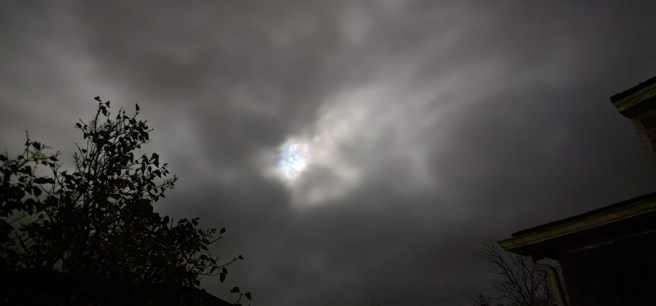 Playing around with the night setting on my Galaxy cell phone has produced some surprises, beginning with the aurora borealis.
Here is a full moon that looks like a sun in the breaking storm clouds. Zoom in and you’ll see that the moon’s round. Cameras see a moon as being much smaller than our eyes do.
Any photo that shows otherwise has been manipulated. Care to discuss?
My definition: contra, English country, squares, and rounds, or folk rather than ballroom or rock – though a tango fascinates, I do the Swedish hambo, when a partner appears at one of our contradances.
~*~
This note came from before I discovered the line dances at Dover’s annual Greek Festival and then the “secret” of dancing them. The event took place every Labor Day weekend, though I did come to find other opportunities to dance in Greek circles.
All of them to date, though, have been in New England.
For him, that also shook up the universe.
The 150th anniversary of the birth of the American maverick takes place Sunday, the 20th, and despite his relative obscurity, he was a giant as an uncompromising modernist classical composer and as an innovative executive in the insurance industry.
Born in Connecticut and a graduate of Yale, Charles Ives’ musical transformation was certainly one of the most extraordinary cases in history, made all the more remarkable by the fact that he was forced to compose largely without hearing many of his adventurous works played by an orchestra or soloists until a half-century or more after their composition. Even the sonatas, songs, and chamber music suffered from widespread neglect.
As a matter of confession, I am quite fond of his music, from the wonderfully rich late-Romantic scores of his youth to the craggy, thorny modernist fireworks of only a few years later. I am among those who feel scandalized by the fact that this season orchestras aren’t playing even one of his symphonies in celebration, much less all four. Two of them did win Pulitzers, by the way, once they were finally aired, and riotous cheers often break out at the conclusion when the works are performed.
For a biographical overview of this American original, turn to my post, “Thoughts while listening to Charles Ives,” of November 5, 2013, at my blog, Chicken Farmer I still love you.
Today, I’m offering a Double Tendrils. Let’s start with ten quotations about music.
~*~
And here are ten Ives quotes about life itself.
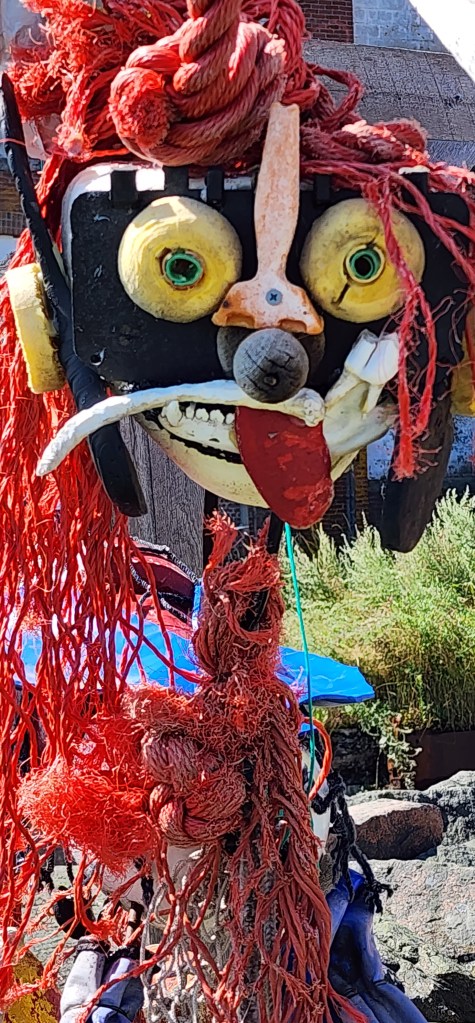
Lubec blue-collar artist Chuck Kniffen created Rosebud, above, and Unicorn, below, from debris found along the shoreline.

Might as well start by eliminating the word “meaning” from the question.
That leaves the core mystery to savor before expressing its wonder in mere, pale words.
Life itself is unfathomable. Why me, you, us? As is our very awareness. It’s more than a neurochemical reaction or the like.
Descartes, for me, fails the mystery altogether. Thinking, which can wander all over the place, is secondary. Feeling is more primal, closer to what the Bible calls heart.
I prefer recasting it as “I breathe, therefore I am,” as more embodied. You know, inspiration, expiration. Inhale, exhale. It’s more Zen, and the Hebrew word for breath is the same word for soul, so I’ve been told. (And soul equals heart there.)
Action, then, perchance, as a way forward? Even one breath at a time?
Explain any of that, if you can.
Without raising too many more questions.
Now, have a great day.
Ever encounter shining moments like these?
As I found in a Facebook comment mentioning me: “A compelling and brilliant man.”
Oh, my.
Or, another time, a friend telling of a colleague who asked, “Who was that distinguished looking gentleman you were with?”
Really?
That said, everyone needs some positive reinforcement!
Islands come in all shapes and sizes, and even that can change dramatically with the tides. Now that I’m living on one, I’m really beginning to appreciate their variety. Some you can drive to or from, while others require a ferry or even an airplane. The better-known ones seem to be vacation or travel destinations.
Here’s a sampling, starting with home.
Care to tell us about others?
 Jnana's Red Barn