One commute I can’t complain about

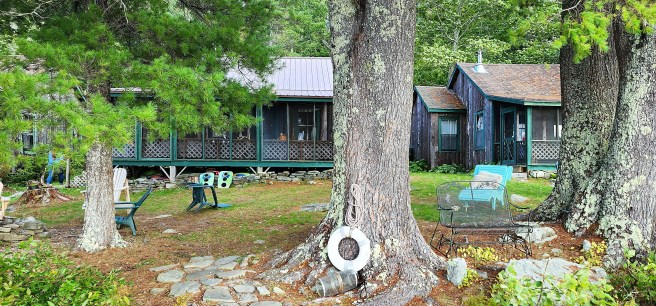
Some Sunday mornings, my drive to and from the Quaker meetinghouse a half-hour from my home is a meditation in its own right.

Even in fog or snow, it can be refreshing.

Much of the road is through forest, plus stretches along Passamaquoddy and Cobscook bays and their tributaries. The route also passes through a tribal reservation and a national wildlife preserve, which does sound a bit exotic though I take it as routine.

Eagle sightings are common, and I have had to stop for deer or turkeys in the middle of U.S. 1. Once I even spotted a moose far ahead on the pavement.

A radio program of classical choral music on a CBC station that comes in quite clearly is often also an element, depending on my mood.

Do you remember the freedom you felt when you first learned to drive? Some mornings, especially when there’s no other traffic, that elation returns.

While I’m tempted to proclaim “What could be more glorious than this!” I will also note many of the scattered homes I pass resemble junkyards – poverty in Washington County is a constant – so there’s a reminder of that reality, too. I suspect there are more dead cars and trucks here than people.

As an added touch, there are no traffic lights, either.

You’d think those birds would be far more ravenous in the depths of winter

We continue to keep our bird feeders out through the summer (something we wouldn’t do if we had bears in town), but I am surprised by how much more they eat in summertime, when there’s plenty of other food available, than they do in deep cold and snowy conditions when they need more to keep their metabolism up.

Yeah, we know there are more of them now and that they’re also feeding their babies. But on some days they eat as much as they would otherwise consume in two weeks – or more.

On the other hand, we do enjoy watching the variety and drama as they dine right outside the window at our kitchen table throughout the year.

I’m feelin’ some schooner excitement

Somewhere in my youth I fell under the spell of windjammers – vessels under full sail in the wild ocean. Those were as far away from my native Ohio as were the white-capped mountains that also caught my fancy.

Over the years, though, even as I came to know first the Pacific Northwest and later, coastal New England, I never considered actually going on an overnight windjammer cruise. Dismissed it as too expensive on our limited income. For contrast, I should note that I’ve never had any interest in an ocean-liner cruise. Zip.

But in late May, a dear friend from Vermont stopped by for a few days on his way to his annual windjammer trip on Penobscot Bay and that, well, reignited those dreams.

My wife looked at our budget and encouraged me to join him on his early autumn return. For the record, she’s declining to go too, remembering a bad seasick whale watch excursion when we were first together. No way would she venture forth for so many hours or days.

Upshot is at the end of next month buddy and I will spend the better part of a week under sail on a historic schooner exploring some famed Maine waters, especially the lighthouses along the way.

I have to admit, a windjammer should be my kind of excitement. And because my buddy grew up sailing, I’ll certainly be privy to a deep source of inside information. At least maybe I’ll have more of the terms right when I report on our adventure.

In addition, many of the classic sailing ships were built only a block or two from our house, back in the heyday of masts and canvas sails. The remaining keel of one schooner is exposed at low tide only a block or two from my house.

I’ve started counting the days till we set sail.

Dipping in glorious waters

I haven’t written a real poem
in at last a decade
prose, especially fiction, has taken the fore
plus relocating to a remote Maine island
do I even consider the photography

How else do you think
other than by talking to yourself even silently
or through the fingers or feet

I’ve long preferred instrumental music, abstract
or airs in languages I don’t understand
and usually forget the lyrics and lines in scores
I’ve sung in concert

So I was swimming a half-mile a day
before the pandemic but haven’t been back
in deep water, fresh or surf, indoor or out till today,
my first venture in a little-known river pooling
too rocky for laps but perfect for extending myself
in the familiar chill under a cloud-strewn afternoon sky

yes, it’s glorious and refreshing
in a way I discovered my first year after college
in hippie abandon or the New England coast
and Dover’s Olympic pool later
it’s the sunlight and breeze
stretching above, around

a call to attend to my rooting as well
in meditation, prayer, Scripture, favored poets
all as seemingly impractical

Adding to the memories

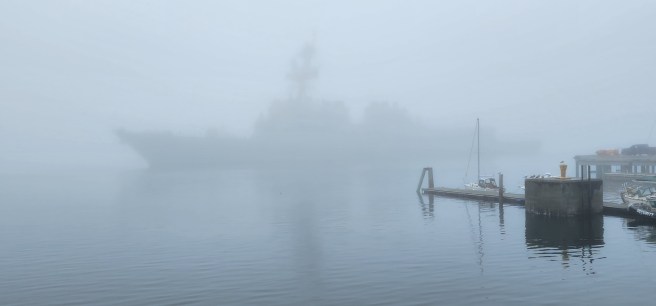
Sailors who visited Eastport for the Fourth of July voiced their amazement at the pilot who guided their U.S. Navy destroyer vessel at the Breakwater pier in some very dense fog.

They could hear the conversational voices of humans on the pier and shoreline but couldn’t see a thing. We could hear them but not see them, too.

And then they were landed, gently and safely.

They told us he was a magician, and from my angle of observation, it was true. Even the commanding officer was most amazed, in what became a memorable experience.

By the dawn’s early fog

For the first time since the outbreak of Covid, Eastport is being graced by the presence of a U.S. naval vessel at the Breakwater for the city’s big Fourth of July festivities.

The USS Oscar Austin arrived in heavy fog Friday morning and will depart for Norfolk on the 5th.

The community rolls out a big small-town welcome mat for the crewmen, especially when the landing gives them their first taste of American soil in many months. (Not so, this time; they instead sailed up the coast.) The arrival is rather quaint, actually, even if their focus sometimes seems to be on the local bars. There is a basketball game between the sailors and the high school alum, too, though I doubt the stakes are high.

Eastport does claim to have the biggest Independence Day bash in the state, and the Navy’s destroyer is just part of it. .

Many of the sailors are being joined by their families, who will then continue with them on the final leg of this voyage.

Bringing such a vessel to dock is no small venture. The skipper of such a ship doesn’t just spin the compass to see where he’s going next. Rather, the itinerary is planned months in advance, with many protocols to be observed. In our case, that includes both U.S. and Canadian officials. The pilot’s plan document reads like a small phone book, minute by minute, and it’s not just about tides and currents at the expected time of arrival.

Heavy fog was a complicating factor, and we could hear the ship’s bold horn booming long before we could see the massive vessel emerge nearly alongside the Breakwater.

It materialized out of the fog and a very loud booming horn.
Details, including the crew, slowly came into view.
The ship was pushed to the dock by tugboats.

A few more candid reader reactions

Despite nearly 60 years of writing, I’m still not accustomed to having readers come up to me in public with enthusiastic reactions.

My book Quaking Dover just may change that.

Here are two recent examples.

“It’s like you’re speaking right to me! It’s not like a history at all!”

That’s from a city councilor far from Dover.

I do hope that doesn’t put off history book addicts, though.

On the other hand, a Dover history buff said this:

“The clearest presentation of George Burdet I’ve read. Usually the histories of him are convoluted and hard to follow.”

When she first mentioned him, I felt some trepidation. Burdet wasn’t a Quaker and in fact predated them. He was one of those side details that could trip up the central argument if I had misread something.

More important than any praise is the confirmation. Or correction, too, for moving forward.