If only I had been more open to fun

Volume 10, mostly tiny script, often difficult to decipher. This is the first volume to have an actual date inscribed (Sunday Jan. 15), though the practice is not yet the norm. Many of the entries are introduced, though, by the day of the week, which at least provides a sense of progression.

I am surprised to see how much opportunity – missed opportunity, in fact – was finally appearing in my social life, if I had only known how to “close the deal.” I was meeting young women, finding some fascination and crossing paths repeatedly but failing to consummate the action. We were even going to movies (on campus, I’m guessing) or to casual meals but never really “dating.” I just couldn’t get serious, not with Nicki weighing so heavily on my soul. Many of these I have no recollection of now (among them, Karen, “with the big breasts and small nipple,” as I recorded, who I kept running into; or Janet – and who was the nymphomaniac living in the apartment behind Polly and Molly? The same one who was getting into sadomasochism? Or who, for that matter, replaced Esperanza as the third roomie?). Judith kept returning to the scene, at one point hoping to move in with me, or even my [now] housemate Marj [after Len moved off with Esperanza] – I’m left wondering why I didn’t just settle for convenience there, as well as pleasure. Polly was more involved than I’d thought, while Molly was just plain scared of sex (like Kara, but much funnier and more insightful) but also a key figure.

I must confess how often the descriptions of the new women I met mentioned their breast size (usually small), relative height, and eye color. A real pig, then, or simply desperate. In a fuller view, I was unintentionally comparing them to my two previous loves, Fay and then Nikki – first real girlfriend, as I came to consider the former, and my first lover, or my college lover, for the latter. To some extent, I was looking for an accessory, to give me value I deeply sensed I was lacking. If I could only have seen myself as something other than a tall, skinny, crooked-toothed impoverished intellectual, my engagements would have been different. Maybe that self-perception is what generated the funky vibes D-Man and Thor picked up on.

These pages reek of deep loneliness and depression. I clearly wasn’t out for fun but something utterly serious.

For all of its dross, this volume (and others from this period) had flashes that might be revised into a Brautigan set of poems – an homage to Brautigan, possibly. The recent publication (2025) of my Antique Menu and Aquarian Leap poetry sets in this light are a revelation; many of the lines and stanzas originate here. .

Other pages became the Susquehanna chapbook or bits of Hitchhikers, Daffodil Uprising, and High Jinks.

The stabs at poetry arise largely in my rejection of general society – the superficial Christianity, pompous political motions, ongoing Vietnam war, and consumer-based capitalist economics. What I lacked was a definable, positive identity apart from that: an inner vacuum, back hole, was at my core.

Both places I lived in Binghamton, just out of sight below, have been razed amid redevelopment. The riverside is no longer neglected thickets, either. I barely recognize the place. Aerial view of downtown Binghamton by TW Farlow at Shutterstock

~*~

This notebook picks up, apparently, right on Christmas Eve. Me in the third-person, with Esperanza. We went out to the fancy place just outside town; she had duckling, I had crab (surprising, considering how central it would become six years later, in the Northwest), “in the glow of intimate candlelight.” [On Christmas Day 1989, Yankees legend Billy Martin would die in a single-vehicle crash after leaving the establishment heavily intoxicated.]

Then the trip to NYC for New Year’s with Len and D-Man.

At the close, this fat volume also covers much that would prompt what sits as Big Inca, or originally, Inca Invasion … as well as a lot more, which is a good thing, considering that Inca still has a few memo entries that need filling.

WHAT WAS I EATING IN THIS PERIOD? BESIDES CANNED SOUP?

One note has me boiling many of my meals. Another mentions that Len has no idea about broiling anything, especially a steak.

And apple turnovers from the Italian bakery a few blocks over became a huge favorite, along with their napoleons.

~*~

Other gleanings:

Just read De Sade, Pinter, Bergman [movie scripts].

Lambert called me Hodson, just like Jennie in Love Story called him Barrett. Guess it’s an Ivy League thing.

I work best in extended spurts, unpredictable.

Judith spent the night. So nice to have soft-soft warm body to cling to. She said she slept so much better than she did in the dorm. She’s talking about moving in, but I don’t want that. Her uptightness repulses me, I like my solitude, too. Her voice can be like an upright out-of-tune piano wire.

Next entry regarding her: Went straight to campus after work [apparently, I had the early Saturday shift, which would later become the zombie-shift “presidential death watch”]. Saw Judith, we talked, she mostly about Howie and how she was going to let him down gently, how much he likes her, etc. [Who the hell was Howie?] I swam ½ mile in the women’s pool because of a swim meet in the men’s. Except for one girl and the lifeguard, I had the pool to myself. In the deep quiet, muffled and grumpy, sunlight angled in through the south windows so that as I swam into a patch of sunlight, my body transformed briefly into a gold, a fire-fish! And then turned off as rapidly. Swam twice my usual distance and felt I could have swum more. I love that feeling in my arms and chest and now understand Fay’s “torturing” her body in gymnastics.

Slept in Judith’s dorm room, went for coffee around 7:30, ran into Renee [first mention: who on earth was she] and went with her to see monster flicks. The first one was in color, right there I knew it wouldn’t be spooky. And then Moose Sinatra showed up as a convict, so I was so certain. It was very funny, unintentionally, a very formulaic. The other film, though, was excellent, based on Shirley Jackson’s Haunting of Hill House. … Very terrifying, half of the audience stoned, screaming, tense, laughing, Renee screamed and grabbed me and I was glad I could grab her, too …

With both Nikki and Fay, when the relationship started turning south, they were always late in meeting me. One night when I, too, was 45 minutes late to pick up Fay, she was an additional 45 minutes getting ready.

The week after Florida was the week Nikki and I had the flip-out at the Preservation Hall Band concert. [Why was I finally recording these bits of already ancient history? Here I was, a full year later and a world apart.]

~*~

From Spiralbound Hippies, with commentary from now.

I do wish there were more details

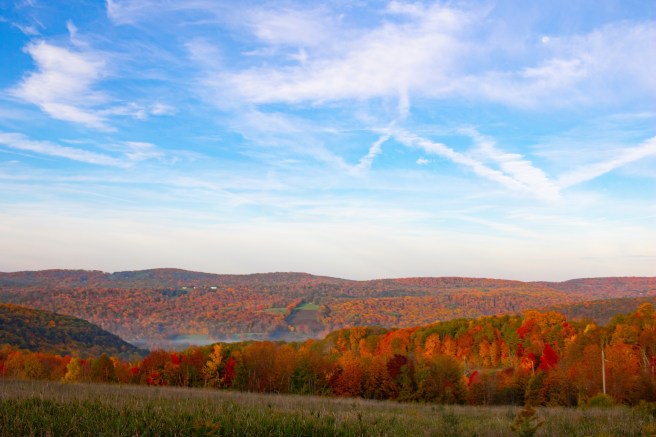
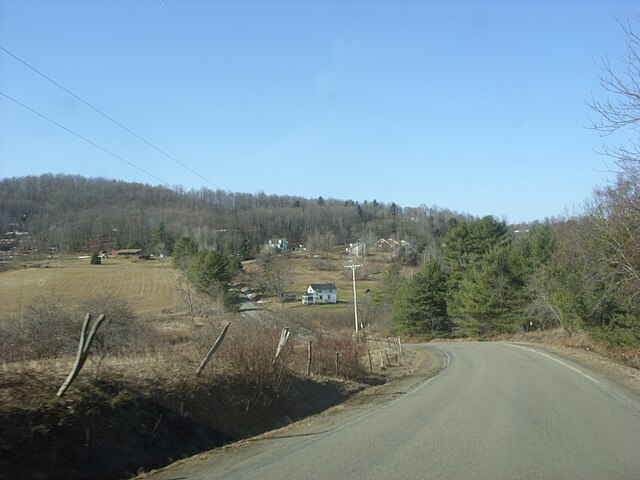
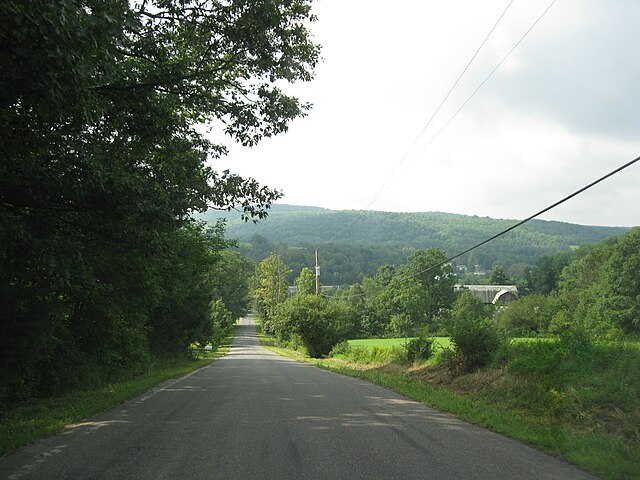
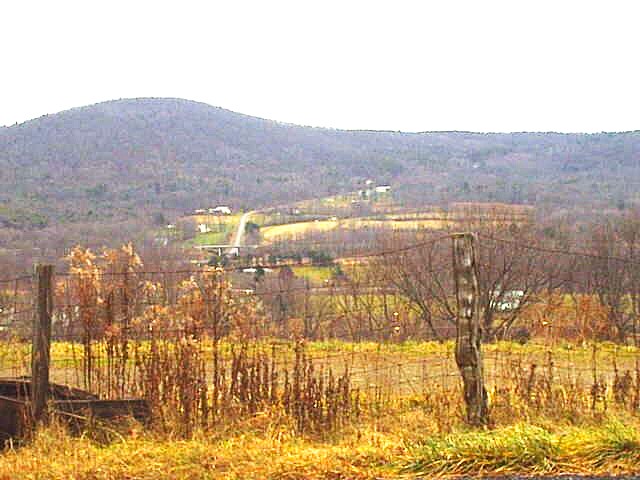
My first autumn there exposed me to a mixture of New England’s intense fall foliage and that of the Southern forests. I drove many miles in the afternoon hours after my shift at the newsroom ended in explorations of the neighboring forests. The region was called the Southern Tier of New England, paired with the Northern Tier of Pennsylvania. Sometimes I got lost on lanes like this or on winding country roads.

Peak fall leaves in Athens, Pennsylvania, just downstream from Binghamton, by Gray Cat Photography at Shutterstock

~*~

The cover of Volume 9 of my journaling purposed a college geography course. I didn’t recall ever touched a map there, either. Turns out to have been Geog 314, urban geography – anything as long as it’s related to the city – part of my Urban Studies certificate program.

Includes a page torn from another notebook, about spending the night with [Judith, I presume, or perhaps Polly], and her moistness. Very confusing now.

Mostly Christmastime ’70: more winter observations.

The Kara lobster incident, quite telling: “What a little girl she is, how frightened of growing up into sex she is, of how much she is running away from herself, using work as an excuse.” Etc.

So she was home from Cornell for the holidays?

Also, reaction to getting Fay’s letter … “She’s further down than I am.” Also, my comments that we would never get back together, because “there is so much she will never tell (her friends) / bikes [motorcycles], sex thrill, freedom … she is physical” in contrast to me.

I was apparently spending time with Judith at this point, much earlier than I remembered. The book includes Christmas Eve, when D-Man and Helene moved to the second-floor place with the rounded bedroom.

I’m surprised by the lack of any record of the spectacular autumn foliage and my explorations of country roads after getting off work in the early afternoon.

Much of what was percolating in my life through these months will instead be found in my novel Pit-a-Pat High Jinks.

In general, it was a difficult time for me.

[Incinerated]

~*~

From Spiralbound Hippies, with commentary from now.

With degrees of disorientation

From banter with Esperanza, I see I was already harboring a dream house in the woods, rather than the sleek flat in a high rise in midtown. Woods, but no mention of lakefront.

From there, the volume leaps rapidly into autumn. “It’s been so long since I have written. … Vagueness replaces articulation.”

Molly says everybody talks about their problems, but very few talk about what makes them happy.

At one stretch, I ranted about how few people could relate to my love of classical music etc., yet also how little I knew of rock or Hollywood stars. I see now that wasn’t the root of my loneliness, but rather my inability to see them as feeling creatures for reasons other than what facts they might share.

~*~

Out of the blue: “Nikki’s fucking up my head. I look strange (though mystic, interesting, intriguing) when I see myself in reflection: the hair and beard: where am I? I want to run but realize the malaise is within. … I’m homesick, but for where? Not Dayton, unless it’s [her family]. Not my parents or the Moons. Or Antioch?

~*~

Molly’s “We’re going to discuss infinity.”

“Oh, that will take forever.”

A note of taking a bubble bath at Molly’s – we didn’t have a tub with our apartment.

Also, her friends had the strangest names: Leo, Lousy Ruly, Zoom-Zoom, Beaver. How would a plain James fit in?

~*~

“It kinda pissed me to discover I paid $1.95 (plus tax) for Trout Fishing in America only to see it was set not by Linotype but rather electric typewriters, probably some poorly paid secretary …”

~*~

Interesting, when I claim there’s nothing Quaker about Quaker Lake, other than being in Pennsylvania. “Nor is there a meetinghouse for miles about. … Unlike Brackley’s roadside dive.” Quakers were still way off in my future.

~*~

Recollections of Fay, her smiling baby teeth and playful body, her wordplay mind, yet eons behind … while Judith gives nothing but her body but wants my soul, says I still love Nikki and should see a shrink.

We lived in rundown housing a few blocks from downtown. The center of the city still had some charm and much potential. Photo by Yuriyt at Shutterstock

~*~

Much of the volume continued the lines of judgmental social commentary cloaked as verse. Interwoven are attempts to define the landscape, both surrounding me and for the nation at large.

There were also pages written in pencil, now too faint to decipher.

The back page has both Nikki’s brother and Pips’ phone numbers and their addresses at Cornell. [Kara was now also there, all three as freshmen.]

A typed teletype roll insert: Time is flying by on dragon wings. Let us use Chinese dragons: they are beings of beauty and magic and have a pearl between their teeth.

So who I was addressing when I concluded, “Catholic hang-ups are beyond my scope of comprehension: I hope you arrive to where you can not only name them but comprehend them: the task of living is immense: we have no other choice. Peace & love.”

[Incinerated]

~*~

From Spiralbound Hippies, with commentary from now.

A little of this and a little of that

I’m guessing this is from a few weeks after my futile trip to Montana and Utah.

The pages open with some Pips at Quaker Lake details, opening with Sunday, “the most beautiful day since I’ve been here.” I arrived to find her in the water, playing with children who were climbing all over her. “The water was refreshing and clear and black. I could see my toes on the flat stones four feet under water. … Swimming together to come out somewhere beyond the weeds.” Reading the Sunday New York Times while she worked the crossword, “I felt like a lord.”

Pips, do note, was a courier at the office, fun to be with but interested in me only as a buddy. For me, she was much better than being alone.

“That night,” on the phone, “Nicki told me she’s going to Salt Lake for three weeks … and I decided to quit” the pursuit. “I feel so free, albatross from my neck.”

Yeah, right. Like a kick in the gut.

A few days later, after a big breakfast with Thor and Vivienne, I went to check out the Hawley Street apartment building, came home to throw the I Ching, and asked Vivenne to accompany me in seeing the unit. She had a coughing problem the whole time I was around her.

The coughing had in fact awakened her; she came out in Thor’s blue robe, its waist hitting her below the ass, pockets at her knees.

“Jesus, you’re short,” I giggled.

My day off, I stopped at the office to get my paycheck. It came out on Wednesdays? Also, got a new tie.

We went back to the apartment, I put $250 down – two week’ pay – and returned to Susquehanna Street, where I removed my tie, changed shoes, and put on a headband.

Then we were off to Scranton, where she would get the bus to Manhattan.

She whipped out some joints (from Thor’s stash) for a joyous ride. We picked up hitchhikers.

Back in Binghamton, though, the loneliness whammy.

Within the next week, Nikki was in Syracuse with her parents. Seeing her in the hotel suite, “our first glance, a terrified emotional rush, afraid to touch … but I put my arm around her. Her voice has changed … mellower, like feather down. She wants me to respect her.”

She’s off to Binghamton with me. We make love, it’s incredible (she’s learned new tricks), until she remembers my confession about Peter’s letter. And I cry too much, too often (like Monday night with Polly).

“In bed, lying next to me: who is this stranger? I’ve never seen her before. She’s so porcelain, such transparent skin, so fragile. And I never knew her mind, it’s so strange.

“We argued over trivia, viz., why did I get a post office mailbox?” She screamed and cried, thinking me paranoid. And I’m scared you’ll lose my other notebook.”

The weekend with Nicki in Syracuse and Binghamton. Apparently, she tore into me over many small decisions.

Why do I defend others, like clerks or waitresses? Am I trying to identify with them, like I’m OK, not freaky like you?

We hit the zoo on the hill and then the Roberson.

“Every time I leave you, it’s death. Will I see you again?”

[In revisiting this, I recast it: “Every time you leave me, it’s death. Will you see me again?” I may have been dropping her off at the hotel, but the fact was that she was the one departing.]

“I know I must avoid your father’s spell: it tears me from your mind.

“What a prison marriage can be: but what misery is this!”

What hurts most about her being with others was my fear of being second-best. Or was it of being alone, alienated?

I even admitted that she loved Bruce. The one in Utah?

“I promised you I would hide you, if necessary.” [Something that would haunt me.]

~*~

From Spiralbound Hippies, with commentary from now.

Welcome to the riverside ghetto

My first residence after college was sharing the upstairs apartment of a house in what was an Italian neighborhood by day and Black ghetto at night. Here goes:

Twelve-hour drive, from Dayton, I guess, on Friday. [This was in the blue Buick Skylark I was purchasing from my father.]

Saturday, swimming in the campus pool at Harpur, and then a string quartet concert with Kara. Sunday at her parents’.

Next Friday (did I oversleep work? Got a call from Bob at 8, to my chagrin). This turned into the steak-in-the-rain event with Esperanza that ended at Howard Johnsons to eat and then back to her place, where D-Man was unexpectedly sitting in a chair. “They make fantastic dancers, and I slink into depression.”

And then, after a brace of empty pages, comes “Tromping Through the Wilderness with the Choir” as a long prose entry before my futile flight to Montana and Utah and back. Much muck here, as well as some sharp flashes that have been woven into my earliest “professional” poems. Much of the rest wallowed in self-confusion.

My house? [Susquehanna Street, presumably.] Nikki’s strand of bells above my bedroom door, her candles, my T-shirts and bellbottoms, her gift of Lili Kraus playing Mozart.

Includes mention of a letter, where I read “Nikki” but not the “good-bye” – when I read it aloud to D-Man and Al (ah, not going by his usual “Thor”), both responded, “That sounds bad.”

My own bit, to self: “Do I want you? I don’t know. I despise you, but I am you.”

Wound up taking the following week off, the futile Montana trip.

She asked why they wanted her back. They see her throwing her life away. As for me? I saw her running away from what she saw as an empty life. “I’m supposed to do in two or three days what I couldn’t in 1½ years? It’s impossible.”

She buys expensive dresses she’ll never wear.

Great Falls “looks like any Midwestern city, except that the lawns are better watered and the people are friendlier, probably because there aren’t as many of them.”

At breakfast, a conversation with a woman psychologist. I got around to mentioning Nikki.

“Is she spoiled? Does she pout (or get upset) when she doesn’t get what she wants? … She needs psychiatric help.” Unprompted.

She needs to do something on her own. We need to commend what she does right. In giving her attention for doing something bad, we may encourage her more whenever she seeks attention.

Lyric poems lack maturity, Yellen said. But these aren’t poems, I’ll confess, they’re teardrops.

My freedom’s shallow, unlike my sorrowful loneliness.

~*~

Three aged yellow teletype paper letters were also folded into the notebook, all lower-case, undated; one to Ostrom, written on a Sunday afternoon. Mentions swimming a quarter-mile three or four nights a week, playing violin, and getting ready to hear Ella Fitzgerald that night.

[Incinerated]

~*~

From Spiralbound Hippies, with commentary from now.

Edging into the ‘70s

The first five spiralbound volumes reflect much of my thinking and experience underpinning my novel Daffodil Uprising, yet lacks many of the human sides of the story.

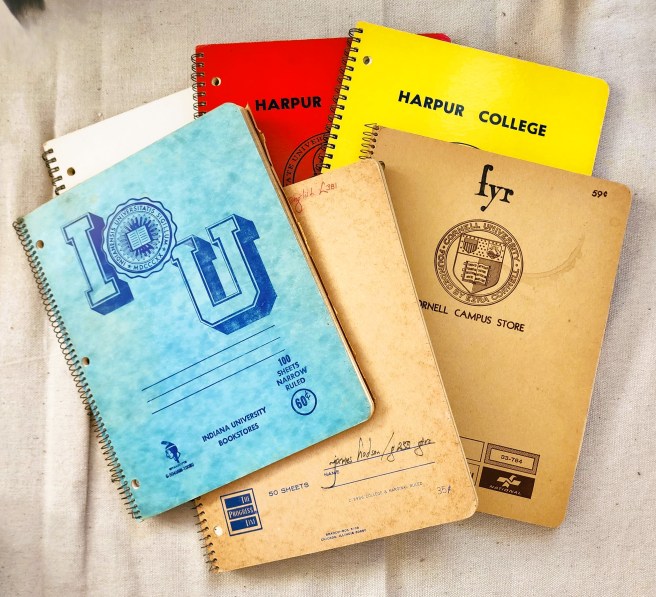
As you’ve noticed, none of them stand as journals or even systematic reflections, although one notebook opens, “I resolved the conflict between egotistic drive for position, for empty status, and intellectual quest,” arising from my decision to step down as arts editor at the Indiana Daily Student early in my junior year. Packman was among the first I consulted in making the move.

That volume, with an IU cover, does have my Men’s Residence Center address sticker, indicating I took my film course the spring of my junior year, rather than in my senior year. The first half has detailed notes taken during films, and my relationship with Nikki was in full force, though my record is only – apparently – class notes or scribblings while viewing, starting with Renoir’s Grand Illusion.

~*~

I was still far from journaling,

That would switch with the sixth volume, a book that starts out in Bloomington in the fall of 1968 as college class notes, but ends (after a big gap) in my emerging turmoil in Binghamton. That is, June 1970, the beginning of what would be a fervent, transformative decade for me: Bloomington, Binghamton, ashram, Fostoria, first marriage, Bloomington again, and then Yakima.

Two of the previous notebooks originated in the winter and spring of 1970, the second-half of my senior year of college, but with this notebook I was finally out on my own, my first full-time job, paying rent, owning a car, in despair regarding my first lover.

Revisiting this, I expected that much had been closely gleaned for the novels and poems.

I was surprised by how much hadn’t.

~*~

What strikes me, looking back, is the neurotic frenzy of those years, even before adding in the evenings of concerts, operas, lectures, and so on. Just where was my sense of direction? Or was it more likely escape?

My major was political science, by the way

These notes were from a grad-level seminar, Frontiers of Public Policy and Action. Classmates included Brian Loveman, George Strump &/or George Stein, Paul Wogaman, and Major [his given name] somebody.

Takeaways:

Selecting one form of action as policy does not preclude other possibilities. So what causes policy to limit choices?

Soft constraints = a matter of choice, which leads to difference.

Hard constraints = invariance, operating across all political systems, including political inequality.

We assume that a dollar is a dollar. But is that true when dealing with the public treasury?

What happens when a dollar of yours is used to harm you? When you are taxed to harm yourself?

A public good may become a public bad.

A political price is assumed in all political systems.

Capabilities = potential assets.

Limitations = political liabilities.

Every decision reflects these.

With multi-tiered political systems, the concept of commons becomes ambiguous.

The bribe = the rich get richer; the poor, poorer.

Public entrepreneurs. Public goods and services.

Behavioral theory as an alternative to top-down management perceptions.

Unity of command: limited span of control. A belief the organization is always directed toward the center. (As for a bell curve?) (Or that which deviates from authority?)

Bureaucratic disfunctions. Formal versus informal policy/action.

Rules of procedure may dictate the solution.

Medieval epistemology quite at variance with contemporary perspectives. As in, spirits as an opportunity for Truth to be revealed, as well as magic and myth.

As for those who are negatively affected by an action (externalities) = direct consequences of actions.

A bilateral monopoly = oligarchy or other monopolists.

Water policies in the West as an example of a local matter that exerts much wider influence.

Trade associations within public agencies …

Dynamic of a hidden hand, an equilibrium without direct intervention.

How do we assure that rivalries between cities, states, or nations work toward a common good?

The aristocracy of the South became a military caste. State military colleges in South, not North, Midwest, or West.

Can bureaucratic professionals regulate their superiors? Or is a self-centered careerist more interested in pleasing the superiors who control his promotions?

As for strong client relationships?

Is what we’re buying with tax dollars in the national interest? (Block grants versus categorical grants.) Are these grants or are they purchases? Are we buying what we should?

Taxing capacity = real jurisdiction.

Politics as a subset of corruption.

Public education as a public good yet to the individual’s advantage.

Monocentric decision-making processes in a large city lead to

  • Moves toward common, central preferences. (Bell curve, with a tendency to lose information on different interests.) Also, what is necessary to put together a minimum winning coalition?
  • Deterioration of public services, along with decomposition of neighborhood, fundamental social change.

Mafia as a shadow bureaucracy versus government collective action.

~*~

 From Spiralbound Daffodil, with commentary from now.

A solid introduction to some then-living novelists

My last two surviving college notebooks, from the period just before I began personal journaling, nevertheless offered some clues to my state of mind at the beginning of the ‘70s. From the cover, I see I lived in I lived in G253, an honors dorm in the Graduate Residence Center. Yes, some undergrads were allowed.

Terence Martin turns out to have been on his way to a distinguished career he ended as a professor emeritus. “His first book, The Instructured Vision: Scottish Common Sense Philosophy and the Origins of American Fiction, became a classic study of how Americans wrote fiction in a society deeply suspicious of the imagination.”

In addition to Seth and Diane Rubinstein/Rubenstein, my classmates included Monroe Anderson, Julie Harvey, and Jeff Hersh.

The reading list:

  • Ken Kesey One Flew Over the Cuckoo’s Nest
  • Tom Wolfe Electric Acid Kool-Aid Test (which was largely about Kesey)
  • Kurt Vonnegut God Bless You Mr. Rosewater and Cat’s Cradle.
  • Robert Coover: The Universal Baseball Association, Inc., J. Henry Waugh, Prop.
  • Ralph Ellison Invisible Man
  • Joseph Heller Catch-22
  • John Hawkes Second Skin
  • John Barth Floating Opera
  • Donald Barthelme Snow White
  • Thomas Pynchon V
  • Ishmael Reed The Yellow-Black Radio Broke Down and the Freelance Pallbearers
  • Peter S. Beagle Last Unicorn

In retrospect, I’m seeing how much this course shaped my own attempts at fiction. Do note that there were no women and no Kerouac on the list.

For a closer look at the course and the authors, see While Their Novels Were Still New in Thistle Finch editions.

~*~

Mention of AFSC in Dayton – draft counseling?

Natt Thompson may have known Joe Elder.

Roy and Alice Leak or Leaky, faculty from North Carolina.

~*~

End matter had a page of journalism recruiters on campus, February 17 through March 11, from Chicago Tribune, Milwaukee Journal, Wall Street Journal, Miami Herald, Lindsay-Schaub papers (Decatur, Illinois), Louisville Times. Unfortunately, a wave of layoffs shortly afterward meant the job interviews were for nil.

There’s also a listing of Chekov pages for my Russian lit course (though taught by the Russian language department, the readings were in English).

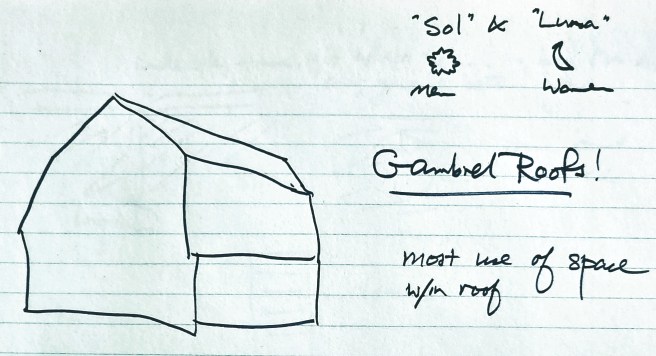
Another page sketches plans for a “cell in the woods,” something with a glass roof and a cot or hammock. Buckminster Fuller had his geodesic dome; I was playing with a square-turned-diamond (from the gable end), the bottom corner sunk into the ground, diagonal width 12 feet at ground level – the overhang would leave two sides sheltered. Maybe I’d stack firewood there. The cot would be at one end, rather than the workbench I expect.

~*~

 From Spiralbound Daffodil, with commentary from now.


As a prelude to regular journaling, I found this

In one notebook, only the first eight pages were used. The remaining pages remained blank. Somehow, I was now at Indiana University, Bloomington.

I’m confused about the time of these entries. Page 2 opens, “Tiempo comes out this week: it is beautiful, austere, and masculine. Will the effort to excise the cobwebs, the Romantic [Victorian?} cancer from this God-forsaken place be worth the effort?” On page 4 there’s a bracketed [November 14] entry, “at breakfast time, the puddle was frozen. At lunchtime, a butterfly flitted in sunlight; I thought it was a falling leaf.”

Yet the entries have me suspecting the entries might actually be from early spring or later, when my love life was in turmoil. The only notation on the opening page was a pathetic: “Poem to Nicki. Can I be your older brother / if I cannot be your lover?”

There’s also a description of our visiting Toad Hall with my sister and our driving to Bedford, with the Hoosier hills creased by naked trees and framed by blocks of farmed fields, rocks cut away by creeks, golden fallen leaves, and yellow cut limestone. Also, Cezanne quarries with mottled gray skies.

Still, these details also would fit November.

~*~

My reading stack included Steppenwolf, which I read half-drunk on one of my first bottles of wine, as well as Leviathan, Dark Ghetto, Hostettler’s Amish Society, Morning Watch, Einstein on Mozart’s piano concerti, the usual studies grind, Neibuhr’s Moral Man and Immoral Society, and the Kerner Report.

Story idea: Levithan (or the perfect ruler): the sovereign as an omniscient computer. [Remember, this was at the end of the ‘60s!]

~*~

My primary focus was on Nikki or, more accurately, her absence. In the years since, I had forgotten that we had ongoing struggles long before the final split.

“The library on Saturday night is quiet: a great escape from couples.”

[I see I was using colons the way I now use dashes. One seems literary, the other journalistic, often as a substitute for parentheses.]

Sunday morning is for the purest music: Mozart piano concertos, the Shostakovich preludes, Herbie Mann, Beethoven’s sixth.

And then:

“This week has been weird. Nikki’s decision [whatever that was], then all night Wednesday after our tearful walk. My feeling suicidal playing dodge ‘em with cars. The beauty of being together, skin against skin, her breasts pressed into my arms. Pale sunrise, lavender against blue. Gut-torn scars exposed again. The same lines Fay gave. ‘But I’ll still want to know where you are, too, and know what you’re doing.’ ”

[Funny, neither of them followed up long on that.]

“She is so fucked up, makes herself unhappy when she should be the happiest,” despite the humor that makes my friends think she is so funny. … but I really don’t know her yet. …

“Her chemistry is different. She smells and tastes so different from other girls. Maybe it’s Jewish.” Hmm: “Fay and I had an unspoken language Nicki & I don’t. But Nicki is more human, more sensitive, more the artist and intellectual.”

More the child, actually. If only she would grow up Yet “she stabilized me …”

“Running the door into Paul, the pianist who has never heard of Von Karajan, as he carried hot chocolate.” Who was this guy in my dorm?

Or Jack, “who does not understand literature. I read him a few excerpts from Steppenwolf and understood nothing. Intellectual jerk.”

~*~

Artists do not make contented cows on the sidewalk.

As I was going to buy a baby-congratulations card:

Who might the mother have been? Kathy H?

three blue baby buggies
pushed by three
student-type mothers

Now I see that Nikki and I were having troubles before my trip to Florida. The trip, even so, went swimmingly.

Vietnam
Love it
Or leave it

Other bits:

The worst profs I’ve had hold doctorates from Ivy League schools.

One poly sci course offering was about why politicians must tell lies, keeping their constituencies in ideology and darkness.

Two nights a row, meatloaf. On third day, at lunch. The dieticians serve what no one else would dare do.

The best part of any book is the last half. The author has laid all his piddly groundwork: he is now ready to move, if he can.

Really?

Trout Fishing in America: big writing now. [Maybe this was my first awareness of the work, from a reference in Newsweek or Time, rather than actually having the book, something I think happened in my Montana trip in the spring of ’70, after graduation, about the time I started journaling seriously.]

This campus is filled with a bunch of would-bes: would-be writers, would-be lawyers, would-be scientists, all pretending and preventing others from getting ahead. Rah, mediocrity!

Conversation with V.O.: basis of Hobbes and of Kantian ethics is an assumption that good and the maintenance of the state are one and the same. … His wife is teaching what looks like a fantastic course on urban affairs, very problem-oriented …

Make every minute count. It will soon add up.

“I had to obey the rules of war and my flag. I am ready.” – last words of Adolph Eichmann, Nazi leader.

Her family’s Lake Worth rural route address and phone number occupied my back page. The ranch was essentially West Palm Beach.

~*~

From Spiralbound Daffodil, with commentary from now.

An unexpected travelogue from three random loose-leaf pages

First entry had dateline of New York but was from Upstate enroute to Montreal. I’m thinking this was from a family trip taking the Thruway to Syracuse and then I-81 due north to the Thousand Islands region. Pittsburgh, Toronto, and Cleveland were likely on an earlier trip.


Big, bossy women with rough, powdered faces. Big cars. Big-nosed men. The resorts, once elegant, rambling, now crowded, rundown, shabby. Poor cottages deface the landscape. Everywhere cheap tawdriness of sightseeing boats, lying pamphlets, expensive everywhere: highways, bridges.

And then MONTREAL.

Busy, cosmopolitan, the women proud to be women, they carry their heads high, proud, elegant, fashionable. Men handsome, dark, longish [styled] hair – many artsy, with sandals. Both sexes seem to enjoy themselves, full of life. The center of the city is vast, exciting, filled at night with people. The Place Ville-Marie is the most beautiful large-scale design I have ever seen: four tall office towers with a plaza, under which is a gallerie de boutiques, small but expensive shops that stretch under the street to the central subway station and the Queen Elizabeth Hotel, the city’s proudest. Everywhere construction of clean, modern glass-wall offices. But driving is nervous, quick, dangerous. Most cars are dented and crushed in, somewhere. Everybody parks in “no parking” zones. Little wonder so many take the legions of taxis or numerous buses (fare just 20 cents). Live theater abounds, as well as cinema. Visiting cultural events abound: New York Philharmonic, La Scala Opera, Hamburg Theater.

The city’s filled with apartments, many with outside stairs leading to the second and third floors. Everything in French, one finds difficulty in common communication. It is like being in Europe or some obscure corner of New York City.

We see the Expo area tomorrow. [Was it under construction? The fair took place over the summer of ’67.]

Sorry, janitor, restroom writers have struck again.

Montreal was the first city I encountered that wasn’t awash in suburbs.

~*~

Western Quebec/Eastern Ontario: Flat country that must be cruel in winer. Woods of birch, maple, and pine. Houses of brick, steep-roofed, and without ornamentation. The land is sparsely settled, with many unpainted, storm-beaten frame houses graying into ruin.

My guess this was the summer of ’66, perhaps at the end of summer. Our last family vacation?

 ~*~

From Spiralbound Years with commentary from now.