Finding the right tone for the story

Working on my novel What’s Left, had me exploring unfamiliar terrain when it comes to writing itself. Here I was, after a lifetime in newspaper journalism and a shelf of experimental novels and volumes of poetry, now drafting and revising a new work that was unlike anything I’d done before.

The details, for the most part, felt right, as did the structure. I’d eased into a voice in which Cassia could relate her progress, with the verb tenses of past events repeatedly changing back to the present, the way people do in speaking. The opening pages and final chapters actually excited me. But something bogged down along the way in-between. Not that it wasn’t good; it just wasn’t … well, something.

Much of my awareness as a writer has regarded the matter of style. How crisp, sharp, polished, muscular or sensual, even musical are the pages? In literary circles, that would ask just what in particular gives a specific writer a unique signature or sound, but my background originated in my high school years when I discovered the dictates of newspaper style — the strict rules given journalists for uniform spelling, story structure, word choices, and so on, matters that essentially create a uniformity or even anonymity in voices. Anyone want to mention Hemingway at this point?

With What’s Left, though, the word that kept popping up for me was tone. It was somehow just a little off.

Thinking of it in musical terms, I’m always surprised at what happens when our choir changes the tone of a piece by moving it up or down a half-step or so. It becomes brighter or more melancholy, for instance, as well as easier or harder for us to sing, depending on how it presses our vocal ranges. Well, this is also looked at as a matter of pitch. And it can make a world of difference.

With my novel, I slowly realized I didn’t want it to sound too much like a novel — I wanted it to be more an overheard conversation. As I also found, that can be tricky when we’re looking at a stack of old photos or family history.

~*~

In the family, Cassia’s great-grandfather Ilias would have known food like this. A plate of cooked snails with tomato in Crete, Greece. Served in the town Agia Galini. Photo by Helentr via Wikimedia Commons.

~*~

Now that the novel’s finished, I’m reflecting once more on the basic of tone. One definition calls it the attitude of a writer toward a subject or audience, and I’m seeing how it’s been both in my case. Over the course of the revisions, the subject mutated from her father to his photographs and, finally, to the experiences of Cassia herself. In addition, her position shifted from her telling of looking back on her discoveries to having her tell of them as they occurred — in effect moving the center of gravity of the story well into her early teens. That, in turn, changed my attitude toward the audience.

Tone, as the definition continues, can be formal, informal, serious, comic, sarcastic, sad, and cheerful, among many other outlooks. Well, where her voice got younger, I did find her bursting into outrageous, delightfully irrational lines that have become some of my favorites.

My thinking about tone was also stimulated by things my ex-wife, a painter, had repeated about the necessity of tone in visual art — something many artists seem to lose sight of (sorry about the pun) as they work. Here it’s the contrast of lightness and darkness, in color as well as black and white — highlights and shadows. Squint your eyes and see if everything blurs into one. It’s still an important parallel to the written word.

So in my novel the tone would need to be colloquial. In the draft and early revisions, Cassia’s mostly the reader. But in the final draft, it’s largely her father. My attitude toward the subject has definitely changed, as has hers.

There’s also the attitude toward details. In fiction, to establish the contrast of lightness and darkness, it helps to keep many of these suggestive, open to the reader’s imagination — unlike the specifics demanded in journalism. Think of having shadowy areas where things can move about in the background without interrupting the action at hand.

In another shift, as she began voicing questions in place of flat-out statements, the reader just might start arguing with Cassia (not me!) — or even to say to herself, “I remember something similar” or “I’m glad that’s not how it happened with us.”

~*~

Since her family’s involved in the restaurant business, we can change our perspective slightly. Finding the right tone is something like deciding what kind of meal you’ll sit down to. A picnic, for example, is quite different from one with white linen on the table or from a quick lunch of burgers and fries.

As for something at home? It helps to know who’s coming.

What would you serve Cassia for a meal?

~*~
How Cassia herself evolved in the revisions

No matter how much my novel What’s Left is framed by the ending of my first published novel, most of its characters and action are entirely new.

Well, if you can call going a few more generations “new,” they’re fresh characters in my fiction, filled with color all their own.

Cassia herself and her brothers and cousins and aunts Pia and Yin are certainly original to this story. And yes, a lot has happened in the 50 years since her father joined in with the family.

As one now-deleted line admitted:

Your very presence alters the vibe. There’s the whole nonconformist groove.

This was a description of what her parents’ generation was doing to the restaurant immediately after the fatal car crash, but it could fit much more widely.

In each revision of the novel, Cassia took another step forward. She’s always started her quest at age 11, but most of it was told as a young adult recalling her string of discoveries. Now, however, much of it emerges when she’s 13 and moving up through her teens. For contrast, the final section comes a decade later, after she’s ranged the wider world.

Crucially, in the final revision, she’s speaking directly to her father throughout, rather speaking about him. And, as noted, much of the action has moved forward into her early teen years.

Somewhere along the way, her quest took a flip. It became more about her discovering just who she is and her role in the action. And that’s when she started dictating passages to me, the author.

When I selected her name, Acacia, I didn’t realize how prominent it is in the Bible. In the King James translation, it’s rendered as shittim — what an ugly word! — but Moses was very fond of the extremely hardy wood, and it’s mentioned more than 30 times, often as a required material for holy construction. Americans are most likely to encounter it as the fragrant black locust tree, thorns and all. (OK, officially that’s considered false acacia, but still … close enough for me.) Its flowers are quite fragrant.

~*~

Well, an author can’t include all the details.

What do you think Cassia’s favorite food would be? (Don’t you dare say the Streetcar!)

~*~

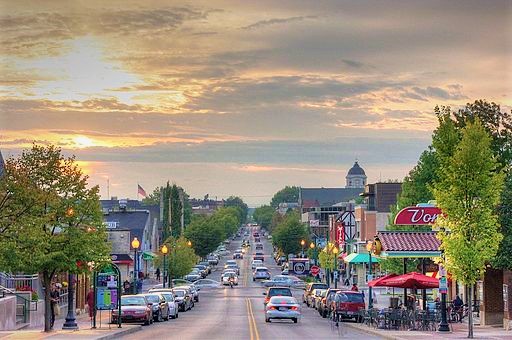
Kirkwood Avenue in Bloomington, Indiana, a town that inspired much of the novel. Cassia’s family compound and restaurant would have been off to the left.

~*~

Maybe this is backwards, but the cover can change the story

This self-publishing field means an author is typically deeply involved in all parts of the project rather than just the writing itself.

In my Smashwords releases, I initially hired a book designer to do the covers, but my current releases have all been created by me. (Someday, I really would like to have an artist design the front, but for now, I’m sticking to photos or existing stock artwork. We’re on a strict budget.)

Still, finding an appropriate image can be a challenge.

Has anyone else had this experience? You come across a picture that clicks and select it – and then you go back into your manuscript to make the visual fit better with the text?

For me, that happened with the portrait I settled on for Promise – the model gave me a clearer vision of my character Jaya. (That novel’s now part of Nearly Canaan.)

More recently, with Yoga Bootcamp, the handstand dog reminded me to keep the story lighthearted and humorous in my final revision. Did my decision to nickname the swami Big Pumpkin and Elvis come after the pooch was on board? I don’t recall now, but it certainly wouldn’t surprise me.

Do tell me about your favorite book cover. Does it influence how you see the story? If you’re a writer, has the art on your book led to revisions?

~*~

By the way, I do hate it when the character on the cover is shown, say, as a blonde but is described in the story as a brunette. That sort of thing.

And don’t forget: You better be good to toads!

One more throwaway line

I still like the line, even though I cut it from my novel What’s Left:

Manoula, in the end, would become Penelope awaiting Baba’s return.

~*~

Do you think a teenager would have uttered a sentence like that? Do you catch its classical reference? Or would you need to have it explained?

~*~

Cassia’s roots included inspiration like this. Stairs in Patras, Greece, with view of Varasova mountain across the Gulf of Corinth. Photo by Jerome via Wikimedia Commons.

~*~


Roads not taken on the way to earning a living

In my novel What’s Left, Cassia ponders her father’s career. In an earlier draft, she noted:

At the least, he might take a position on a magazine or major metropolitan daily, based on the portfolio he’s amassed.

Even so, about the time he moves in with her family:

He replies honestly. He’s living hand-to-mouth as it is, thanks to his full-time professional calling.

~*~

I’ve known more than a few people with great talent and great potential. Somewhere, though, they failed to leap the gap. I could point to big changes in society that increased the distance, but even so, I mourn that we’ve lost much.

Step back and look at your situation now. In the movie version, where would you find glamour? And what would come across as funky? Give it a title, if you will, as part of your pitch. Let’s live fully, where we are!

~*~

Don’t forget: You better be good to toads!

How divinely appropriate

In my novel What’s Left, her mother inherits a name whose attributes suit her well. The chaste Roman goddess Diana (or Artemis in Greek) rules the hunt, the moon, childbirth, and nature. In the story, she’s calm and faithful, with a spark of fire that infuses her music-making and likely much more. I even have her evolving into much more of a night-person than her early-rising husband, though I hadn’t thought about that connection till now.

~*~

As I wrote earlier:

The real hunt had begun. With practice, within this lifetime, however long or brief, a remarkable enlightenment might yet blossom into wisdom. From flowers and bees, the harvest comes.

“Come, Dhyana, let us sit together. Let us ride in unison. That is all.” He accepted fully, “The female energy is my Shakti power.”

~*~

Given the urgency of her father’s Buddhist practice, it’s entirely fitting that his wife — Cassia’s mother — would share in the experience. Here he also recognizes an Eastern perception of a uniquely feminine spiritual energy that would complement his own nature — in a way also honoring the goddess essence of Diana’s own name.

By the way, if you’re interested in the origin, meaning, and pronunciation of my name Jnana, visit the Bio page here at the Red Barn. Think it fits me?

Do you know anyone whose first name perfectly suits their personality? Or how about someone who’s the exact opposite of what you’d expect?

~*~

Roman goddess Diana

~*~


Learning to see your own world through another’s eyes

After the death of her father in my novel What’s Left, Cassia and her mother grow emotionally distant. Perhaps a rivalry for his attention had already been festering or perhaps it’s a natural development for many girls at the onset of adolescence, but Cassia, at least, senses something is missing in their relationship.

She even blames her mother for not preventing her father from departing on the trip that ends in his accidental death. In the aftermath, Cassia wonders if she can fully trust anyone to stick around or if she must guard herself on all sides.

Her mother, Diana, is outwardly reserved, unlike her innately effusive sister-in-law Pia. Much of her time is also focused on her successful career as a small-press publisher and performing in a respected string quartet.

Cassia’s aunt Nita subtly begins channeling the girl’s desire for her father’s presence into a long-term project of examining and organizing his vast photographic collection, including thousands of negatives that were never made into glossy prints. In effect, this is one place Cassia has him largely to herself. Here, as she surveys the world through his eyes and mind, she moves from grief to discovery and insight, especially as his unseen guidance leads her more and more into her own extended close family, which he had so vibrantly joined.

~*~

Somehow by the final version this line was no longer needed:

As you’ve seen, Manoula’s family is a whole other story.

~*~

Well, for one thing, he arrived as an outsider, so he did have a fresh perspective from which to view his new relations. They introduced him to a much different set of experiences and, ultimately, accomplishments.

Like him, I moved away from my native corner of the world and encountered much my parents never did. Just joining living in a yoga ashram or later joining the Society of Friends (or Quakers) altered my perceptions.

How do you see the world differently than your parents? Or, for that matter, other people who’ve been around you?

~*~

In the family, Cassia may have had food like this. Mouse-shaped sweets from Katerini, Pieria, Greece. Photo by Lemur 12 via Wikimedia Commons.

~*~


Finding another dimension of personal growth

In my novel What’s Left, one of Cassia’s big discoveries is how much her father had changed in the span from high school to his return to the college town a few years after his graduation.

Among the passages I cut from the final version is this:

No, I guess Baba takes it all in stride because of all the healing and growth that had happened within him since Nita introduced him to Tibetan practice.

~*~

Not everyone, of course, looks deeply into the people and the world around them. Some seem oblivious to the cosmic harmony or greater good that could be shared.

Too many, in fact, remain blatantly superficial, considering the threats now before human existence.

But I’m preaching. I’ll apologize.

There are other options, as I discovered when I took up yoga.

Who or what have you seen helping people you know change for the better? Is there any practice or teaching you’d recommend?

~*~

Cassia’s hometown may have looked something like this. Front of the store at 109-113 South College Avenue in downtown Bloomington, Indiana. Built in 1895, it is part of the Courthouse Square Historic District listed in the National Register of Historic Places. (Photo by Nyttend via Wikimedia Commons.)

~*~


And then there are Cassia’s two older brothers

In the early versions of my novel What’s Left, her brothers stayed off in the background. But Gyatso and Billy moved far forward in the eighth and ninth revisions, especially when I discovered they didn’t require a lot of narrative development to be present. Sometimes a single short detail now pops their activity into fullness.

One thing about Cassia’s extended close-knit family is that her cousins are practically her siblings, too. Cassia’s cousin Sandra, for instance, could well be her sister, and both Gyatso and Billy line up well with some of their boy cousins.

It’s a fine line to walk, keeping the story moving without bogging down in too much detail, but it’s a rich matrix all the same.

~*~

I once had a coworker who grew up in a family where the way they showed affection for one another was by exchanging truly negative words and phrases. As far as I could tell, physical harm wasn’t part of it. Even so, maybe they understood what it meant and felt affirmed and included, but when he did the same thing with those of us in the office, many of my colleagues felt deeply insulted, even wounded. Maybe you know of writers capable of re-creating the domestic scene, but I’m not one of them. I’m still largely baffled.

The dynamics of siblings can make for endless intrigue. I’d love to know more — much more — of how they work in our lives.

Are you from a large family? Do you have brothers or sisters? Do you ever “borrow” their clothes? (Or anything else?) Does your household make you different from your friends or classmates? How would you describe your siblings — and your feelings for them — in a few words? Go ahead, vent, if you must.

~*~

In my novel, the family restaurant could have been like this. Cornelius Pass Roadhouse, Hillsboro, Oregon, by M.O. Stevens via Wikimedia Commons.

~*~


Are you sure you’d want your parents to see this?

In What’s Left, Cassia spends hour after hour organizing the chaotic mess of her father’s photo studio after he vanishes in an avalanche halfway around the globe.

He was something of a hippie, too, as she sees in some of his excesses from the period. Here’s something that popped up for her in a conversation with her aunt Nita. You won’t find it in the final version of the novel, though — some things just got toned down.

And? You ever see the movie he made about the courthouse?

The one with the dome turning into his girlfriend’s breast? Diz’s?

You remember he made that while he was still an undergraduate? Before all the really freaky stuff that followed?

Yes, and that reminds me. We need to have to get that reel converted to digital from Super 16. Before it starts disintegrating or fading. 

You know what a hit that was in some circles? How he was on the verge of notoriety or celebrity?

So why didn’t he continue in that vein?

How would he have paid the bills? The big bills? Where were his introductions? Producers, distributors, even actors? Or his confidence,

~*~

I’ve been trying to think if there’s anything in my past quite that outrageous, but it all seems to be included in my Freakin’ Free Spirits series. My kids would likely be disappointed, but I’m glad my parents never knew the details. I hate to think, though, of some of the things my two girls are hiding from me. My, the times have changed!

What’s something you or your friends are hiding from your parents? What’s most shocked or surprised you about them? What other directions might their lives have taken? What might you hope your own kids never ask you about?

~*~

The vibe lives on, one way or another.

~*~