Consider the Theotokos in the Nativity events

When it comes to the mother of Jesus, Eastern Orthodox Christianity has developed a perspective that differs in subtle ways from the Roman Catholic and Protestant streams. Much of the teaching is not found in the standard Bible but does round out a broader understanding.

Here are ten points from the Orthodox tradition without getting to some very fine hair-splitting.

  1. She is called the Theotokos, Greek for “God-bearer” or “God-birther.”
  2. In her full title, she is referenced as the “all holy, immaculate, most glorified and blessed Lady, the Theotokos and Ever-Virgin Mary.”
  3. Elsewhere in the liturgy, she is called the Mother of God, though the theology does but put some limits on that, as in “Mother of the Incarnate God.”
  4. She was the only child of an elderly couple, Saints Joachim and Anna, mentioned in the New Testament apocrypha Gospel of James. Their childlessness was a cause of shame, as the drama goes, until their big surprise. Their festival day is July 26.
  5. The Orthodox celebrate her nativity on September 8. Fittingly, that’s a week after the beginning of the Orthodox liturgical calendar year.
  6. Her presentation into the temple is celebrated on November 21. According to tradition, she was taken at age 3 and left there, consecrated to its service, where she remained until age 12 in preparation for her celestial role. The feast day comes about a week after the beginning of the 40-day Nativity fast, the Orthodox parallel to what Western-Christianity observes as Advent.
  7. The annunciation, where Archangel Gabriel appeared with glad tidings to inform her of her surprise pregnancy, is celebrated on March 25, nine months ahead of Christmas.
  8. On her death, or Dormition (Falling Asleep), she is believed to have been ascended into heaven. The event is celebrated on August 15. In support of the argument, the faithful are reminded that no bones remained behind. Thank “doubting” Thomas for that, when he arrived late for the occasion. Had there been any bones, they no doubt would have been highly regarded wonder-working relics preserved in a famous church or monastery.
  9. Her icon is displayed on the iconostasis that separates the sanctuary (altar) from the nave in an Orthodox house of worship. She stands holding the child Christ on one side of the Royal Door, through which only the priests may pass, while Jesus is depicted at the other.
  10. She is also referred to as Queen of Heaven and Mother of the Church.

 

How do you feel about family?

Cassia would have to say she’s in a big happy extended family, but she would disagree with

Tolstoy on his other point. Hers is not the same as any other. As for the unhappy part, she carries a world of grief after the disappearance of her father in a mountain avalanche.

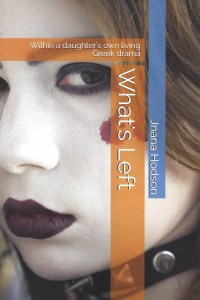
My novel What’s Left follows the bereft daughter in her quest for identity and meaning over the decades that follow. Bit by bit, she discovers that he’s left her far more than she ever would have imagined, in effect guiding her to some pivotal choices.

The ebook is one of five novels I’m making available for FREE during Smashword’s annual end-of-the-year sale. Pick up yours in the digital platform of preference.

Think of this as my Christmas present to you. How can you not be interested in insights about family, especially at this time of year? Even if this one does have some Goth twists, probably unlike yours.

For details, go to the book at Smashwords.com.

Just to get Saint Nicholas clear

He’s not a synonym for the fat man who comes down the chimney at Christmas, especially in Eastern Orthodox Christianity, where he’s especially revered. Let’s set the record straight.

  1. He was born in 270 CE to wealthy parents of Greek descent in Patara, now southeastern Turkey.
  2. After they died of an epidemic, he went to live with an uncle, also named Nicolas, who was bishop of Patara and guided him into the priesthood. After ordination, he gave away his large inheritance to those in need, establishing his reputation for generosity.
  3. During the first half of his life, it was illegal to be a Christian in the Roman Empire. Even so, he was ordained bishop of Myra, also in southeastern Turkey, before being imprisoned for refusing to worship idols.
  4. After his release from prison in 305, he zealously made the rounds of local pagan temples and shrines, smashing their idols and turning their temples to dust, as the account goes.
  5. In 325, Nicholas was sufficiently esteemed to be summoned by Emperor Constantine to a gathering to discuss issues Christians were facing. There, at the First Ecumenical Council, he became so outraged at hearing views voiced by Arius (“the first heretic”) that he either punched or slapped the offender. He was then stripped of his bishop’s robes and thrown into prison because it was illegal to strike someone in the presence of the emperor, to say nothing of his own violation of his bishop’s code of non-violence or self-restraint. While in shackles, Nicholas repented of his actions but not his views, and then received a nighttime visitation by Christ and the Theotokos (Virgin Mary). Constantine freed him the next morning. (Nicholas is somehow not mentioned in the writings of any of the people who were actually at the sessions. Ahem. It’s still a hot story.)
  6. In another report, a formerly wealthy man had three daughters of marriageable age but not the money for a dowry or prika for them to be married to good men. He feared they might become slaves. When Nicolas heard of the man’s plight, he came by the house secretly at night and tossed a sack of gold through the window, where it bounced into a sock or a shoe. This happened each time before a daughter’s wedding. The third time, the father saw who the secret donor was. Nicolas pleaded with him to keep the secret. In another, more salacious version, the father had planned to sell off his daughters, into either slavery or prostitution, and Nicholas arranged to save them all from a host of sins.
  7. He is attributed with many miracles, including saving drowning people at sea, rescuing three innocent soldiers from execution, and restoring at least one mortally injured sailor.
  8. He’s widely known as Nicholas the Wonderworker and one of the highly regarded Eastern Orthodox saints.
  9. He died peacefully in his sleep in 343 in his old age, that is, 73.
  10.  In 1087, Italian sailors from Bari seized at least part of the saint’s remains from the church where he was buried in Myra, over the objections of Greek Orthodox monks. Two years later, Pope Urban II personally placed those relics under the altar at the new Basilica di San Nicola in Bari. For the Eastern Orthodox and Turks alike, it remains theft.

~*~

So much for Santa Claus, eh?

A prolific writing life

Many days when I enter the Red Barn, I find myself amazed at the amount of work I’ve created. I can get dizzy just touching on the places I’ve lived and loved, or the friendships that have blessed me in those many moves. Or all of the painful losses as well.

Even though I was employed full-time in other pursuits, I set aside time for writing, revising, and submission to literary journals and publishers. These days I keep asking, How did I do it? Or more accurately, just what else did I fail to do?

Still, for perspective, a new poem a week for 50 years comes out to 2,500 pieces. And some poets consider themselves satisfied with a lifetime collection of 400 to 500 poems. Perhaps they’ve lived a more fruitful and balanced life than I have. You’d have to ask the people around them, though, for their perspective.

~*~

On a related note, I’m wondering if those who invaded my journals and expressed disappointment were expecting juicy gossip. In all of the upheaval and daily scheduling, I was usually pressed simply trying to record a trail of where I’d been and what had been happening. Without that, forget the emotions or gossip. Those just might fall into place later, perhaps prompted by the notation that the event had even happened.

My, it’s been a long trail!

~*~

So here we are. My novels are available at the Apple Store, Barnes & Noble’s Nook, Scribd, Smashwords, Sony’s Kobo, and other fine ebook distributors and at Amazon in both Kindle and paperback. Let me suggest starting with Cassia.

The paperback cover …


Some similarities between Greek Orthodox Christianity and Tibetan Buddhism

In my novel What’s Left, there are hints that Cassia’s father was becoming interested in similarities between his line of Buddhism and the Greek traditions of his wife’s religious roots.

Here are ten things he might have observed.

  1. Both have a funny alphabet.
  2. Both are quite elaborate and ornate compared to other traditions.
  3. Esoteric teachings often based on teacher-student transmission and interpretation.
  4. They’re both viscerally rich. Heavy incense, for starters, and candles, with their wax dripping on fingers, for the Orthodox, while the Tibetans touch prayer wheels or mala beads.
  5. External visualization. Icons, for the Orthodox. Tankas, for Tibetans. Plus robes and processions and gold and deep red color everywhere.
  6. Death obsession.
  7. Chanting and ritual, including the liturgy for the Orthodox and mantra for the Tibetans.
  8. Monastic backbone. It’s a lifetime commitment.
  9. Both are rich in cultural context. Greeks are Greek and Tibetans live at the top of the world.
  10. Militancy is a matter of survival.


Ten things about Martha and Mary

The two sisters of Lazarus in the New Testament play a bigger role in the overall story than they’re usually given credit for. You often have to piece it together from the four different Gospels.

  1. Mary anoints Jesus with costly oil.
  2. In one version, she’s identified as a harlot (prostitute).
  3. So what does that make her sister? And why are they single rather than married? (Take that as a clue.)
  4. Considering her aforesaid status, as well as the expectation that women not be present alone with unrelated males, see how much scandal that element adds to her going in to listen to the guys rather than help prepare dinner. (Yes, it’s still an affront to social customs, only more.)
  5. Martha gets slighted for feeling a responsibility for feeding their guests, but she does openly rebuke Jesus earlier for his failure to come to the aid of his (presumably close) friend or relative. That is, don’t see her as some shy feminine type.
  6. Mary can’t keep a secret. She blabs, and that’s why everybody and his cousin shows up on the streets of Jerusalem for Palm Sunday a few days later.
  7. By the way, don’t get this Mary confused with Mary Magdalene as a prostitute. No suggestion there, despite widespread assumptions. No, the Magdalene maybe had only mental problems, as far as Scripture reports, nothing of a salacious nature.
  8. Although Jesus revives Lazarus from the stinky dead, the religious authorities come back and kill the girls’ brother a second time. Is this some kind of bad joke?
  9. Bethel, where they live, has always had a rap as a disreputable neighborhood. FYI.
  10.  The Hymn of Kasianna, in the Eastern Orthodox Passion Week services, is no doubt the most erotic piece of Christian liturgy ever. Look for it at the end of Tuesday evening’s or Wednesday morning’s service, the only time in the year it is chanted. It voices Mary’s deep gratitude for redemption and salvation despite everything.

~*~

Now, do these considerations add or detract from your estimation of these two saints?


Christos Anesti!

For the Eastern Orthodox, today ushers in 40 days of Pascha, or Easter. It’s not a one-day event, but the joyous response to Great Lent, culminating in the feasts of the Ascension and Pentecost.

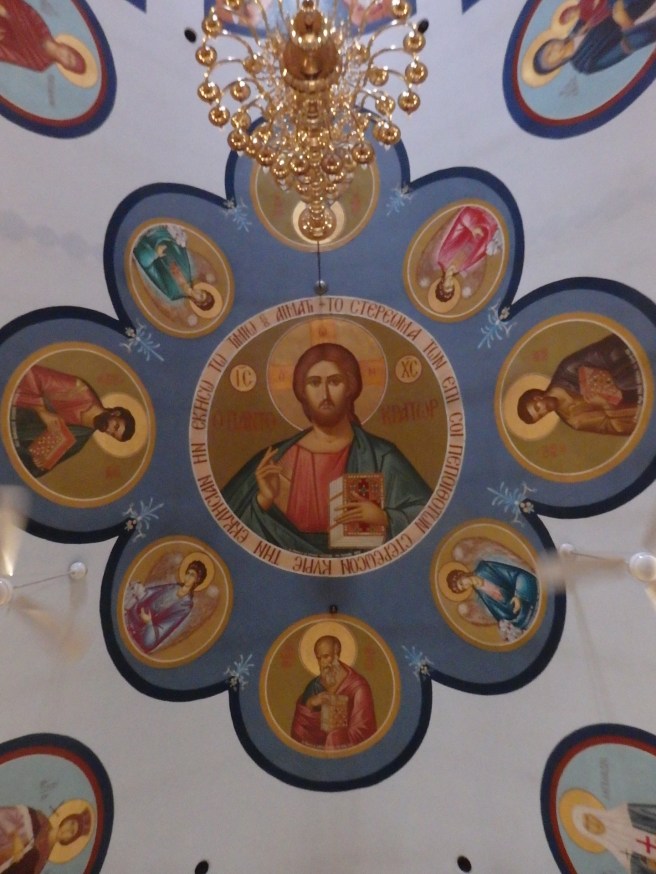
The center of the ceiling in an Eastern Orthodox house of worship typically displays a large icon of Christ Pantocrator, or Ruler of the Universe. Here is the image from Annunciation Greek Orthodox church in Dover, with four angels and what I presume are the authors of the four gospels. Every time I look up at that face, the thought arises, “I could follow that man.”

Climbing the family tree

When she sets out in the task that’s become my novel, What’s Left, she doesn’t expect to be creating a family genealogy going back through her great-grandparents. But there’s no avoiding it.

As I explained in an earlier draft:

Theirs is a unique odyssey – one where the final homecoming is far from its point of origin. As a tragedy, the suffering comes at unmapped turns in the quest for the American dream. As a comedy, well, there are hot dogs, hippies, Hoosiers, and hope. Take your pick.

She gets insights on her parents’ generation:

Thea Nita notes that children in her generation grew up hearing of the woes of the Great Depression as a staple of conversation at big family dinners. In our case, that included the diner shooting.

A good genealogist doesn’t turn back when the details get disturbing:

By now I’m rather astonished at the events Thea Nita’s uncovered. Every family has things it wants to keep secret, but as a journalist, she’s driven toward disclosure. What did I tell you about listening closely to arguments? The dirt that comes up, even years later? Or even in what might transpire in mother-daughter confabs.

~*~

Does it work for the reader? I certainly hope so.

One reason, I suspect, is because Cassia is part of a family that holds many experiences in common. They live close to one another, work in the restaurant or related enterprises, play and grow up together, worship in one of two streams they’ve blended. Whatever they have flows from a shared source.

~*~

Speaking of family, Cassia’s oldest cousin, Alex, would be quite a catch. Where would you want to dine with him – romantically or just as a friend?

~*~

A large Queen Anne-style house with a distinctive witch’s hat tower something like this is the headquarters for Cassia’s extended family in my new novel, What’s Left. If only this one were pink, like hers. (Rochester, New Hampshire)

Ten ways the Eastern Orthodox differ from other Christians

The world’s second-largest Christian body, with 250 million members, is officially known as the Orthodox Catholic Church. It shared communion with Roman Catholics until the schism of 1054.

Here are ten ways it varies from its Western counterparts.

  1. Unlike the Roman Catholic denomination, the Orthodox operate as a communion of autocephalous churches, each governed by a bishop (often known as a metropolitan). In practice, these often have a national or regional identity, such as Greek Orthodox or Russian Orthodox.
  2. Metropolitans, rather than the pope, are the head of each of the self-governing churches, and together they form the Holy Synod. The Ecumenical Patriarch of Constantinople is recognized as the first among equals.
  3. Advent and Christmas. Advent is longer and Christmas isn’t celebrated until January 7.
  4. Lent and Pascha. The liturgical calendar differs from those used in Western Christianity, with Easter (Pascha, the Greek preferred term) typically being aligned to Passover. Great Lent is longer, too. The Feast of the Assumption and Pentecost are holy days nearly equal to Pascha.
  5. The Theotokos. The Virgin Mary, Mother of God, is venerated and central in the liturgical worship. More nuanced, too, than in Roman Catholicism.
  6. Greek, rather than Latin, as the basis of its Scriptures and theological discourse. It’s a language more suited to nuance and philosophy, so I’m told.
  7. The priests may marry (unlike Roman Catholicism) but the bishops cannot (unlike Protestants).
  8. Sensuous richness. Incense, bells, chanting appeal to the nose and ears. An abundance of iconography, especially, surrounds the eyes.
  9. The iconostasis. An elaborately decorated wall stands between the altar and the congregation. It has three doors – the angel doors, to either side, and the blessed door in the center. The priest passes repeatedly through the central door, which is left open during the service, while the deacon or others may use the side doors, as required.
  10. You show up for the Sunday service – the Divine Liturgy – you’re likely to think you’re late. The priest, deacon, and psalmists have already been celebrating the Orthos for an hour, sometimes alone, in preparation.

~*~

AS AN ASIDE: In 978, Vladimir the Great sent emissaries to study four religions in neighboring regions – Judaism, Islam, Latin Rite (Catholic), and Eastern Rite (Orthodox). Reputedly, he rejected Judaism as lacking power, since it had lost Jerusalem. Islam, because it banned alcohol. Latin Rite because of the political power of its pope. But Eastern Rite, with the sumptuousness of its liturgy in Hagia Sophia in Constantinople, won him over. As they wrote, “We no longer knew whether we were in heaven or on earth.” And thus, the Russian Orthodox church was born.

~*~

Admittedly, this is a superficial overview. I’m hoping for a lot of clarification from more knowledgeable readers.