If you’re speaking of dances, for me, it’s New England 

My definition: contra, English country, squares, and rounds, or folk rather than ballroom or rock – though a tango fascinates, I do the Swedish  hambo, when a partner appears at one of our contradances.

~*~

This note came from before I discovered the line dances at Dover’s annual Greek Festival and then the “secret” of dancing them. The event took place every Labor Day weekend, though I did come to find other opportunities to dance in Greek circles.

All of them to date, though, have been in New England.

I never realized how much I was surrounded by Greeks

For whatever impulsive reason, I ended my first published novel, Subway Hitchhikers (now revised into Subway Visions) in a Greek family’s restaurant in Indiana. In a town I I’ve dubbed Daffodil, which shows up in the title of the next book in the series., in fact

At the time, I saw it as emblematic of East Meets West, especially apt considering its Tibetan Buddhist twist.

Little did I know, once I picked up the trail again not quite two decades after that publication, of the ways Greek-Americans interacted with my life, even in the Midwest.

Consider these tidbits:

My best friend’s mother was delighted by her neighbor’s repeated explanation, “Athens! She is beautiful. The rest of the country?” A spitting sound I could never ever spell out was accompanied by the open palms of both hands coming down side by side from overhead.

His other best friend was Greek-American, someone of a philosophic outlook who wound up living in my circle in Upstate New York after getting out of the Army. Yeah, some hippies were veterans.

Later faint details of a landmark restaurant passing into a new generation much like the one in the novel, still in Daffodil.

In the Pacific Northwest, discovering souvlaki on our forays to the University District of Seattle.

Back in Northeast Ohio, the Greek bakery in a small storefront surrounded by houses on a quiet street six or seven blocks east of our home.

In Baltimore, “All the pizza’s made by Greeks,” which seemed wrong – where were the Italians? And, in my salesman role on the road, “All the diners are owned by Greeks.”

In New Hampshire, the Athens restaurant downtown – popular but, to my senses, bland and tired – in contrast to one of my favorite takeout places where we ordered for the office – the menu that introduced me to gyros.

Add to that the cathedral’s big Glendi, which sent food to the newsroom in gratitude for our coverage, or the little frame St. Nicholas church I’d pass on one route to and from the paper.

One of our older coworkers, a photo lab tech, was Greek – kind, smiling, though I got to know little else. Later, one of the men I worked more closely with in the composing room was half Greek. His name, Perry, was after his grandfather, Pericles.

All of this fleeting, fragmentary, but coming together in once I moved to Dover and its annual, free-admission Greek Festival. From there, I picked up Greek dancing and the liturgy of the Orthodox faith, not that I converted. It still enriched my Quaker Christian strand.

And then there was Davos, in Watertown Square, a block down the street from my weekly choir practice. The restaurant was expertly run by Hispanics after its founders moved on.

It’s an element I miss living on this end of Maine. The closest Greek restaurants are in Brewer and Waterville, both blissfully satisfying.

For more of what they present, look to the Cassia’s World category here at the Red Barn or to the novel, What’s Left, which is available in the digital platform of your choice at Smashwords, the Apple Store, Barnes & Noble’s Nook, Scribd, Sony’s Kobo, and other fine ebook retailers. It’s also available in paper and Kindle at Amazon, or you can ask your local library to obtain it.

 

I don’t remember his name

Or much else, for that matter.

He was my introduction to philosophy professor, and then a semester of logic.

I expected to learn pithy bits of wisdom but discovered that philosophy is mostly about bottomless questions. I did find symbolic logic enticing, akin to geometry a few years earlier.

He was young, apparently Greek, as I recognize today – that curly hair and beard resembled any of a slew of statues. Rumors were that he was madly in love with his girlfriend and spent most of his nights talking long-distance to her in Europe.

What fascinated us was his clothing, the same cheap gabardine suit and tie and pair of scuffed brown oxfords every time he showed up for class. We assumed it was the same pair of socks and same shirt, too.

The next semester he wore a different suit but only that one to every class.

Later, hearing of his finals question from the previous year, I was grateful I hadn’t had him then.

The question he assigned for the blue-books scribbles was just one word:

“Why?”

Nothing else.

Most of the students labored away, hoping to chance across an acceptable answer.

The “A” grade went to the one who wrote a one-world answer:

“Because.”

And the “B” went to the one who used two: “Why not?”

How do you feel about family?

Cassia would have to say she’s in a big happy extended family, but she would disagree with

Tolstoy on his other point. Hers is not the same as any other. As for the unhappy part, she carries a world of grief after the disappearance of her father in a mountain avalanche.

My novel What’s Left follows the bereft daughter in her quest for identity and meaning over the decades that follow. Bit by bit, she discovers that he’s left her far more than she ever would have imagined, in effect guiding her to some pivotal choices.

The ebook is one of five novels I’m making available for FREE during Smashword’s annual end-of-the-year sale. Pick up yours in the digital platform of preference.

Think of this as my Christmas present to you. How can you not be interested in insights about family, especially at this time of year? Even if this one does have some Goth twists, probably unlike yours.

For details, go to the book at Smashwords.com.

Acid test novelist: Nikos Kazantakis (1883-1957)

Another recent addition to my elite list is the master best known for Zorba the Greek, though the protagonist’s name was rendered into English incorrectly – it should be Zorbas.

Inclined toward big, knotty books, Kazantakis tackled the upheavals of post-World War II Greek culture, a volatile realm even before The Last Temptation of Christ, his most controversial novel.

My favorite, though, is The Fratricides, centered on the struggles of an out-of-favor Orthodox priest in an impoverished village as he and it are drawn into the crushing vise of civil war itself.

As I’ve welcomed Greek perspectives into my awareness – befitting the element in my novel What’s Left – I appreciate his contention that Greece is neither West nor East, a place where Eastern instinct is reconciled with Western reason. Or, in his novels, logic is pitted against emotion.

I’m in no position to argue whether his language reflects the peasants he met in his travels around Greece, but in translation, it feels large-boned and sure-footed.

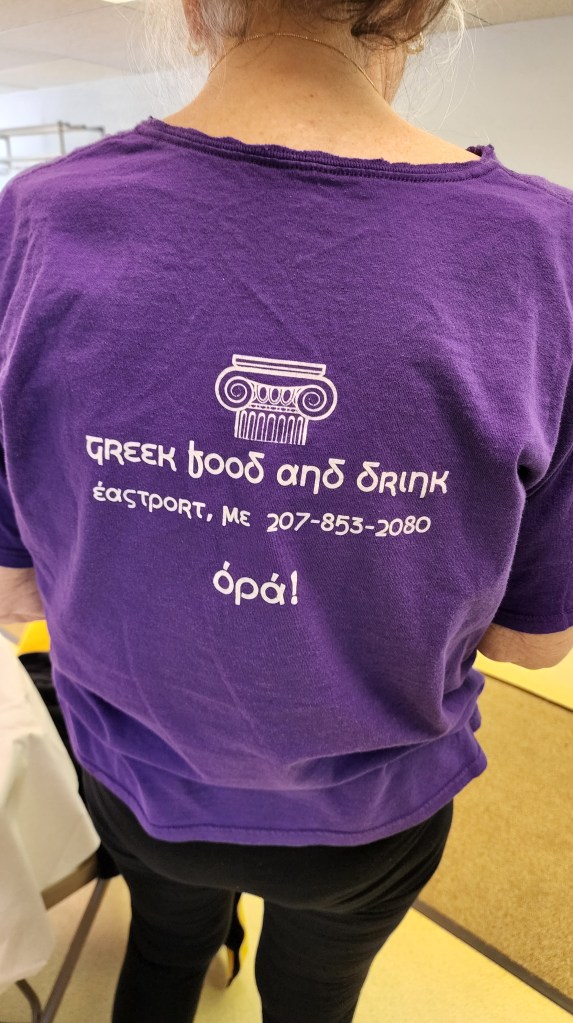
When I saw this tee-shirt, I started drooling

Where, for heaven’s sake, would this place be? We don’t have a lot of options in our remote rim of Maine.

And then I was told the restaurant was a late and lamented site a block from my home, now reincarnated as an echo of the grill and bar next door. Only, perchance, a shade better.

Well, as a reaction, I did have an appropriate Greek slang expression I’d found earlier when researching background for my novel What’s Left, not that I’ll quote it here.

Heavenly perfection

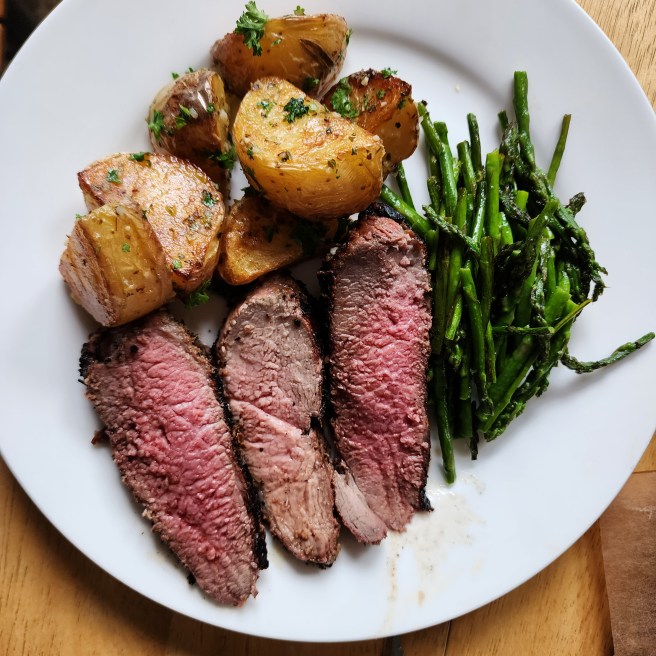
Here’s how our Pascha repast looked last year, when the Eastern Orthodox Easter observance came two weeks earlier than this year’s.

Grilled leg of lamb, medium-rare, roasted Greek potatoes, and fresh asparagus suit me as a perfect follow-up to the Eastern Holy Week observations. Or the marathon, as some justifiably refer to the sequence of services.

The quartered, peeled potatoes were coated with a mixture of olive oil, lemon juice, garlic, oregano, and fresh rosemary and placed on a small baking tray that had been sprayed with oil to make the cleanup easier. When done, the crusty exterior covered a hot creamy interior that melted in the mouth. As my late German mother-in-law would have said, this is better than God living in France.

Let me say I’m looking forward to another round today, fully aware of the glorious experience awaiting those who have observed the nearly seven weeks of strict dietary restrictions they call fasting. Truly.

Opa!

In relocating from Dover, I do miss its annual Labor Day weekend Greek festival – the food, conversations, dancing with live music, and overall happy vibe. What they call kefi.

For Greek Orthodox congregations across North America, these events have become a traditional way of celebrating their culture, welcoming the surrounding community to sample it, reenforcing the bonds of their membership, and conducting some needed fundraising, sometimes for local charities as well as the church itself. The deep commitment of the volunteers and the overall organizational skill always amaze me, and it has been fun to be part of the food-serving line some years.

Earlier in the summer, neighboring Portsmouth usually has its own, similar but also with differences, and both weekends draw big crowds, jammed parking, and partisan comparisons. Dover’s has free admission, unlike Portsmouth, which has more dance addicts.

The festivals closet to Sunrise County are in Portland and Lewiston, downstate five or so hours away. Or, for variety, Halifax, Nova Scotia, which has a four-day schedule but is a six-hour drive away – or seven if you take the shortcut ferry ride across Fundy Bay.

~*~

For the Labor Day weekend, Eastport has a much more low-key observance, the Salmon and Seafood Festival.

Things get wilder the following weekend, then the pirates invade for what’s our blowout to the summer tourist season.

What are you doing special for the holiday weekend?

Farewell to a Greek treat


Best wishes to the owners of Café Nostimo in Portsmouth, New Hampshire, who have just announced that they’re closing their Greek restaurant at the end of today after 16 years in business. Time to retire. We can understand that, especially the part about working nights and weekends.

Theirs had become a must-stop on my return trips to the Seacoast region, and I was looking forward to indulging myself next Wednesday, before my Quaking Dover presentation at the Dover Public Library.

Wish I’d known about the place pre-Covid, when I lived in nearby Dover. I had heard that some nights even had Greek dancing. The restaurant did have a large tent pavilion beside it for summer dining and more.

Lamb shank was top-of-the-line, but their gyro wrap was heavenly. I could argue about some details elsewhere, especially in comparison to a favorite version in Watertown, Massachusetts, but their desserts lineup was unbeatable.

I’m viewing this like a great dinner and the time you look at the empty plate while you’re full of happy memories.

As the translations on their wall proclaim, Yamos! And: Epharisto!

The act of tedious revision can lead to some favorite lines

My novel What’s Left, was in no rush for completion, contrary to my own desires. Still, I wasn’t going to artificially pressure this one.

As for my personal surprises this time? Some of my favorite lines popped up while swimming my daily laps in the city’s indoor pool.

Here’s one of Cassia’s outbursts that almost prompted me to change the name of the novel itself:

Oh, my, am I torn! I’ll tell you this, though. Buddhism comes in very handy when other kids are giving you so much grief you threaten to cast a spell on them and break out chanting Su To Ka Yo Me Bha Wa repeatedly and then just watch them back away. Oh, I tell you, it’s so satisfying!

What’s that do?

You’ll find out. You better be good to toads.

You get lots of respect for doing that.

~*~

Which title Do you think’s better — “What’s Left” or “You Better Be Good to Toads”? Or have I overlooked something even better?

~*~

Think of it as a cool Christmas present for somebody really special. Available at the Apple Store, Barnes & Noble’s Nook, Scribd, Smashwords, Sony’s Kobo, and other fine ebook distributors and at Amazon in both Kindle and paperback.

Within a daughter’s own living Greek drama