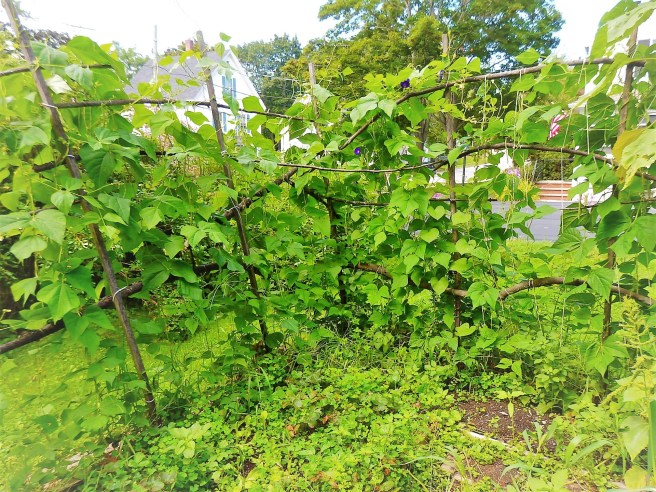
Netting around the blueberries

In previous years, the netting we’ve used to keep birds and squirrels off the blueberries simply sat on top of the bushes. It tangled in the plants, and resourceful critters could still get at some of the berries. Last year we used fallen branches to create this rig, which kept the netting further from the plants. It made harvesting much easier, too – just lift one side as needed. How do you think it looks?

Corral for raspberry bushes

A couple of particularly nasty winter storms brought down a lot of big limbs in our yard. I really do need to get a chain saw to convert them to firewood, but in the meantime, I’ve put them to work in the garden. One place is in the row that lifts the raspberries away from the rest of the yard. Using the limbs here is much more satisfactory than the rope and wire of before – the branches keep the fence poles from pulling toward the center. How do you think it looks?

Busy bees

My wife couldn’t resist getting up close to the entrance to our new beehive and using her cell phone camera to record this. The portal is getting a lot of action during the day as the honeybees are take off in search of food and return. The one with the fat yellow legs is carrying a load of pollen home. The colony itself seems to be thriving. 

Got bees

Blame my elder stepdaughter. Or give her all the credit. She took up the cause last year by setting up two beehives at her house. Her mother and I then witnessed much of the excitement and drama that followed. It was contagious.

Jump ahead to this spring. We were encouraged to get our own hive, starting with the boxes and frames from another couple at Quaker Meeting, and then, drawing on said daughter’s expertise and guidance, we launched into our own “greening” venture. I painted the brooder- and honey- “deeps” or “supers” and the landing board all a light green, and set up a concrete-block base to discourage dampness, ants, mice, and our local skunks from invading. Positioned the entry to catch the morning sun, per said daughter’s instructions. And then she taught us how to attach sheets of what are called foundations to each of the frames that go inside the boxes for the bees to build their honeycombs on. Oh, there is definitely a whole new vocabulary for us to ingest.

The buzz really kicked in when our colony and queen arrived from Georgia earlier this month. We gingerly poured them into the hive, like a big glop, and they do seem to be settling in perfectly. Watching the details is fascinating, from their purging of the drones shortly after the big move and then moving on to the guard bees who expel “robber” bees trying to invade from other colonies while the workers get their bearings, explore, and arrive home with their legs brightly loaded with pollen. Who would have thought there would be so much personality in an apiary? We haven’t even gotten to the queen bee yet,deep within the hive – we hope.

We’re not expecting to collect any honey this year – we’d rather have the hive be well supplied for its first winter – but the benefits to our garden and the surrounding environment give us justification enough.

Yes, we got bees – honeybees!

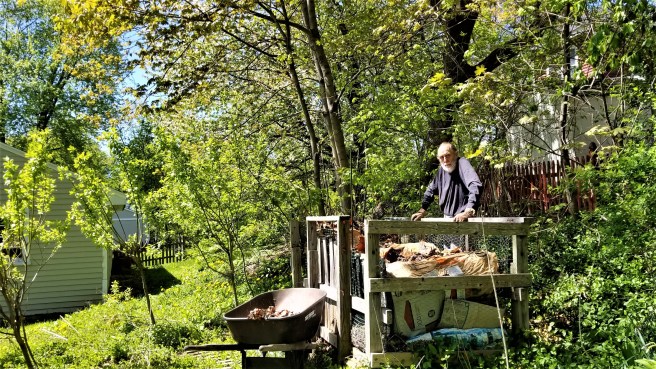
Once the colony’s fully settled in, we’ll add another “brooder deep” to the beehive stack sitting at the edge of our raspberries. The structure off to the right is our compost bin.

OUR GARDEN’S MOST PROLIFIC WEEDS

Even with a field guide, weeds can be hard to name. At least in polite terms. As a gardener, identifying them as weeds is easy enough, once they’re past a certain point of sprouting – they aren’t what you’re expecting and they’re growing faster than what you planted. Staying ahead of them is another matter, especially if you’re trying to be organic like us.

Here are 10 that have been especially problematic this year.

  1. Virginia creeper: Initially, it looks like a nice ground cover in a wooded area. Maybe something to climb a tree trunk, too. But beware, it develops tenacious woody roots that can grow six feet a day – that’s not an official measure, by the way, just a sense I have returning to the same site a day after I thought I’d cleared it. This beast nearly took out one of our big shrubs last year. ‘Nuff said?
  2. Bindweed: Another one that can strangle a neighbor in no time. It looks a lot like a morning glory, which can also go rogue.
  3. Creeping Charlie: This little ground ivy and a shiny-leaf cousin take over in no time. One couple two blocks away covered their entire garden in black plastic this year in what we suspect is a futile effort to eradicate it.
  4. Mystery stalk No. 1: It has large leaves and started popping up like crazy in our strawberry bed. New to us this year. Looks like its seeds come at the base of the leaves. Think it’s also the one in two of our potato pots … kinda resembles the young tater plants. At least it was easy to uproot.
  5. Mystery stalk No. 2: This one has nasty-looking jagged leaves and a big fuzzy stalk. Also new to us this year. Can’t find either of these online.
  6. Wild chervil: Looks kind of like Queen Anne’s lace, which we tolerate, but I just read the down and dirty on this deceptive tan flower. It’s going to be big trouble next year. Ouch!
  7. Multiflora rose: Its vines are always a pain, and they take over in no time. For us, they’re often near the equally stubborn Japanese honeysuckle.
  8. Dandelions: My, what taproots! And if you don’t get all of one up, you’ll soon have another opportunity … to fail.
  9. Common purslane: Another one that gained a foothold this year and will be back with a vengeance next year. My wife says I better learn to like it in salads.
  10. Grass: Many varieties invade the garden and squeeze out what we’re growing, but the Bermuda roots and stems have been particularly nasty this year.

AS A FOOTNOTE AT THE TABLE

I wonder if the longstanding tradition of morning cleansing of marble steps at the front door in many inner city neighborhoods of Baltimore has survived the stresses of two-income families or single-parent households? Who knows when it started or in how many other locales it’s also practiced. This has been a custom of row houses, connected to each other – blue-collar communities, in fact – and not of detached suburban housing. And that makes the foremost difference.

These poems consider what women do and preserve – though not always exclusively. Yes, I’ve known women who bale hay or decipher monastic manuscripts, and I’ll also admit men can know nothing of bearing children or nursing. Yet, somehow, many women seem most at home around the kitchen, even if it’s nothing more than a teacup or a picnic. Even her garden, should she be so inclined, seems to extend from that table or the alchemy of her oven. And that goes for flowers, as well as vegetables and berries. (Remember, though: not all mothers and daughters can stand to be in the same kitchen at the same time, though they both be masterful cooks.)

Looking back on Baltimore, I remember my next-door neighbor, each morning in season watering the black locusts between our houses and the street. Maybe she did her stoop, as well. But the trees, which seemed to have always been there, were beautiful and timeless, as if spreading their own table.

Returning 1

~*~

For the poems, click here.