IN THE FLITTING MOMENT

The delight of watching from our dining room as a hummingbird goes from one bloom to the next in a tithonia beside the window – observing the balanced hovering of what looks like giving each one an injection of a special nectar and then moving on, to repeat the dance figure. And then, it’s gone.

It’s the joy of embracing a rare moment before it’s gone. And then? It’s a lesson in appreciating life itself.

NOT REALLY JUST FOR THE TAKING

The concept of community gardens, where public land is made available to individuals and families to raise produce and flowers, is a noble one. When it works as envisioned, gardeners get to know and respect one another while swapping advice and their harvests, families eat healthier and tastier, and a piece of ground is simply put to good use.

Of course, there are spoilers, as we hear.

One year, for instance, all of the purple cabbage heads kept disappearing from the different families’ sections at one site, at least until a restaurant owner was caught in the act.(The audacity!)

Another year, I think, some of the garlic was raided.

This year, a large blooming tithonia plant was dug up and taken. It’s a big plant!

And more recently, as one man worked his plot, he observed a woman going through the neighboring sections and filling bags. Excuse me, he said, those aren’t yours.

But it’s a community garden, she retorted.

You’re stealing, he said, dialing his cell phone. I’m sure the police are perplexed by this one.

She was well-dressed. Her Audi was full of produce. She’d driven more than 30 miles from her home.

Does she really have no awareness of all the work that goes into ordering seeds, starting them indoors, transplanting, weeding, watering, weeding, watering, weeding, watering, staking some up … oh, well …

I’m waiting for the rest of the story. For now, I just can’t wrap my brain around this one.

OH! WOW!

Gourmet is one of those words I’ve come to detest, in large part because it’s lost any genuine meaning. Well, these days it’s usually an excuse to charge more for an assembly-line product, but that’s about it. As an adjective to suggest quality, it rarely reflects excellence. As for its other definition, as a noun, we have glutton or pig.

So here I am thinking once more of the “wow factor” on our tongue and palate. It’s the surprise that accompanies an amazing first morsel or sip, when our reaction is “Oh! Wow!” in discovering the treasure before us. Often, it’s uttered before we’re fully conscious of doing so.

I know those who take the over-the-top approach here, adding and adding to a dish until it’s simply overwhelming. Or taking a drink to near-lethal alcohol levels for its whammy.

For us, the “wow factor” is more simply direct. It honors the ingredients and makes them shine. It knows there’s no substitute for freshness, and its techniques aim at enhancing that.

If you want to read more of this philosophy, Angelo Pellegrini’s writings, as my wife attests, lay it out delightfully. A generation before Julia Child, he began instructing fellow Americans on the ways of applying homegrown herbs and spices and appreciating the pleasures that follow. His lovely essays are about gardening as much as cooking, along with a few diversions like making your own wine or the joys of being a granddad.

I come back to this each year as our own garden kicks into gear. Forget any argument that gardening is cheaper – it’s not, even before you consider your own labor. It’s the taste that accompanies freshness – sometimes while the strawberry’s still warm from the sun or the lettuce was crisped earlier in the afternoon. Real tomatoes in contrast to the impostors at the grocery are another matter altogether. I’ll go ten months without the latter, if necessary.

We managed an overnight getaway to the Cape recently and decided to try the bakery-bistro combination across the highway. There are good reasons the line’s out the door in the morning. As for the evening, when we decided to stop for drinks and appetizers, we figured we could walk home rather than drive.

As I was saying about Wow? From start to finish. Let me warn you, it wasn’t cheap, not even by today’s average. But it was worth every penny – something I won’t say for any of the chains where I’ve eaten in the past few years. And what they’ve done to the former clam shack in the past six years is amazing – you’d never guess something this charming could come out of something that had been so decrepit.

I’ll try not to go into a restaurant review, but let me say I never imagined corn (fresh, local) could be pureed with (forget the cooking-school terms) the sweat from a baked salmon to produce a cold soup this heavenly. As for the oysters on the half-shell, the presentation was breath-taking – generous in the ice, accompanied by the in-house sauces – but the oysters themselves were fat and succulent, the way they are in November or December, fattened up for winter, rather than this time of year. Responding to that observation when chef/owner Philippe Rispoli stopped by our seats at the bar counter, we heard his pride in working with Richard Blakeley and paying top dollar for the best. I know this was Wellfleet, but I’ve had Maine oysters that have surpassed what I’ve had in other establishments in town – until now. As for their variant on Oysters Rockefeller, we go back to Wow.

We ordered wine by the glass – and our sauvignon blanc was priced reasonably, and the portions were generous. Perfect.

My wife, always a critic when it comes to food, declared her pate to be everything she’d hoped for, even before she got to the accompaniments and salad. The vinaigrette, as she noted, was amazing – whatever measurements he’d worked out, there’d be no changing this recipe.

Curiosity taking priority over any appearance of sophistication, we also ordered a side of pommes frites – or French fries, to most of us. They arrived in a glorious presentation with a red-and-white checkered napkin – and one bite once again went Wow. The chef asked how we liked them, grinned in response, told us he made them himself.

I should explain that we’ve decided fries are often a reliable test of a restaurant’s ability. Are they straight from a supplier’s frozen batch – or made from scratch, like these? Are the outsides hot and crusty and well seasoned, like these? Or limp and flavorless? Are the insides creamy and yummy, like these, or merely whatever?

The test also extends to a restaurant’s attention to its frying oil and batters – fried onion rings are another big litmus test here. Light and fresh? Old and heavy? As we say, “They do cooking oil well.”

OK, if you’re planning a trip to Cape Cod (I first typed that Cape Cook, make of it what you will), I won’t keep the place secret. Just click here.

LESSONS IN PICKING BERRIES

“You’re a gardener?” I’m occasionally asked, only to reply, “Not really. My wife is. I’m the compost master – and I like to eat.”

Well, I also do a lot of the harvest. The planning, vision, and execution, though, are entirely hers. Along with the shoebox of seed packets.

Each summer, though, one lesson keeps coming back to me when it comes time to pick ripe berries. Well, sugar snap peas, too. It’s a reminder of patience and human imperfection. I like to think of myself as observant, but what I keep noticing is that no matter how thoroughly you think you’ve harvested a particular bit – say a square foot or two – once you move over a step, you’ll see you’ve missed some. Often, more than a few. Someone can come along behind you and find you’ve missed almost as many as you collected. Seriously. Don’t be offended, it’s simply a fact of reality. Call it a lesson in humility. And a lesson in the importance of assuming multiple perspectives — something that definitely applies to the revisions of poetry and fiction or the reading of a good text, even Scripture.

Picking blueberries this morning, I sat in a lawn chair much of the time – one knee has been especially painful if I kneel just so. The chair had nothing to do with laziness. Rather, it allowed me to get under the foliage. To lift each branch and see the ripe berries hiding underneath the thickness of leaves. So another lesson has to do with getting a view from ground level, or as close to it as you can. Too often we like to look at life from the top down, not that it doesn’t help. Rather, it’s only one of several approaches — and in harvesting here, you’ll need a handful.

Another lesson, seen most recently in our raspberries, is an admission you can have them all. Some are in places you just can’t reach, especially when they’re surrounded by prickly stalks. So those we’ll share with the wildlife, once the netting’s off. There’s no need to get greedy. Persistent and careful are another matter.

Which brings up a lesson in defense. You have to remain vigilant. No matter how well you think you’ve secured the netting, a few birds or squirrels (especially) will find a way through. Or just sit on top and glean what’s in reach.

That part has me remembering a detail I never included in my Hippie Trails novels. The farm in front of ours had a commercial blueberry operation with some of the bushes not more than a hundred feet or so away from my bedroom window. Once the berries started to ripen, its water cannon would start booming every few minutes. The sound was supposed to frighten the birds away. I can’t remember if the noise continued 24/7 or ceased for the night, but it did take some getting used to. As for the tranquil countryside? Oh, you city folk, you’re in for a rude awakening there. Unlike our little city farm (huh, should that be our little little-city farm?) that’s delightfully quiet on this Saturday morning. Apart from the joyous birds’ singing.

Oh, yes, there’s the lesson of generosity and sharing. I’m tightfisted by nature, so this always needs practice. But eating them with others rather than alone is essentially far more pleasurable. Or taking the bowl you just collected and handing it to a cook who, after a moment of happy admiration, transforms them into fresh scones and tarts before the whole household has stirred?

Don’t overlook the lesson of discomfort, either. If it’s not mosquitoes, it’s blazing sun or a drizzle. It’s rarely perfect. So be tolerant and grateful. Oh, yes, and when it’s perfect? Appreciate the glorious moment. The King of France never had it so good.


THE SCYTHE

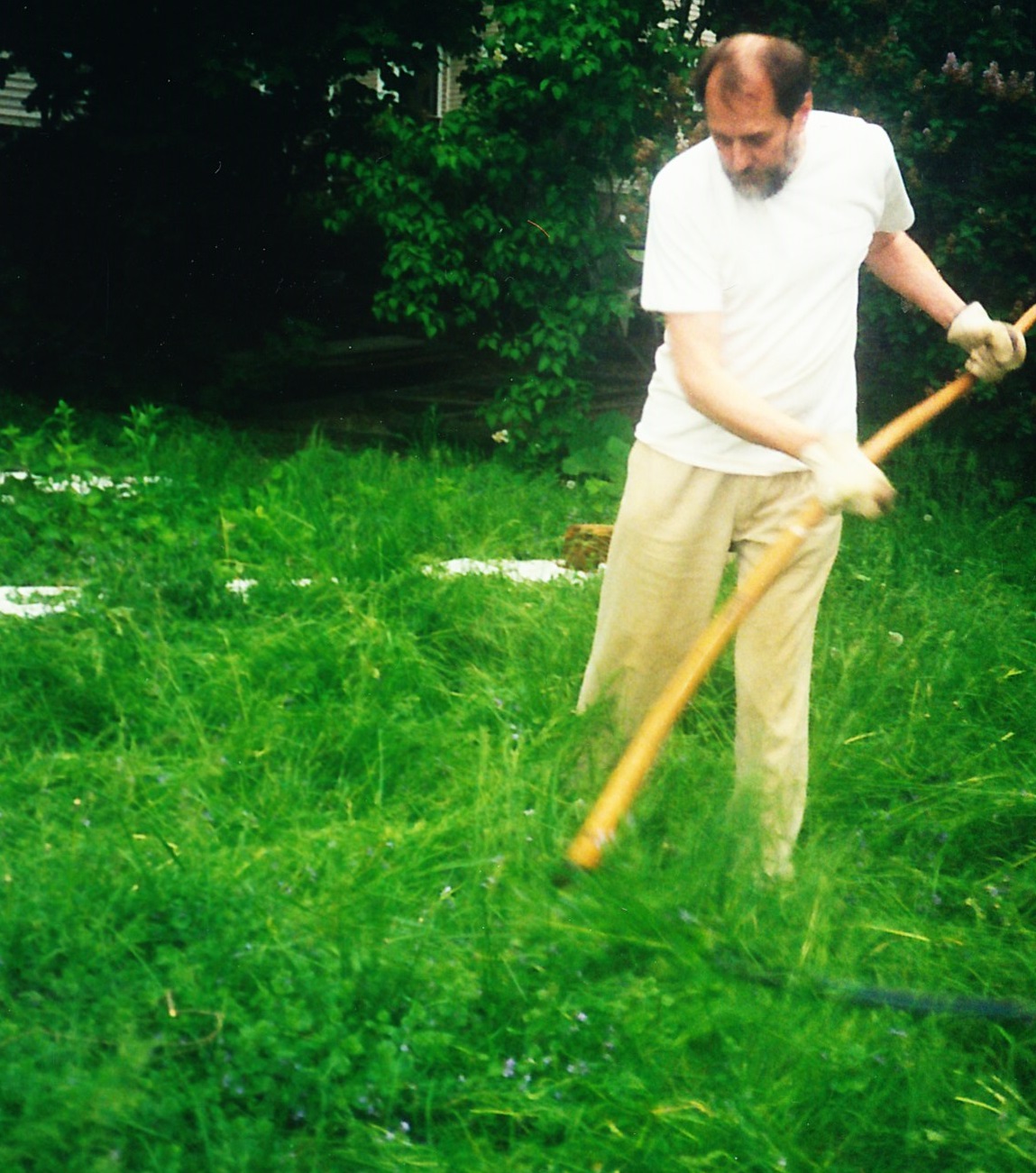
Our first spring in the house, we discovered that our lawnmower wouldn’t work. Maybe we wouldn’t have been able to use in it the Swamp anyway, considering how wet that side yard can be. By the time the mower was back, though, the Swamp had gone wild. Waist-high with growth.

That’s when our elderly neighbor, Ernie, told me he had a scythe, offered to lend it to me, showed me how to cradle it and cut, and just how sharp he’d honed it.

So off I went. He was right, there’s a trick to using it right. But it’s work, all the same. Hard work.

So it’s something I’ve now done once in my life. And, hopefully, never again.

Yes, there’s good reason weed-whackers have taken over.

SCYTHE

 in the meantime, waiting to refurbish
the red cobwebbed mower my wife salvaged
from her first marriage. The plot grows waist-high
and matted until our elderly neighbor extracts
a scythe from his garage and demonstrates its use

after which I vow, “never again!” while admiring
its hungry edge and once commonplace muscular skill

yes, before I get a functioning lawnmower
the swamp erupts in waist-deep weeds

on its far side, elderly Ernie laughs knowingly
before lending my his scythe
and demonstrating its use

“just call me Scythemaster”
my girls are instructed
watching me rock the cradle

oh, then, do I ache deeply …

poem copyright 2015 by Jnana Hodson