Clammed up pun

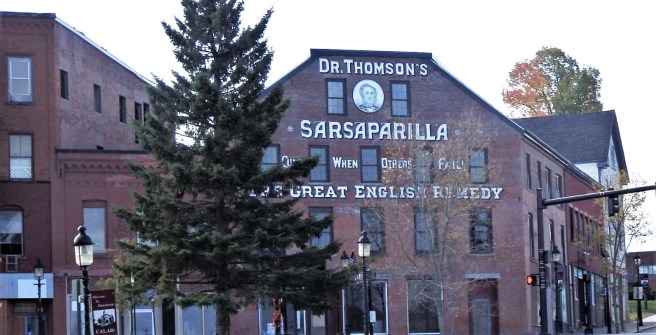
We’ve driven past the site countless times without noticing the motto on the now abandoned motel and restaurant. Oh, shucks.

Here’s the stone dam behind it, its pond long drained, built for the famed iron works in Pembroke in 1832. Here it’s seen from away from the U.S. 1 highway.


Calais, the one just north of us

The biggest municipality in sprawling Washington County is the city of Calais, pronounced CAL-us, like hardened skin, rather than the French Cal-LAY, its namesake port on the English Channel.

Set north of Eastport and having a population of slightly more than 3,000, it’s the retail hub of the county and neighboring Canada and the principal international border crossing for traffic to and from the industrial port city of Saint John, New Brunswick, and other coastal points.

With that in mind, here are a few more facts.

  1. Thanks to the border traffic, much of it as Sunbury tractor-trailer rigs, Calais has all of the permanent traffic lights in the county. Three, make that four, if I’m counting right. Yup, pay attention.
  2. It’s the eastern terminus for the Airline Highway, a section of State Route 9 that connects those trucks to Interstate 95 in Bangor and all points south and west in the U.S.
  3. Calais abuts Saint Stephen in Canada, which has both a candy museum and manufacturer and the best health fitness center in our region. The Saint Croix river separates them before continuing upstream as the international boundary.
  4. Calais has the only new auto dealership in the county, as well as the only Walmart.
  5. It’s home to the community college.
  6. The first European to explore the place was Samuel de Champlain in 1604.
  7. That year he was one of two leaders in settling on an island in the tidal stretch of the river. That effort was abandoned the following spring after a brutal winter in which more than half of the colonists perished. Had the venture succeeded, it’s possible we’d all be speaking French here. Today the site of this first French settlement in New France is commemorated at the Saint Croix international historical park.
  8. While its name honors French assistance to the American Revolution, I should also point out that the original had also sometimes been part of England.
  9. It was first settled by Daniel David Hill of York County, Maine. He was likely a descendant from an old Quaker family affiliated with Dover, New Hampshire.
  10. In summer, it’s often much hotter than Eastport. In winter, it’s typically colder.

Oh, yes, there’s even a tiny movie theater we want to check out.


The interior static continues

Ten more random notes in no particular order:

  1. The “award-winning” writer or actor or whatever is such a cliché anymore I will assume everyone’s won prizes. It’s the ones with money that count.
  2. Jail visitation makes the inmates feel safe, gives them respect.
  3. A surprise way to increase your wealth. Hit square on the calculator! Beats the interest multiplier for sure. Could this be the secret of cryptocurrency?
  4. I see she’s moved back to Allentown from Rhode Island.
  5. Cops at the coffee shop. What an iconic image.
  6. Playing cards were invented during the reign of Tudor king Henry VII (1485-1509) and his wife, Elizabeth of York. Their portraits have appeared eight times on every deck ever since.
  7. New leap for storing leeks through the winter: peat moss! Rather than hay or straw or sand.
  8. Overhead light in the car interior … not just replacing a bulb anymore …
  9. The blue haze in the forests that gives the Great Smoky Moutains their name is actually a fog released by volatile organic compounds in the region’s vegetation.
  10. Marden’s Surplus & Salvage has 14 locations in Maine. As for Remy’s?


Urban deer, oh dear

Eastport – centered on Moose Island – is one of many small cities being overrun by deer. You may have met some of the culprits here at the Red Barn.

Here are some random bits as a result.

  1. In the Wampanoag language, they’re known as “the ones with wet noses,” for the way they investigate the world around them.
  2. Why do fawns have white spots? I suspect it could be a good opportunity for a storyteller to develop. Along with the question of why fawns eventually lose them.
  3. They like apples. Man, do they. Some will dance on their hind legs in reaching for the branch overhead.
  4. They can destroy a garden overnight.
  5. That said, they’ll eat just about anything. One even swallowed a spigot on our bird feeder.
  6. Speaking of which, a bit of cayenne pepper in the feeder seems to repel them. As the adage goes, better late than never, regarding some lessons.
  7. They’ll eat out of your hand if you’re patient. Not that I advise that.
  8. Bucks get bumped out of the circle as they come of age.
  9. The most we’ve counted in our small yard at one time was ten.
  10. We’ve had an albino in the north end of town. I first thought it was a goat in the night.
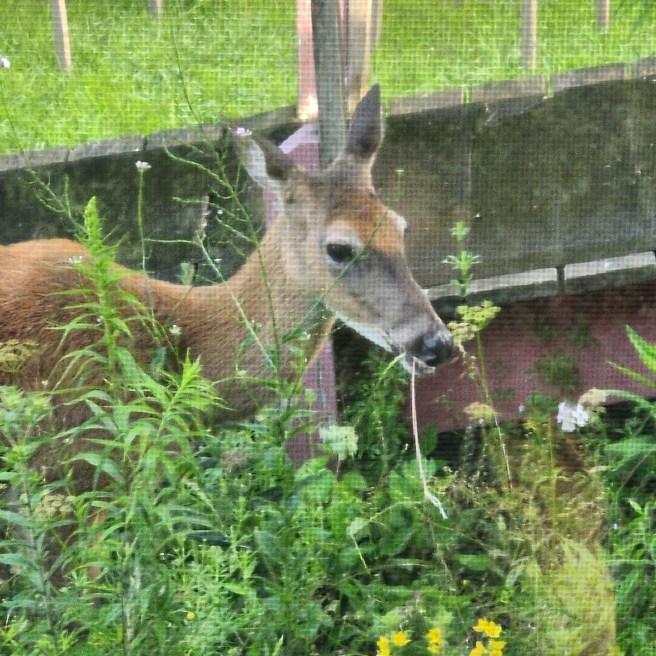
Here’s a shot from our dining table. Or hers, as well.

This is a clue to what really occupies my mind some days

Ten random notes in no particular order:

  1. I’m still learning to spell Katahdin.
  2. Was it a mama moose I hit that cold night on my commute back from the office, rather than a deer? Now that I’m getting to know deer, I think the collision involved something bigger.
  3. Red states? They’re where nobody really wants to live. Or at least the paying jobs.
  4. How dark the house is at night in an electrical power outage! There’s no ambient light from the street lamps or apparatus power-on buttons.
  5. Glyphs = little typographic devices.
  6. I dreamed I was playing violin again. In an orchestra, no less.
  7. How deeply backpacking as a youth shaped my values (forget efficient as a factor). It’s that travel light thing.
  8. After living in New Hampshire, I’m still not used to a sales tax.
  9. English country dance lyric, “If love were an ocean / and water was gin / I’d walk a long plank / and throw myself in.” It’s not from “Robin, Mad Robin,” is it?
  10. A voicemail message for today: “Let me a message or text me. I’ll get back.”


Have you ever been to Acadia National Park?

Maine likes to tout itself as Vacationland, and Acadia National Park is definitely a star attraction. I know people who gush that it’s their favorite place ever. Not that I’d go that far.

Still, let’s consider:

  1. With four million visitors a year, it’s among the 10 most popular national parks. Most of them crowd in during the prime summer months.
  2. The official version has the park being named after Arcadia, a region of Greece that it supposedly resembles. New France, however, referred to eastern Maine as Acadia before being expelled by the English in 1763. In their migration, some of those Acadians became known as Cajuns down in Louisiana. I’m siding with the French here, despite my fondness for Greek culture.
  3. It was the first national park established east of the Mississippi and encompasses 47,000 acres, mostly on Mount Desert Island. Not that there’s any desert, it’s just wild. Additional, less well-known tracts are on Schoodic Peninsula (my favorite) and Isle au Haut as well as smaller islands. And a fourth of the land total is privately owned but under easements and similar arrangements.
  4. With 108 square miles, Mount Desert Island is the biggest island in Maine and the sixth largest in the contiguous United States.
  5. The park has 158 miles of maintained hiking trails spanning mountainous terrain, panoramic views, rocky Atlantic shoreline, mixed forests, and lakes. Former carriage roads are also popular with bicyclists.
  6. There’s a private trolley service for those who’d prefer to view the scenery more than the traffic jam.
  7. Backcountry camping and overnight parking are not permitted, but there are campgrounds and lean-tos for those who plan well ahead.
  8. French explorer Samuel de Champlain gets the creds as the first European. He encountered the place in September 1604 when his boat ran aground on a rock. He applied the name Isles des Monts Deserts, or island of barren mountains, to the bigger scene. Well, some are pure rockface.
  9. In the 1880s, the island became a summer retreat for Rockefellers, Morgans, Fords, Vanderbilts, Carnegies, and Astors who built elaborate vacation dwellings they called “cottages.” Many of those were destroyed by a vast wildfire in October 1947.
  10. Its principal gateway is Bar Harbor, a city of 5,000 full-time residents that swells with summer people and their second homes, tourists, and often a big cruise ship or two that add several thousand more people to the crowd. Be warned that parking is at a premium in high summer.

For more adventurous souls, let me suggest exploring two hours to the east, to the Bold Coast, for a less spoiled alternative.

There’s more to the legacy of New Hampshire’s Hiltons

While Edward Hilton is hailed as the father of New Hampshire and was early on joined by his older brother William, both drifted away from my history Quaking Dover. Still, some points of interest remain.

Among them:

  1. His son, Edward Hilton Junior, married Anne Dudley, daughter of Puritan minister Samuel Dudley, allying his line with a prominent early New England family in Exeter. I sense there’s much more to this union that is presented.
  2. Edward’s grandson, Colonel Winthrop Hilton, was slain by Natives in 1710 while harvesting mast trees in Epping. He had succeeded Richard Waldron as head of the New Hampshire militia. His other grandfather was Massachusetts governor John Winthrop. So much for high connections.
  3. Winthrop Hilton’s brother Dudley was carried off in the attack and never heard from again.
  4. Edward’s nephew Captain William Hilton mapped an island in South Carolina in 1663, naming the location Hilton Head Island. He also mapped Cape Fear that year. He sailed out of Charlestown on Boston Harbor but acknowledged finishing the maps in the home of Nicholas Shapley in Maine – that is Shapleigh, a major figure in my book. Just look at Billy’s uncle’s second wife.
  5. That is, the elder Edward’s second wife, the widow Katherine Shapleigh Treworgy, who had a daughter marry into the equally prominent Gilman family.
  6. Into the late 1900s, one line continued to live on the farm settled in Newmarket around 1630. In fact, they claimed it was the oldest homestead in the state.
  7. Descendant Daniel Hilton, born in 1794, removed from Newmarket to Meredith, where he had 18 children and left an estate of 80,000 acres by the time of his death in 1867. His ancestry also included Thomas Wiggin, who had brought many of the first wave to settle in Dover after the Hiltons.
  8. Daniel’s son Charles became chief engineer of the New York Central railway, in charge of the building of bridges over the Hudson River and a viaduct in Albany in addition to Grand Central Station and grain elevators in New York City. So much for humble Granite State beginnings. He was also a high-ranking Free Mason.
  9. The Hilton family burial ground along State Route 108 in Newfields, just across the town line from Newmarket, rather thickens the plot.
  10. There’s no connection to Conrad Hilton and his hotel chain.


And now for Lubec

I’ve been posting a lot about Eastport and nearby scenes but said little to date about the neighboring communities here in Way Downeast Maine.

So today I’ll turn the spotlight to a town to our south, one we easily see from the Breakwater and other points in Eastport. It also sits across the water to our west. Despite the proximity, driving between the two takes nearly an hour.

Lubec as seen from Campobello Island, New Brunswick.

~*~

Here are a few additional facts.

  1. It’s pronounced “LOO-beck,” named for Lubeck, Germany.
  2. It has roughly the same (small) population as Eastport but is organized as a town rather than a city. That’s why it can claim to be the easternmost point in the continental U.S., while E’port struts about being the easternmost city. It’s a hairline difference.
  3. Lubec’s also the closest location in the continental U.S to Africa. Yes, way up here nearly on the 45th parallel, halfway to the North Pole, rather than say Virginia or tropical Florida.
  4. Set on a peninsula, the town has more water than land.
  5. With its Quoddy Head State Park and the iconic peppermint-pole lighthouse, Lubec can be seen as the gateway to the Bold Coast trailheads that provide access to spectacular shoreline and bluffs. It’s like Acadia National Park without the crowds.
  6. It also has a “sparkplug” lighthouse in the water south of downtown and faces the Mulholland lighthouse on the Canadian side of Quoddy Narrows.
  7. Speaking of Canada. Neighboring Campobello Island, New Brunswick, is home to the Franklin Roosevelt International Park, originally the family’s summer “cottage” and compound and then Eleanor’s favorite home. Today the historic site covers five square miles that include trails of shoreline and forest. To get there, you have to drive through Lubec.
  8. SummerKeys is a kind of music camp for adults, mixing skill levels from beginning amateur to skilled professionals into a lively and supportive environment. Free weekly concerts in the Congregational church are a highlight for the rest of us.
  9. While statics are unavailable, one friend tells of a summer when every day in Lubec was beset by heavy fog. She’s made it sound unbroken. I have been in town on several afternoons when the place was quickly socked in the dense gray invasion, and from Eastport I’ve often seen its thick steely blanket roll over the downtown at the fringe of our view before inching up the water toward us. Another friend tells of the common frequency of heavy winds. Either way sounds harsher than what I’ve encountered in nearby Eastport.
  10. The town no longer has a high school. When it did, athletic events between Lubec and Eastport were often followed by fights.


Among the reasons for Quaker decline, let me suggest

Relocation to the West, especially, wasn’t the only reason Dover Friends Meeting in New Hampshire declined in the 1800s. Here are a few other factors.

  1. Being Quaker can be hard work. Not just a Sunday thing. Things like honesty.
  2. Tightening of personal discipline in the mid-1700s. The marriage restrictions definitely cut into membership.
  3. Plainness in clothing, design, and possessions. That is, personal expression.
  4. Employment and other business ethics. Refusal to take oaths kept Friends out of some professions, such as the law, and bankruptcy was a disownable offense.
  5. No “vain entertainments.” And thus, no music, dancing, fiction, theater, paintings, card playing, horse racing, or gambling.
  6. Pacifism during the Revolutionary and Civil wars, plus withdrawal from political offices in the 1760s.
  7. The separations that split the Society of Friends into factions from the 1820s on.
  8. Aversion to emotion, starting with anger.
  9. Emerging restrictions on alcohol and tobacco. Being “disguised by hard liquor” was a big problem on the frontier.
  10. Even the appearance of wrongdoing could be an offense. And all that led to deadly quaintness.

Not that these quite apply today. Still, they could prompt a book in themselves. For now, you’ll have to consider Quaking Dover for the story. Order your copy at your favorite bookstore. Or request it at your public library.