- Sitting beside our newly installed wood-burning stove on otherwise chilly mornings and evenings.
- Completing the second phase of our upstairs renovations along with moving into the back half up there, including my book collection when it comes out of storage.
- My second week on the water in the schooner Louis R. French.
- Revisiting my journals from the Baltimore years on.
- A magazine orgy.
- Renewed time with the Bible.
- Using my passport. We do live right next to Canada, after all.
- Events at the arts center.
- Continuing Quaker worship face-to-face rather than Zoom.
- Scallops in season as well as local blueberries, cranberries, lobsters, and crab.
Tag: Funny
A few things I’m grateful for in the past year
- A second presence in the house year-‘round. Plus our guests.
- Seeing the home renovations finally under way. And how.
- My maiden voyage in a ship overnight. As you’ll be seeing.
- A steady supply of real tomatoes, once they started arriving at the beginning of September, thanks to a serious, raised-bed garden already featured here at the Red Barn.
- Our new choral director. We may be a small community, but there’s some deep talent.
- The resurrected film society. The showings are followed by some serious discussion into the wee hours.
- Contradances, too, both here in Eastport and at the Common Ground Fair.
- My appearances resulting from Quaking Dover. You can still find some of them online.
- Scallops in season. (And local blueberries, cranberries, lobsters, and crab.)
- All the eagles I observed during the alewives’ run and additional encounters after. Always inspiring.
Well, maybe this should go somewhere
Still more random notes in no particular order:
- Why so many churches? Only an unbeliever would ask.
- Note the hippie vibe of Pride Day. Like a time warp.
- The jolt of phoning someone and preparing to respond to the voicemail only to have a live voice pop up instead.
- Keys that don’t fit anywhere.
- It’s a Catholic church too small to conduct bingo games.
- I’m spending as much time keyboarding as ever.
- All those years I worked five-day weeks every holiday ‘cept maybe Christmas Eve. Or commuted in atrocious weather.
- What is literature? And why does it matter?
- She strikes me as little more than skin-deep beauty.
- What do you like about Christmas?
A shoutout some outstanding vocal ensembles
With the holidays just ahead, we’re coming up on the prime choral season of the year.
Look around, and there are many outstanding groups, not just the big, famed organizations in the footsteps of conductors Robert Shaw, Roger Wagner, Margaret Hillis, or John Oliver, either.
Hit on some of these on YouTube or Vimeo and let me hear what you think.
- Old Order Mennonite Harmonia Sacra. Let’s start from an old American shape-note tradition of harmony. Singing from the 1832 hymnal compiled by Joseph Funk in the Shenandoah Valley of Virginia, this video will likely lead you to others in this unique stream, including the Shenandoah Christian Music Camp. I’m inclined to sing along, using some much later Mennonite hymnals. Imagine an entire congregation singing parts like this, and many do. Eventually, it may even lead you to the unique Sacred Harp style. If you want to talk about American roots, don’t overlook this. I’m forever indebted to my exposure in this vein. So where do we turn from here? How about something completely different in the religious vein:
- Detroit Mass Choir. This large, tightly disciplined urban body runs flawlessly, turning on a dime when director Jimmy Dowell spontaneously decides to repeat a phrase or section or even jump back several parts or similarly ahead. Their take on Charles Tindley’s 1905 “The storm is passing over” is outstanding. Yeah, it’s one more place where stony unemotional me gets teary. That confessed, don’t overlook the instrumentalists, either. And I, for one, do appreciate the audience support throughout, something my mother would have considered interruptive and rude.
- Jehovah Shalom Acapella. And you thought the King’s Singers or Cambridge Singers epitomized the small, elite, all-male a cappella field? This six-member Ugandan Gospel group, members of the Seventh-day Adventist faith, delivers with an unbelievably smooth pop style. Where, by the way, do they find such an incredibly deep bass? Now, if we only knew how they’d handle Handel, Bach, and Mozart as well, we might have even more cause for amazement. By the way, we’ve also delighted in live performances by athletic Ladysmith Black Mambazo.
- Central Washington University chamber choir. Within a higher education state institution in tiny Ellensburg, well east of the Cascade Range and Seattle, there’s long been an outstanding fine arts program. In such situations, a few good teachers can make a lasting impression. (I hate to think of the destructive obverse.) Under the direction of Gary Weidenaar in works by contemporary Ola Gjeilo or Renaissance master Tomas Luis da Victoria , these student singers reflect, I feel, the high standards found in many other pockets across America – and not just its great conservatories and leading music schools. Returning to the shape-note tradition:
- Amherst Madrigals. In William Billings’ “Euroclydon,” a distinctive masterpiece, these ten singers blow me away. It’s a very demanding piece, after “all. And they present it so clearly, with no conductor in sight! For further confirmation, listen to what they do his “I am come into my garden.” Or, for pure polyphony, move onto another group for this:
- Indiana University’s Conductor’s Chorus. Their master’s of music performance of Palestrina’s “Sicut cervus” for conductor Daam Beam Kim in 2016 is unbeatable. After seemingly endless rehearsals and a few public performances of this choral masterpiece, I can’t imagine anything more ethereally sublime than this. Period. Even as an IU grad.
- Saint Olaf College Choir. This Minnesota Lutheran institution makes some incredible music. The diction in their videos and recordings leaves me envious, and their annual Christmas broadcast is understandably anticipated and admired. Still, compare their rendering of William Billings’ “What wondrous love is this” to one led by Ukrainian conductor Yuriy Kravets and the Shenandoah Christian Music Camp orchestra and choir, previously noted. Both are deeply moving.
- Luther College. Set along the upper Mississippi River in Decorah, Iowa, this church institution also has a superb musical program. Just listen to what its Nordic Choir can do. I’m even more impressed when I notice they sing their parts from memory and then their ease in navigating dynamics. Oh, my, that soon leads to a Baton Rouge high school performance that definitely stands out. Yes, high school.
- Quoddy Voices. My current chorus is an amazing group in a small remote fishing village with an active arts scene in easternmost Maine. Still, we would really welcome some younger voices. During the Covid restrictions, director John Newell put together some remarkable virtual presentations online, despite the fact we were recording individually under some highly unfavorable conditions. Now that we’re back face-to-face, I’m also delighted and humbled to be part of this circle and its stellar leadership.
- Boston Revels. A unique half-century-old organization that blends history, folk traditions and classical music, dance, plus theatrical acting and story line, I have to admit a bias in being part of the organization though not its justly celebrated annual winter holidays extravaganza. Each year’s Christmas show ends with the entire audience joining in, in full harmony, on the Sussex Mummers’ Carol, inevitably drawing tears from me and, I suspect, most others in the packed and wildly cheering Sanders Theater at Harvard. As a charter member of its community chorus, I do confess this family custom is one thing I do miss in relocating to Way Downeast Maine. Thanks for the memories, all the same.
You seldom know what you’ll find in an old barn

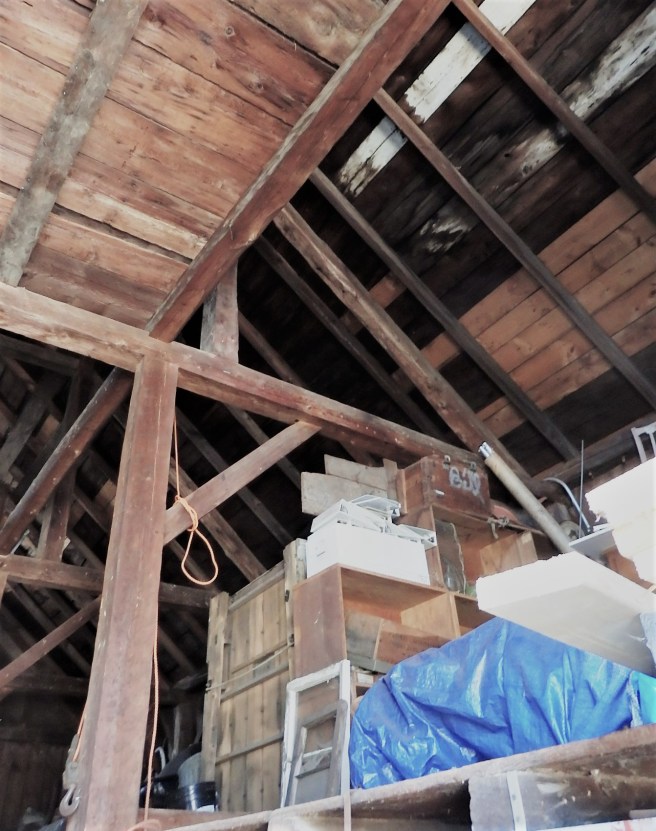
Well, it is the premise of this blog. For the record, a lot of our junk was stored under this floor, though this barn in York, Maine, was never ours.
Doodling around with the origins of ‘Yankee’
The label does have a range of applications, from residents of the six-state New England region or Connecticut in particular to a Manhattan professional baseball team to anyone north of Dixie (often prefaced with “damn”) to anyone from the USA who lands in a foreign country.
Along with the shortened “Yank.” Or its many uses as an adjective.
The word’s origins, though, are contested.
- The earliest recorded use is credited to British General James Wolfe in 1758 when he complained about the Americans under his command. The British continued to use it in a derogatory fashion. The pompous fools.
- A largely dismissed theory had it arising in a French word for English-speaker that the Wyandot rendered into Y’an-gee.
- Another had it being adopted when New Englanders defeated a Native tribe who had identified themselves as Yankoos – meaning invincible. Problem there is the tribe must have been invisible all along.
- More likely is a derogatory Dutch-language origin in the early 1600s through New Amsterdam, beginning with the name Jan, for John, pronounced Yan. One theory has Jan being applied to any Dutch-speaking English colonist, a kind of winking acknowledgement that they could converse. How about having it originate among those Dutch-speaking Englishmen? I haven’t seen that suggestion before.
- Or it may have been imported from the Old World as Jan Kaas, “John Cheese,” a generic nickname the Flemish had for Dutch in the north.
- Or Jan might have been combined with another popular Dutch name, Kees, into Yankee, as English-speakers turned it against the New Netherlanders.
- And then those New Netherlanders soon slapped the word on English colonists in nearby Connecticut.
- By 1681 there may have even been a Dutch pirate, Captain Yanky or Yanke. The Dutch settlers, now subsumed into the English colony of New York, may have seen the Brits as pirates. Sounds awfully late in the timeline for me. I think it was definitely widespread slang before that.
- By the time of the Revolutionary War, the song “Yankee Doodle” was well established. Whatever its original intentions of mocking the Americans as simpletons, New Englanders took it as a badge of honor, macaroni and all.
- Somehow, after the Revolution, it became a synonym for Protestants descended from New England Puritans and their values. Take “Yankee ingenuity” as a prime example.
None of these quite convince me, but I feel Scottish, Swedish, and even Persian roots are even less likely.
Pumpkins are no longer just a Halloween and Thanksgiving thing
At least in New England, pumpkins have become a ubiquitous autumn flavoring, from bread and doughnuts to muffins and classic cheesecakes and pies. I still balk at beer.

Here are some more facts to chew on:
- They’re actually fruits, though I’m glad they don’t grow on trees. And, yes, they’re technically also vegetables, something they share in common with watermelons.
- Each pumpkin contains about 500 seeds. For the record, many birds love those. Roasted, for humans, they’re low in calories and rich in iron.
- Some varieties can grow 50 pounds a day.
- Every part of a pumpkin is edible, including the blossoms – well, they share that with other squashes.
- As pie, pumpkin is America’s favorite Thanksgiving dessert.
- For the record, small sugar squashes are superior in taste to pumpkins for making those pies or also soups.
- The orange color comes from the same chemical that gives carrots and sweet potatoes their distinctive look. It’s good for Vitamin A, which in turn aids eye and skin health and supports your immune system.
- The first Jack o’ Lanterns weren’t carved from pumpkins but rather turnips. The practice arises in an Irish tradition regarding someone who tried to get the Devil to cover his bar tab and failed. Irish emigrants to America found the pumpkin superior to a turnip for those carvings.
- Illinois produces more than twice as many pumpkins as its nearest rival in the USA.
- The heaviest pumpkin grown in America was by Steve Geddes of New Hampshire in 2018 – a 2,528-pound monster.
Now for Machias
The governmental seat for sprawling Washington County is the town of Machias, or “bad little falls” in the river where it meets an arm of the Atlantic. Well, others have suggested the Passamaquoddy term would be more accurately rendered as “nasty” or something I suspect is much worse. From what I’ve seen, going over the cataract at the tidal line in a canoe or any other kind of boat would have been fatal. Not that I want to tempt anyone to prove me wrong, like those who have actually gone over Niagara Falls in a barrel.
That said, let’s look at some more facts about the town and its neighboring East Machias, Machiasport, and related neighborhoods.

~*~
- It’s pronounced “maaah-chEYE-us,” the central syllable running along the lines of a hardened SHY.
- Washington Academy in East Machias is not only among the oldest boarding schools in the country, but thanks to publicly-funded tuition students from neighboring towns, it’s also the largest high school in the county. It does attract an elite from abroad. Go Raiders.
- The state university branch campus is often ridiculed but definitely working toward an upgrade.
- An initial English attempt at settlement in 1633 was rebuffed by a French attack, creating a gap of more than 120 years.
- Machias is the birthplace of the U.S. Navy, and its inaugural victory was won, in part, with pitchforks. I’m not kidding. Look it up. I’ll even suggest it as a plot for a comic opera. Notably, Passamaquoddy Natives were instrumental on the colonists’ side.
- It briefly flourished as a lumber exporting center in the late 1800s.
- ATV riders will find a great entry to the Downeast Sunrise Trail here. The path follows an old railroad line.
- The flea market atop the causeway on U.S. 1 can be delightful, especially Earle’s fresh seafood truck toward weekends. I do have to wonder how the reconstruction of that crossing will affect tradition.
- Its emergency room and hospital are often favored over those in Calais. I won’t get into the details.
- We do love the general store and natural foods emporium. As for the tiny movie theater? Still on our to-do list. Best wishes.
Looking for direction?

Could be political, too, or even aspirational.
There are things about aging I really don’t like
Oh, my, facing this can be painful.
- My mountain climbing days are past.
- I’m not as flexible as I was, and my sense of balance is unreliable. It’s even led to feeling queasy on heights, a realm I once fearlessly loved. And a fall late at night can be terrifying.
- Along with spidery thin hair.
- As for the bladder?
- Slower mental recall, along with hearing.
- Declining mojo.
- Can’t get warm in winter. Or autumn. Or early spring. I’ve always been cold-blooded, but geez Louise!
- Being addressed as “Sir” by polite female teens. I am, after all, emotionally still 17.
- The shrinking horizon of life goals and dreams. Like is that best-seller ever going to happen, really?
- All the damned pills in the morning.
Gee, and we haven’t even gotten to an inability to understand pop “culture” or the appearance of varicose veins.
 Jnana's Red Barn