Full sail!

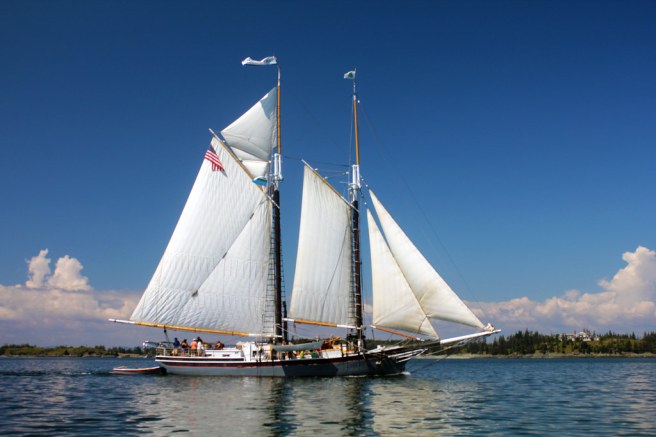
The evolution of the surviving coasting schooners from freight to a summer vacation platform where people could get a taste of what had previously been available only aboard the yachts of the rich is largely credited to Captain Frank Swift and his efforts from 1936 to create what he saw as a kind of dude ranch escape on the waters of Penobscot Bay.

In time, other owners joined in.

Notably, in 1973 Captain John Foss purchased the Louis R. French and removed her from the freight trade. He spent three years restoring the vessel to her original sailing condition and outfitting her hold for passengers. Oh, my, did he!

In 1986, he sold the schooner to his brother-in-law, who sailed and captained the French out of Rockland and then Camden until she was purchased from by Captain Garth Wells in 2003, who in turn sold to Captain Becky Wright and Nathan Sigouin. Maybe “passed her on” would be a more apt description.

Meanwhile, the already legendary Foss turned his attention to renovating the American Eagle, which he purchased in 1984. It’s now one of the few schooners that undertake longer voyages to places like Grand Manan Island near me or down to Gloucester on Cape Ann, Massachusetts, in addition to venturing offshore looking for whales.

At first, those names meant little to me. Now, however, I understand why they’re often uttered in reverential tones.
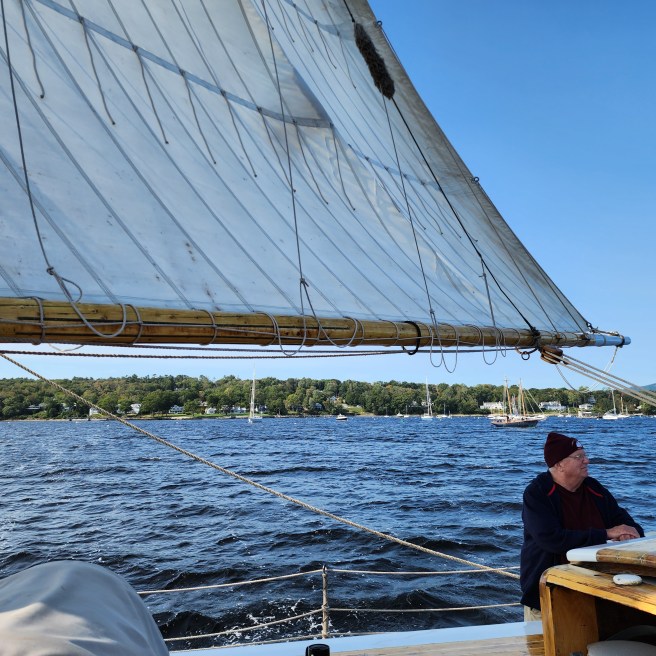
first, flapping fabric as wind kicks in
then a surge at my seat and flooring
like riding a stallion
muscular under the saddle
They weren’t always considered romantic

The 1990 application to include the restored and repurposed Louis R. French in the National Register of Historic Places includes much more than a detailed physical description of the schooner and her history.

The National Park Service document, Louis R. French (Schooner), available online  portrays the two-masted coasting schooner as the most common American vessel type, with tens of thousands of them functioning as the “freight trucks” of their time, carrying coal, bricks, iron ore, grain, oysters, lumber, and even ice between ports.

Yet, at the time of the application, only five of them were surviving in the United States.

In addition, the French was the oldest surviving sailing vessel built in Maine, the center for wooden shipbuilding in the United States after the Civil War.

As the application noted, until the outbreak of World War II, the coasting schooners were so common that nobody paid much attention to them. Designed to run fairly close to shore, the coaster lacked the fishing schooner’s ability to ride out a gale offshore on the fishing grounds. Nor did the coaster approach the scale of the great four-, five-, or six-masted coal schooners that transported coal from southern to northern ports.

Deepwater sailors, who occasionally took a large schooner across the Atlantic, scorned the useful and ubiquitous little coasters, sometimes accusing their skippers of “setting their course by the bark of a dog.”

The application quoted maritime historian Howard I. Chapelle, who observed “the straight fore-and-aft-rigged schooner is decidedly a coastwise vessel, and attempts to use such craft for long voyages have invariably been disappointing and disillusioning, if not disastrous to the adventurers.”

The schooner supplanted the square-riggers in the coasting trade for practical reasons:

Fewer sailors were required to handle the vessel, and a schooner could be worked into and out of harbors and rivers more easily than any square-rigged craft. Her trips could also, as a rule, be made in quicker time, as she could sail closer into the wind, and it was hardly necessary for her to sail from Maine to New York by way of the Bermudas, as some square-rigged vessels have done during baffling winds.

Put another way, they were the errand boys, the short-haul freight droghers, and the passenger buses for many a year, and their contribution to coastal community life, especially in New England, was substantial.

“Without them, the country could hardly have been settled,” as the report quotes one source.

These days, there’s nothing Plain Jane about them, though. Not in my boat – err, book.

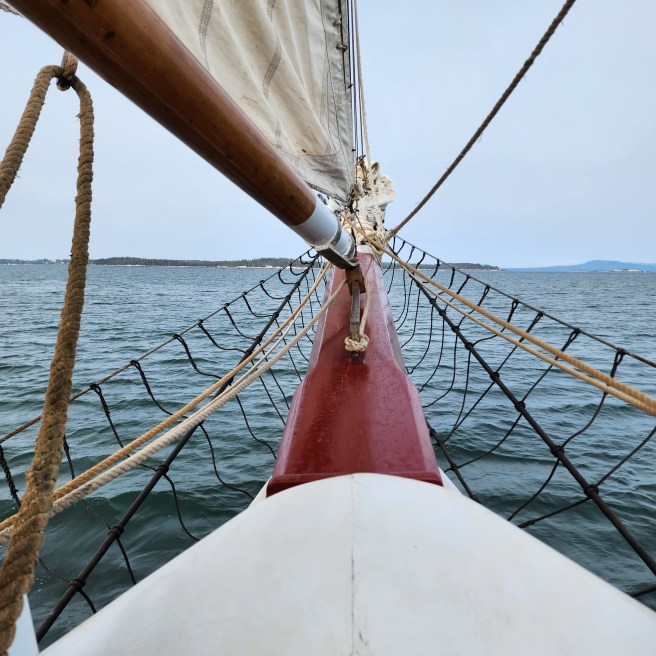
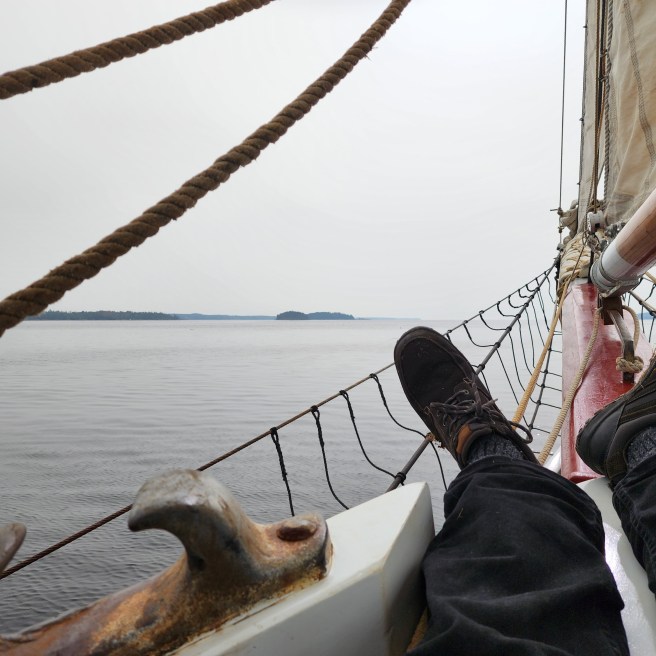
From the bow seat

Finally warm enough to take my cap off
and we’re getting some wind

yes, it’s all atmosphere

haze-infused grays with tinges of green forests
and bluish mountains

pulley block rasping behind me

the advantages of a cloudy day
without sunscreen
for a bald guy

sitting motionless
apart from a slight roll
in a nearly dead wind

how calming

am still surprised the tiny yawl can push this big boat

a porpoise here, a porpoise there
a bald eagle flies past

the chains to even the tension
on the bowsprit with jibs

Fine carpentry, too

Jesus was a carpenter, after all, surrounded by fishermen and their boats. Maybe he built a few to float, too.

the curve of the deck – sheer
ours noticeably higher at the bow
than even the stern

while the crown with its sides
for water runoff

a dutchman
a piece of wood
cut in
to replace a rotten section

ditto in our home

The Angelique, too

if not a schooner
a ketch

Technically, a ketch rather than a schooner.
the Angelique a beautiful ketch

at anchor nearby
rust-colored sails
quite distinctive

yes, ketch that

everyone else went ashore in the yawl
to the boat school etc.

Brooklin

just me and the crew left aboard

someone in a white sweatshirt

jumping rope on the dock
the sound of the slapping rope
across the water
caught my attention

finally wearing my new hoodie
with its kangaroo pocket

learned that phrase yesterday

Joe bought the E.B. White democracy book while ashore
after hearing us discuss the author
(the son became a famed boat builder)

boat school temp tattoos stamped
on other passengers, crew

we’re leaving the Angelique at anchor