Our annual salmon festival has me thinking of sardines

The American Can Company factory, now a hulk out over the water, had a daily output of more than a half-million cans for sardines. It employed 300 people. It was at the end of the line for the railroad, too.

In the adjacent canneries, sardine-packing women had hands moving so fast in cold water you saw only a blur, according to a friend who was a teen at the time and couldn’t begin to keep pace when he worked there.

I still have no desire to eat a sardine, though. Consider that the statement is coming from someone who’s learned to appreciate anchovies in his old age.

The Salmon Festival always takes place over the Labor Day weekend. 

As I said in a recent letter to the editor …  

One of the more baffling things I’m finding in living here is the reluctance of folks in one town to participate in something in a neighboring town, as if they were worlds away.

It’s not just a matter of coming in to the Eastport Arts Center, either, or watching a movie in a little theater in Calais.

Pembroke’s renovated library has been hosting a series of free chantey sings by maritime historian Stephen Sanfilippo, and those would welcome (and do deserve) more participants. His well-researched programs usually include much than work songs, despite the title. A recent one that dug into clams and oysters would be a fine eye-opening example.

The most recent event included an illustrated talk by Susan Sanfilippo, drawing on the town’s historical society’s archives. She discussed ships built along the local tidal banks and then showed images of the resulting vessels as they sat in faraway places like Cuba, China, San Francisco, or Hawaii.

Stephen then used the varied destinations of the Pembroke ships as the basis for songs we all joined in singing later, often including nonsense verses while we looked at slides of the vessels. A calypso, anyone?

I should say it was all delightful and enlightening.

Besides, it was a sampling of what happened all along our Quoddy coast. I could image launchings from Shackford Cove in Eastport that then made similar extraordinary voyages.

Who says there’s nothing to do around here? Please look again and expand your horizon.
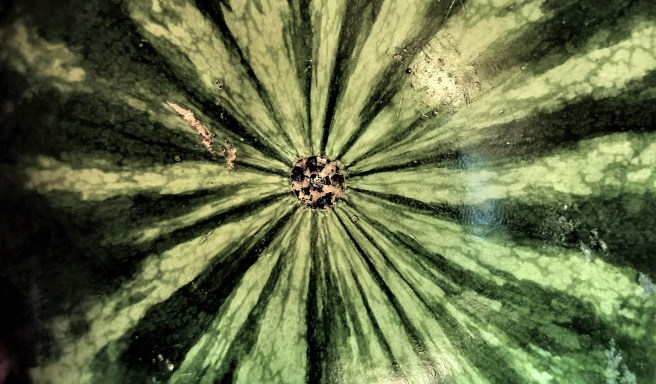
Does anything celebrate summer more than a watermelon?

And here I was about to investigate all kinds of melons, starting with cantaloupe.

That said, just consider:

  1. A watermelon is one of the few foods to be classified as both a fruit and a vegetable. Wish I could count it twice on my daily dietary requirements but guess that would be cheating.
  2. It’s a relative of both pumpkins and cucumbers.
  3. It’s far and away the most popular melon in America.
  4. There are more than 1,200 varieties, but the seedless hybrids are the only ones you’ll likely find nowadays at the market, at least in the USA.
  5. Those seedless versions aren’t genetically modified. Technically, they’re simply sterile with white seeds that are perfectly safe to eat.
  6. Watermelons originate in Africa and have been cultivated in Egypt for 5,000 years. That’s why they really do need a long stretch of summer.
  7. Based on weight, watermelon is the most consumed fruit in America.
  8. It’s 92 percent water yet rich in vitamins and contains only six percent sugar. By the way, there’s no bad fat or cholesterol.
  9. Its flesh isn’t always red – orange, green, yellow, or white are other options.
  10. In Japan they’re grown in glass boxes to maintain the unnatural cubed shape.


Oh, those clean starched white dress uniforms

The 350 U.S. Navy sailors who descended on Eastport for our extended Independence Day festivities were the first to uphold the longstanding tradition since before the Covid pandemic.

They were a welcome contingent in our small community, often appearing in their pristinely ironed white uniforms, which do look impressive even though, as I was told, they can be a challenge to keep clean. You have to lean way over while eating, for instance, to keep from spilling anything on yours. Not that we noticed any dirt when they marched as a big bloc in the grand parade Tuesday afternoon. At least the sailors and officers who fielded teams in the very messy cod relay contest the previous day were more practical in their dress.

What they got was a six-day taste of small-town America having summer fun.

As the police chief reported, “the Fourth of July was relatively quiet, aside from a couple of fights involving sailors … which were handled by the crew from the Navy ship.”

Hold on to that fish!

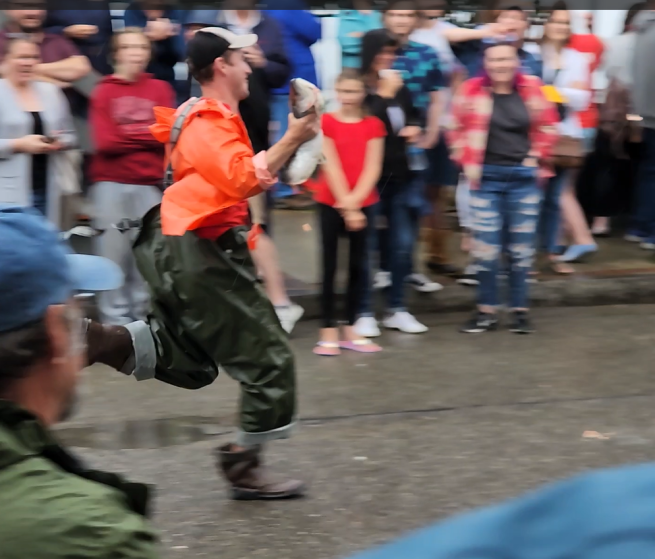
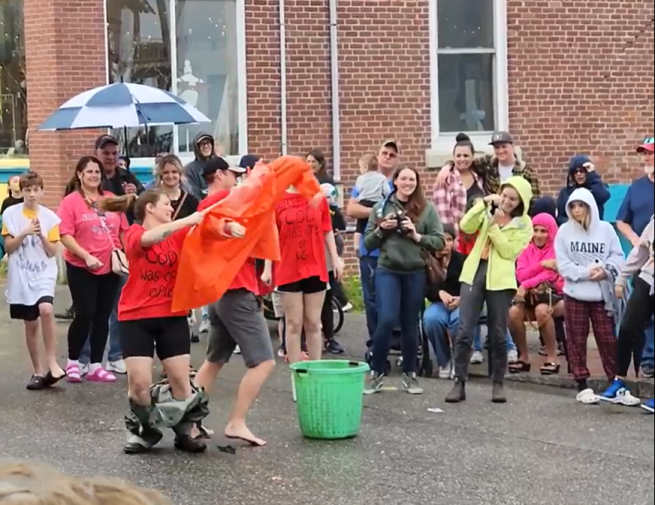
An annual cod relay race – using raw salmon instead – is one of the more hilarious traditions at Eastport’s extended Fourth of July festivities.

Running down the street with a fish is only part of the excitement.

Relaying the gear – boots and the slicker, along with the fish – to the next runner is the heart of the contest. Here, two of the younger runners have it almost down to a science.

All-ages teams are paired off during the day until there’s a first-place winner.

I’m really looking forward to tonight’s reading

If you’re a musician or writer or some other kind of performance-potential artist, you probably find being part of an open mic event invigorating. Not just because you get to air your own work and see how it fares on exposure, but also because you’re amid so many kindred spirits.

Tonight has a kind of hybrid version — six featured published writers at the wine bar downtown — and it is creating a buzz in our small community. Each of us gets about 15 minutes in the spotlight, as well as a book-signing and chat time afterward.

I’ll be reading a chapter from my new book, Quaking Dover, one that details a remarkable but often overlooked outburst in early New England, the bohemian colony called Merrymount. I had settled on that excerpt, a side I hadn’t yet presented in my presentations, before realizing how appropriate it is for this weekend’s ArtWalk festivities, many of them reflecting Pride awareness.

So, here we go … just as the summer season is beginning in our oceanside setting.