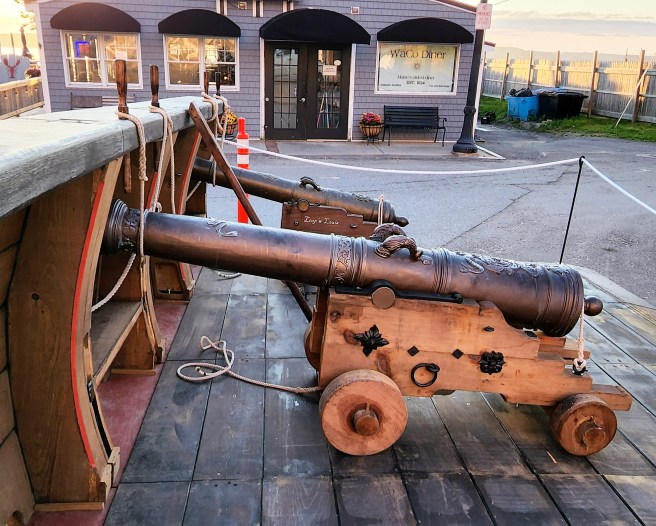
Castine thickens the plot  

If you’ve been following my Red Barn, you know about the 400th anniversary celebrations of Dover, New Hampshire, as the third oldest permanent European settlement in New England and the seventh oldest in the continental USA.

That history does underpin my book Quaking Dover, after all.

As I point out, that “permanent” adjective can become a real ringer, in contrast to “earliest.” “Oldest,” for both the town and its Quaker Meeting, can also be defined as “continuous.”

Don’t be surprised to hear me admit that I keep learning a lot more after researching and writing the book. Some of my newer findings will be posted here at the blog later this year. I’ve already shared the experience of visiting the Pemaquid village site in Bristol, Maine, a settlement that interacted with Dover’s early years.
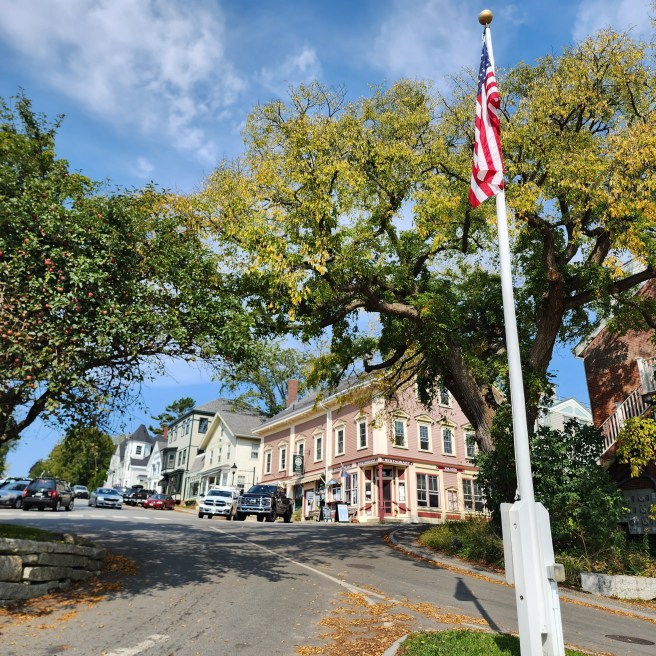
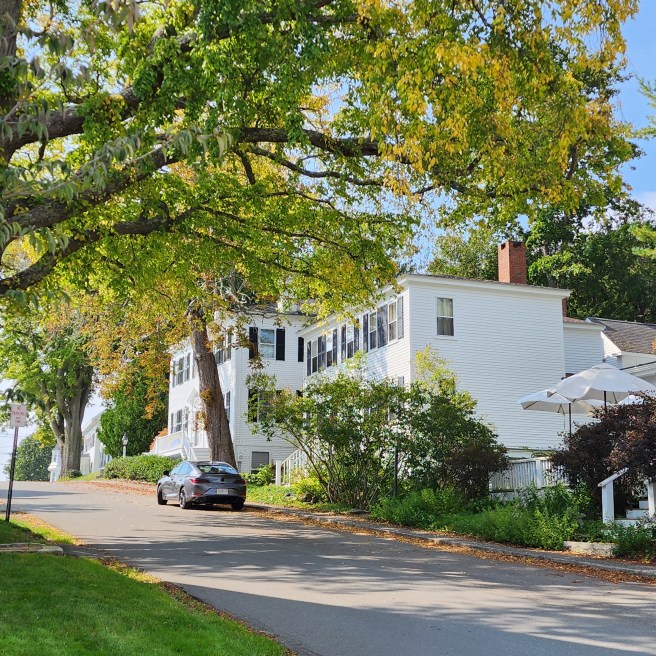
Castine as seen at the landing.

The Castine development at hand arose while killing time between the Common Ground Fair in Unity, Maine, and my setting sail a day later. Or, more accurately, boarding ship with a buddy from Vermont for our first overnight in the vessel before casting off and hoisting the sails the next morning. Literally. Peter joined up with us for a night at the Airbnb before he and I ventured off together. That left us with a day to fill. On a whim, I suggested a land excursion as an alternative to the Farnsworth American art gallery or the transportation museum down the coast. Peter was game, and besides, he knew the town and accompanying waters.

Our destination was the town of Castine, which I had heard of as the home of the respected Maine Maritime Academy and as one of the eastern Maine towns that surrendered without a shot during the War of 1812, along with Eastport and Machias.

He drove, freeing me to observe the winding scenery on the eastern side of Penobscot Bay. It was less upscale and less developed than the U.S. 1 corridor linking Searsport, Belfast, Camden, Rockland, and Rockport – more “real” Maine, if you will.

Coming into Castine, however, a sign jolted me: Founded 1613.

What I read soon after that pointed out that Castine was settled before the Plymouth Bay colonists we know as Pilgrims started building in 1620. (Remember, they never called themselves that, but rather Separatists and the like.)

The claims made it sound like Castine was the oldest European settlement in New England.

Still, it didn’t show up on the lists I examined nor on those that Dover’s celebration committee referenced. The problem is just how many, if any, settlers remained in Castine between the many invasions and changing of flags from French and British to Dutch and American over the years.

Still, looking at the murky history prompted me to revise some of my thinking about Maine’s past.

For one, Castine was occupied by the French during the years of fighting when English settlement was erased all the way down the state to a toehold at Wells and York and on to New Hampshire.

That also had me looking at the French and Indian wars through Canadian lenses. That point of view presented the village of Norridgewock along the Kennebeck River as a French settlement, the headquarters of Jesuit priest Sebastien Rale, including a church he erected in 1698. The English, on the other hand, considered it a Native encampment.

Rale worked to ensure French control of the region, with events escalating into what is known as Father Rale’s War, at least in English versions where he is sometimes presented as the commanding officer in the attacks. Native accounts take more credit for their own leadership and skill.

The conflict culminated in the destruction of Norridgewock in 1724, including the death of Rale, a chief, and nearly two dozen women and children. French control of much of Maine faded in the aftermath, much earlier than I had believed. English settlement did, in fact, resume much earlier than the 1763 Treaty of Paris that ended the final French and Indian War.

At that point, Castine – named for Baron Jean-Vincent d’Abbadie de Saint-Castin, a 1667 arrival – was turned over to the British. And how!

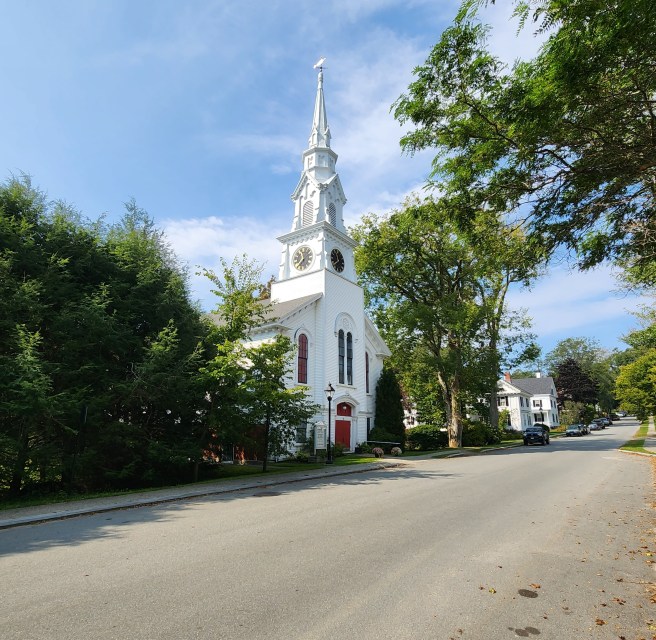
The Common, with the Unitarian church at the left.
Congregational church.
Birthplace of the Maine Maritime Academy.
Post office.
Side street.

An influx of Massachusetts colonists of Puritan and Pilgrim cast gave the town a distinctly Yankee character that remains, perhaps more than anywhere else in Maine.

The down dock is an active place.

I love the town
with its Yankee Puritan flavor unspoiled
contrary to old-money haven Bar Harbor
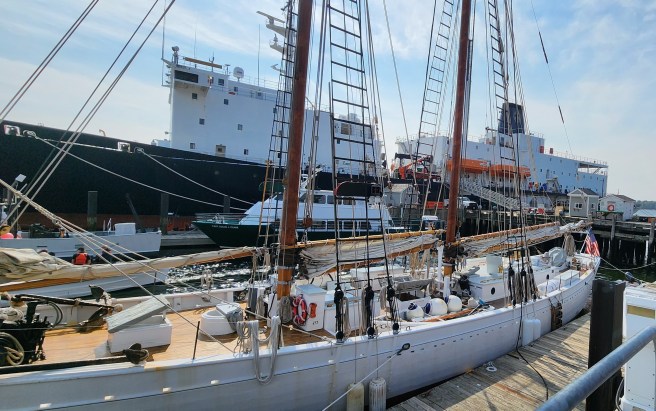
Schooner or later

Ships come in all sizes and shapes, and people aware of the differences see vessels that float quite differently than the rest of the population. Well, it’s like looking at birds and then birders.

Living beside the ocean I had learned to differentiate a sloop from a schooner, or so I thought. Both have triangular sails, with sloops having just one mast and schooners, two or more.

Not to be confused with square-riggers, the kind of tall-mast ships most people envision from history. Or so I once did. You know, Old Ironsides, the USS Constitution, or even the Mayflower, however much smaller.

As for triangular sails, like those on sailboats. Not quite accurate when it comes to schooners. There’s something called a gaff … creating the hip-roof look of a schooner’s sails.

The Bowdoin of Arctic exploration fame.

My closeup introduction to a schooner came in a side trip earlier in the day I would step aboard one for my virgin voyage that will inform later posts. To kill time, so I thought, my buddy and I headed off to Castine, then a hole in my inner map of Maine, apart from references by friends.

And that’s where I was introduced to the Bowdoin, now named for the college of the same name but more importantly a historic vessel used by Donald Baxter MacMillan in his Arctic expeditions. Quite simply, she was designed to withstand incredible freezing – and did. I’m now wondering how the crew did, under those conditions.

That said, she was a schooner. I had seen one docked in Eastport, but this time I had a curator at hand to explain the distinctive parts.

Emphatically, it is not a square-rigger.

Schooner, as Dutch, it’s not SHOONER, after all, as my New Amsterdam Dutch-descendant Peter could easily point out, yet from deference, hasn’t. (Do I get points for noticing?)

Typically, a crew of 2½
two men and a boy
no cook?

an average life of 25 years

for a wooden ship
(owned in shares
spread the risk and profits)


Let’s fill in some more blanks

Some people sit down in the depth of winter to peruse seed catalogs and dream of harvests. We’ll be doing some of that in our household, and you’ll no doubt sample some of the results here.

Some find it a good time to revisit highlights from the previous year or further back. Yup, that too.

The snowy months also offer delightful travel opportunities, and not just to warmer climes. Even if you stay close to a wood fire or the equivalent, taking time to sift through brochures can stimulate plans for trips long or short later in the year. Consider my upcoming posts based on my week on the waters of Penobscot Bay at the beginning of autumn in that vein.

Quite simply, retirement and winters aren’t a blank stretch in my life.

~*~

One movie I viewed as a kid in the Dayton Art Institute’s tapestry-walled auditorium left a lasting impression on me. I think the film was scheduled to be shown outdoors but this was the rain site. What I do recall is its presentations of windjammers racing along under full sails. I was still far from any actual encounter with the ocean or sailing, but from that point on I did realize I had no interest in a traditional cruise, or what I’ve seen as a floating nightclub. No, if I went out on a cruise, it would be under sail. Not that the option quite came in front of me.

Instead, the closest over the years were jaunts on ferryboats in the Pacific Northwest and then the Northeast, along with whale watch daytrips and, especially, my boss’ 32-foot sailboat in the Gulf of Maine.

One impression I gleaned from those outings is how differently a geography fits together when it’s experienced from its waters rather than its land. That awareness certainly came into play in my history research for Quaking Dover.

Being on the water filled in some blanks.

~*~

As a lover of maps, from childhood on, I’ve also learned how the mere fact of being in a place transforms the charts. A location becomes real when I’ve walked around in it. Or, as I learned in my time on Penobscot Bay, if I’ve walked around in a boat just offshore.

Listening to new friends in Maine presented a series of towns I could place only vaguely – Castine, Stonington, Brooklin, Islesboro, Southwest Harbor – along with related locations like Vinalhaven, Isle au Haut, Blue Hill, Swan’s Island (not to be confused with Swan Island in the Kennebec River), or Little Cranberry. I could nod along with a blank look. My week on the water filled in more of that comprehension.

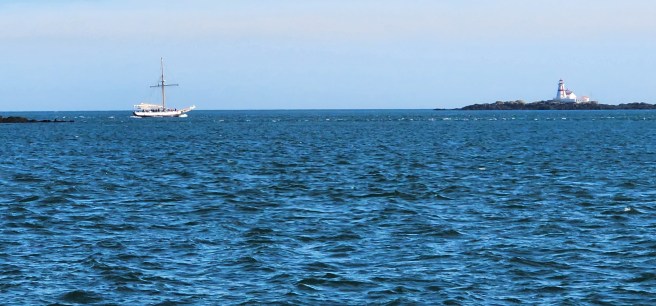
Now, let me fill in the name of the ship in question here – the Lewis R. French – and the fact she was a schooner, a very special distinction, as I would learn.

And as you’ll see.

As for a film society’s choices

The Eastport Arts Center was a major factor in my decision to relocate here. Quoddy Voices is one of its constituent groups.

Another was the Northern Lights film society, which only recently resurfaced but greatly diminished after the Covid hiatus.

I’ve found its offerings invigorating and sometimes disturbing. The deep discussions that follow the showings are especially valued, even for the recent Carnival of Souls and Night of the Living Dead horror vein.

What was perplexing was that the society was essentially two people, one a veteran of its 47-year history, give or take a few seasons.

They were asking those of us who kept coming each week for our input regarding possible selections from the two vendors available to us. Learning of the licensing hurdles for presenting movies even at a nonprofit arts venue was daunting. I’ll spare you the details.

I will, though, share my response to the possibilities and the situation we’re facing.

~*~

As I wrote:

Seems to me our thinking about the film society comes down to building a larger audience. That, in turn, adds considerations of “branding” – the image the public has – as well as the types of films we air and even our geographic range of appeal.

What do we show this week that will bring people back for our next film? That is, what’s our continuity or identity? What has them awaiting the next round? Are we an “art” films circle, an awards-driven following, a sensual experience sharing group? Do our screenings enhance or compete with other arts ventures in the region?

If we’re limiting ourselves to two showings a month, let me suggest making those the second and third Sunday evenings of the month. I’m feeling there might be a “bounce” in favor of that second showing, perhaps even with some common thread for the month. Let me also push for 6 pm so more viewers from throughout Washington County can readily attend. (Note, too, the problems of getting anyone out on a Sunday night, plus the competition with the winter Sunday afternoon series at the arts center and Stage East matinees.)

My thinking is that we might get some synergy and energy that way, especially in getting the word out. The Tides comes out on the second Friday (we might have occasions when the showing falls a week before that).

Orchestras and live theater companies have long relied on season subscribers but have been finding, even a few decades before Covid, that the model was eroding. Festival programming – a cluster – has been one alternative that’s created excitement and ticket sales. I’m seeing that as something that might work with the second/third Sundays model, perhaps even giving us the option of adding a fourth Sunday for a suitable extension.

That said, we are also shaped by the collections of our two distributors.

At the first, I’m steering clear of the traditional art films for now – the Italian, French, German, Japanese, etc.

Instead, I’d look at the USA (not Hollywood, for the most part, which is the global conglomerate movie center) and three Canadian films, many of them documentaries, and at the Latin films – Mexico, Cuba, Spain, Portugal, Brazil. Viridiana stands out on that front. Washington County has a large and largely overlooked Hispanic population.

Cluster options here: Orson Welles, Robert Downey Sr., Chaplin and Harold Lloyd, silents The Freshmen, The Kid Brother, The Most Dangerous Game, and King of Kings (if we can keep a straight face), Norman Mailer, John Huston (Under the Volcano and Wise Blood).

Among the docudramas etc.: A Brief History of Time (Stephen Hawking), Burroughs: the Movie, Don’t Look Back (Dylan), For All Mankind (astronauts), Gimme Shelter, God’s Country (Louis Malle), Jimi Plays Monterey or Monterey Pop, Louie Bluie, Multiple Maniacs (John Waters), Eating Raoul (Warhol).

Titles that catch my attention: The Baron of Arizona, The Beales of Grey Gardens, Border Radio, Buena Vista Social Club, Cameraperson, Carnival of Souls, Chop Shop, Clean Shaven, Desert Hearts, Detour (possibly anchoring an international film noir survey), Dillinger Is Dead (OK, it’s Italian but still), possibly with I Shot Jesse James, Drylongso, The Honeymoon Killers, Push Cart Man, Paris Texas (yeah, it’s French), A Poem Is a Naked Person, Poto and Cabengo, Routine Pleasures, Smooth Talker, Slacker, Sweet Sweetback’s Badass Song, Symbiopsychotaxism, Twin Peaks, Thank You and Good Night, and The Watermelon Woman.

Looking way ahead, sometime it might be fun to do a festival based on Japanese Godzilla fixation.

And then, at the other: For the most part, these offerings strike me as highly commercial creations most people stream at home. Still, American audiences look for star-power rather than directors, so this might provide some extra punch for attendance. That said, some offerings to consider: Barbie, Oppenheimer, Gran Turismo, Joy Ride, Insidious, Tar, Asteroid City, Dear Evan Hansen, The Little Mermaid (with ArtsWalk), The Outfit, Samaritan, The Black Phone, and Cruella (if it’s not too Disney).

~*~

Well, we’ve had a second meeting and set a course for the next year, one that seems to be generating a buzz. We’re focusing on one boffo film a month, with both a matinee and evening showing, and tying the offerings into other events happening in town, when possible.

The first one is indeed Barbie on the Thanksgiving weekend.

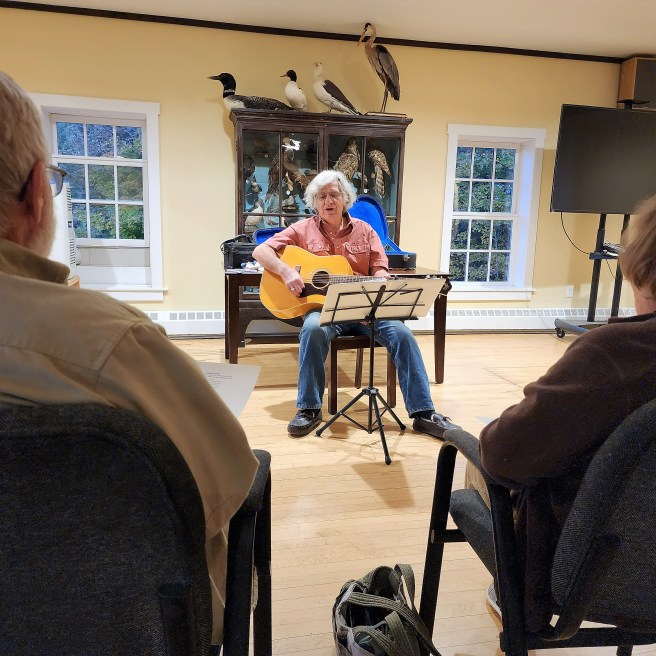
Asking us singers for our suggestions was a bit unnerving

One of the unanticipated developments in my life after I retired from the newsroom was that I became an amateur choral singer, first as a charter member of Revels Singers in Boston and now with the much smaller but no less excellent Quoddy Voices.

In that, I’ve been blessed to work under four incredible music directors and also experience a few other fine conductors, each bringing something unique to the enterprise.

Still, the newest vocal maestro is truly one of a kind, yet still of the highest standards.

When he stepped up to the task in September, he handed out stacks of sheet music from four or five different sources, a very wide range of repertoire, maybe 30 pieces in all.

We set about sight-reading these, and I found myself getting teary as I recalled earlier experiences. Leadbelly’s “Bring Me a Little Water, Sylvie” was a staple of the Boston Revels’ autumn equinox Riversing along the Charles River, and backing up our teens’ choreographed routines was always exciting. “Wild Mountain Thyme” always ended the spring equinox concert, with David Coffin leading the audience gathered into a large circle, holding hands. “All God’s Critters (Place in the Choir)” raised many other memories, especially of Quaker children but also with the composer himself, who lived just outside Dover. And then there was Sweelinck’s joyous “Hodie,” my introduction to polyphony at the opening of the second classical concert I ever attended, the Roger Wagner Chorale around 1960. Never, ever, would I have imagined actually singing that – well, not until the past few years.

~*~

While I’m relatively new to being a member of a musical ensemble, I can say it’s a remarkable identity to assume. We expect to be followers, even with our own grumbling in the back row.

And that’s where Gene threw us a curve ball this fall. He wanted our opinion in what pieces we want to do, including those on our upcoming holidays concerts.

As others said, “The conductor’s always come in with the the pieces and said this is what we’re going to perform. Let’s get started.” To which, in our new situation, they added they were feeling a bit disoriented and perhaps even dismayed.

Well, he did want us to rate the pieces before us, something like a homework assignment, so here’s what I added to my ratings sheet:

“I’m guessing that many of the others will be leaning toward pop/rock songs they’re familiar with and find fun. As you see, I lean the other way, looking for pieces that stretch me to explore and achieve more. Looking at scores from the bass line is a fresh perspective. The tenors and ladies typically get most of the action while we’re stuck in the basement. (No pun intended.) Or even sidelines. I don’t mind holding a drone note in modal music, including Eastern Orthodox services, but what I’ve seen in the pop/rock harmonies seems pretty rote, uninventive, or shallow with little to hold my continued interest, especially if we were to do some deep rehearsal.

“On the other hand, doing one-time run throughs, perhaps with an audience, could be a fun community event, our own version of a pops concert. Summertime, even?

“Or even a hymn sing?

“Still, you asked, and thanks for that. And you’d still get my vote if we were selecting a music director. (My, that was an experience with my previous choir down in Boston.)”

~*~

I am happy to report that the Renaissance and other classical repertoire that I favor came in at the top of the stack, but there’s also a healthy blend outside of my usual comfort zone. The process did cut into our concert preparation time, but I’m confident we’ll catch up.

This really is a fun group to be part of, and that runs top to bottom and back up. I’d say things are percolating.

When it comes to photos for blogging

Have you ever thought about the best shape for a photo in blogging?

So much depends on the device your reader is using. A large PC screen offers many alternatives a cell phone or tablet doesn’t. My own frame of reference is a laptop.

My earlier posts often mixed the sizes of pictures in a post, for variety the way a newspaper photo essay would. But cell phones require a strong image rather than detail.

In general, then, I’ve been settling on full width but shallow – not that the visual content always cooperates.

Alas, those shots do lose some power in fitting into the blog’s formula width, unlike the full screen I use in selecting and editing.

In a grouping, I’ve been keeping them full-width rather than mixing and matching sizes. When our reader scans down, this functions somewhat like a moving camera roll shot. It’s not the way you’d “read” a photo on paper or in an art gallery, admittedly, but it’s an option the technology leads to.

But I’ve also been shooting a lot of square shots, which not too long ago was considered verboten by many observers.

And then, sometimes a deep vertical shot is dramatic, revealing itself portion by portion instead of fully at once.

What’s working best for you?