Tagging a tree

Our custom is to bring the tree indoors on Christmas Eve and decorate it then. Sometimes we’ve even waited till that very morning to head out to the tree farm to harvest the one we had tagged earlier. But that was back in New Hampshire.

Here in Real Downeast Maine, we instead initially gleaned our Yule tree in the neighboring forests, sometimes even along country roads under utility lines, first in tabletop sizes and then full-size. The vegan member of our circle, however, complained that they weren’t full enough. She wanted something more classically ideal. Definitely nothing Charlie Brown.

Well, the natural – organic – ones do tend to grow mostly on one side, nestled in with others, unless you fell a taller evergreen and lop off the top five or six feet. Not that such an argument went anywhere. Even so, the rest of us were perfectly delighted with what we put up and strung lights on and all the rest.
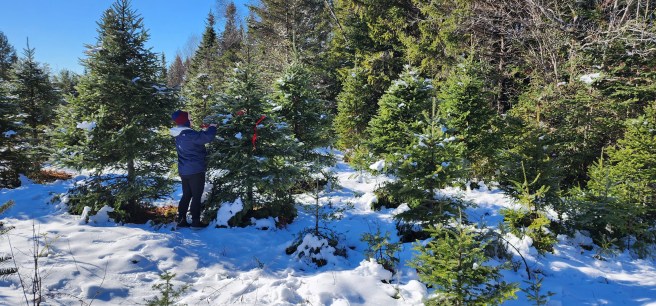
Against that background, we finally relented and were then astonished at one nearby family tree farm that goes along for perhaps a half-mile in clearings along an unpaved lane into the bigger forest. There are probably enough trees for every child, woman, and man in the county, and the prices are ridiculously low in comparison to what you just paid, wherever.

The kids in the family will even come around with electric chainsaws to cut it down for you. What more could you ask? Well, maybe that netting before we jam it into the hatch of our car?

What you see here is us claiming one to be ours, that is “tagging” it with ribbon and an identifying label, ahead of time. We trust that nobody else will ignore those markers. (It’s happened to us only once, back in more populous Dover. We still found a fine replacement. Maybe better?)

My, those needles y do smell good, outdoors and in.

Here’s wishing you and yours and happy and memorable togetherness.

Ghosts in the neighborhood

I’ve previously posted on the phenomenon of ghosts residing in homes in New England, especially, somehow, Maine.

In that vein, I’m surprised we haven’t sensed anything in the household, especially considering its age. Maybe Anna Baskerville’s good vibes should get some credit here.

But I have asked about a few of our neighbors, and they quickly told of theirs. I am surprised by the details, including a smell or two. Also, so far, they seem to be limited to one per house and do prefer to don dark clothing.

At least they seem to be benign, only sad.

Note to self: Keep asking around. It is a great conversation starter.

~*~

Here are some related facts gleaned from Harper’s Index in recent years:

  • Minimum percentage of Americans who say they’ve had a paranormal experience: 67.
  • Who say this experience involved “smelling an unexplained odor”: 30.
  • Who say they have the ability to psychically sense others’ emotions or auras: 24.
  • Percentage of U.S. homeowners who believe their homes are haunted: 49.
  • Of Gen Z homeowners who believe this: 65.
  • Number of states in which sellers must respond truthfully if asked whether a murder has occurred in a home: 9.
  • If asked whether a home is haunted: 1.

A thought while assembling Tendrils

Once upon a time, meaning not all that long ago, trying to track down ten more or less related facts impinging upon a particular topic would have required a very tedious amount of time in a library. Or may some more remote back office or agency, wherever.

Instead, thanks to the Internet, the list can be cobbled together within a few hours on a laptop.

It can seem like cheating or at least borderline plagiarism.

No guaranties on accuracy, either.

Popcorn goes way back in antiquity

Last year I presented a Double Tendrils about the popular and seemingly ubiquitous snack of popcorn. Quite simply, it’s not just for watching movies. And around this time of year, we start eating more. Not only that, but it turns out to be a uniquely American contribution to the world’s cuisine.

The topic simply overflowed so much that we didn’t have room for tidbits about its deep history.

So here goes with ten related factoids that pop up on that front.

  1. Try to think of a more purely American food than popcorn. Whether salted or buttered at a movie theatre, or as kettle corn at a county fair or a caramel popcorn ball come the holidays, we hoover it up, even when we’re not watching movies, OK?
  2. Look, archeologists have found traces of popcorn in 1,000-year-old Peruvian tombs. But it goes back way even earlier.
  3. The first use of wild and then cultivated corn points for now to the Bat Cave of west central New Mexico in 1948. Ranging from smaller than a penny to about two inches, those ears are about 5,600 years old, older than Adam and Eve, for anyone counting.
  4. In tombs on the east coast of Peru, researchers have found grains of popcorn perhaps 1,000 years old. These grains have been so well-preserved that they will still pop.
  5. Popcorn was integral to early 16th century Aztec ceremonies. As Bernardino de Sahagun observed, “And also a number of young women danced, having so vowed, a popcorn dance. As thick as tassels of maize were their popcorn garlands. And these they placed upon (the girls’) heads.” In 1519, Cortes got his first sight of popcorn when he invaded Mexico and came into contact with the Aztecs. Popcorn was an important food for the Aztec natives, who also used popcorn as decoration for ceremonial headdresses, necklaces and ornaments on statues of their gods, including Tlaloc, the god of rain and fertility.
  6. An early Spanish account of a ceremony honoring the Aztec gods who watched over fishermen reads: “They scattered before him parched corn, called momochitl, a kind of corn which bursts when parched and discloses its contents and makes itself look like a very white flower; they said these were hailstones given to the god of water.”
  7. Writing of Peruvian natives in 1650, the Spaniard Cobo said, “They toast a certain kind of corn until it bursts. They call it pisancalla, and they use it as a confection.”
  8. Kernels of popcorn found in burial grounds in the coastal deserts of north Chile were so well preserved they would still pop even though they were 1,000 years old. Likewise, in southwestern Utah, a 1,000-year-old popped kernel of popcorn was found in a dry cave inhabited by predecessors of the Pueblos.
  9. Indigenous Iroquois people in North America were documented popping corn kernels in heated pottery jars near the Great Lakes region in the 1600s.
  10. The first patent for a microwave popcorn bag was issued to General Mills in 1981, and home popcorn consumption increased by tens of thousands of pounds in the years following.

If you’re speaking of dances, for me, it’s New England 

My definition: contra, English country, squares, and rounds, or folk rather than ballroom or rock – though a tango fascinates, I do the Swedish  hambo, when a partner appears at one of our contradances.

~*~

This note came from before I discovered the line dances at Dover’s annual Greek Festival and then the “secret” of dancing them. The event took place every Labor Day weekend, though I did come to find other opportunities to dance in Greek circles.

All of them to date, though, have been in New England.

What a Treat to explore

Officially, Treat Island is part of the city of Eastport, Maine, and once had its own thriving fishing village, school, and post office.

Today, though, nobody lives there. Instead, it’s one of the many preservations of the state’s coastline now held by the Maine Coastal Heritage Trust.

At low tide, it’s connected by a rocky breakwater to Dudley Island, which is officially in the town of Lubec.

The only way to get there, do note, is by water.

To take a quick tour upon landing, including its 7,000 feet of shoreline at the mouth of Cobscook Bay, check out the free photo album at my Thistle Finch blog.

Back to the press and a personal debt

The first printing press in Britain was established at Westminster in 1476 (during the reign of Edward IV, 1461-1483) by William Caxton. Modern movable type had been invented not that much earlier around 1450 by Johannes Guttenberg.

Caxton is considered a central figure in establishing Chancery English to the standard dialect used throughout England. In his haste to make translations for publication, he imported many French words into English.

Well, England did rule much of France during the century.

As a reader and writer, I’m indebted to both men and a host of those who followed.

Lately, I’ve been returning to the Baskerville typeface, which we used for our high school newspaper, though now its in honor of an earlier resident of our house. The face dates from the 1750s.

One classic I’ve long been fond of is Caslon, from the 1720s, by another English designer. It’s similar to Goudy, a 1915 American design based on historic Italian faces and one I’ve been using on my Thistle Finch publications. It really is elegant.

Sometimes the very appearance of a word in type or a well-designed page will make my heart sing.

Just so you know what happens when ink gets in your blood.