One my thoughts returns frequently to a conversation I overheard on a Saturday afternoon in Baltimore’s Little Italy. A couple, recently back from New York City, was trying to impress the restaurant owner that everyone they had talked to was raving about the establishment, saying it was clearly the best in Little Italy. Finally, the owner was able to thank them, with this rejoinder: “Anyone who doesn’t think he’s the best in this neighborhood shouldn’t be down here.”
I admire that sense of upholding your own pursuit of excellence. No excuses. And I admire that esteem for the standards of others doing the same. Rivals. And yet colleagues.
I don’t want to hear a salesman slam the competition, or a priest short selling another denomination or congregation, except in this light.
My work is the best. And so is yours! And, yes, we can both do better!
My fondness for mountain laurel goes back to my days of living in the ashram in the Pocono Mountains of Pennsylvania. There, the undergrowth of the forest was filled with these blossoms in season.
Over the years, my own spiritual practices have undergone many changes. Even in a tradition like the one I’ve embraced, seemingly free from the annual routines of a liturgical calendar or outward emblems, there appear cyclical changes mirroring those of the seasons. Cycles, too, like those of progressing from childhood and parenthood into retirement or release. In Salem Quarterly Meeting in Ohio, the session each Fifth Month meant rhubarb in the applesauce. See it as sacrificial and special.
There are times of struggle, doubt, and distrust. Times of whirlwind passion and excitement. Times of discovery. Times of drought or deep winter, relying on what’s brought out of storage. Times of renewal and recharge.
This has manifested as periods where I’ve been able to dedicate significant time to meditation, solitude, travel in ministry, prayer, Bible study, research into history and theology, organizational service, teaching, correspondence, or writing, as well as to regular disciplines such as fasting or physical spiritual exercise (the hatha yoga sessions or even wilderness hiking). Emphatically, however, one would predominate while others would likely be absent or greatly diminished. In addition, they would be strongly impacted by the events of my daily life itself – whether I was single, married, divorced, or “in relationship,” my hours and nature of employment, my friendships and faith community, my driving patterns through the week.
The result of all of this would be a crazy-quilt tapestry or a ricochet trajectory if it weren’t for a spiraling within it. That is, over the years, various periods and interests begin to overlap one another, creating a kind of harmony or accumulated depth. My asparagus bed in New Hampshire has roots in my experience of asparagus along irrigation canal banks in Far West desert three decades earlier. A dog sitting through Quaker meeting here is a reminder of dogs sitting through predawn meditation sessions in the Pocono Mountains, or of the cats aligned on the scaffolding outside the windows, as if they, too, were deep in concentrated worship. I read a particular Psalm and see the passage taking twists I hadn’t perceived earlier.
In my own life, my childhood was filled with natural science, hiking, and camping, each with its mystical visions and moments. Adolescence led into politics, classical music, opera, and writing complicated by unrequited sexual yearning. Without romantic companionship, a Lone Ranger journey. Rejection of existing creed while ensconced in church office was followed by flight into atheism and hippie excess landing, inexplicably, in a yoga ashram with its Hatha exercises and sustained meditation. From there, into Quaker practice, though of the ABC – or “anything but Christ” variety. The ashram lessons were applied here, in circles of deepening prayer life. By steps, I moved toward Christocentric and Plain speech, and an especially faith fervent language. Among the Wilburite Friends as well as Mennonites, especially, I came to wrestle within Scripture while similtaneously undergoing repeated Dark Night journeys and questioning. Turning to therapy, I wondered if anyone could come along with me through all of this. By now I was no longer meditating to get high, or transcend, but rather to center down to the Seed. Here, with all of its committee work, I was engaged in a religion that combines mystical experience with social witness and activism. In a nutshell, then.
Each swirl also stirs up something from before. What failed in earlier marriage or relationships reappears. What has been left unfinished is not left entirely behind. What has been shredded remains to be woven. I heard this opera in its entirety a hundred times. Have I ever heard this note before?
I moved from the Midwest to the East Coast and back before heading on to the Pacific Northwest in what seemed an epiphany but instead shattered amid volcanic eruption and devastation. I left the wilderness for another kind of wilderness, back across the Midwest to the East Coast. The pendulum, as they say. Here, I now see life as both linear and circular – that is, spiraling. The spirit requires flesh, or is it that flesh requires spirit? Seasons include times that are full or overflowing, and times that are barren or dry. I now welcome the questioning that is not hostile is both essential and healthy.
My first spring in the orchard, I expected all of the trees to blossom simultaneously. They don’t. The apricots and cherry petals give way to plums, pears, and peaches. The apple blooms arrive last, when others are already gone.
Experiencing a new place through a full year or repeated years provides a much different understanding than a tourist gets – even one who spends several months there. Relocating requires a year-and-a-half to gain familiarity with the new surroundings – to get beyond the obvious, to establish friendships, to be oriented with the elements one finds essential or special. A favorite restaurant, a woodland pathway or place to swim, a boutique or gallery.
There are seasons for a person of faith, from winter to spring elation and then into fullness, dryness, struggle, or disillusionment. To harvest, perchance. Marriage? Family? Children? Extended into joy, compassion, humility, appreciation – one begins observing and naming.
The turning point in my own journey came when I accepted a new name.
As I was lunching al fresco for the first time this year, having savored our first asparagus of the season (which I’d sautéed with minced garlic leaf in olive oil and then fried two eggs atop the mixture), I realized I was still hungry. So glancing up, I noticed a sprout of dandelion, got up, plucked a leaf, brought it to the table, wiped it in some of the remaining egg yolk, and … it was good. It was very good. Somehow, the yolk overcame whatever bitterness I expected at the end of the bite.
So I harvested the remainder of that cluster (which also doubled as weeding, let’s be candid), went indoors to rinse it and fry another egg to serve with it, covered the resulting salad with salt and coarse-ground fresh pepper … and it was still good. Very good.
So for dinner, another round, this time with a fresh mustard vinaigrette my wife had just made … and it was still good. Very good.
Maybe I’m hooked. Yes, we’ve read some fine food writers who’ve extolled their pleasure in fresh dandelion every spring, before the leaves turn too bitter and too tough. Until now, though, our dandelions were treasured only by our pet rabbits.
Not anymore. Another first.
Now, to see how it works blanched. Or maybe as a spinach substitute, say in a Florentine-style dish.
Not that I have any intention of turning the Red Barn into a food blog. Oh, no. I know my limitations.
Although I do my share of the weeding and much of the spading, I’m not the gardener. My wife is the one who studies the varieties of plants, selects and orders, fusses and sows, evaluates soil and sunlight, while I’m more likely to mow, do the composting, construct the raised beds, and transport ferns, Quaker ladies, and ox-eye daisies from the wild. In recent years, our elder daughter has taken delight in getting seedlings started and transplanted, especially, as well as making jams from the fruit we harvest. (The younger one could care less.)
While my dad, mainly, raised vegetables and tomatoes behind the garage when I was growing up, and my mother fussed over flowers that generally failed, and despite my later experiences living on a hippie farm and then the ashram as well as my first wife’s efforts in Ohio, Indiana, and the fertile desert country of Washington state, my perspectives on gardening center on Rachel and her world. Everything before was simply preparation. Little did I suspect, when we set out to buy a house as part of our marriage, how much she was calculating garden opportunities; many of the urban New England properties, surprisingly, have little usable space for raising plants. Only after bidding successfully on the house we now inhabit did we learn that it included not just a small but manageable strip beside the driveway but a half-lot on the other side of the house, as well – the side we’ve come to call the swamp.
Once upon a time, or so it seems now, a girlfriend sent me out with orders to come back with hot dog buns, which is what I did.
But when I handed her the grocery bag, she cried out, “Oh, no! What are these?”
“They’re hot dog buns,” I replied ever so naively.
“No they’re not!” she insisted.
“But they’re what I’ve always had hot dogs on,” and they were.
She would not believe me, so off we went, together, to the supermarket.
“These,” she said, “are hot dog buns.”
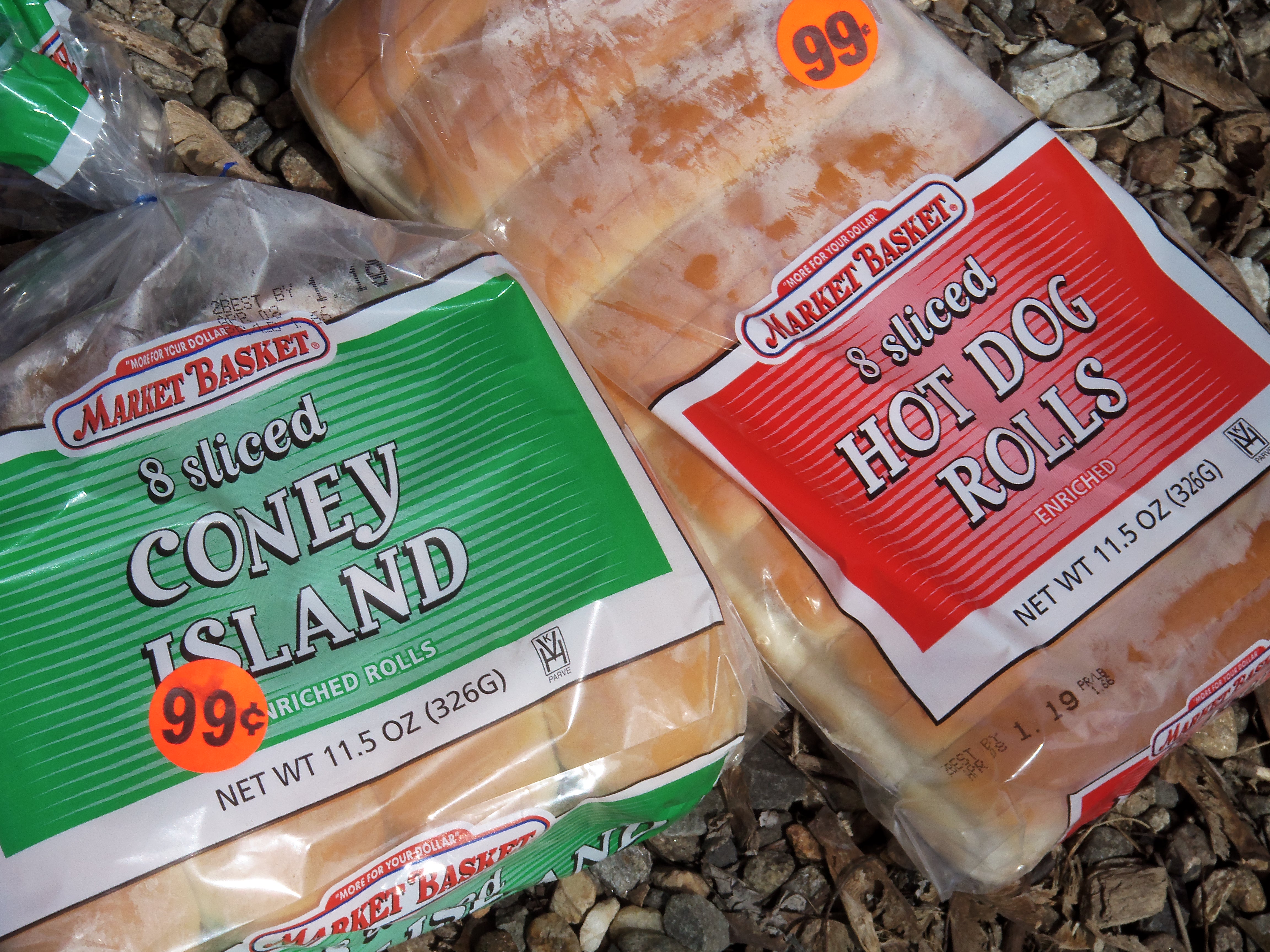
Asked to pick out a hot dog bun, which would you choose — the ones sliced on the top, at left, or on the side, at right?
They looked like a flattened loaf of bread cut in fat slices. The side of each “bun,” in fact, was without crust – naked, to my taste.
Pointing to another shelf, I looked at the kind I’d always known – the kind, that in fact, came labeled Hot Dog Buns. Hers, in contrast, were labeled Frankfurter Rolls.
Hmm, we both said without satisfaction.
She had, in truth, grown up in New England and lived nowhere else. And her idea of how to serve a hot dog was unique to the region. Not in something she considered a torpedo roll.
Ah, but the plot thickens. As I bought packages of each this time around, there was no Frankfurter label — and the Hot Dog tag instead went on what my wife confirms are often called Frankfurter buns or rolls around here. As a further complication, we now have the term Coney Island, which confounds my elder daughter while bringing to my mind something completely different, a miniature hot dog where I grew up, often served covered with “chili.” But that’s a whole other story.
This can, in turn, point to a lot of other regional distinctions. Whether you call a device a watercooler, a water fountain, or a bubbler, as we do here. Or whether you order a soda, a pop, or a cola. Feel free to expand the list. It can go on a long time.
Fast forward, then, to lunchtime at a national conference being held in Rhode Island. I sat down and joined a random group that included a handful of teens. One was from North Carolina. I pointed to the hot dog on his neighbor’s plate. He looked bewildered. “What’s it wrapped in?” he asked.
“Would you call it a hot dog bun?” I prompted.
“No way!”
“Oh yes it is,” said the girl from Connecticut. “It’s what we always use.”
You know where the conversation went from there. Yes it is, no it isn’t.
At least the college cafeteria knew to stock both Hot Dog Buns and Frankfurter Rolls. As we all discovered.
Hmm. Maybe next time we have a crowd over and we’re grilling hot dogs, I’ll get packages of both – and then see which kind goes first.
Seems I’ve always been a coffee lover, as far back as those “coffee milks” our Gran used to serve my sister and me on Sunday afternoons. Maybe that’s why I still prefer mine café au lait – half milk heated with a liberal dose of sugar or sweetener.
For decades now, my days have begun with a round of hot coffee, often abed – yes, how blessed I was after remarrying, when my wife would appear with the perfect mug when I needed to awaken. And how much I lament how that ceased, in part because the office rejuggled my schedule, meaning she never knew quite when I would be rousing.
For someone in a faith tradition that eschews rituals, I have to admit where they really appear – and be willing to acknowledge anything that’s an addiction, as well. (Remind me to take a coffee fast in the next year, OK?) Yes, maybe the editors of one poetry journal had it right when they admitted they were devotees of the Goddess Caffeina. (Oh, she has temples everywhere.)
More recently I’ve begun to question whether it’s really the coffee itself I like. That is, I can drink it black. And, yes, I also demand dark coffee – the darker, the better. I even like Starbucks, though that has nothing to do with my years in the Nevergreen State. (Remember, I lived in the desert side of Washington state.) No, I realize when the mug’s turned cold, my beverage tastes a lot like the cartons of chocolate milk we used to purchase in the elementary school vending machine – the ones that cost us a nickel. So maybe it’s that chocolate underpinning that grabs me.
Is it possible that even at six-foot-two, the chocolate stunted my growth? We can’t blame the coffee, now, can we?



 Jnana's Red Barn