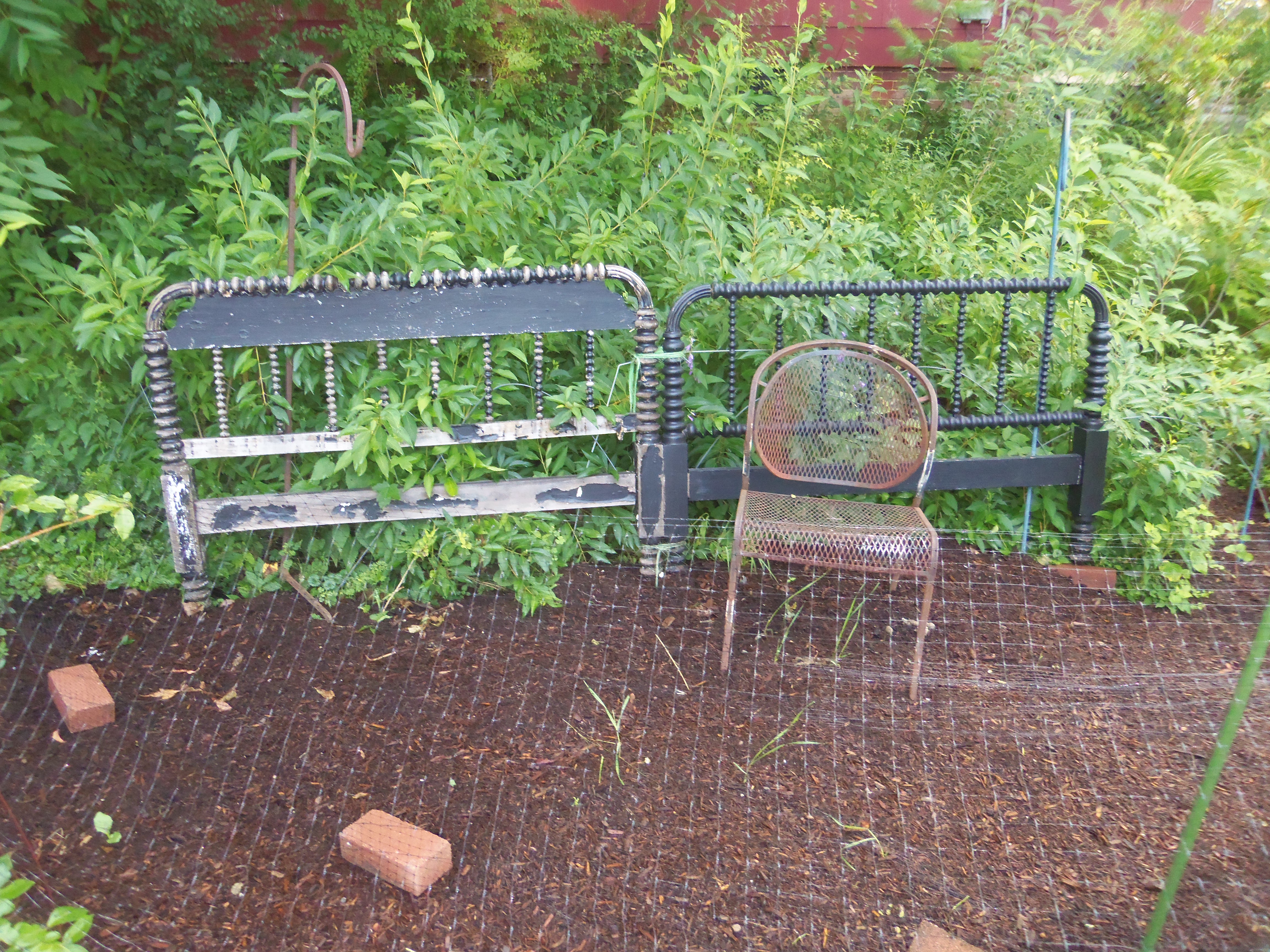
THE FREEZER IN THE BARN

In one of our discussions of feasts and fasting as spiritual practices, a Friend mentioned purchasing a used freezer and how much he and his wife have saved over the years – by purchasing in quantity when supermarkets have sales, especially. It tipped the balance in our own decision to buy one, which we fit into the barn.

My wife’s no slouch in the grocery specials department, but its bigger value has been in preserving our own produce. How wonderful in January to pull out our own peas, or our own strawberries in February, or our own tomato sauce in March (if there’s any left!). Often, while she’s digging around in its drawers, she comes across surprises. Eggplant, anyone, already sauteed? And we never go wrong with a roast chicken bought on sale or, while it lasted, something from the half-pig we met at the farm.

In fact, we wound up buying a second freezer at a yard sale — and both are packed with goodies.


POTLUCK HITS

Quaker circles seem to be big on potluck dinners, which are humorously called a “meeting for eating” rather than the traditional Meeting for Worship or Meeting for Business. I know we’re not alone in enjoying this kind of gathering – in some locales, they’re called a “covered dish supper,” and I suppose other terms are used elsewhere in the world. And I still have fond memories of the Mennonite versions.

Still, trying to decide what to prepare and take can be baffling, as I found back when I was single. Many people lean toward soups, which I find difficult to handle in any setting that means mingling rather than sitting down at a table. Ditto for salads. There’s also the temptation to present purely showoff dishes, which in reality are usually overlooked in the array on the buffet.

My solution was potato chips, and these were often the first thing to disappear, especially if children were around.

Since then, we (meaning wife and daughters) have found several simple-to-make sure-fire hits, though:

  • Deviled eggs: Always the first plate to be emptied. The downside is they must be refrigerated and can be difficult to make if large quantities are required. Still …
  • “Tater tots for grownups”: We’ve been playing with several variations on this, essentially savory garlic potatoes that are squished for a flatter shape and then baked or roasted. Google the phrase and you’ll have no shortage of recipes. The one we’re working from is found here. http://www.epicurious.com/recipes/food/views/Potato-Bites-15806
  • Lemon squares, cheesecake bars, brownies, or a torte: Desserts like these prove popular, and since they can be delivered in serving-size portions, you avoid the mess of cutting and plating at the event. Nifty.
  • Mudslide truffle: My elder daughter proclaims this a guaranteed crowd-stopper. It’s a multilayered sin typically made from Cool Whip (she uses whipped cream), chocolate or vanilla pudding, crushed brownies, and Kahlua or Bailey’s Irish Cream. A Google search will deliver a lot of variations, including almonds. Yes, this one does require both hands for eating, but it also travels well, she says, and looks very impressive when delivered in clear glass showing all the layers. The Kahlua or Bailey’s rules it out for church events, so the search for a suitable substitute is under way.

So that’s for starters. Apart from the tater tots or the torte, though, there’s nothing for vegans. So what would you suggest for the list? It is a potluck, after all, and the table’s open.

RISING TO ‘COMPANY FOOD’

Even before sweet potatoes became a trendy go-to thing in health-conscious circles, my wife and I were considering them anew. Not the marshmallow-covered side dish I loved at Grandma’s dinners, but in something less Candy Land. You know, as chips or fries, for starters. Let’s not overlook the basics before moving on to international cuisine.

Still, getting those just right can be tricky, but my wife has been tweaking the details. Let me say, though, they’re good. Very good, indeed.

In fact, sampling the last round, I proclaimed, “These could be company food,” meaning something we keep up our sleeves for those times we’re expecting guests.

“It’s something they probably wouldn’t get regularly,” she agreed.

That, in turn, had us pondering traditional French fries, which Americans seem to find on every restaurant menu.

“People just don’t make those at home anymore. And homemade can be glorious when they’re done right.”

Amen.

Well, that had me remembering Grandma again, this time her deep-fat fryer and the hand-cut fries she used to make and then serve with her homemade ketchup.

Thinking of that and how both would be “gourmet” items today, I had to admit, “We really didn’t appreciate those properly at the time.” Back when we were kids.

Back before McDonald’s. Back when “dining out” often meant the “drive-in,” rather than the “drive-thru.” For the uninitiated, the drive in had waitresses who came to your car.

TURKEYS IN THE WOODS

I pulled over to photograph some ducks on a pond, or so I thought. When I turned around, this is what I found.

There they go.
There they go.
Unruffled.
Unruffled.

Wild turkeys have made a remarkable comeback in New England. The other day, I had to stop behind a stopped car on the road. That’s when I saw the gobbler stroll off the pavement. There was even one in our yard, we’ve been told.

DON’T KNOCK VANILLA

There we were seated in the social hall, waiting for a final rehearsal to begin for our round of Christmas performances.

One of the baritones was nibbling away at a takeout carton of unmarked ice cream – as he admitted, from a top-of-the-line local hamburger joint. “I’m a New Englander,” he explained. “I eat ice cream all year.”

It was vanilla. I heard the echoes of mocking from a girlfriend’s mother way back, quite the New Yorker, something about being unimaginative.

I don’t care if she was a endocrinologist, she was so wrong.

As taste goes, what can be more heavenly than pure vanilla?

Actually, the simple things done well can be the best indicators of quality, even sophistication. Care to begin that list?

On the other hand, there are many ways to cover up flaws and errors. Just keep adding more doodads and trinkets. Not so when it comes to simplicity, which is all about truth.

If you think all vanilla’s the same, by the way, think again. Madagascar beans are the most popular, for good reason. But Tahitian is more floral and truly delightful, as I discovered in a gelato served at the Union Bluff hotel in York Beach, Maine. And then the Mexican beans have developed their own devoted following.

CANDY COLLECTORS

Getting ready for the trick-or-treaters tonight means bringing the box of decorations down from the loft of the barn, perhaps carving a jack o’ lantern or two, putting up some spooky lights, and making sure we have bags of candy ready for the kids who come knocking on our door between 5 and 8 p.m. (Dover’s officially sanctioned window).

For readers in other countries, I should perhaps explain America’s Halloween tradition of allowing children to go door to door, knocking or ringing the doorbell, and then calling out “trick or treat” and receiving a sweet morsel in return. In the old days, there was the veiled threat, “or else,” which often led to a prank like having your windows soaped – or worse. These days, it’s often a matter of having any pumpkins left out being smashed in the middle of the night, regardless of your good acts.

Over the years, though, the event’s lost a lot of its edge.

For one thing, as a result of tales about razorblades being found in apples and other urban myths, only commercially prepared and sealed products are acceptable as handouts – no more apples, little bags of homemade caramelized popcorn or cookies, or (my favorite) Rice Crispies squares. It’s almost universally little candy bars, door after door. Gone’s the wide variety you’d compare at the end of the evening. Of course, most kids get candy throughout the year, so it’s no longer the Other Christmas when it came to rare sweets.

For another, concerns about safety mean it’s rarer to allow children to roam on their own. In our neighborhood, at least, almost everyone’s accompanied by a parent – and many of them have better costumes than the kids. For that matter, they often seem to be enjoying it more, too.

The safety issue has led to some weird twists of its own. Manchester, for instance, moved the event to Sunday afternoon – broad daylight. As one neighbor kid at the time observed, how lame! There’s nothing spooky in that! And then there’s the going store to store in the malls. Even lamer.

The one vexing situation is the car that cruises slowly while their children go door to door. Get out and walk, please! You’re being asocial. Usually, these are people who don’t even live in the neighborhood but have chosen to live out in the country, “away from neighbors.” And now they want what they don’t offer in return.

I remember, especially, living in a neighborhood of modest townhouse rentals and seeing the BMWs and Mercedes cruising through. Nobody in the neighborhood could afford vehicles like those, and now we were expected to give their kids little gifts?

I had the urge for a little tricking on my own in return. If I only had a plan …

LOVELY LEEKS

Unlike the rest of my family, I have an aversion to onions. Or maybe it’s the other way around. It’s not pretty. I’ll spare you my rant. Likewise, I could cite a long history, with heavy childhood quagmire, but we’ll just leave it there.

Leeks, on the other hand, create no problems. They’re marvelous and so beautiful in and out of the garden. So it’s a glorious compromise, all the way around. (Shall we say that potato-leek soup is one of my favorites?)

And I’ve developed quite the love for garlic. In and out of the garden.

CORKING THE STATE LIQUOR COMMISSION

For all of it reputation as the “tax-free state” and “live free or die,” New Hampshire has some pretty convoluted ways of making ends meet. True, we have no sales tax and no income tax, but that simply means finding a lot of nickel-and-dime ways of raising public revenues, starting with a hefty property tax rate. (Renters, of course, get no break on their federal taxes there, either – as I said, convoluted.) And if you dine out, even for breakfast, there’s another big hit, eight percent or so, one of many others. Eventually, it all adds up.

New Hampshire also has a reputation as the go-to state for cheaper liquor, compared to the rest of the Northeast. For all of the official conservative rhetoric of free enterprise, the state clutches its monopoly on the sale of hard liquor, unlike, say, neighboring Massachusetts, with its liberal tradition of neighborhood mom-and-pop “package” stores.

The conflict I see comes in the fact the state is both the regulator of alcoholic beverage sales, ranging from bars to groceries and wine stores and home consumption, and also the distributor. That is, the same agency, the State Liquor Commission, is both the policeman and an active dealer in what it is policing. It’s a situation rife with the potential for favors, favoritism, and outright bribery or corruption. As the Founding Fathers were well aware, whoever polices the police should not be the police. You separate them – the classic separation of powers, each keeping jealous watch over the other.

Not so here in New Hampshire. When it comes to alcohol, the only line of defense might be the Legislature or the Governor and Executive Council as the counterbalance, but that’s not the way it should be, especially when we factor in the possibilities of hefty campaign donations. The enforcer and distributor should be under separate agencies – then, if conflict arises, they appeal to higher authority. As it is, they’re likely to squelch any complainer … or else.

In addition, when it comes to wine, all the supermarkets, grocers, and independent wine shops face a double whammy. They’re required to buy their wine from the state (through the one and only licensed warehouse dealer), even though the state also sells directly against them. In fact, it’s the same agency they must apply to for their very permit to do business in this field. And then the agency adds its own percentage to the product, even if it’s from a winery the state wouldn’t otherwise stock except for the retailers’ order. As I said, convoluted and rife for abuse.

I first noticed this when I found a certain label for sale much cheaper in Massachusetts. Seems the Bay State has one less layer of middleman in the process. So much for the “Taxachusetts” tag we Granite Staters so often brush on our southern neighbor. Tain’t always so.

More recently, I found an example of the state’s monopoly bully at work when a local supermarket was out of several of its more popular varieties. Could it be someone had said something that miffed somebody in the state agency that was supposed to deliver the product, which now was just sitting in the warehouse? Who do you complain to, after all? You can’t switch to a different supplier, either. Where’s the free market free enterprise in this case? The official line may have been that the state was in the midst of shifting from one licensed warehouse operator, which had held the contract for decades, to a new one. But, as the old contractor miffed, the situation “is just the latest example of many where the the commission has cut a special deal” with the new licensee.

For years, I received the weekly release of which bars, restaurants, and convenience stores or supermarkets had their liquor licenses suspended by the State Liquor Commission, usually for underage sales of beverages. Not once did I see a State Liquor Store in that list. Not that they weren’t as prone to violations. As I said, who polices the police?

Yes, New Hampshire gets the revenue. As long as I’m not forced to go to Maine or Massachusetts to get the wine I want, where it’s available, maybe even more cheaply.

Any future MBAs interested in doing a case study? This one could be a doozy.

GREAT TASTES FROM NEARBY SOURCES

There are some things we’ve decided not to grow. Sweet corn, for example, requires more space than we’re willing to allocate.

Part of our decision reflects the reality that we have some fine farm markets nearby, and we welcome the exchange of a local economy. The same-day butter-and-sugar or all white ears are unbeatable, especially when accompanied by our own tomatoes. Who says a feast has to be expensive?

A pick-your-own orchard presents another example. We have fond memories of family journeys to Butternut Farm in Meaderboro for peaches and apples. For me, of course, the visit reminds me of living in the orchard in Washington state’s Yakima Valley, so many years ago, now, though I welcome its many varieties other than Delicious. A Gala, anyone?

The annual trek to a Christmas tree farm here in the city feels related – first, to pick out our choice, and then, a few days before Christmas Eve, to harvest it and somehow fit it into the car. We still treasure the bird nests we’ve found in ours some years.

PYRAMID OF VINING BEANS

Back on June 14, I posted a photo of our newly erected tepee for the pole beans. Now that they’ve sprouted and taken off, here’s how it looks.

The vines have climbed to nearly seven feet tall. I'll need a stepladder for picking.
The vines have climbed to nearly seven feet tall. I’ll need a stepladder for picking.

If the plants produce as well as our first round of sugar snap peas did, I’ll be feeling like a pharaoh of beans. (I hear the groans in our household already. So, she might ask, did that make me a sugar-snap daddy?)