ESPRESSO FIT FOR THE GODS

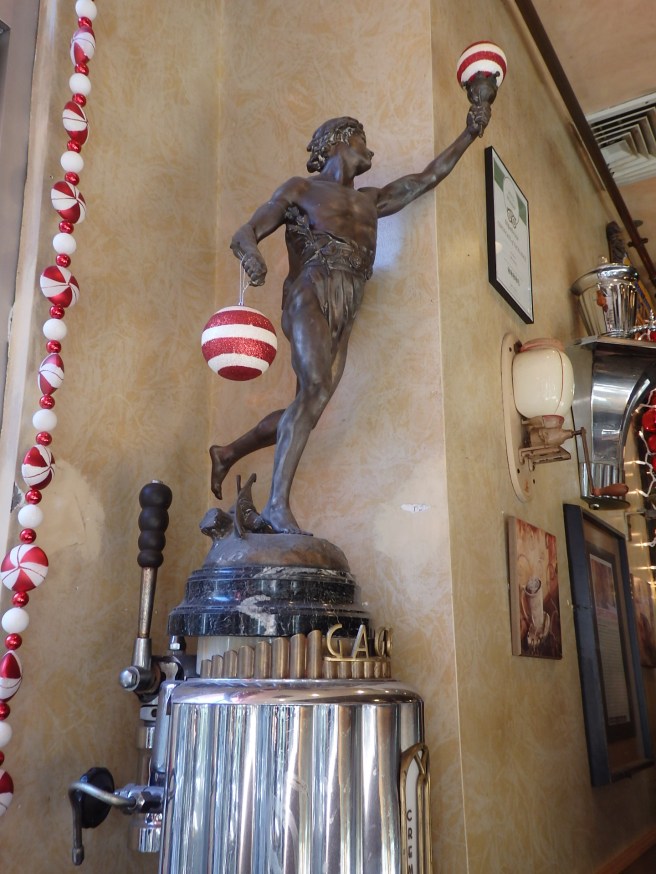
With a holiday touch.

Vittorio’s in the North End is famed for its espresso and pastries. With Mercury as one of the coffee makers, you can see why the neighborhood is also renowned as Little Italy.

Boston is a rich and varied destination – the Hub of New England, or the Universe, as they used to say. Living a little more than an hour to the north, we’re well within its orb.

ONE SIGN OF AMERICA’S CHANGING TASTES

Out in the middle of seemingly nowhere in rural Vermont.
Out in the middle of seemingly nowhere in rural Vermont, I thought this was farm equipment.

Yes, you expect a range of ethnic foods in any big city, and many smaller ones, including the place I call home, now feature a range of international dining options. But when you’re driving mile after mile inhabited mostly by cows, you’re surprised to find anywhere to eat, apart from the occasional convenience store gas station. You know, hot dogs accompanied by potato chips and soda.

This, though, was enough to make me swing around for a second look. As it turned out, they weren’t serving breakfast.

But this is what it turned out to be -- a taco stand! My, how America's mainstream tastes have changed!
Yes, this is what it turned out to be — a taco stand! My, how America’s mainstream tastes have changed!


FOOD FOR CONTEMPLATION AND GROUNDING

Through much of the history of the Society of Friends, Quakers lived under stick codes of conduct that shaped their distinctive Plain Speech and Plain Dress, along with a host of less visible restrictions. Apart from the Peace Testimony and sets of guidelines that would have us not swear oaths, gamble, live ostentatiously, indulge in most of the fine arts or other entertainments, and so on, those days are long past.

When it comes to food, Friends have long held to the “eat to live, not live to eat” standard, one nonetheless accompanied by a delight in fresh produce, good cheese, and gardening itself. Some of this outlook is guided by our testimonies of simplicity and, by extension, honesty, as well as a respect for quality rather than quantity. Alcohol has had a more varied history, given that it was a basic of daily life at the time the movement emerged in the mid-1600s. Initially, the offense was for “being disguised by hard liquor,” rather than imbibing itself. Only later did much of the Quaker world abolish the consumption of alcoholic beverages altogether. As social drinking has become more widely acceptable in recent decades, so, too, has much of that opposition abated in Quaker households.

That’s not to say individual Friends don’t follow dietary disciplines. Vegans and vegetarians are common in our communities, even before we get to the medically prescribed limitations of gluten, lactose, diabetic, allergies, and more. (Trying to plan for a dinner of potluck can be trying these days – should we save that for a later discussion?) And, a step away, smoking is always discouraged.

As I discussed in Around the Table, a Dec. 17, 2015, posting in the Talking Money series on my Chicken Farmer I Still Love You blog, the issues of feasting and fasting, as well as dietary limitations, are major components of religious practice and awareness. To my thinking, apart from the reasoning behind a ban on one item or another is the essential strengthening of an ability to say No – to curb one’s initial desires and impulses, a virtue that can be conveyed to more difficult decisions in one’s life. We start with the simple things, after all.

Fasting, a common practice among early Friends, is a cleansing I came to appreciate through my residency in a yoga ashram in the early ’70s. It can also be quite liberating and joyful. You’d be surprised.

More recently, I’ve had to acknowledge another kind of fasting – one in which food is not totally avoided but instead the daily diet is greatly curbed, with entire categories of food perhaps removed from cooking or eating.

Looking at the complex regulations the Eastern Orthodox churches impose for Advent and Lent, my wife remarked that vegan would generally fit right in. Since we’ve already (voluntarily) been observing Advent and Lent by abstaining from alcohol, we decided to switch to a vegan cuisine for last Advent, something we’ve considered returning to with Lent, which starts Monday. Yes, I do miss the milk in my coffee, but I’d been intending to reduce the sugar intake anyway – while sweets themselves aren’t off limits, sometimes one step makes another one easier, too, as I’ve found here.

We recognize there are two ways to approach this. One is to go for self-mortification, a bit of suffering, if you will. The other is to delight in many of the options that get overlooked in the abundance we enjoy daily. We’ve been intending to eat more beans, for instance. How do we rise to the challenge? What do we have to use instead of butter or olive oil? Is margarine cheating? How about coconut milk? You get the picture.

Since the Orthodox do relax the Advent rules at times during the week, we’re pondering similar with fish and (other) meat – once or twice a week, at most, and then in small quantities – as an alternative approach . Well, we will confess that Thanksgiving Day was a big exception in our Advent observance. The rules for Great Lent, by the way, are much stricter than those imposed in the approach to Christmas. How do the Orthodox do it?

Anyone have similar thoughts on Kosher or Halal or the yogic considerations of Satvic, Rajasic, or Tomasic or any of the other places where spiritual practice meets earthly tastes? Pipe up, please!

THIS OLD HOUSE

I used to like the Public Broadcasting System series, back before I bought an old house. Now it’s too painful. Look at all this old wiring, the plumbing problems, the rot and warping, the fact the bulkhead needs replacing. The flaking paint, again. (Bulkhead? Didn’t even know what that was beforehand.)

What else do you want to know about New England?

 ~*~

Home Maintenance 1

For more on my poetry collection and others, click here.

PULL UP A SEAT

It’s a kitchen table, rather than a largely ignored dining room. Or outside, in the rain. Or even a restaurant or diner.

Well, in one of the poems, it’s linen covered beside a black pond. But that’s for a formal occasion.

As for the rest of the series, the pieces reflect home and family and a calling to intimacy. How informal do you want to get? And how do you like your tea?

Returning 1~*~

For your own copy, click here.

FREEZER DISASTER TIMES TWO

Somewhere early in our time of living in this house – the property that includes the Red Barn – my wife and I bought a freezer. And then we got another, free, which also found a space in the barn. (Somebody was moving and couldn’t take it with them. So we came to their rescue.)

These two upright chests were great for stocking up on grocery specials, as well as banking our garden harvests and a lot of prepped dinners. How did we ever live without them?

When I was employed, these towering white caches were a source for many of my dinners at the office – and I was surprised by how much money we saved as a result. Cuban black bean soup, anyone? Just one of the specialties made in quantity and stored in serving-size plastic containers. As for our side-street harvest of real tomatoes, Brussels sprouts, blueberries and raspberries, eggplant, and more? Or loaves of homemade bread? Or the marked-down meats found at Market Basket? How could we live without them, indeed.

Both freezers were packed to the proverbial gills. And maybe then some.

From my perspective, this was glorious. What would we do for Sunday dinner? How about a roast chicken? How perfect! Some weeks we needed little more than fresh milk from the store.

But! This winter brought two disasters. First, one freezer died, and that meant salvaging what we could, seeking homes for some of the packages elsewhere (elder daughter, especially, rushing to the rescue), along with an orgy of using up what treasures we could.

All this happened, mind you, before the scheduled defrosting of the freezers and reorganizing of the contents, a delay prompted by other household crises.

My, what feasts while they lasted!

And then, before we’d cleared our way free, the other freezer died. This was getting serious! There was no margin left.

Some of the meat, having thawed, went straight into the trash. No value in having people getting sick. A few hams and pork tenderloins were gifted to neighbors, if we could catch them. Elder daughter had a few more spaces in her freezer and refrigerator, bless her. (Younger daughter, the vegetarian, lives too far away for consultation.)

Skip ahead a few steps, and we have a store-bought new freezer. The second one, cross your fingers, seems to be working again. The dead one’s gone to the city dump aka recycling center, via a borrowed pickup. (Yes, my back and ribs are still aching.) Some of the thawed meat has been cooked into sauces and the like and returned in new form to the new freezer. And we’re grilling each chance we can.

Oh, there’s so much more I could be saying.

But at least our life seems to be back in some kind of balance.

I hope. Now, back to the intense rounds of planting the garden. We’ve got to stay ahead of the weeds — and the advancing daylight.

WE’RE HAVING A SHARE IN THE CATCH

This summer we’re participating in a program that’s introducing us to varieties of fish caught off the New Hampshire coast. Once a week we trot down to the natural foods store in town to pick up our delivery – our location gives us a three-hour window – and we return with a pound of very fresh seafood. Every week it’s a different variety (11 are likely over the season), and we get an email earlier in the week notifying us what will be on the way, allowing the cook in the household to begin considering menu options. Or we can go to their website for links to suggested recipes.

It’s not cheap – you pay when you sign up, in our case for the 15-week program – about twice what we’d normally shell out for what’s featured at Market Basket, but there are other factors to weigh in. For one thing, living in the Seacoast Region of the state, we’re very aware of the plight of the once vital fishing industry across New England and the struggles to sustain both a way of life for families and communities and the fishing grounds themselves. While we’re not militant local-harvest activists (it just isn’t economically viable for our part of the world, not with its long winter), we are inclined toward small-scale economics wherever possible (just consider the banks, for starters). So we feel good about our token support for our neighbors. In a way, it’s like a farmers market, except that we’re committed to taking the week’s delivery, the way you are in a community-supported agriculture (CSA) setup.

That leads us to another consideration, the fact that the program itself arises in an attempt by the commercial fishermen sailing from Seabrook, Hampton, Rye Harbor, and Portsmouth Harbor to counter the negative impacts of a practice begun in 1976 that directly sold the local harvest in international auction. Rather than having their fishing practices driven by global market pressures, they wanted a more sustainable alternative,  a strategy to better manage marine resources and fish more selectively. In response, four years ago the harvest coop they organized was given an ownership right to collectively manage the federal groundfish fishery. In other words, there’s a strong environmental component here, including a more efficient use of high-cost fuel along the way. As they say, their fish catch hasn’t been sitting on the boat for a week – it comes to port the same day it was caught. Good for them!

Of course, all of that still needs to come together at the dinner table. This isn’t charity, after all, but a win-win deal we’re looking for. We can start with a sense of adventure as we explore previously unknown types of fish. (Acadian redfish, anyone? Or dabs? Or dayboat dogfish shark?) Let me rave about the monkfish on that front – as I ate, I kept thinking this could be lobster tail. So what else is swimming in the same water with me each summer? My curiosity is heightened. What they’re delivering isn’t everything in the local catch, but it is a way of supplementing their income and providing more balance in their cash flow.

We’ll admit this is our splurge, the way our weekly wine tastings were, back when I was duly employed, or the half-pig we ordered from a farm in Maine, two other examples that allowed us to learn more of the range in taste and satisfaction in our world. Admittedly, we couldn’t do the fishery program when the kids were still living in the house – they can be picky that way, with one easily upset by the mere whiff of fish cooking. Oh, my.

Initially, too, I thought a pound would be on the skimpy side when it comes to our dinner, but we’re finding the enhanced freshness in flavor satisfies in smaller portions – we can serve three and still have a bit left over. Actually, it’s about what we’d get in a restaurant while spending much more.

Reading the profiles of the participating fishermen on the website has me wondering how long I’ll go before making a list of their boats, just so I can identify them when they pass by in the water or tie up at dock. They seem like nice guys, too. Maybe we’ll wave. It does change my perspective, doesn’t it.

Now I’m wondering about similar alternatives being developed around the world. Pipe up, if you wish, along with your own growing awareness.

~*~

New Hampshire Community Seafood is a cooperative of fishermen and consumers that has 18 pickup locations with deliveries spaced from Tuesday through Saturday.