Ten special diets

These days it seems everyone’s on a restricted diet.

Here are ten of them.

  1. Kosher. This means the historic Jewish restrictions. You know, no ham. But that’s just for starters. And even the plates must be blessed.
  2. Halal. The Muslim equivalent of dietary laws. By the way, Ramadan still sounds like cheating. I mean, what’s the hardship of refraining during the day if you can eat like a pig, uh, beast all night?
  3. Eastern Orthodox fasting.  Food’s allowed, but the options are highly limited. No olive oil, for instance, and no meat. It can be tricky.
  4. Caffeine-free. The Mormon church recently lifted this restriction from carbonated drinks, though it still holds for hot coffee or tea. Some other disciplines, including yogis, also ban it.
  5. Vegan. Or its less restrictive vegetarian alternatives.
  6. Gluten-free or lactose-free or peanut-free. Based on a medical diagnosis, OK?
  7. Healthy Heart. A little broader, largely to reduce cholesterol levels.
  8. Weight-loss. Oh, my, these are endless and ever so trendy.
  9. Alcohol-free. Sometimes as a religious tenet, sometimes as a consequence of addiction.
  10. Hindu. No beef. Those cows are sacred … and sources of milk.

Are you observing any dietary restrictions?

Ten essential cheeses

When I was growing up, cheese in our household was almost exclusively of the processed variety. Some even came out of a jar, like yellow glue. Grandma and Grandpa would have the real stuff – Colby longhorn or a bitter Swiss, mostly. It wasn’t until I was off on my own after college – and in the ashram, especially – that I discovered how marvelous natural cheese could be.

Here are ten favorites.

  1. Cheddar. These days, we rely on Cabot. Mild to sharp, it’s all good.
  2. Calef’s. A general store in a neighboring town makes its own, starting with rat trap but extending into cheddar. The roasted garlic and wasabi variations are special treats here, especially after picking apples.
  3. Mozzarella. Lovely stringiness for pizzas and French onion soup.
  4. Parmesan. Grated on soups, pastas, and salads, of course, but also delightful with eggplant.
  5. Feta. Let’s start on salads for a Greek twist.
  6. Baby Swiss. Especially when made by nearby Amish cooperatives as I learned living in Ohio.
  7. Provolone. Love it on sandwiches, hot or cold.
  8. Gruyere. Uncork a wine, too, and open the crackers.
  9. Gouda. Ditto. With a sliced apple, anyone?
  10. Cream. For bagels and cheesecakes, especially.

What would you add to the list?

What would you eat in Kittery Foreside?

The square where it’s happenin’.

Kittery, Maine, is a few miles downstream from where I live. It’s also across the Piscataqua River from Portsmouth, which is loaded with eateries – maybe as many per capita as Manhattan.

For much of its existence, Kittery has been pretty blue-collar. It’s home to the Portsmouth Naval Shipyard – the U.S. Navy’s oldest continuously operating yard – and now tasked with the upkeep of nuclear submarines. It’s also home to a lot of lobstermen.

When I first came to New Hampshire, the Kittery Grange Hall was the scene of a monthly contradance – both the grange and the event now ancient history.

Oh, yes, and its strip of discount outlet stores along U.S. 1 is a major tourist attraction. Seriously. As is the adjacent sprawling Kittery Trading Post.

But with Portsmouth booming and the cost of its retail space skyrocketing, Kittery has been undergoing a transformation. Nowhere is that more apparent than in Wallingford Square, which used to be a gritty cluster of bars around one of the shipyard’s two gates. Today it’s been rechristened Kittery Foreside and is the center of some enterprising fine dining and food sellers.

Here’s what you’ll find.

The keystone restaurant.
  1. Anneke Jans. Upscale trendy dining with a devoted following. It’s the culinary anchor.
  2. Rudders Public House. Specialty: Kittery Fried Chicken.
  3. Lil’ s Café. Crulers, anyone?
  4. AJ Wood Grill Pizza. Get the picture?
  5. Anju Noodle Bar. For that Asian touch.
  6. Wallingford Dram. Artisan cocktails in “that walk-in closet, timeless gem of a bar,” as one critic describes it.
  7. The Black Perch. Duck-gravy laden pontine.
  8. Festina Lente. Rustic Italian.
  9. Authentic India. As it says.
  10. Tributary Brewing Company.

~*~

Nearby is the Beach Pea bakery, the best baguettes around, and Loco Coco’s Tacos, with its wonderful fine Mexican cuisine.

Naval shipyard viewed from the square.


Fresh spuds

I stuck two rotting potatoes in the ground and got eight pounds in return.

Not a bad investment, is it?

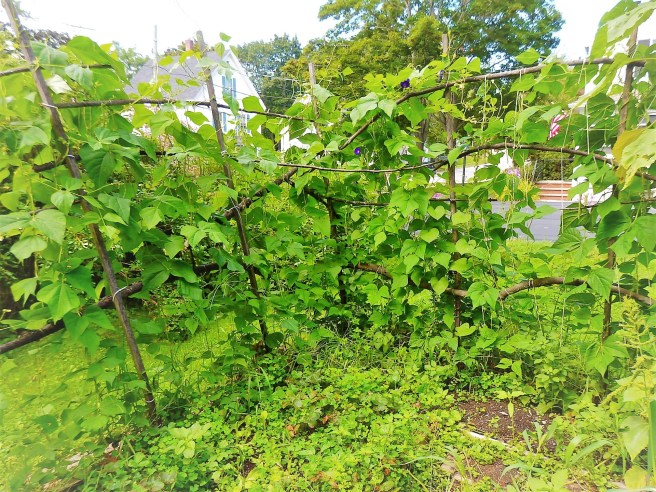
Well, I stuck them in two old planters with just a covering of soil at the bottom late last spring and kept covering them as the stems and leaves shot upward. Didn’t take long for the entire container to be full. Three or four months later, in early September, the lush foliage went kaput, and it was time for harvest.

Have you ever eaten truly fresh potatoes – the kind picked just an hour or two before cooking? It’s a revelation. Roasted, they’re so creamy and sweet. Melt in the mouth, if you nibble at the oven. By the time they get to the table, they’re getting some firmness … but, oh, they’re still heavenly.

You don’t have to visit Maine or Idaho or even live there to discover what this means.


Welcome to the bar

At the risk of being considered a prude, I’ll have to admit I’ve rarely been fully comfortable in a bar. Could it be a reflection on my tea-totaling upbringing? Still, I can think of places I’ve loved to listen to jazz or even read poetry to an appreciative audience.

The developments in my novel What’s Left, by the way, parallel events in at least one restaurant/bar I’ve heard related. And then there is an old church a few towns over that has a respectable history as a launching pad for hot musical acts. I’ve had some memorable musical experiences there, come to think of it.

Back to the book. Nothing seems to escape their notice as they anticipate changing their core business. Here’s how another passage stood in an earlier draft of my novel:

Our Taverna presents its own challenges. Under Papou Ari and Papou Perry, it’s been largely an afternoon refuge for retirees who are joined by tradesmen quitting their shifts. But it’s never developed as a destination for older students or faculty, who have gravitated to an English pub across from our Hoosier Dog House.

Barney senses the Taverna might attract a younger late-night crowd as the original clientele thins out. Plenty of up-and-coming musicians would be eager to play for us if the Taverna stays open later – and, as we discover, stay busy to the end, most nights.

Oh, I’m so glad Cassia stopped talking like this! In the final version, she’s pretty snippy. She really can have a hard-edge reality.

So as we put the Taverna together? What would most attract you to a nightspot – live music, big-screen sports action, the crowd itself, a quiet corner for conversation, a dart board or pool table? Something we’re overlooking? Is there someplace you especially enjoy? Tell me about it, pretty please. Imagine ourselves sharing a drink.

When food opportunity knocks

Among the talent that shows up to work at the family restaurant in my novel What’s Left is a very, very talented baker. As they conversed with him, they could smell opportunity.

Still, these two lines were more than the scene needed:

What can you do here with what we have?

Pierre rolls out a list. We’re impressed.

Oh, I’m so glad Cassia stopped talking like this! In the final version, she’s pretty snippy.

~*~

Let’s just say everyone rose to the occasion. As a result, he started making real French bread to southern Indiana – and a lot more many of us take for granted nowadays.

Of course, the world doesn’t always come to you. When it comes to food or drink, where would you like to travel? Or, for that matter, return?

Getting ready for the big moves to begin

By this point in the story, we have what could well be a business-based fairy tale. Everything seems blessed. For me, as the author, this required a lot of business-cap thinking. For the reader, though, many parts can be distilled and compressed – a suggestion rather than detailed descriptions will do.

Here’s how part of the timetable stood in an earlier draft of my novel What’s Left:

We modify our plan. Bliss will open first, at the beginning of summer. It requires minimal behind-the-scenes support and will give us a sense of the new building’s food storage and laundry functions. The traditional Carmichael’s and Taverna would close for the month of August and reopen in the new space at the beginning of the school year – each with twice the seating of before. Graham worries that what’s felt cozy might now feel cavernous if we don’t attract a lot of new clientele.

Barney will have his hands full training staff and adjusting to the expanded operation. What dawns on us is that we’ll be veering sharply away from a purely family-centered operation. We’ll have to rely on a large staff. The kitchen design, for one thing, now has men’s and a women’s locker rooms, plus staff restrooms. Not everyone can run home to wash up and change into uniform, not the way we have with Big Pink around the corner. Will Barney be comfortable in his new role? This, too, is a gamble. If nothing else, though, he needs an office to shelve his cookbooks. 

Oh, I’m so glad Cassia stopped talking like this! In the final version, she’s pretty snippy.

~*~

Someplace around here I should have been asking myself what Harry Potter would have done in this situation. Despite the fact that many of these details are among those I turned up in my research, I’m on some very unfamiliar ground, as one insider reminds me.

If you’ve ever worked in a commercial kitchen, what would you most want to see in the new Carmichael’s? What common-sense touch would be most welcome from the workers’ end? What improvement is usually overlooked?