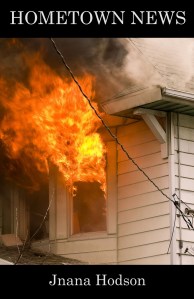
Finally, I turned the camera on the newsroom

My novel about small-market journalism originated as an experiment on my first PC, an off-brand back in the days before hard drives or the Internet. In this case, I decided to build a book as a series of variations on a theme relying on a template chapter that I then copied and pasted for development. Set in a newsroom, each day was the next day’s edition but sampled months down the road. Some of you may think of the movie Groundhog Day, but that was still seven years in the future. The key to the book’s development was a set of seemingly random search-and-replace possibilities I then ran through the manuscript – on both of the 5.25-inch floppy disks that were required for the full book. Other variations required physical input, one by one. Either way, think of Mad Libs with seemingly random repetitions popping up like loose threads through the entire tale.

The basis, of course, was a composite of several of the newspapers where I had worked. By extension, it could also represent offices anywhere, but I found myself thinking about how little we usually know about our coworkers. Often, it doesn’t go much deeper than a phrase they repeat all the time or a piece of their favorite clothing or some annoying habit they have. It was enough to sketch each of them through the rounds of the book.

And then I put it aside to season before tackling it again.

When I returned afresh, I had to admit that the variations were insufficient. The loops were, uh, loopy. By then, the revision was turning into a kind of paint-by-numbers to flesh out the bones.

The tale still needed more work. So much for my pioneering experiment with A.I.

~*~

Hometown News did take my fiction in a fresh direction. It wasn’t exactly countercultural, for one thing. And it took place largely within a workplace, with day-to-day drudgery many people might identify with or at least recognize.

While Kenzie in my hippie novels labored as a photographer on his campus newspaper and then on a small-town daily chronicle, he did move on to higher pursuits once he married. In contrast, when my savings ran out, I was back in the newsroom.

Another surprise as I look back. This manuscript was also in the works before my Baltimore sabbatical big writing spree opened.

I have memories of jotting down notes while driving Interstate 95 between sales calls in Connecticut. My time on the road and in motels left me plenty of opportunity for uninterrupted thinking.

Even with TV shows like Lou Grant and Mary Tyler Moore, the public had little idea of what really happens in a newsroom. At the time, the job carried some prestige, if not outright fear.

There was an adage that every newsman had a novel waiting to be born, and there was the cliché of the crusading reporter battling corruption and crime. Even Clark Kent and Lois Lane of Daily Planet renown. Mine wouldn’t be anything like those. The villains weren’t politicians or mobsters but, in the ultimate view, capitalism itself. And here I was, cheering for small, local enterprise.

For me, what emerged is the most problematic of my published novels, yet one of the most fertile. It certainly has the darkest humor and a large dose of dystopia.

I do recall one newspaper editor who candidly admitted to having taken a popular genre novel and essentially written over it to launch his own successful line of commercially published successes. Should I note that the owners of his newspaper also had one of the top book publishing houses in the world? Connections? Don’t discount them. Just don’t think of them as literary success, which I was aspiring to.

Rather than having the high drama of big bad guys somewhere outside of the newspaper company, mine were more insidious. In my experience, though, a more pervasive conflict smoldered behind the scenes within the business itself between the journalists, on one side, and the bean counters and their bottom line of obscenely rich profits, on the other. As the saying went at the time, many newspapers were a means of printing money for their owners. Not that much of it ever got down to the workers.

Let’s just say, too, that some papers were more competitive and innovative than others.

In my job of calling on editors across the Northeast, I heard personal stories that added to my own insights from working within two dailies that had undergone major transformations under inspired leadership, as well as lessons from leading a small paper in the town I call Prairie Depot and some stints elsewhere. Let’s skip the rest of the resume and get on with the book.

It was a world all its own. Or so I thought. And yes, it was set vaguely somewhere in the American Midwest.

Check it out at my Jnana Hodson author page at Smashwords.com.

Acid test essayist and novelist: Madeleine L’Engle (1918-2007)

Although she’s famed for her young adult fiction, what I appreciate more is her personal writing reflecting her life with a well-known actor, including the years of hiatus they spent in a 200-year-old farmhouse in Connecticut before they returned to New York City and his acting career.

Her candid reflections on being subject to prejudice from both liberal parties, who shunned her books for their religious content, and from conservative Christians, who avoided them for their universalism, speak of a painful reality for those of us who embrace a radical, even revolutionary, faith.

A devout Episcopalian, she mentions deep discussions with Chase, who turns out not just to be the father of a fine friend of mine but also a rector of the Cathedral of Saint John the Divine in Manhattan. My friend has mentioned babysitting her grandchildren in her apartment several floors above his family’s.


More than volcanic ash spewed out from my days in the Pacific Northwest

Stephen King has advised novelists to have only one Big Idea in a book, but I came across that way too late to put it into practice. (Maybe if I ever tackle another novel?)

As I hunkered down in my self-imposed sabbatical in Baltimore – or was it self-incarceration or even cloistered? I did little else – my attention eventually turned to a more recent span of my life than the Kenzie novels covered. It was time to consider my nearly ten years of marriage and its breakup. If only I really knew how to star in it.

I thought that this next book would be about the most heavenly time and place imaginable, but as I typed and would eventually see, the real story was about a deeply troubled marriage, with me holding the debris after it blew up and a whirlwind romance afterward left me in a fog where I was.

So courtship, marriage, and relationship per se were one big subject. (Idea, in King’s expression, feels too refined.)

The other was the Pacific Northwest as seen from the other side of the Cascade mountains in Washington state, a land that is essentially desert rather than rainy gray Seattle.

One was something many people had some familiarity with, but the other was what I found more enticing as a writer. Besides, I had written many landscape poems I could draw from. Swami’s insight from her first visit to India, that the reason Hinduism had so many gods was a reflection of the ways each locale had a distinct vibe. The Yakima Valley and the Cascades were unlike anything I had experienced in the eastern half of the U.S. Especially the vast spaces you never see in a movie or read about in a book. And there I was with my new bride.

My inner drive was to better understand – and remember – the events leading up to what I thought was near perfection, my Promised Land. Except that it all blew up after four heady years, and we retreated eastward in haste. Now, six years later, I was trying to make sense of everything, and writing is my primary tool of thought.

One big hurdle was that I still had too many unresolved issues to provide clarity on the relationship struggles. I couldn’t see that the darling I thought every reader would find fascinating was, in a wider view, dislikable.

The plot – and the manuscript – kept growing by the proverbial pound.

Baltimore for me was so many lonely nights broken periodically by sex that wasn’t with my beloved. The whirlwind who came after the marriage. The one others have called my one true love. If only she had been true.

~*~

I really should go back to my journals to get a clearer sense of what I was going through both as I drafted it and also during its revisions. I suspect the reality would be painful, even embarrassing, and as I write this, those volumes are wrapped in plastic under the house renovation. Maybe that’s for the better.

What was I even originally calling the manuscript?

What coalesced for me was the many dimensions of the word “promise,” including the wedding vow, potential, and what I saw as our Promised Land. And then I had the flash of ending the book on a shocking note.

Well, so had much of my life.

I suspect that I spent far more effort than I’ve thought on the novel that now stands as Nearly Canaan.

Somehow, I even had a round with a real literary agent, who ultimately passed on the project.

During later revisions in New Hampshire, the big blob of material I had in hand turned into three parallel volumes – Promise, Peel (as in apple), and St. Helens in the Mix. And I was wondering about my subsequent engagement and the young woman I thought was a perfect subject for later. (I now see how banal that would have been.)

Would the project have been any easier if I had all the facts rather than empty denials and evasions? What if I had steered this more into the fantasy realm, perhaps having the earth magically speak directly to Jaya? Or broken it into a sequence of short books, each with a sharper focus?

A very bruised journalist, alas, was still at the helm, one still engaged in a difficult, painful exile and trying to report on the facts before me.

~*~

I’m trying to recall books and authors I was reading at the time, especially ones that might have nurtured this project. What comes to mind are Ann Tyler (I can smell the back entry of some homes in her Roland Park section of Baltimore); the Random House Vintage Contemporaries series edited by Gary Fisketjon and writers like Jay McInerney (Ransom more than Bright Lights, Big City) and Tama Janowitz; beyond that, Larry McMurtry, Tom Robbins, and Joan Didion; as well as Calvin Trillin’s U.S. Journal letters from here or there in the New Yorker. I also had John Nichols (Milagro Beanfield Wars), Ken Kesey (Sometimes a Great Notion), Edward Abbey, and Ecotopia.

~*~

Promise came out as an ebook at Smashwords but went nowhere. Rather than pay for covers for two companion volumes, I released them as PDF freebies at my Thistle Finch imprint, only to find nobody was downloading anything that big. Ditto for the full-length poetry collections. There would be a major refocusing of the offerings.

Acid test novelist: Kurt Vonnegut (1922-2007)

When I first encountered his writing during the fall of 1968 at the recommendation of a friend who was attending a college elsewhere in Indiana, Vonnegut was a breath of fresh air. I loved the sassiness, hipness, and dark humor of books. They had none of the pretentiousness of serious literature but were seriously satirical.

Besides, he was writing about the heartland of the neglected Midwest, at least at one point in each book. God Bless You, Mr. Rosewater nails the milieu and remains my favorite.

Overall, though, I feel an overarching nihilism negates a redemptive mission for his work. As for the gimmicks? Let’s just say this former favorite has shrunk in my estimation over the years.

Employment is a big thread running through my fiction

In my parallel universe, my real-life life, newspapers were caught up in technological “advances” that kept setting us back. Those changes had started well before my sabbatical break, but they were speeding up. Back when I was starting, perforated teletype tape meant we really couldn’t edit stories we received from the Associated Press or United Press International or similar services. And then scanning of typewritten pages made improving even staff reports physically difficult. After that came the early stages of computer screens and keyboards, where editing took about three times longer than it had with a pencil – moving that cursor around took more effort, certainly, and computer crashes were commonplace. These were all matters that impacted the emerging story of Hometown News, though I believe anyone working in a large business office would have parallel experiences to relate.

We forget how much reliability our laptops and PCs have gained. Does anyone else remember losing a draft to a static electricity spark that then erased whatever was on your screen? Or, for that matter, when it was a bigger power outage?

I could detail the shifts from letterpress and hot type to pasteup and eventually pagination or from typewriters and linotype machines to early computers to, well, the digital devices we have today or from letterpress to offset printing and now digital editions skipping paper altogether.

Or similar leaps in photography, as we see in following Kenzie.

~*~

Paid work occupies a large part of most adult lives. Even when it doesn’t, how we handle our money, wealth, time, and so on is a highly emotional issue, no matter what the dismal science of economics insists. (For that line of useful inquiry, go to the Talking Money series on my Chicken Farmer I Still Love You blog.)

I just couldn’t create characters without their having jobs. Well, most of them – the hippie farm had some of dubious means.

Besides, so much of a typical male’s identity and life purpose is tied up in his job, especially when he can take pride in it. The job even defines his social circle.

I didn’t want to add another book about a hopeful writer to the literature. What a cliché. Or a musician or actor or even a painter. How about a plumber or fireman or circus clown?

But I still needed a witness figure for the history abstracted to fiction that was before me. I defaulted to using a photographer, in part because I had wished I had taken up a camera, if only I could have afforded the time and a darkroom, blah-blah-blah, and in part because I had been a serious visual artist in high school. You can see those elements developing in Daffodil Uprising and later coming together in What’s Left, but they also play out in Pit-a-Pat High Jinks and Subway Visions. I’m a highly visual guy in my awareness and thinking, OK? The fact he was employed at a newspaper is one part I couldn’t evade.

I still value novelists who manage to set their story outside of the writing world, and that includes universities. Charles Bukowski gets points for me for his novel Post Office. Well, I guess that’s also where genres kick in, too. They’re about detectives and spacemen and billionaires and cowboys and so on.

Photojournalist? At the time of the first draft of Subway Hitchhikers, I didn’t have any models to draw from, but that quickly changed. I wound up working with some of the best in the business.

Over time, photography, the kind that required light meters and F-stops and film and darkrooms, became ancient history. That part I would have to intensely rework and explain as my books underwent revision, thanks to Cassia in What’s Left.

In contrast, Hometown News was primarily about work. I had no problem in this case where everything took place at a newspaper plant, though the economics of the surrounding community also emerged as a central thread.

Jaya became a more difficult case. Her career in the early drafts was drawn from my newspaper offices and hours, now vaguely abstracted to management in general. It would get more specific in the revised titles, where she specializes in nonprofits management. It’s a real job description in a major component of the economy. For that flash of inspiration, I could look to one neighbor in Dover and the impact she had statewide in peace and social justice matters.

Acid test essayist and poet: Kenneth Rexroth (1905-1982)

Indiana-born in the shadow of Chicago, Rexroth’s childhood took place in a liberal household filled with socialist activity in the years before the First World War. The radical network across the Midwest that he details in his Autobiographical Novel will surprise most Americans, who believe it was confined largely to big East Coast cities. Not so, as he insists.

His family was at a less restrictive edge of the Brethren heritage, today a handful of pacifist denominations where some still resemble the Amish. It was very much a counterculture from its arrival in Colonial Pennsylvania and Maryland and on through the Civil War. While Rexroth himself headed in a much different direction, some of those roots continued to shape his actions and his religious questioning and questing.

Orphaned in his teens, he broke loose at 19, filled with anarchist thought and an IWW (Wobbly) identity, hitchhiked west, and worked odd jobs, including a Forest Service stint at the Marblemount Ranger Station in the North Cascades, where Gary Snyder would later spend several crucial summers in the high fire watch posts, as did others who came under Rexroth’s spell.

With a wife, a painter, he settled in San Francisco in 1927 as what his biographer calls “forerunners of the flower children who flocked to northern California during the fifties and sixties.” All along, he was notably active in civil rights, anti-war, and feminist circles, along with jazz and Buddhist influences. His book, Communalism: from Its Origins to the Twentieth Century, remains a fine overview of counterculture communities over the centuries. In some of these circles, he was aligned with Brethren, Quakers, and Mennonites, perhaps without being fully aware of the connection. His personal life, however, had its tangles.

His translations of classic Chinese and Japanese poetry are what first caught my attention, and still do. His own works are strongly crafted, often with an erotic strand.

He’s sometimes called the father or even the heart of the Beat movement, both as a mentor and as the MC at the famed reading at San Francisco’s Gallery Six in 1955, but it would be more accurate to call him a godfather of the Bay Area poetry renaissance that began blossoming before that and flourished for several decades after. Weekly readings in his house now sound like a who’s who of literature.

I remember that when he died, about the same time John Cheever did, Cheever got the accolades in the press while Rexroth got brief mention. I still think they had it backward, considering the lasting influence of each.

When a fictional scene can use a shot of reality

While I’m thinking about visuals, let me mention a few ways they’ve helped me in creating my novels.

Not to slight dialogue, even when you nail it, or, for that matter, narrative, but a visual detail can be a great way to spark attention in a character development or a scene. It can make a passage visceral. It can rescue a connecting passage that’s gone flat or leaving you floundering for just the right idea.

I don’t know about you, but my memory overlooks a lot of telling specifics in the history I’m investigating. It’s not just memory, either, but so much that should be obvious but we simply block from awareness. That’s where I’ve found photographs to be a great prompt. Sometimes they even provide data, as my Orphan George blog demonstrates in posts examining family photos, when they’ve been available. Other genealogists can weigh in on ways snapshots and portraits have provided crucial data.

Through many of my moves, I didn’t even have a camera. I have no shots of many of the people who were central in my life, not even some of the lovers or places I’ve inhabited. The shots can counter my tendency to idealize. A bit of grit can restore some reality.

In the process of writing and revising my novels, I began collecting photos from magazines or other sources as prompts. This character in my book (often they’re a compression of several real people) might look like the one in this photo or wear something in that. Or here’s a small-town square that would work. They even allowed me to reconstruct a darkroom for Kenzie.

The Internet, of course, has made this backgrounding much easier.

Acid test novelist: Ken Kesey (1935-2001)

Although my classmates in a contemporary novel course rhapsodized over One Flew Over the Cuckoo’s Nest and the author’s later role as a Merry Prankster advocating LSD use, I was fonder of Sometimes a Great Nation, which I read while living not all that far from its setting in the coastal mountains of Oregon. Sections from the unfinished Seven Prayers of Grandma Whittier were also tantalizing. Now I am wondering about his naming of the grandmother, as a nod to … Quaker?

Kesey is fascinating as a forceful, larger-than-life counterculture celebrity, even notoriety, from the Beat movement on. How could anyone begin to compress his activities into prose, either fiction or nonfiction?

Both of his novels were published by the time he was 30. Maybe he was just too busy living to continue.

Let’s be clear, you do judge a book by its cover

With my training as an artist, I have some strong feelings about book covers. Most of the ones I see leave me cold. I think they’re too cluttered, and most of them lack a strong graphic element – I prefer a good photograph though am coming around on the painted image argument – and I like a clean, easy to read impression. Some of the typefaces used for the title or the author are nearly impossible to make out.

I did have a friend who was a professional illustrator for a Fortune 500 corporation. CAD (computer assisted design) was overtaking the field, and he felt it was destroying his artist’s hand, the one with the Rhode Island School of Design sharpened skills. His aspiration was to design old-fashioned book jackets, and while his style there wasn’t my cup of tea, I could see its appeal. Fortunately, he conceived a children’s book that took off, in part because it was based on a Pete Seeger song, which did get buyers’ attention. And led to many more all on his own.

I still don’t understand all the nuance, though. Is it true that a certain strand of fantasy is supposed to have a specific element woven into the cover to alert a potential reader that this is the subgenre she’s looking for? You know, maybe a touch of moonlight or a small bat in flight or a golden glimmer in someone’s eye?

I am learning, though. A cover makes a promise with a reader, so I’ve heard at Smashwords.

My thoughts on cover design and some of my favorites appear in earlier posts here at the Red Barn.

Self-publishing requires much more than merely producing a compelling text.

Naming a book is hard enough. For the record, I found naming What’s Left to be my most difficult, as I’ll explain in a future post.

In the world of books, and not just ebooks, a strong cover is crucial.

If you can afford to hire an illustrator or graphic artist to design yours great. I’m envious.

My first novel, in paper, wound up with an “art designer” misfire. Rather than respecting the black-and-white photo of passengers in a subway car, a flat yellow lotus shape was cut into the image with the title and author credits inside that field. It didn’t fly. In addition, my name wasn’t left as simply Jnana, as I desired. It was the full yoga version, an additional five syllables or 14 letters. Well, it kinda has a 1950s feel, even with some graffiti on its walls, but the action was all high hippie ‘60s and early ‘70s. I’m now wondering if getting a tagger to do the cover would have been a more successful alternative. I’m sensing it would have been a more in-your-face result. Buy me now!

For my first round at Smashwords, I hired a book designer who was, I seem to recall, living in the Czech Republic. Emailing made everything easier, including paying him via PayPal, which was new to me. Since he had a deal with a stock agency for low-cost photos, I rifled through its online pages filled with shots that might fit my need.

It’s harder than you’d think.

A good cover isn’t a poster. It’s more like a billboard on a much smaller scale. And your potential readers are zipping by.

The right photo turns out to be a rarity. It has to somehow reflect the story and still attract a buyer.

Even when you find a good fit, there can be problems. For instance, the photo I settled on for Hippie Drum was a black-and-white portrait of a shirtless young male playing a set of Conga drums. It even looked a lot like me at the time of the story. Little did I know how many viewers it repulsed.

There is debate over showing a person’s face on the cover. It can limit a reader’s perception of your central character, for one thing, and one reader’s ideal can be an instant rejection from another.

If you’re going the human face route, you may find the perfect photo with one slight flaw. She’s a redhead while your character’s brunette. It may be easier to tweak the book to fit the cover.

The experience of tweaking a character to fit the cover image.

There’s also a debate over a painted or drawn artwork versus a photograph.

When I got around to designing my own covers, I came upon a drawn image of a single daffodil bloom. How perfect and I still love it. And within the title I inserted a peace emblem for an “O” in DAFFODIL SUNRISE.

A few years later, when I changed the title, that cover went out of circulation. That peace emblem just didn’t work with the new version’s Kindle print-on-demand cover, either.

I have to admit a special fondness to the ones on Subway Visions, Yoga Bootcamp, and the Secret Side of Jaya – none of them photos.

Jed Vance does have a sense of déjà vu all over again

Back in my wildly ambitious youth, shortly after graduating from college, I envisioned writing a genre-bending novel blending politics and science fiction. Well, my degree was in political science and sci fi was one category of literature that had a growing readership.

My premise was space aliens dropping a young male off in an older suburb of Cincinnati, as in Ohio, where he would be groomed to run for president of the United States. With a nod toward what we now classify as AI, he would be perfectly programmed to fit the market surveys. And with another nod toward what is so-inaccurately called “reality television,” he would be given a fictional past and identity.

The working title was The Cowboy from Mars, and this was back in the early ‘70s.

~*~

I hate to admit  that getting from there to an acutal campaign narrative required much more development than I was equipped to produce as an aspiring novelist, and a race for the White House could have been its own War and Peace in terms of characters and pages. Should I add that comedy is very hard to write?

Was I wrong to assume the project had potential?

Is what we’re facing today some kind of weird acid trip?

I mean, the man who presumptuously eliminated the periods from his initials for some kind of marketing vanity but grew up not that far south of me in what looks like far more privileged economic conditions now appears weirdly, well, like a silicon boob. I do hope that doesn’t offend anyone but it is the best I can do.

~*~

Looking at the current political situation has me seeing what would have been unimaginable in its absurdities. It really does seem fictional, outrageous, even tragic. It’s enough to make me wonder which candidate came from Mars or beyond.

As for those of you viewing this from outside of the USA? What are you making of it?

From what I’ve seen of the Founding Fathers of my country, I can say that they believed in rational thought. I hate to think they were wrong there.

Maybe that’s why I couldn’t write that novel.