While Tom Wolfe charged that no great novel sprang from the hippie counterculture, a challenge akin to the holy grail of the great American novel, his quest overlooked some fine stories that reflected any of its many dimensions.
Among the gems are the three self-published novels of DeVillers’ Eve Chronicles, grounded in the author’s experiences in moving from her native Wisconsin to the Pacific Northwest, where she spent several years – harsh winters included – with a crew in the rugged mountains of eastern Oregon replanting forests in the wake of clear-cut logging. I had heard of the legendary Hodads in the western part of the state (they took their name from the short-handled pick/spade they used), but DeVillers’ case gently probes the realities of the marginal existence and the varied types of people it attracted. Though this was not the Haight-Ashbury stereotype of the era, it was one of the counterculture’s many flavors. She was definitely back-to-the-earth throughout the span of the books.
Another was the holistic health-care work she took up in what she called a nomadic life before settling down in the Willamette Valley, where the Chronicles continue, again reflecting the conflicts of living out deeply felt values.
She began writing the novels after being diagnosed with MS and drew on her spiral-bound notebooks as source material. (Fortunately, those had survived her many moves.) I love the fact that she’s not inventing stories or characters but distilling what she’s known firsthand. She presents scenes – even aromas and lighting – I’ve experienced, too.
I was going to say her tone is reminiscent of Joni Mitchell but now see the singer was an inspiration. How right, then.
She was working on a manuscript about the health care industry and big money and big politics set in the Covid pandemic, but I don’t know how far she had gotten with it.
Levertov is a poet I began reading the summer after I graduated from college. There was something in her work that seduced me, something along the lines of Brahms and Rilke, as one early advocate said of her. (It was Kenneth Rexroth, whom you’ll meet later in this series.)
What I didn’t see straight-out was the religious underpinning of her work, even in her atheist phase.
I do remember an encounter after a poetry reading in Baltimore, where one audience member approached her and asked how one could sustain a pacifist stance while remaining an atheist. She replied that without faith, the practice was very difficult. A few minutes earlier, I had asked how she had come to become a pacifist and she replied it was through her first lover, who was a Quaker.
The ‘80s hit me with a couple of hard setbacks. First, Mount St. Helens blew up, as did my job in what I had seen as my Promised Land. I went bouncing back east, first to a stint along the upper Mississippi in Iowa and then three years in the Rust Belt of Ohio, where my shirt-sleeve management position ate up 60 hours or more of my life every week. Shortly after my first marriage fell apart there, my job was eliminated. At least I had a hot love going, with an engagement to be announced once I could relocate to Baltimore, where she had moved for her studies.
Somehow, I landed a field representative job with the Chicago Tribune’s newspaper features syndication service, one that allowed me to move anywhere I wanted within the 14 northeastern states I would be covering. Baltimore was perfect.
Except, once I ensconced in the top floor of an 1840s rowhouse in a gentile in-town neighborhood, my beloved wasn’t. If only I could get a straight answer from her.
Complicating matters was that I was out on the road three weeks out of four, home only to unpack and repack on the weekends. The job introduced me to a world many American men know: frequent flyer lounges, taxis and limos, hotels and motels, expense and mileage reports, quarterly sales meetings, three-piece suits custom made at Joseph Banks, a company car, bonuses. Newspaper management, especially on the smaller papers that I had known, were nothing like that. You might get a nice note from your boss or someone up the ladder thanking you for a particular job well done.
Getting from one sales call to the next gave me a lot of time for thinking as I drove or even reading, if I was flying. The time allowed me to decompress from a decade that had included 11 addresses in seven states. I could journey at ease or read or revise earlier manuscripts at night in my room, whatever its number.
My personal life included some of the loneliest nights ever but also led to my best friendship ever, a Plain Quaker who worked as a supermarket meatcutter when he wasn’t working as a nurse. I also had a circle of Mennonites who introduced me to four-part a cappella part-singing, a step that would lead me to the excellent choirs I would join in Boston and Eastport. I also visited among Friends, aka Quakers, and sometimes managed a few hours for genealogical libraries and archives or walking through cemeteries where my ancestors are buried. I even revisited the ashram and my old stomping grounds in upstate New York.
None of this apart from the newspaper world has entered my fiction directly. I thought she would be a fine character to build on, except in retrospect it turned out all too banal. What these experiences did feed was my poetry later.
Thanks to my best friend from my junior high and high school years, who was now living an hour south – unlike the previous decade, where we kept landing on opposite ends of the country – I obtained my first PC, something some of his buddies were building. It had 5¼-inch floppy disks, which would be ancient history to so many tech-savvy youths today.
In my travels, I saw much industrial wasteland. Not just Pittsburgh and western Pennsylvania or Sparrows Point outside Baltimore, but also around Philadelphia, across upstate New York, in Worcester and Buzzards Bay and the Merrimac/Merrimack River in Massachusetts and New Hampshire.
The newspaper industry was also taking hard hits. As manufacturing jobs disappeared, so did readership for afternoon papers, which were read by people taking the bus home or waiting for dinner. That greatly reduced the opportunity to place new features in their pages. As I was told, only a few years earlier, I would have had no difficulty selling to editors. Now, the challenge was keeping them happy with what they were already buying. I also saw great turnover at the helm of papers. I would curry an editor and have promises for a sale once the new annual budget was approved, only to find that he was no longer there in a year. The position I had aspired to and been groomed for was now revealed to be something less than desirable.
What became clear to the five of us out on the road was that the business was in trouble. One or more of us would be cut. I was the one. Besides, I really never was much of a salesman.
My observations of visiting other papers did augment my actual newsroom experiences that would emerge as the novel Hometown News.
A longish poem addressing his father, The Eyes of Blood, and then the poems experimenting with Kabbala are what caught me either in my return to Bloomington or right after, in the Pacific Northwest. Neither example fit the typical 20- to -28-line poems that filled the literary magazines, and each one worked a different vein – one essentially lyrical, the other, bullets.
At the time, I was reading and enjoying a wide range of the San Francisco poetry outpouring – I’ve long felt more at home there than I did with the New Yorkers of the era. Smeltzer’s on my list over some other better-known colleagues, probably because of a feeling of connectedness.
Despite acquiring a handful of his chapbooks, I wasn’t aware of his role in the San Francisco Beat scene, including jazz performances, but that detail has me wanting to go back to revisit his work, once we have room here for what’s currently in storage at the other end of Maine.
When I sat down to my personal writing, I felt an ongoing tension between the daily grind of newspaper editing that paid my bills, contrasted to my ambitions for something more permanent, more confidential, and more creatively advanced than the anonymous work that went into the next day’s trash. The pejorative “hack writer,” often applied to newspapermen from the early 18th century on, was what I aspired to rise above. The term has haunted me ever since reading Samuel Johnson’s derision.
In my private labor I aimed for something unique, thoughtful, sophisticated, meticulously developed, complex, and even challenging for both me and the reader. If news stories limited attribution for a quote as the neutral “said,” I nearly banished that colorless word from my prose, relying instead on everything from “answered” or “asserted” to “cried” or “swore“ to “wept” or perhaps “whispered,” with a wide range of variants in between. Do note, I’ve come to treasure a thesaurus for ways in can enrichen a text and sharpen the underlying thought and feelings, even though doing so requires additional time and consideration.
My journals, on the other hand, sought mostly to catch up on my life from the previous entry, often in cryptic terms I might get back to and fill in later, though that rarely happened.
~*~
Hemingway could write for a sixth-grade level reader because he was no longer in a newsroom. It could kill you, believe me, if it’s all you got to do.
I needed to foster my literary ambitions simply to keep my editing skills sharp.
It did make for tension in my private work, though. I still love a good 250-word sentence.
~*~
Let me also say something of the ethics. Being told not to wear a politician’s campaign button. No appearance of partisanship. Leonard Downing of the Washington Post even refused to vote in an election for fear it would taint his neutrality or objectivity.
Were we, as one girlfriend taunted me, ethically castrated? My first editor, Glenn Thompson, worked behind the scenes to get progressive things in motion and did urge us interns to have causes.
By the way, I have worked for some very conservative papers and also some very liberal ones. It didn’t affect what I did for them.
What is it that made Bukowski such an unmissable figure in the reading life of young poets and others in the ‘70s and beyond?
You probably wouldn’t want to meet him in person, he seemed to be rather obnoxious, even ugly, even before getting drunk or in a fistfight. He was, from evidence he presents, an abusive lover.
Even so, part of the appeal came, I sense, in his unflinching reflection of life in near-poverty, a world where many of us were also residing. His subjects, though, were everyday poor people, drudging away in marginal jobs when they could, rather than recent college graduates intent on moving on.
Another part of his appeal, though, was his embrace of being a Poet and the ways the daily practice of writing kept saving his miserable life. Black Sparrow Press, with its signature look and literary dedication, was created for his work, and the successful relationship provided a platform that gave exposure to many other poets and novelists – the “bird mob,” as one poet I knew said with outright envy.
Was there even a poetry scene in Los Angeles at the time? The focus in California was almost totally on the Bay Area to the north.
I was especially fond of his short novel, Post Office, but the spare lines of his poetry are unpretentiously masterful and sharp-eyed. He cut the BS, for certain, in a life of squalor that’s a revelation. It’s a life most of us would rather avoid yet somehow touches on our own.
While living in the small industrial city that’s the setting for Hometown News, I began exploring my genetic roots, at least on my father’s side. It involved a lot of correspondence, especially with a cousin of my dad’s generation, as well as probing whatever records we could dig up.
By this time, my spiritual practice had recentered in the Quaker stream, or Society of Friends, where it turned out my ancestors had been active from the early 1660s until my great-grandfather moved from North Carolina to Ohio and “married out” in 1893. I now had access to historic minutes, correspondence, journals, and other resources that proved helpful.
My findings are presented on my Orphan George blog, should you be interested.
What fascinates me in regards to my fiction is the fact that so many of my ancestors were essentially countercultural in regard to the broader society. They were pacifist, for one, and wore distinctive garb and used distinctive language. (Sound hippie?) In North Carolina, their community had the first manumission society in the state, buying freedom for slaves and transporting them to safer lands. This was not the Deep South of popular culture.
These findings, and the research methods, proved quite helpful when I drafted my nonfiction New England history, Quaking Dover.
The techniques and insights also played into my novel What’s Left, where I took Cassia’s lineage on both sides back to her great-grandparents, including their quite different faith traditions.
I am intrigued by the values and practices from one generation to another. What is rejected and what is embraced?
In my case, I discarded the mainstream Christianity and lifestyle of my parents and grandparents only to find myself later reconnecting with much of the radical Christianity and countercultural outlooks of my great-grandparents. Well, most of them on my dad’s side. My mother’s were an entirely different matter.
As I’ve found, genealogy often presents a much different history than we’re taught in the conventional versions, especially when our focus is on everyday people rather than the political and military leaders and the upper class. The lives can go ways we wouldn’t have plotted. For instance, my family in North Carolina had a gold mine.
Who was I to think I could say something fresh about underground public transit? Well, the outsider has long had a place in the arts … and in comedy.
I had expected to wind up living in a big city, where I’d have access to frequent symphony concerts and perhaps opera as well. Foreign films, well-stocked bookstores, kindred souls. All the rest. My life journey and my career went another way, but I still wound up as a subway rider, of sorts. I was far from a private jet or even taxi kind of existence.
My introduction to underground transit probably came in a series of big, cartoonish, wildly rendered Subway Riders canvases that received a special exhibit at the Dayton Art Institute sometime in my high school years. I think they were by a hot New York rising star who was visiting Ohio as an artist-in-residence or an arts school guest instructor, though his identity eludes me now. Flash in the pan? Rubes in the sticks?
I wasn’t exactly wowed, but I was intrigued. He wasn’t Rembrandt.
The furthest east I’d been was Pittsburgh. Perhaps the next year my family got to Toronto and Montreal, though I didn’t venture on the subway in either of those cities.
Do families even take such vacations on the road nowadays? We did have our camping gear in the trunk of our red Buick Roadmaster.
~*~
Writing about subways – becoming fascinated by them, their offensive grit, stench, and loud noises included – was about the last thing I would have expected when I graduated from college or even high school. I was a Midwesterner through and through. The closest I had come to what I saw in those Subway Rider paintings was on the City Transit trolleys at rush hour. We definitely weren’t flashing along a dark tunnel or loading by hoards or packed together like sardines.
But people kept telling me I wasn’t destined for my hometown, no matter how loyal I felt. Or was that defensive? The message they conveyed was that I should look to Manhattan or some equivalent opportunity. Even Cincinnati, an hour away, looked sophisticated.
The hippie outbreak, or Revolution of Peace & Love, was still somewhere in the future, though the Beatles were shaking the status quo and skipping around Elvis in what we’d now call the pop culture scene. Culture was, let me emphasize, concerned with things that would raise our vision and intelligence rather than merely mark social norms as in averages, either mainstream or ethnic.
By the time I actually rode a subway train, I was nine months away from earning an urban studies certificate, thanks to my multi-disciplinary college studies. The journalism career that embraced me would instead lead out in the boonies or an equivalent emotional wilderness.
~*~
My book that sprang from those encounters started out short and flashy as its first draft in ’73. Inspired, in part, by Brautigan’s Trout Fishing in America, I typed away sitting cross-legged before a converted coffee table and my beloved Olivetti Lettra 22 blue typewriter. The very portable one.
Graffiti, wild splashes. This was going to be my wild hippie book, the essence of it all. It had the Midwest – what would emerge as Daffodil – and it had the Big Apple, where so many of the freaks I knew after graduation had grown up. The movement was a confusing clash of youthful excess.
It was too much – way too much, actually.
By the time I distilled it down into what was published as Subway Hitchhikers, it was more of a lacy collage presented in a strobe-light kind of then/now alternation that I came to see was overly ambitious to be effective rather than confusing.
What I did sense was the way big cities draw on the interior landscape, almost like vampires on the innocent. Not that I ever expressed it that openly, but I am now thinking it fit Gotham if only I were usually trying to look at the bright side of life.
Was it even a novel? Short, and perhaps meta-fiction?
After recently tweaking the cover for my Hometown News novel, I found my eyes zeroing in on another volume and once again questioning its effectiveness.
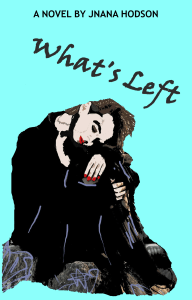
This design continues at Amazon. While Cassia goes Goth in the plot, I suspect this was a bit extreme for her style.
What’s Left: Within a daughter’s own Greek drama had been especially difficult to develop, as I’ve explained in earlier posts, but ultimately ended up following a girl who lost her father in an avalanche on the other side of the globe when she was only 11. She then continues on into her emotional recovery and growth, rounding out in her mid-30s.
By the time the book appeared in both digital and print-on-demand options at Amazon, the cover image had settled on a photo of a Goth girl.
For technical reasons, she continues at Amazon, while my cover at other digital retailers got updated.
I wanted a better sense of the initial suffering, or even an edginess in her development, but nothing worked perfectly. I am still taken with the daring in her stare at the camera, but is that enough? (I did a post about the earlier covers on December 20, 2019, should you want to explore my archives. I was quite fond of the first cover, the one with its falling egg yoke, but nobody else seemed to get the connection.)
The figure appears more ambiguous in my attempt to do something more in line with some of the Young Adult covers I saw. Ultimately, this was a mistake.
Furthermore, she’s genetically a mix of Greek and American Midwest and a tad on the pudgy side. I hate it when a story follows, say, a brunette but the cover shows an obviously dyed blonde.
Another challenge involved balancing the two words of the title. The second word, “Left,” should have the emphasis, but it’s only half the size of “What’s.” Nothing I tried corrected that. In many of the typefaces I sampled, “Left” simply didn’t read easily, either. It could have been “Lest” or “Lett” on first reading. In making a sales pitch, there’s no time for deciphering the message. “What’s” presented similar challenges in other typefaces.
The text had been difficult enough to nail down in a convincing voice, but the cover was equally problematic – especially finding an appropriate image. How do you summarize all this in a single graphic impression, especially one that works thumbnail size online?
Do note, there’s an ongoing argument about using a facial image on a cover, period. Does it grip a potential reader or does it turn one away? Will it even limit a reader’s impressions of the character at the heart of the book?
At last I had a photo that more or less captures her despair. The title and author presentation never quite matched.
Remember, my budget wasn’t generous enough for a graphic designer, the kind who would create a flowing dust jacket replete with insider clues for a potential reader. I’m not particularly fond of those designs anyway. In general, I think photos pack more punch in a first impression. Just look at magazines at a newsstand. Remember those?
Cassia, or more formally Acacia, goes into mourning after her father’s death and then morphs into Goth dress and appearance through her teenage years, where much of the story develops.
The book doesn’t fall neatly into genres – part of it could be Young Adult, but I’d say the core of it is New Adult and beyond. So how old should she look on the cover?
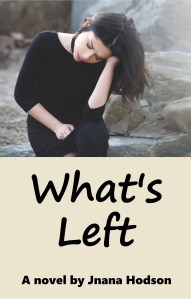
Finally, in the latest stab at this problem, I decided to run with an image I’d settled on earlier. This time, it would bleed off the cover at both sides for maximum impact. I then decided to run it off the bottom, too. Somehow, that left the photo square, a format her photographer father pursued.
At last, we have this.
My reason for cropping the photo tighter was to give it more depth, putting the focus more fully on the girl and her emotion. I’m now seeing that the rocky background I eliminated had actually suggested another kind of story. No more of that distraction now. An artist might have replace it with her extended family, by the way.
In leaving the top open for author and title, rather than separating those elements with the photo in the middle, she has more presence and gravity.
I’m also glad I stuck with an impulsive decision to not fill in the remaining cover with a background color. A new typeface for me, Yu Gothic Semibold, seemed to work best for the title, though I’m not exactly happy with the single-stroke bar apostrophe. But “Left” carries its own weight in the dance of letters.
Book Antiqua, meanwhile, a fallback for me, does nicely in italic for the author.
That’s all – clean, simple, and somehow daring in its starkness. Without an obvious border, the design declares its independence from paperbook constrictions. It’s also quite contemporary, in a confident way. It even pops out on websites. And there’s no question that it comes together more harmoniously the one it replaces.
This one’s now available on your choice of ebook platforms at Smashwords.com and its affiliated digital retailers. Those outlets include the Apple Store, Barnes & Noble’s Nook, Scribd, and Sony’s Kobo. You may also request the ebook from your local public library.
Although she was known as a poet and story writer, her book that I most value is An Island Garden (published the year she died), with illustrations by Childe Hassam, an Impressionist painter I admire highly. (He hated the term, by the way, and didn’t fit the label neatly, but it gives you an idea.)
The island, in the Isles of Shoals of the shore of Maine and New Hampshire, is a remarkable place, as I found in a visit I posted here on June 14, 2020, “Celia’s garden … on Appledore Island.”
Under her guidance, the hotel her family owned and operated became what can be seen as the nation’s first artists colony every summer, attracting a who’s who of writers, painters, musicians, and more. Her influence can be seen especially in many of New England’s authors of the period.
Reading about her, I’ll confess, can be as pleasurable as reading her work itself.


 Jnana's Red Barn